A Practical List of AI Models for Image, Video, 3D, and Audio
Explore a practical list of AI models for image, video, 3D and audio, with production use cases, tradeoffs and governance tips.
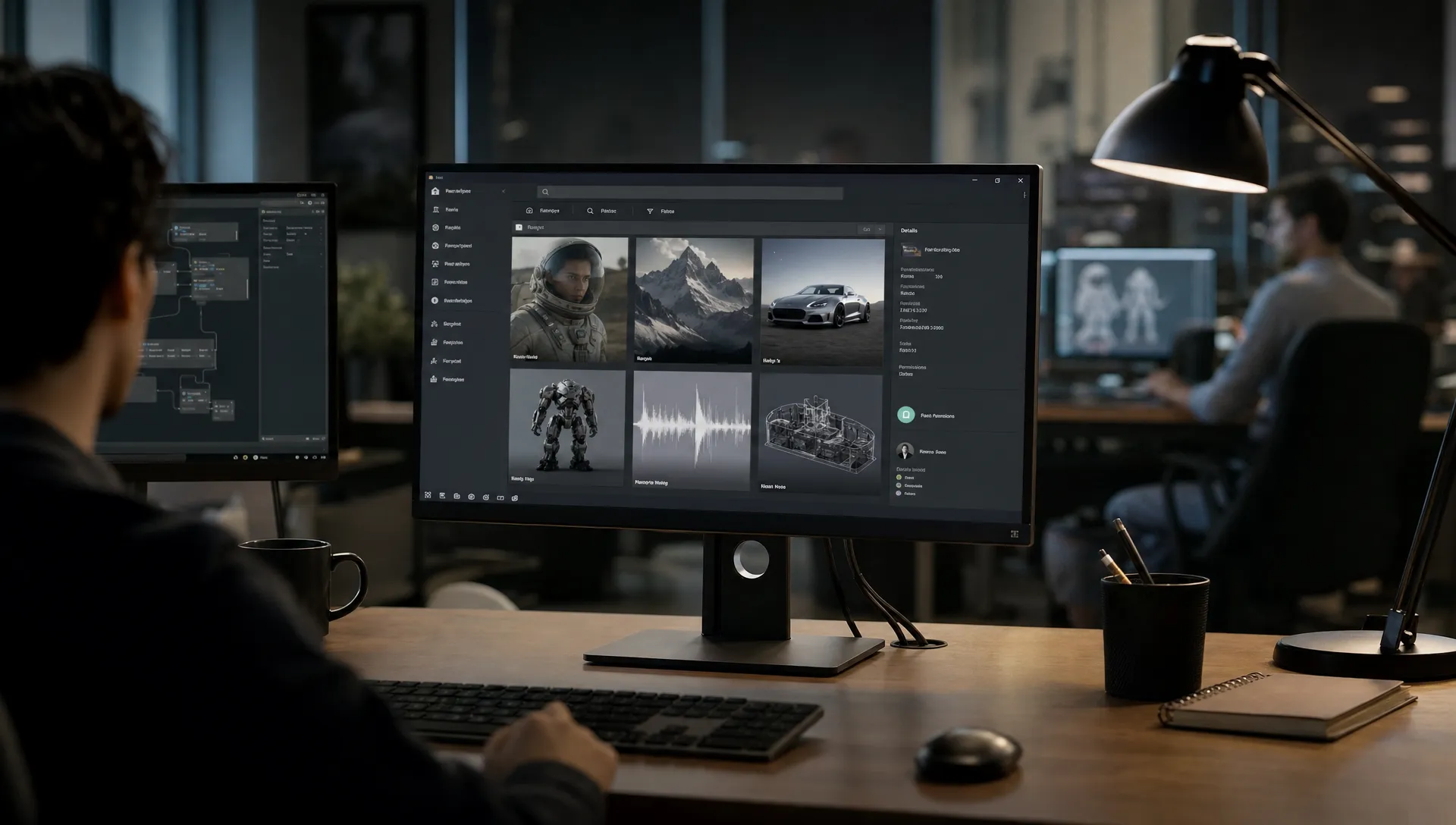
A practical list of AI models should do more than name popular tools. For creative production, the useful question is not “Which model is best?” but “Which model is fit for this asset, this workflow and this risk profile?”
That distinction matters for CMOs protecting brand consistency, art directors pushing visual quality, application managers integrating approved systems and game developers moving assets into real-time pipelines. Image, video, 3D and audio models all mature at different speeds. Some are excellent for ideation but weak at revision control. Others offer strong enterprise terms but less stylistic range. A few are research models that are valuable for experimentation, not direct production.
Use this article as a practical working catalog. Model access, pricing, licenses and safety features change quickly, so every shortlist still needs a legal, security and creative review before deployment.
How to use this list in a production environment
A list of AI models becomes useful when it is mapped to production stages. In most studios, AI output moves through several gates before it reaches a campaign, game build, ecommerce catalog or client delivery.
For practical evaluation, separate models by the job they perform:
- Concepting: Fast idea generation, mood exploration, campaign territories, storyboards and style directions.
- Controlled production: Repeatable assets that match brand, art direction, character identity or product constraints.
- Post-generation refinement: Upscaling, inpainting, image-to-video, cleanup, retopology, material work, sound editing or localization.
- Governed deployment: Rights review, metadata, approvals, asset storage, compliance checks and downstream integration.
If you need a broader selection framework beyond the catalog below, Virtuall’s guide on how to choose AI models for image, video, audio and 3D covers evaluation criteria such as output quality, control, production readiness and governance.
The sections below group notable AI models and model systems by creative format. They are not presented as a universal ranking. They are a practical list for teams building a model portfolio.
AI image models
Image generation is the most mature creative AI category. The strongest image models now support sophisticated prompt interpretation, style exploration, inpainting, outpainting, reference guidance and higher quality typography than earlier generations. For enterprise use, the differences between models often show up in controllability, licensing posture, private deployment options and consistency across large batches.
| Model or model family | Best fit | Output strengths | Production notes |
|---|---|---|---|
| Google Nano Banana Pro (Gemini image models) | General-purpose generation and conversational editing, multi-reference composition | Strong prompt following, multi-image fusion, reliable in-image text | Practical default for iterative editing. Confirm data handling through your approved Google or partner channel. |
| GPT Image 2 (OpenAI) | Prompt-driven concept images, campaign visuals, presentation work | Accurate prompt adherence, coherent scenes, solid typography | Successor to the retired DALL-E line. Review platform terms and privacy settings before using proprietary briefs. |
| Midjourney V8 | Art direction, mood boards, cinematic concepts, stylized imagery | High aesthetic quality, draft mode for speed, omni reference for consistency | Popular with creative teams, but enterprise workflows need clear governance around prompts, references and asset approval. |
| FLUX 2 (Black Forest Labs) | Custom image pipelines, fine-tuning, controlled generation | High fidelity with open and commercial deployment routes | Good fit where teams need control over infrastructure, LoRA workflows or custom brand styles. |
| Stable Diffusion 3.5 and Stable Image Ultra | Self-hosted and cost-sensitive production, adaptable workflows | Open weights, broad tooling ecosystem, predictable licensing | The practical successor to SDXL and SD3 for teams running their own infrastructure. |
| Ideogram 4 and Recraft V4 | Posters, logos, packaging, social concepts and design systems | Best-in-class text rendering; Recraft adds native vector output | Useful for layout ideation, but final brand typography should still be checked by designers. |
| Adobe Firefly Image 5 and Google Imagen 4 | Brand-safe creative workflows inside Adobe or Google ecosystems | Commercially oriented terms and deep product integration | Strong candidates for teams already standardized on Creative Cloud or Google Workspace and formal review processes. |
If your reference list still names DALL-E 3, note that OpenAI retired it in 2026; GPT Image 2 is the current equivalent.
Prompt following and editability now matter more than raw fidelity. Google’s Gemini image models pushed conversational editing into everyday production, while Stability AI’s Stable Diffusion 3.5 release keeps an open-weight route available for studios that need to run models on their own infrastructure.
For art directors, the key distinction is often aesthetic speed versus art-directable precision. Midjourney can be very strong for early look development. Open-weight workflows built on FLUX or Stable Diffusion can be stronger when a studio needs repeatable character, product or style control. Firefly can be attractive when the buying committee cares heavily about vendor alignment and commercial usage language.
For CMOs, image model selection should not happen in isolation. Brand consistency, claims compliance, local market adaptation and legal review matter as much as the first output. A model that produces beautiful images but cannot be governed at scale is risky for a global content engine.
AI video models
Video generation is developing quickly, but it remains less predictable than image generation. The main challenges are temporal consistency, character continuity, camera control, editing precision, copyright risk and the cost of iteration. In many enterprise workflows, video models are most valuable for previsualization, social variants, style tests, animatics and controlled shots rather than final long-form production.
| Model or model family | Best fit | Output strengths | Production notes |
|---|---|---|---|
| Google Veo 3.1 | Cinematic shots, previs, brand films, high-fidelity motion | Up to 4K with natively synced audio and strong camera language | Evaluate through approved Google or partner channels. Check regional availability and watermarking behaviour. |
| OpenAI Sora 2 | Advanced text-to-video with dialogue and sound | Scene coherence, synced audio, strong physical plausibility | Available through the API; the standalone consumer app was discontinued in 2026. Verify deployment terms before production use. |
| Kling 3.0 | Narrative sequences, character continuity, multi-shot work | Element consistency across shots, native audio, 4K output | Widely available through inference platforms. Confirm data processing location for sensitive briefs. |
| Seedance 2.0 | Reference-driven generation and high-quality short-form work | Multi-reference input and unified audio-video generation | Currently one of the strongest models in blind comparisons. Test on your own reference material before committing. |
| Runway Gen-4.5 and Aleph | Editing-oriented video work, controlled shots, in-context changes | Professional editing controls rather than one-shot generation | Good for iteration and creative testing. Production teams still need review and rights workflows around generated clips. |
| Luma Ray3 | Image-to-video, cinematic motion tests, fast shot ideation | HDR output and reasoning-guided motion for short clips | The successor to Dream Machine. Strong for visual exploration; evaluate data handling before wide deployment. |
| Pika 2.5, Alibaba Wan, MiniMax Hailuo | Short-form videos, motion experiments, social formats | Accessible generation, stylized motion, competitive cost per clip | Useful for fast creative exploration. Validate resolution, consistency and export needs for professional delivery. |
Older names still circulate in internal decks: Runway Gen-2, the first Sora and Luma Dream Machine have all been superseded by the versions above, and Stable Video Diffusion is now a legacy research route rather than a production option.
Google DeepMind’s Veo model page is a useful reference point for what current video generation covers, including synced audio and higher resolutions. OpenAI’s Sora 2 announcement set a similar bar for coherence and sound, even for teams that have not approved it for production.
For application managers, video models raise different procurement issues from image models. Generated video files are larger, iteration costs can rise quickly and review workflows often involve more stakeholders. Security teams may also care about whether prompts, reference images, product shots or unreleased campaign concepts are processed in approved environments.
For game developers, video models are rarely a direct replacement for engine-ready animation. They can still help with mood trailers, cutscene exploration, camera language, environment motion references and pitch materials. The output usually needs translation into engine assets, animation systems or cinematic tools.
AI 3D models and model systems
3D generation is not as standardized as image generation. Many 3D offerings are model systems that combine diffusion, neural reconstruction, multi-view generation, mesh extraction, texture generation and sometimes Gaussian splatting. For production, the decisive question is whether the output can survive the handoff into Blender, Maya, 3ds Max, Houdini, Unreal Engine, Unity or a product configurator.
| Model or model system | Best fit | Output strengths | Production notes |
|---|---|---|---|
| Meshy 6 | Text-to-3D, image-to-3D and textured asset generation | Cleaner topology than most generators, with PBR texturing | Often used for concept and background assets. Production teams should still inspect topology and licensing terms. |
| Tripo P1 | Fast image-to-3D and stylized asset generation | Quick, controllable meshes from a single image or prompt | The production successor to the TripoSR research release. Check scale, UVs and material readiness. |
| Rodin Gen-2 | High-fidelity assets and geometry editing | Strong detail retention and part-level editing | Suited to hero props and product objects where silhouette accuracy matters. |
| Hunyuan3D | Open-weight 3D generation and custom pipelines | Competitive geometry and texture quality with self-hosting options | Useful where assets or prompts cannot leave your own environment. |
| CSM Cube | Scene and multi-object generation | Generates sets of related assets rather than single objects | Helpful for environment blockouts and set dressing exploration. |
| Gaussian splatting and photogrammetry systems | Capture-based reconstruction of real products, sets and locations | High realism from real-world reference | Best where a physical object already exists. Conversion to clean meshes still requires artist work. |
Point-E, Shap-E, GET3D and DreamFusion remain important research milestones, but they are no longer part of a practical production shortlist.
The move from research releases such as TripoSR to today’s commercial systems shows how quickly single-image-to-3D workflows have matured. For a more detailed professional workflow, Virtuall’s guide to AI image to 3D model generation covers source image preparation, conversion settings and refinement steps.
3D has stricter downstream requirements than most 2D work. A visually convincing mesh preview is not enough if the asset has broken topology, unusable UVs, excessive polygon count or inconsistent scale. For games, the model may need retopology, LODs, collision, rigging, material optimization and engine-specific testing. For ecommerce, it may need accurate dimensions, approved materials, product metadata and integration with a PIM or DAM.
AI audio models
Audio AI includes several distinct tasks: music generation, sound effects, voice synthesis, voice cloning, speech enhancement, dubbing and audio editing. These use cases carry different risks. A music bed for a mood film is not the same as a synthetic executive voiceover or localized product claim. Consent, licensing and provenance need to be explicit.
| Model or model family | Best fit | Output strengths | Production notes |
|---|---|---|---|
| Suno | Song generation, music concepts, demos and creative exploration | Fast full-song generation with vocals and instrumentation | Now operating under label licensing agreements. Still review commercial terms and brand suitability before use beyond concept work. |
| ElevenLabs Music v2 | Structured music generation for films, ads and product content | Section-level control and genre shifting rather than one-shot tracks | Editability makes it easier to fit picture. Confirm rights coverage for the markets you publish in. |
| Stable Audio 3.0 | Music, sound effects and audio-to-audio transformation | Open weights, longer tracks, DAW integration | The strongest option where audio must be generated inside your own environment. |
| Google Lyria 3 | Music generation inside the Google creative ecosystem | High-quality music generation with provenance controls | Availability depends on Google product access. Watch watermarking and rights controls. |
| Udio | Music ideation and genre exploration | High-quality demos and stylistic variety | Export and download rights have been restricted following label settlements. Verify before planning any external use. |
| ElevenLabs voice and dubbing models | Voice generation, narration, localization and character voices | Natural speech synthesis, cloning and multilingual dubbing | Strong consent, likeness, approval and security processes are required for enterprise use. |
| Meta MusicGen and AudioCraft | Research and custom audio pipelines | Open ecosystem for music and sound generation | Valuable for technical teams, but no longer competitive with the leading music systems on quality. |
Riffusion no longer exists as a standalone service; its team and technology moved into Google’s music tooling.
Audio should be broken into categories rather than treated as one capability. A model that is strong for music may not be appropriate for voice, dubbing or sound design.
For CMOs and brand leaders, audio can be more sensitive than visuals because voice carries identity. If a brand uses synthetic voice, it needs clear approval trails, consent for any cloned voice, regional review and a policy for disclosure where required. For game studios, generated audio can speed up placeholder dialogue, creature sounds, UI sounds and mood tracks, but final implementation should still go through audio direction, compression settings, localization and engine testing.
Supporting multimodal models
Not every useful creative AI model directly outputs a finished image, video, 3D object or audio file. Multimodal language models can help teams interpret briefs, generate prompt variations, analyze references, write shot lists, tag assets, summarize review comments and enforce production rules.
| Model or model family | Best fit | Production role |
|---|---|---|
| GPT-5 family | Multimodal reasoning across text, images and audio interactions | Brief interpretation, prompt generation, QA support, creative operations assistance |
| Gemini 3 Pro and Flash | Long-context multimodal analysis and Google ecosystem workflows | Processing large briefs, reference sets, documents and structured production context |
| Claude Opus and Sonnet 4.x | Long-form reasoning, image understanding and creative documentation | Review summaries, brand guideline interpretation, structured creative feedback |
| LLaVA and open vision-language models | Custom vision-language experiments | Internal tools, asset tagging, visual QA and research pipelines |
These models are often the connective tissue in a creative AI stack. They help turn brand rules, style references, product constraints and campaign briefs into structured instructions that generation models can use. In enterprise settings, that orchestration layer can matter more than any single generator.
Quick selection matrix by creative objective
The table below is a practical shortcut for shortlisting. It does not replace testing, but it helps teams avoid evaluating every model for every task.
| Creative objective | Models or model families to consider | What to test first |
|---|---|---|
| Premium campaign concepts | Midjourney V8, GPT Image 2, Nano Banana Pro, Firefly Image 5 | Brand fit, art direction range, rights workflow, approval speed |
| Repeatable branded imagery | FLUX 2, Stable Diffusion 3.5, Firefly Image 5 | Reference control, fine-tuning options, batch consistency, deployment model |
| Social video variants | Kling 3.0, Seedance 2.0, Pika 2.5, Luma Ray3 | Motion quality, editability, aspect ratios, review turnaround |
| Cinematic previs | Veo 3.1, Sora 2, Runway Gen-4.5, Luma Ray3 | Shot coherence, camera control, character continuity, access terms |
| Game prop concepts | Midjourney V8, FLUX 2, Meshy 6, Tripo P1 | Concept quality, 3D handoff, topology, engine cleanup effort |
| Ecommerce 3D exploration | Tripo P1, Meshy 6, Rodin Gen-2, capture-based systems | Dimensional accuracy, material fidelity, UVs, DAM and PIM integration |
| Music and sonic mood boards | Suno, ElevenLabs Music v2, Stable Audio 3.0, Lyria 3 | Licensing, brand fit, editability, regional approvals |
| Voiceover and localization | ElevenLabs and approved TTS systems | Consent, voice likeness, pronunciation, disclosure, security |
Over 300 models, one governed environment
Virtuall gives studios access to more than 300 image, video, 3D and audio models, orchestrated by Nyx. Teams opt in to the models they want, and a pre-approved professional set is available for organizations that need compliance from day one. Reach out if you want more models opened in your Creative AI OS.
Talk to our team →If your studio is building a governed stack rather than testing one-off tools, Virtuall’s article on AI tools for studios managing brand and compliance is a useful companion to this model list.
Enterprise governance questions before you deploy any model
Creative AI adoption often starts with model excitement and then slows down when legal, security, brand and IT teams get involved. That slowdown is avoidable if governance is part of the model evaluation from the beginning.
Before a model enters approved production use, answer these questions:
| Governance area | Question to answer | Why it matters |
|---|---|---|
| Data handling | Can proprietary prompts, references and assets be processed safely? | Campaign plans, unreleased products and client IP may be sensitive. |
| Rights and licensing | What do the model and platform terms say about commercial use? | Output rights, training data disputes and usage restrictions can affect launch risk. |
| Consistency | Can the model reproduce style, characters, products or brand rules? | One great output is not enough for large-scale content production. |
| Auditability | Can teams track who generated, edited, approved and exported an asset? | Enterprise creative operations require accountability. |
| Integration | Can outputs move into DCC, DAM, PIM, game engine or review workflows? | Manual handoffs erase much of the efficiency AI promises. |
| Regional compliance | Where does inference happen and what regulations apply? | Data residency, EU requirements and client policies can affect model choice. |
The safest production pattern is usually not a single model. It is a governed portfolio where approved models are assigned to specific tasks, wrapped in repeatable workflows and monitored over time. Creative teams get more freedom because the operating rules are clear. Legal and IT teams get more confidence because usage is traceable.
Frequently Asked Questions
What is the best AI model for creative production? There is no single best model for every creative task. GPT Image 2, Midjourney, FLUX, Firefly, Veo, Sora 2, Kling, Runway, Meshy, Tripo, Suno and ElevenLabs all serve different needs. The best choice depends on output quality, control, rights, security, integration and the asset’s final use.
Is this list of AI models enough for enterprise procurement? It is a strong starting point, but procurement needs a deeper review of terms, data handling, security, compliance, support, pricing and integration. Enterprise teams should also run controlled tests using real briefs and real approval workflows.
Can AI-generated 3D models be used directly in games? Sometimes they can be used for prototypes, previs or background assets, but most generated 3D models still need cleanup. Game teams should inspect topology, UVs, materials, scale, LODs, rigging needs and engine performance before production use.
Are AI video models ready for final production work? They can be ready for some short-form and controlled use cases, especially social variants, mood films and previs. For high-stakes brand films or long-form content, teams still need editing, compositing, legal review and consistency checks.
How often should a studio update its AI model list? Review the portfolio at least quarterly, and more often for video, 3D and audio. New models, policy changes, pricing updates and licensing shifts can change which systems are appropriate for production.
Do creative teams need separate models for image, video, 3D and audio? Usually yes. Each format has different strengths, risks and production requirements. A mature AI stack combines specialized models with orchestration, governance, asset management and approval workflows.
Operate your AI model portfolio with Virtuall
A practical model list is only the beginning. The real challenge is operating those models consistently across teams, brands, markets and production pipelines.
Virtuall is a Creative AI OS for studios and enterprise teams that need to orchestrate AI-powered content creation across image, video, 3D and audio. Teams can define governance rules, use generation blueprints, preserve studio context, manage review workflows and connect AI outputs to broader creative systems through plugins and API.
If your organization is moving from experimentation to production, the next step is not adding more disconnected tools. It is building a governed creative AI operating layer that lets the right people use the right models in the right workflows.