AI in Gaming: Where Studios Win and Where Risk Starts
AI in gaming can speed art, QA, and personalization, but studios need governance to manage IP, quality, compliance, and brand risk.
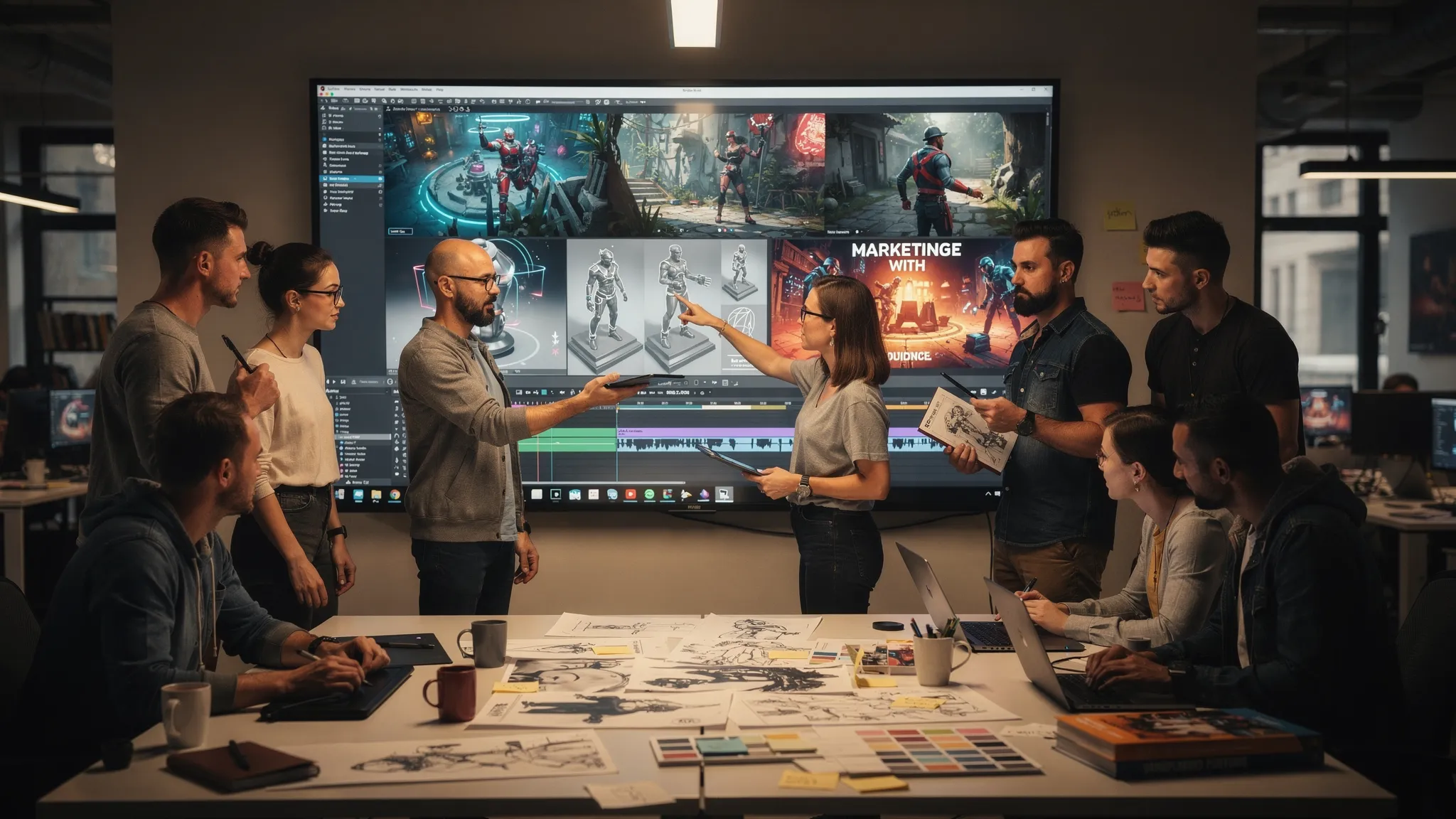
For game studios, the promise of AI is not just faster asset generation. It is a new operating model for creative production, one where concepting, iteration, localization, testing, marketing, and live operations can move with far less friction.
But that same speed can expose studios to new risks. AI can accelerate a beautiful art direction, or dilute it. It can help teams explore more ideas, or create compliance gaps that are hard to audit later. It can support developers and artists, or introduce uncertainty around intellectual property, data security, and creative ownership.
The practical question is no longer whether AI in gaming matters. It is where studios should apply it, where human judgment must stay in control, and what governance needs to be in place before AI becomes part of production at scale.
AI in gaming has moved from experiment to operating model
AI has been part of games for decades, from pathfinding and procedural generation to enemy behavior and adaptive difficulty. What has changed is the arrival of generative AI and multi-model systems that can create or transform text, images, video, audio, code, and 3D assets.
That shift touches nearly every department in a modern studio. A concept artist might use AI to explore visual directions. A game developer might use AI to prototype mechanics or generate test data. A marketing team might adapt campaign assets across regions. A QA team might analyze bug reports or simulate test scenarios. An application manager might be responsible for deciding which tools are approved, how they integrate, and how outputs are tracked.
Industry adoption is already visible. The Game Developers Conference State of the Game Industry has tracked growing use of generative AI alongside strong concerns from developers about ethics, ownership, and job impact. That tension is important. AI is not a simple productivity layer. It changes how creative decisions are made, approved, reproduced, and protected.
For enterprise studios, this makes AI a governance challenge as much as a technology challenge.
Where studios win with AI in gaming
The strongest use cases are not always the flashiest. Studios usually win when AI removes repetitive friction, expands creative exploration, or helps teams make better decisions without replacing human creative accountability.
Faster concept exploration without slowing art direction
Pre-production is one of the clearest areas of value. Teams can explore environments, characters, props, lighting references, UI motifs, and mood variations faster than traditional manual sketching alone. This does not remove the role of the art director. It makes the art director’s taste, constraints, and approval process even more important.
The win is not simply more images. It is faster alignment. Instead of spending days interpreting vague references, teams can test visual territories quickly, reject weak directions earlier, and move promising concepts into structured development.
For art directors, the key is to avoid generic output. AI should be guided by approved style references, project mood boards, palette rules, brand constraints, and production realities. Without that context, the team gets volume but not direction.
Asset variation and production support
AI can help generate controlled variations of props, textures, background elements, icons, cosmetics, UI treatments, and promotional assets. It can also support 3D workflows through blockouts, reference generation, material exploration, and asset adaptation.
This is especially useful for studios managing large content pipelines, seasonal updates, live events, or franchise universes where consistency matters. The production gain comes from repeatability. A team can define a blueprint for a certain asset type, then generate variations that follow the same creative and technical rules.
However, production support is different from unchecked automation. Final assets still need review for topology, optimization, licensing, performance, platform requirements, accessibility, and brand fit. AI can reduce the blank-page problem, but it does not remove the need for production discipline.
Better QA, testing, and player insight
AI can support QA teams by clustering bug reports, summarizing player feedback, generating edge-case test scenarios, detecting patterns in crash logs, and helping prioritize issues. For developers, AI-assisted testing can make it easier to inspect repetitive scenarios that are expensive to cover manually.
In live games, AI can also help teams analyze community sentiment, support tickets, player behavior signals, and moderation queues. The value is not in replacing human judgment. It is in helping teams see patterns earlier and respond with better context.
This matters because modern games are not static products. They are evolving services with content drops, balance changes, monetization updates, regional requirements, and community expectations. AI can help studios listen and react faster, provided that player data is handled responsibly.
Marketing, localization, and live operations at scale
For CMOs and publishing teams, AI can make it easier to adapt creative assets across platforms, languages, audience segments, and campaign moments. Trailer thumbnails, store assets, social variations, ad concepts, influencer kits, and email visuals often require many versions under tight deadlines.
AI can help with ideation, resizing, localization drafts, tone adaptation, and campaign variation. The upside is speed and relevance. The risk is brand drift, inaccurate claims, cultural mistakes, or assets that do not match the game experience.
This is where governance becomes a commercial issue. A campaign can move faster only if the team can trust the workflow, approvals, source assets, and rights attached to every output.
| Use case | Where studios win | What must stay controlled |
|---|---|---|
| Concept art | Faster exploration of styles, worlds, characters, and moods | Art direction, approved references, human selection |
| 3D production support | Quicker blockouts, variations, and material exploration | Technical validation, optimization, asset lineage |
| QA and testing | Better clustering of bugs, feedback, and edge cases | Data privacy, developer review, reproducible findings |
| Localization | Faster drafts and market adaptation | Cultural review, legal claims, platform compliance |
| Marketing creative | More campaign versions across channels | Brand consistency, rights, approvals, final messaging |
| Live operations | Faster content iteration and player insight | Monetization ethics, player trust, release governance |
Where risk starts
AI risk usually starts when speed outpaces control. A single prompt can generate a compelling image, but a studio needs more than a compelling image. It needs to know where the input came from, which model was used, whether the output is safe to commercialize, who approved it, and whether it can be reproduced.
Intellectual property and copyright uncertainty
IP is one of the biggest concerns for AI in gaming. Studios need clarity on training data, reference assets, prompts, generated outputs, and final ownership. They also need to understand the difference between AI-assisted work and work where human authorship is difficult to establish.
The U.S. Copyright Office has made clear that copyright protection depends on human authorship, and purely AI-generated material may not be protected in the same way as human-created work. Laws and interpretations vary by jurisdiction, but the operational lesson is consistent: studios should document human creative contribution, retain asset lineage, and avoid using tools or datasets that create unacceptable rights exposure.
For enterprise teams, this is not only a legal issue. It affects valuation, licensing, franchising, merchandising, platform distribution, and investor confidence.
Style leakage and brand dilution
A game’s visual identity is a strategic asset. If different teams use different models, references, prompts, and settings, the studio can end up with inconsistent output. Characters may drift from canon. UI elements may feel off-brand. Environments may look impressive but no longer serve gameplay or narrative.
This is a subtle risk because individual outputs can look good in isolation. The problem appears when teams try to integrate everything into a coherent world. Art directors then spend time correcting inconsistencies that should have been prevented at the workflow level.
Studios need shared context, approved mood boards, generation templates, and review gates so AI supports the creative system rather than fragmenting it.
Security, privacy, and data residency
Game studios handle sensitive material: unreleased characters, scripts, builds, source code, campaign plans, franchise roadmaps, player data, and partner assets. If teams paste confidential material into unmanaged AI tools, they may create data exposure that is hard to reverse.
Application managers and IT leaders need clear policies around approved tools, user access, data retention, model providers, inference locations, logging, and integrations. This is especially important for studios operating in regulated regions or working with enterprise partners that require strong security and compliance posture.
Frameworks such as the NIST AI Risk Management Framework are useful because they push organizations to map, measure, manage, and govern AI risk rather than treating AI as an informal creative shortcut.
Compliance and regional regulation
AI regulation is becoming more relevant to creative teams. The EU AI Act does not make every gaming use case high-risk, but it raises expectations around transparency, governance, and responsible AI deployment. Studios also need to consider privacy laws, platform policies, advertising rules, consumer protection standards, and age-appropriate design obligations.
For global game companies, compliance cannot be handled at the end of production. It needs to be designed into the workflow. That means approved models, documented processes, role-based access, audit trails, and clear accountability.
Quality risk and hallucinated production decisions
AI systems can produce plausible but incorrect outputs. In a game production context, that might mean broken code suggestions, inaccurate localization, impossible 3D geometry, misleading balance analysis, or invented lore that conflicts with canon.
The more AI is connected to production systems, the more studios need validation. Generated output should be tested, reviewed, and approved before it enters a build, campaign, store page, or player-facing experience.
A helpful principle is simple: the higher the player impact, legal impact, or brand impact, the stronger the human approval gate should be.
The real advantage is controlled scale
The studios that benefit most from AI will not be the ones generating the most content. They will be the ones generating the right content with the right controls.
Controlled scale means the studio can move faster without losing traceability. It means teams can use multiple AI models without turning production into a tool sprawl problem. It means brand and art direction are embedded into the workflow, not left to memory or isolated prompt documents. It means legal, IT, creative, and production teams can all understand how AI is being used.
This is where AI governance becomes a creative enabler. When teams trust the system, they can experiment more confidently.
| Risk signal | What it may indicate | Better operating control |
|---|---|---|
| Teams use personal AI accounts | Shadow AI and data exposure | Approved tools, access controls, usage policies |
| Outputs cannot be traced | Weak IP and audit readiness | Asset lineage, model logs, prompt history |
| Visual quality varies by team | Inconsistent creative context | Shared mood boards, templates, art direction rules |
| Reviews happen outside the workflow | Slow approvals and lost feedback | Annotation, review stages, approval tracking |
| AI assets are hard to reproduce | Unstable production process | Generation blueprints and saved parameters |
| Legal reviews happen late | Rework and launch risk | Rights checks and compliance gates earlier in production |
A practical framework for deciding where AI belongs
Not every workflow needs the same level of AI autonomy. Studios can reduce risk by matching the use case to the right operating model.
| AI role | Best-fit examples | Recommended control level |
|---|---|---|
| Assistant | Summaries, ideation, references, internal drafts | Light governance, approved tools, human review |
| Co-creator | Concept art, marketing variations, localization drafts | Shared context, review workflows, asset tracking |
| Production accelerator | 3D variations, texture exploration, campaign systems | Templates, technical checks, approval gates |
| Decision support | QA prioritization, sentiment clustering, production insights | Data controls, validation, responsible interpretation |
| Player-facing system | NPC dialogue, personalization, moderation, dynamic content | Strong governance, safety testing, monitoring, escalation |
This framework helps different stakeholders speak the same language. A CMO can identify where AI supports campaign velocity. An art director can define the boundaries of acceptable visual variation. An application manager can determine which integrations and controls are required. A game developer can understand where AI output needs testing before it affects the build.
What each studio leader should ask before scaling AI
AI in gaming becomes easier to manage when every function asks questions from its own responsibility area.
For CMOs, the priority is brand, speed, and market fit. Can campaign assets be generated and localized without drifting from the game’s positioning? Are claims accurate? Are rights clear? Can approvals happen fast enough for live campaigns?
For art directors, the priority is creative consistency. Does the AI workflow preserve the visual language of the project? Are references approved? Can the team reuse mood boards, templates, and art rules across departments? Is there a clear line between exploration and final production?
For application managers, the priority is governance and integration. Which AI tools are approved? How are permissions managed? Where does inference happen? How are generated assets stored, reviewed, and connected to DAM, PIM, DCC, or production systems?
For game developers, the priority is reliability. Is AI-generated code reviewed? Are generated assets technically valid? Can test results be reproduced? Does AI output affect performance, gameplay balance, or player trust?
These questions are not blockers. They are what make AI scalable.
How to operationalize AI without slowing teams down
Many studios begin with experimentation. That is healthy. But once AI touches production, experimentation needs to mature into an operating model.
The foundations are straightforward:
- Define which AI tools and models are approved for each type of work.
- Create reusable generation blueprints for common asset and campaign workflows.
- Preserve studio context through approved mood boards, references, and creative rules.
- Track prompts, model choices, versions, and human approvals where needed.
- Connect AI workflows to existing creative tools, DAM, PIM, DCC, and production systems.
- Use role-based permissions so sensitive projects and assets stay protected.
- Keep humans accountable for final creative, legal, and player-facing decisions.
The goal is not to bury artists and developers in process. The goal is to make the safe path the easy path. If governance is built into the workflow, teams do not need to choose between speed and control.
FAQ
How is AI in gaming different from traditional game AI? Traditional game AI usually refers to systems inside the game, such as enemy behavior, pathfinding, or procedural rules. Generative AI in gaming often supports creation workflows, including art, 3D, text, audio, video, QA, localization, and marketing.
Can AI-generated assets be used in commercial games? They can be, but studios need to verify rights, tool terms, training data policies, jurisdictional rules, and human creative contribution. Legal review and asset lineage are important before AI-generated work enters commercial production.
Will AI replace game artists and developers? In serious production environments, AI is more useful as an accelerator than a replacement. It can reduce repetitive work and expand ideation, but art direction, gameplay judgment, technical validation, narrative coherence, and final accountability remain human responsibilities.
What is the biggest risk of using unmanaged AI tools in a studio? The biggest risk is losing control of sensitive data, IP provenance, brand consistency, and approval history. Shadow AI can create outputs that are difficult to audit, reproduce, or safely commercialize.
What should enterprise studios prioritize first? Start with governance, approved tools, and high-value workflows. Concept exploration, marketing variation, QA summarization, and localization drafts are often practical starting points, provided there are clear review and compliance controls.
Turn AI in gaming into a controlled creative advantage
AI can help studios move faster, but only if the operating model is strong enough to protect quality, IP, compliance, and creative intent.
The Creative AI OS is built for teams that want to operate creative AI at scale across image, video, audio, and 3D workflows. With AI governance controls, workflow orchestration, generation blueprints, studio context memory through mood boards, review and approval workflows, asset management, pipeline tracking, and integrations through plugins and API, Virtuall helps studios bring structure to AI-powered production.
Nyx, the intelligence layer of the Creative AI OS, orchestrates multiple industry-leading AI models while keeping intent and context across teams. For enterprise studios, that means AI can become part of the production system rather than another disconnected tool.
If your studio is ready to scale AI with control, compliance, and production-ready consistency, explore Virtuall.