Artificial Intelligence Governance for Modern Studios
Learn how artificial intelligence governance helps modern studios scale AI content creation with control, compliance, and production-ready workflows.
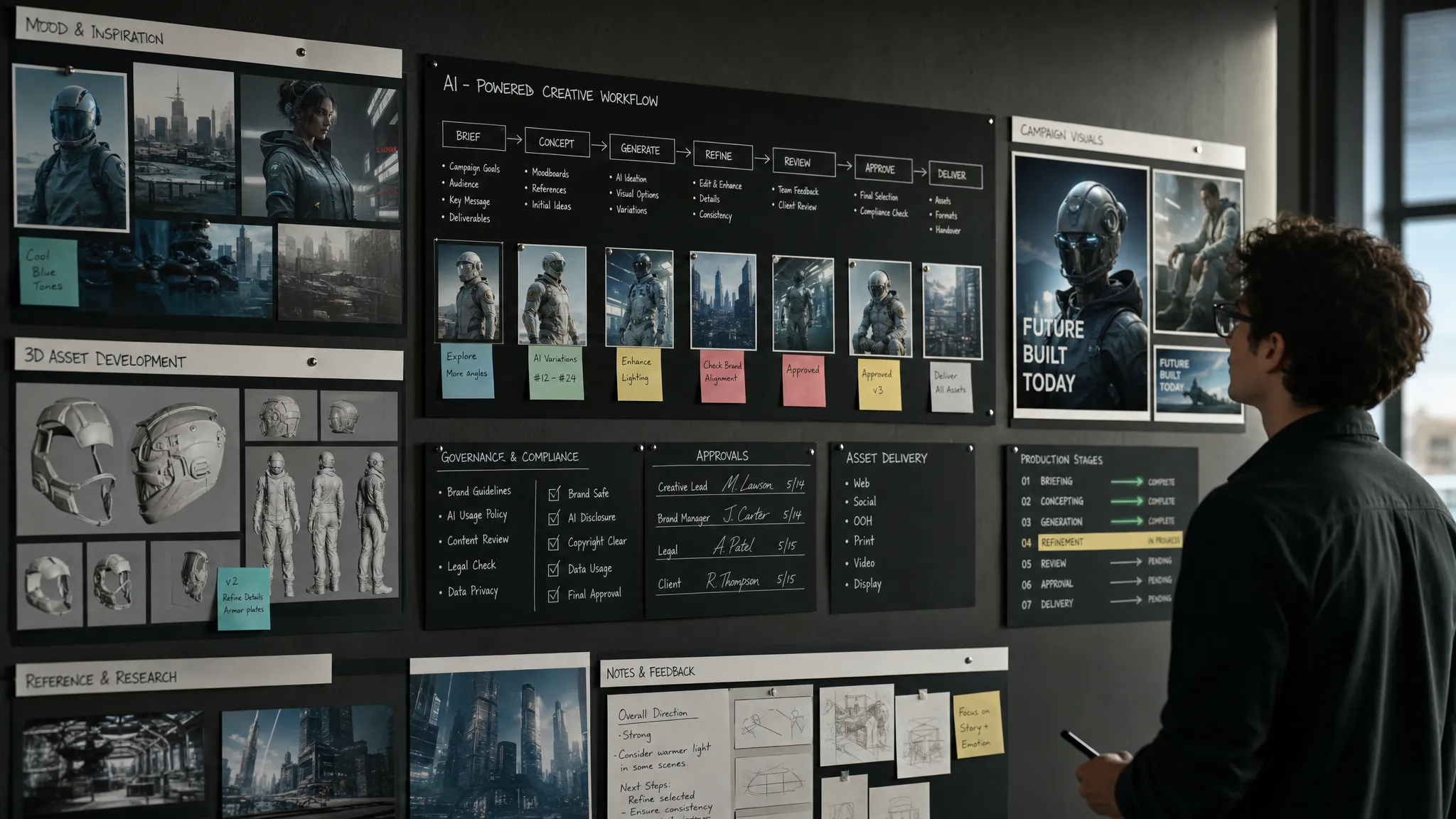
Generative AI has moved from experimental prompts to everyday production infrastructure. In modern studios, teams are using AI to explore campaign visuals, create concept art, generate product imagery, accelerate game assets, localize content, and test video ideas at a speed that was unrealistic only a few years ago.
That speed creates a new leadership challenge. If every team uses different tools, models, prompts, datasets, review habits, and storage locations, AI can quickly become a source of brand drift, compliance risk, duplicated work, and inconsistent output quality.
Artificial intelligence governance is how studios prevent that from happening. It gives creative, marketing, technical, and legal teams a shared operating model for using AI responsibly at scale, without turning innovation into a slow approval maze.
Why AI governance has become studio infrastructure
For a studio, AI governance is no longer just a legal topic. It is a production topic, a brand topic, and a systems topic.
Creative teams need room to explore. Art directors need visual consistency. CMOs need campaigns that stay aligned with brand standards and market regulations. Application managers need tools that integrate cleanly with existing stacks. Game developers need assets that fit pipelines, engines, performance constraints, and IP rules.
Without governance, teams often run into the same problems:
- Model sprawl, where too many disconnected AI tools are used with no clear ownership.
- Inconsistent outputs, where creative direction changes from one team, region, or project to another.
- Unclear rights and provenance, especially when generated assets are stored without context.
- Data exposure, when sensitive brand, product, or client information is entered into unapproved systems.
- Weak auditability, where nobody can reconstruct which model, prompt, version, or approval path produced an asset.
These are not theoretical issues. The NIST AI Risk Management Framework emphasizes that trustworthy AI requires governance, mapping, measurement, and management across the AI lifecycle. For studios, that lifecycle includes briefing, prompting, generation, editing, review, approval, publishing, reuse, and retirement.
In other words, governance is not there to stop creative AI. It is there to make it repeatable, safe, and production-ready.
What artificial intelligence governance means for a creative studio
In a modern studio, artificial intelligence governance is the set of rules, roles, workflows, and technical controls that determine how AI is selected, used, reviewed, and tracked.
It answers practical questions such as:
- Which AI models and tools are approved for which type of work?
- What data can be used in prompts, references, mood boards, and training contexts?
- Who reviews AI-assisted outputs before they move into production?
- How are brand rules, art direction, legal constraints, and regional requirements preserved?
- Where are generated assets stored, annotated, versioned, and connected to project history?
A useful governance model should feel like a studio operating system, not a static policy document. It should live inside the creative workflow, so teams can make compliant decisions while they work rather than after the fact.
| Studio concern | Governance control | Business value |
|---|---|---|
| Brand inconsistency | Shared creative rules, approved references, review workflows | More consistent campaigns and assets |
| IP and rights uncertainty | Provenance tracking, usage policies, approval records | Lower legal and reputational risk |
| Tool fragmentation | Approved model catalog and workflow orchestration | Less duplication and stronger control |
| Poor production handoff | Asset metadata, versioning, pipeline tracking | Faster delivery to DAM, PIM, DCC, and game pipelines |
| Compliance pressure | Audit trails, regional controls, documented decision paths | Easier oversight for enterprise teams |
The goal is not to remove human judgment. The goal is to give human judgment better structure.
The core pillars of AI governance for studios
A strong governance program has to connect policy with creative reality. A PDF policy alone will not help an art team facing a deadline, and a powerful AI tool without guardrails will not satisfy enterprise risk teams.
The following pillars create a practical foundation.
Clear ownership and decision rights
Studios need to define who owns AI governance. In enterprise environments, this often spans marketing leadership, creative operations, IT, legal, procurement, data protection, and production technology.
The important point is that ownership must be explicit. If nobody owns model approval, teams will choose their own tools. If nobody owns output review, approvals become inconsistent. If nobody owns storage and metadata, assets become difficult to reuse or defend.
Good governance assigns decision rights for tool selection, usage policies, creative approval, security review, and exception handling. It also gives teams a path to request new workflows instead of pushing them into unofficial workarounds.
Approved models and controlled orchestration
Studios rarely need one AI model for everything. Image generation, video generation, 3D asset creation, audio, copy, visual refinement, background removal, animation support, and localization can all involve different models.
The governance challenge is to orchestrate those models with control. Teams need to know which model is appropriate for a campaign concept, a production asset, a product visual, or a game-ready prototype. They also need to know which models are not allowed for sensitive or regulated work.
A governed approach creates a model catalog, usage rules, access controls, and output standards. This helps teams use the best available model for the task while keeping the studio aligned.
Context memory and creative consistency
Creative production depends on context. A prompt without brand memory, mood boards, campaign guidelines, art direction, and historical decisions can produce technically impressive but strategically wrong results.
Governance should define how context is captured and reused. That may include approved mood boards, style references, character sheets, product details, campaign rules, tone guidelines, and regional variations.
For art directors, this is where governance becomes a creative advantage. When AI systems can preserve intent across iterations, teams spend less time correcting direction and more time refining ideas.
Data, IP, and compliance by design
Studios work with sensitive material: unreleased products, client briefs, licensed characters, confidential campaign strategies, proprietary 3D files, and market-specific claims. Governance must define what can and cannot be shared with AI systems.
The European Commission describes the EU AI Act as a risk-based framework, with obligations phased in over time. Even when a creative workflow is not classified as high risk, enterprise studios still need documented controls for data handling, transparency, accountability, and supplier oversight.
Standards are also maturing. ISO/IEC 42001 provides a management system standard for organizations developing or using AI. For application managers and enterprise technology leaders, frameworks like this help translate AI usage into auditable operating practices.
Human review and production accountability
Modern studios need human-in-the-loop review, but not every asset requires the same review path. A speculative internal concept may need lightweight review. A global campaign image, game character, product visual, or regulated market asset may need stricter approvals.
Governance should define review tiers based on risk and business impact. The review process should capture comments, annotations, approval decisions, and version history. This protects quality and gives teams a clear record of how final outputs were approved.
A practical implementation framework
Artificial intelligence governance works best when studios implement it in phases. Trying to govern every AI use case at once usually creates friction. A staged approach lets teams build trust, learn from real workflows, and expand control over time.
Start with an AI usage audit
Before writing rules, identify how AI is already being used. This includes approved tools, unofficial tools, manual workarounds, prompt-sharing habits, storage locations, and project types.
A useful audit should capture who is using AI, for which formats, with which inputs, and where outputs go after generation. For a studio producing images, video, and 3D, this map quickly reveals where governance is urgent.
Define policy at the workflow level
Policies become useful when they are connected to real production moments. Instead of only saying that confidential information must not be exposed, define what that means during briefing, prompting, model selection, asset upload, review, export, and archiving.
Studios should create practical rules for acceptable use, prohibited inputs, approved models, prompt documentation, human review, output labeling, asset storage, and exception approvals.
Standardize repeatable generation blueprints
Many studio tasks happen repeatedly: campaign concept exploration, product background generation, character ideation, visual localization, SKU image variation, video storyboard development, and 3D asset prototyping.
Governance improves when these workflows are turned into reusable blueprints. A blueprint can preserve the right model choices, prompt structure, creative context, review requirements, and output specifications. This gives teams speed without sacrificing control.
Connect AI to the existing creative stack
AI governance is strongest when it integrates with the systems studios already use. Generated content should not live in disconnected folders with unclear metadata. It should flow into asset management, product information management, digital asset management, DCC tools, review systems, and production pipelines.
For application managers, integration is central. Governance should support identity and access management, permissions, APIs, plugin strategy, asset metadata, and traceability across systems.
Measure quality, risk, and adoption
Governance should be measured. Studios can track adoption, review cycle time, rework rates, approved model usage, policy exceptions, asset reuse, and production readiness.
This turns governance from a one-time compliance project into continuous improvement. It also helps leaders prove that AI is not only faster, but more reliable.
| Governance maturity | Typical studio behavior | Next priority |
|---|---|---|
| Ad hoc | Teams use AI tools independently | Map usage and identify risks |
| Managed | Approved tools and basic policies exist | Add workflow-level controls |
| Orchestrated | AI workflows, reviews, and assets are connected | Standardize blueprints and integrations |
| Scaled | Governance is embedded across teams and formats | Optimize quality, automation, and reporting |
What governance looks like across studio roles
AI governance becomes more effective when each role sees its own value in the system.
For CMOs, governance protects brand equity and campaign accountability. It ensures that AI-generated content follows brand rules, market requirements, and approval standards before it reaches customers.
For art directors, governance preserves creative intent. Instead of starting from scratch with every prompt, teams can work from approved references, mood boards, style systems, and review feedback. This supports consistency across regions, formats, agencies, and production partners.
For application managers, governance reduces tool chaos. It creates a clear operating model for access, integration, security, compliance, and lifecycle management. This is especially important when AI touches DAM, PIM, DCC, collaboration tools, and production systems.
For game developers, governance helps connect AI exploration to production constraints. Concept art, environment ideas, texture support, animation references, and 3D prototypes need to be traceable, reviewed, and aligned with engine requirements, IP rules, and team standards.
The shared benefit is alignment. Governance gives every team a common language for what is allowed, what is approved, and what is ready for production.
How a Creative AI OS supports governed production
A governance strategy becomes much easier to execute when it is supported by the right operating layer. This is where a Creative AI OS can help studios move beyond isolated tools.
Virtuall is built for teams that need to operate creative AI at scale across images, video, 3D, and other formats. Its role is not simply to generate content, but to help studios control, orchestrate, and scale AI-powered production with enterprise-grade governance.
For modern studios, that means combining several capabilities in one operating model: AI governance controls, workflow orchestration, multi-model content generation, generation blueprints, studio context memory, team collaboration, review workflows, approvals, asset management, pipeline tracking, and integrations with creative tools through plugins and API.
Virtuall also includes Nyx, the intelligence layer of the Creative AI OS. Nyx orchestrates multiple industry-leading AI models and helps maintain intent and context across studios and teams. For organizations trying to scale AI without losing creative direction, that context layer is critical.
Compliance also matters. The Creative AI OS supports enterprise needs with EU-based infrastructure and inference, helping teams align creative AI operations with stricter data and governance expectations.
The larger point is simple: governance should not sit outside the studio. It should be embedded in the way teams create, review, approve, store, and deliver assets.
Common mistakes to avoid
Many studios begin AI governance with good intentions but create systems that are either too loose or too restrictive. Both approaches create problems.
A policy that is too loose leaves teams exposed to inconsistent quality, unclear rights, and tool fragmentation. A policy that is too restrictive pushes creative teams toward shadow AI, where work happens outside approved systems because the official process is too slow.
The best governance programs avoid these common mistakes:
- Treating governance as a legal checklist instead of a production system.
- Approving tools without defining workflows, review rules, and storage practices.
- Ignoring creative context and expecting prompts alone to enforce brand consistency.
- Applying the same approval process to every AI output regardless of risk.
- Failing to integrate AI outputs with DAM, PIM, DCC, and pipeline systems.
Governance should make the approved path easier than the unofficial path. When it does, teams adopt it because it helps them work better.
Frequently Asked Questions
What is artificial intelligence governance in a studio context? Artificial intelligence governance is the operating model that defines how AI tools, models, data, workflows, reviews, approvals, and assets are controlled across a creative studio. It helps teams scale AI usage while protecting brand consistency, compliance, and production quality.
Does AI governance slow down creative teams? It can if it is designed poorly. Good governance should speed teams up by giving them approved models, reusable workflows, clear review paths, and shared creative context. The goal is to reduce uncertainty, not add unnecessary bureaucracy.
Who should own AI governance in a modern studio? Ownership is usually shared across creative leadership, marketing, IT, legal, data protection, and production operations. The most effective model defines clear decision rights so each team knows what it owns and how exceptions are handled.
How does AI governance apply to image, video, and 3D production? Governance defines which tools and models can be used, what data can be included, how outputs are reviewed, where assets are stored, and how versions are tracked. For 3D and game workflows, it also helps connect AI outputs to pipeline constraints and production standards.
What is the first step toward better AI governance? Start by auditing current AI usage. Identify which teams use AI, which tools they use, what inputs they provide, where outputs are stored, and which assets move into production. This creates the baseline for practical governance rules.
Build governance into the way your studio creates
Modern studios do not need to choose between creative speed and enterprise control. With the right governance model, AI can become a reliable part of the production pipeline instead of a collection of disconnected experiments.
If your team is ready to scale AI-powered content creation across image, video, and 3D while keeping control over workflows, context, approvals, and compliance, explore how Virtuall helps studios operate creative AI at scale.