Creative Commons AI: What Creative Teams Need to Know
Creative Commons AI explained for teams: licensing risks, attribution, CC0, training data, and governance tips for production-ready workflows.
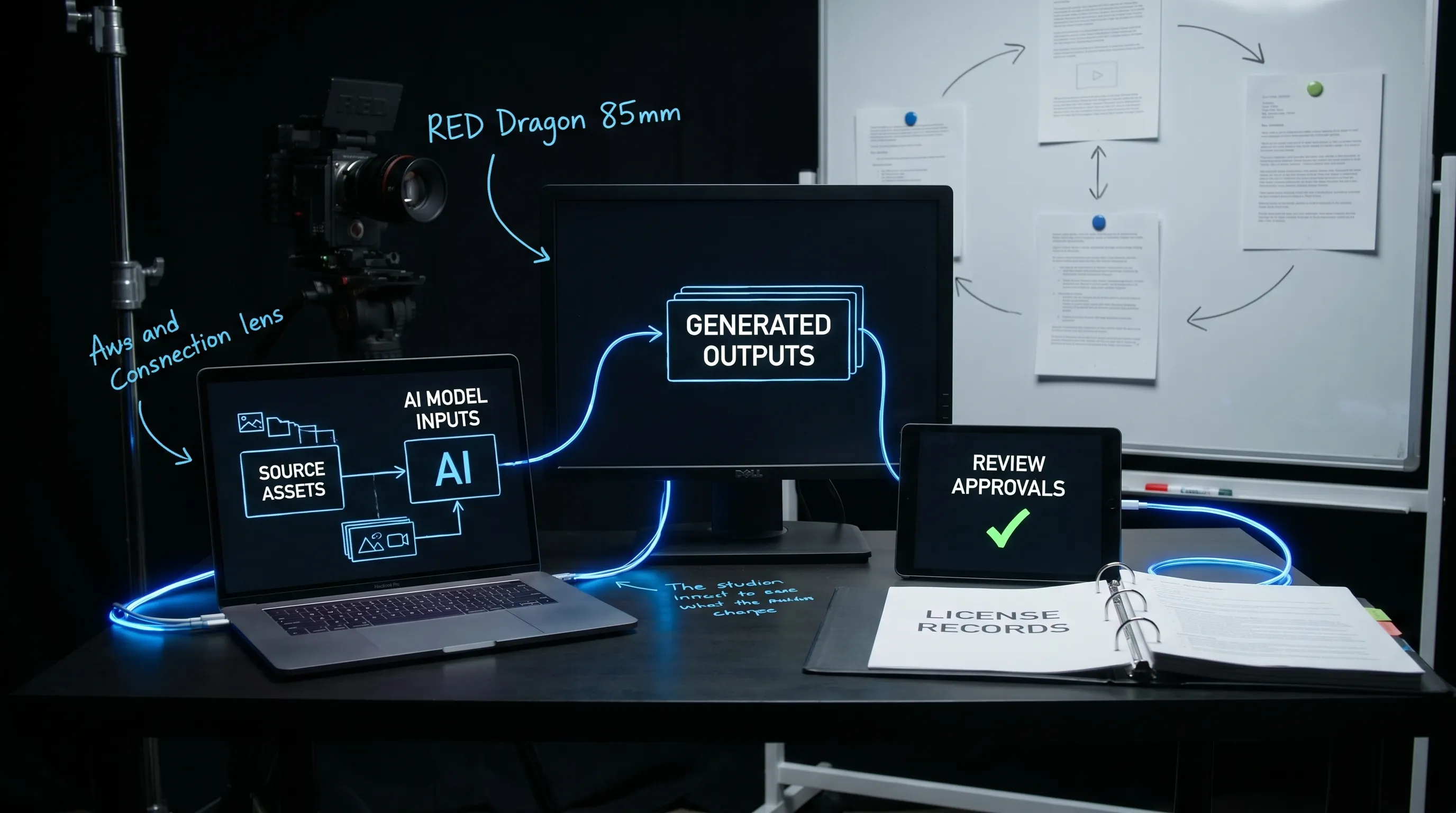
Creative Commons AI is not a separate legal framework, but it has become a very real production topic for creative teams. As image, video, audio, and 3D workflows become increasingly AI-assisted, teams need to understand when Creative Commons assets can be used, what license conditions still apply, and how to prevent licensing gaps from becoming brand, client, or compliance problems.
For CMOs, art directors, application managers, and game developers, the question is no longer simply “Can we use this image?” It is “Can we use this asset as a reference, prompt input, training example, style guide, mood board element, generated output, or commercial deliverable, and can we prove it later?”
This guide breaks down what creative teams need to know before using Creative Commons content in AI workflows.
What “Creative Commons AI” actually means
Creative Commons licenses are public copyright licenses that allow creators to grant certain permissions in advance. They can allow others to share, adapt, and reuse copyrighted works under specific conditions, such as attribution, non-commercial use, or share-alike licensing.
There is no universal “Creative Commons AI license.” In practice, people use the phrase Creative Commons AI to describe the overlap between Creative Commons licensed works and AI-assisted creation. That overlap usually appears in three places:
- Using Creative Commons works as inputs, references, prompts, or mood board material
- Including Creative Commons works in datasets for model training, fine-tuning, or retrieval systems
- Releasing AI-assisted or AI-generated outputs under a Creative Commons license
The key point is that Creative Commons licenses do not make the legal and operational questions disappear. They give permissions under conditions. Your team still needs to know what license applies, whether the use is commercial, whether the output is an adaptation, whether attribution is required, and whether other rights are involved.
Creative Commons explains its licenses as standardized tools for sharing copyrighted works. The organization also maintains a FAQ covering artificial intelligence and CC licenses, which is useful background for teams building internal policy.
Why creative teams should care in 2026
Generative AI has moved from experimentation into production. Campaign teams are generating visual concepts, game studios are prototyping 3D assets, commerce teams are localizing product visuals, and creative operations teams are connecting AI tools into DAM, PIM, and review workflows.
That scale changes the risk profile. A one-off concept image used internally is very different from a global campaign, a marketplace asset, or a game environment shipped to millions of players. When AI workflows reuse Creative Commons material without proper governance, teams can run into several problems.
First, attribution can be lost. Many Creative Commons licenses require attribution, but AI workflows often strip metadata, flatten images, or separate the final output from its source references. If no system records where inputs came from, teams may not be able to provide proper credit later.
Second, commercial use can become unclear. Some Creative Commons licenses allow commercial use, while others do not. A visual used in an internal ideation board might later influence a paid campaign. Without guardrails, a non-commercial asset can quietly move into a commercial production chain.
Third, derivative work questions can be difficult. If an AI output closely adapts a CC-licensed image, character, design, or composition, the original license conditions may matter. If the license includes NoDerivatives or ShareAlike restrictions, that can affect whether the output is suitable for the intended use.
Fourth, enterprise contracts usually require stronger assurance than “we found it online.” Brands, agencies, publishers, and game studios may need to warrant that deliverables do not infringe third-party rights. Creative Commons can be part of a compliant sourcing strategy, but only if licenses are tracked and respected.
Finally, the regulatory environment is tightening. The EU AI Act includes obligations for general-purpose AI providers related to copyright compliance and training data transparency. Even if your team is not building foundation models, enterprise buyers increasingly expect AI governance, auditability, and clear data policies across the creative supply chain.
A practical guide to Creative Commons licenses in AI workflows
Creative Commons licenses vary significantly. Before using CC content in an AI workflow, creative teams should identify the exact license and version, then map it to the intended use.
| License | What it generally allows | AI workflow caution |
|---|---|---|
| CC0 | The creator has dedicated the work to the public domain as much as legally possible | Still check trademarks, privacy, publicity rights, and cultural or contractual restrictions |
| CC BY | Reuse and adaptations are generally allowed, including commercial use, with attribution | Keep attribution records and avoid stripping source metadata from production workflows |
| CC BY-SA | Reuse and adaptations are generally allowed with attribution and ShareAlike terms | Adapted outputs may need to be shared under the same license, which may not fit client work |
| CC BY-NC | Reuse is allowed with attribution for non-commercial purposes | Usually unsuitable for advertising, product content, paid games, or brand campaigns |
| CC BY-ND | Redistribution is allowed with attribution, but adaptations are restricted | Risky for AI transformations if the result could be considered an adaptation |
| CC BY-NC-SA | Non-commercial reuse and adaptations are allowed with attribution and ShareAlike terms | Rarely appropriate for enterprise deliverables unless legal approves the exact use |
| CC BY-NC-ND | Non-commercial redistribution is allowed with attribution, but adaptations are restricted | Best treated as view-only or inspiration-only for most commercial AI production workflows |
This table is a production-friendly simplification, not legal advice. The right interpretation can depend on jurisdiction, the exact use, the license version, and whether the AI process creates a copy, adaptation, or independent output.
For enterprise teams, the safest default is to treat each Creative Commons license as a policy signal. CC0 and CC BY assets may be easier to operationalize, while NC, ND, and SA restrictions require more careful review before they enter commercial production.
The four places Creative Commons issues appear in AI production
Creative Commons risk is easiest to manage when teams separate the workflow into stages. Different questions apply at each stage.
1. Source assets and mood boards
Creative teams often use CC-licensed images, videos, 3D models, or audio tracks for inspiration. In traditional workflows, this might happen in a mood board or concept deck. In AI workflows, those same assets may become prompt references, image-to-image inputs, control images, style anchors, or retrieval examples.
The operational question is simple: is the asset just informing internal direction, or is it being transformed into something that may be distributed? If the asset is only used in an internal creative discussion, the risk profile may be lower. If it is used to guide a production output, license conditions become more important.
For example, a CC BY image used as a visual reference for a commercial campaign may require attribution if it is reused or adapted. A CC BY-NC image may be inappropriate for the same campaign because the intended use is commercial. A CC BY-ND image may be problematic if the final creative is recognizably based on it.
2. Prompt inputs and AI references
Prompting can feel temporary, but many AI tools create or store copies of inputs. If a team uploads a CC-licensed image to generate variations, the process may involve reproduction, transformation, or storage by a vendor. That matters because Creative Commons license terms are triggered by copyright-relevant uses, not by whether the team thinks of the asset as “just a prompt.”
Teams should pay special attention to vendor terms. Some tools may use inputs to improve models unless disabled by contract or settings. Others may process inputs only for the requested generation. For enterprise work, the difference is significant, especially when CC assets are mixed with confidential client materials or proprietary style references.
3. Training, fine-tuning, and retrieval
Using CC works in AI training or fine-tuning is one of the most debated areas. The legal answer can depend on the jurisdiction, the type of model, the way works are copied, whether outputs are substantially similar, and whether exceptions such as text and data mining or fair use apply.
Creative Commons licenses are copyright licenses, and they do not control uses that do not require permission under copyright law. However, if your training process requires permissions, license conditions may matter. For example, a CC BY dataset may create attribution expectations, while NC or ND restrictions may raise concerns for commercial models or transformed outputs.
In the EU, text and data mining rules and opt-outs can also be relevant. Under the AI Act, general-purpose AI model providers must have policies to comply with EU copyright law and provide summaries of training content. This does not answer every question for every creative team, but it does reinforce the direction of travel: documentation and governance are becoming standard expectations.
4. AI-assisted outputs and licensing
Teams sometimes want to release AI-generated assets under Creative Commons licenses. That can be useful for community assets, open game prototypes, educational materials, or brand resources intended for public reuse.
The important question is whether your organization has rights to license the output. In the United States, the Copyright Office has stated that copyright protection requires human authorship, and purely AI-generated material may not be copyrightable. Its 2025 report on copyrightability and AI explains that human creative contribution remains central.
This does not mean AI-assisted work can never be protected or licensed. It means teams should document human authorship, creative selection, editing, arrangement, and final decision-making. If an output incorporates or adapts Creative Commons source material, the source license may also affect how the final work can be shared.
Creative Commons does not clear every right
One of the most common mistakes is assuming that a Creative Commons license clears all possible rights. It does not.
Creative Commons licenses primarily address copyright. They generally do not grant trademark rights, patent rights, privacy rights, publicity rights, or permissions related to confidential information. This matters in AI production because generated outputs can surface issues beyond copyright.
A CC-licensed street photograph may include recognizable people, private property, logos, or protected product designs. A CC0 3D object may still resemble a trademarked product. A public domain artwork may be safe from copyright restrictions but still culturally sensitive or unsuitable for a brand context.
For creative teams, the practical rule is to separate copyright clearance from brand safety clearance. A license may answer one question, but legal, ethical, and reputational review may still be needed.
A governance checklist for creative teams
Creative Commons AI governance should not slow down production. The goal is to make safe choices easy and risky choices visible. Enterprise teams can do this by turning legal and brand requirements into workflow rules.
| Governance area | What to define | Why it matters |
|---|---|---|
| Asset intake | Which CC licenses are allowed, restricted, or blocked | Prevents unsuitable assets from entering production pipelines |
| Attribution | What source data must be captured and where credits are stored | Keeps teams compliant when attribution is required |
| Commercial use | Which licenses are approved for client, campaign, game, or commerce use | Reduces the risk of NC assets entering paid work |
| AI input policy | Whether CC assets can be used as prompts, references, or fine-tuning data | Aligns creative experimentation with legal and vendor requirements |
| Output review | What similarity, trademark, likeness, and rights checks are required | Catches risks before assets are published or shipped |
| Audit trail | How prompts, inputs, approvals, and final assets are documented | Supports client assurance, compliance, and future reuse |
A useful policy does not need to be complicated. Many teams start with three categories: approved, restricted, and prohibited. CC0 and internally owned assets might be approved for broad use. CC BY assets may be approved with attribution tracking. NC, ND, and SA assets may be restricted or prohibited for commercial deliverables unless reviewed.
The most important step is consistency. If every team, tool, and project handles licenses differently, governance becomes impossible at scale.
How to make Creative Commons AI workable at scale
Creative teams do not need to abandon Creative Commons content. The commons can be an important source of inspiration, education, prototyping material, and open collaboration. The challenge is operationalizing it responsibly.
Start by making provenance visible. Every asset used in an AI workflow should have a source, license, date accessed, creator name when available, and usage notes. This information should travel with the asset as it moves from mood board to generation to review to final delivery.
Next, separate experimentation from production. Creative teams need room to explore, but not every exploratory input should be allowed into final deliverables. A sandbox can permit broader experimentation, while production workflows enforce stricter license rules.
Then, standardize generation templates. If teams repeatedly create product visuals, campaign concepts, character sheets, or 3D props, use approved blueprints that define allowed inputs, model settings, review steps, and output requirements. This reduces one-off decisions and makes governance repeatable.
Finally, keep humans in the loop. AI can accelerate production, but human review is still essential for creative judgment, rights clearance, brand consistency, and final accountability.
Where Virtuall fits into Creative Commons AI governance
For organizations operating creative AI across teams, the challenge is not just knowing the rules. It is enforcing them across studios, workflows, tools, and content formats.
Virtuall is built as a Creative AI operating system for teams that need to orchestrate AI-powered creation across image, video, audio, and 3D while maintaining governance and production control. In a Creative Commons AI context, that means teams can think beyond isolated generation tools and design a governed workflow around how assets are sourced, used, reviewed, approved, and tracked.
The Creative AI OS supports AI governance controls, workflow orchestration, generation blueprints, team collaboration, review workflows, approvals, content annotation, asset management, and pipeline tracking. Its studio context memory, through mood boards, helps teams preserve creative intent and context across projects. Nyx, the intelligence layer of the Creative AI OS, orchestrates multiple AI models while keeping intent and context aligned across studios and teams.
For enterprise teams, this kind of operating layer is especially valuable because Creative Commons questions are rarely isolated. They connect to brand guidelines, client requirements, regional compliance, vendor policies, DAM and PIM systems, and production deadlines. A governed AI workflow helps creative teams move faster without relying on informal judgment at every step.
Frequently Asked Questions
Can Creative Commons content be used to train AI models? It depends on the jurisdiction, the license, the training method, and whether the use requires copyright permission. Creative Commons licenses may not restrict uses that copyright law does not control, but if permission is needed, license conditions can matter. Enterprise teams should get legal review before using CC works for training or fine-tuning.
Can we use CC BY images in commercial AI campaigns? Often, CC BY allows commercial reuse if attribution and other license terms are followed. However, teams still need to check whether the image includes trademarks, recognizable people, private property, or other rights that the CC license does not cover.
Are CC BY-NC assets safe for client work? Usually not without legal approval. “NC” means non-commercial, and client campaigns, paid products, game releases, advertising, and ecommerce content are generally commercial contexts.
Is CC0 completely risk-free for AI workflows? No. CC0 reduces copyright friction because the creator has waived rights as much as possible, but it does not automatically clear trademarks, privacy rights, publicity rights, contractual restrictions, or brand safety concerns.
Can AI-generated work be released under a Creative Commons license? Possibly, but only if you have rights to license the work. If the output is purely AI-generated, copyright protection may be limited in some jurisdictions. If humans made meaningful creative contributions, or if the work includes licensed source material, the analysis becomes more specific.
Do we need to attribute Creative Commons works used only as AI references? It depends on whether the reference use involves copying, sharing, adapting, or otherwise using the work in a way that triggers the license. From an operational standpoint, it is wise to record attribution data even when you are unsure, because missing provenance is difficult to fix later.
Turn Creative Commons AI policy into production practice
Creative Commons AI is not just a legal topic. It is a creative operations topic. Teams need clear rules for what can be used, where it can be used, how attribution is preserved, and who approves final outputs.
If your organization is scaling AI-assisted image, video, audio, or 3D creation, Virtuall can help you bring governance, orchestration, context, and review into one operating layer for creative production.
Explore Virtuall to see how enterprise creative teams can operate AI at scale while staying consistent, compliant, and production-ready.