A Guide to Frame Within a Frame Composition
Discover how the frame within a frame technique adds depth and focus to your creative work. Learn to apply it in photography, film, and AI art generation.
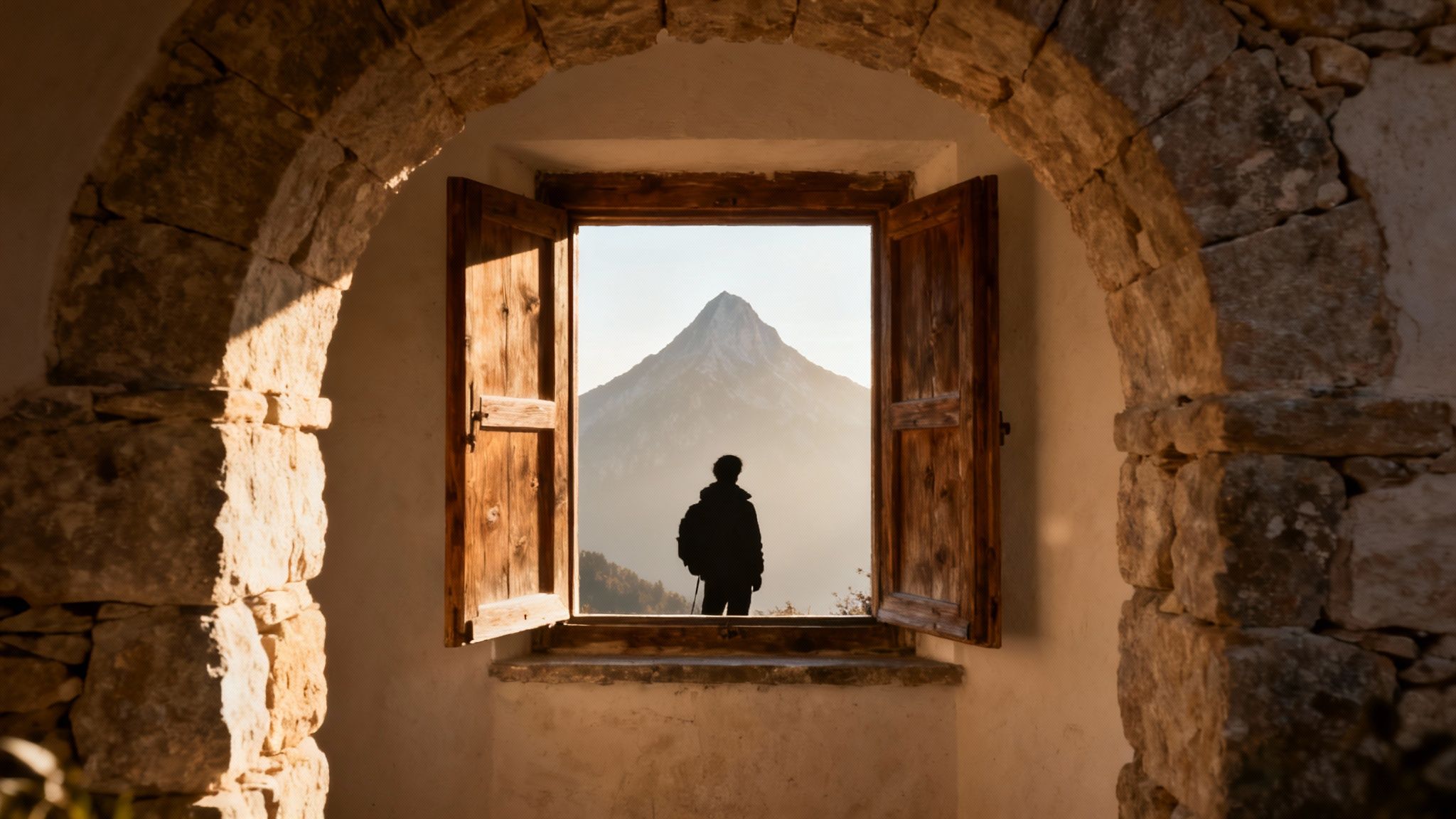
As creative professionals, we continually seek new ways to craft compelling visuals that guide an audience's attention and tell a memorable story. One of the most effective techniques is frame within a frame. By using elements within a scene—such as doorways, windows, or even shadows—to create a natural border around your main subject, you can instantly add a sense of depth and focus to your work. Before we dive in, if you're ready to apply these professional techniques to your visual creative work, you can get started with the VirtuallPRO Creative AI OS. For those who have not generated anything already, you can try it for free.
The Secret to More Compelling Visuals
At its heart, the frame within a frame technique is a clever way to lead the viewer’s eye exactly where you want it to go. Think of it as a natural spotlight. Instead of letting someone's gaze wander aimlessly across the image, this internal frame acts like a funnel, channelling their attention straight to the most important part of the scene. It's a method that's been used for centuries, from Renaissance paintings to modern film, simply because it works.
By placing your subject inside a secondary frame, you instantly create a stronger, more organised composition. The technique works by adding layers and creating a clear separation between the foreground and the background, which is a fantastic way to establish a real sense of place. It doesn't just look good; it builds a narrative.
Adding Depth and Context
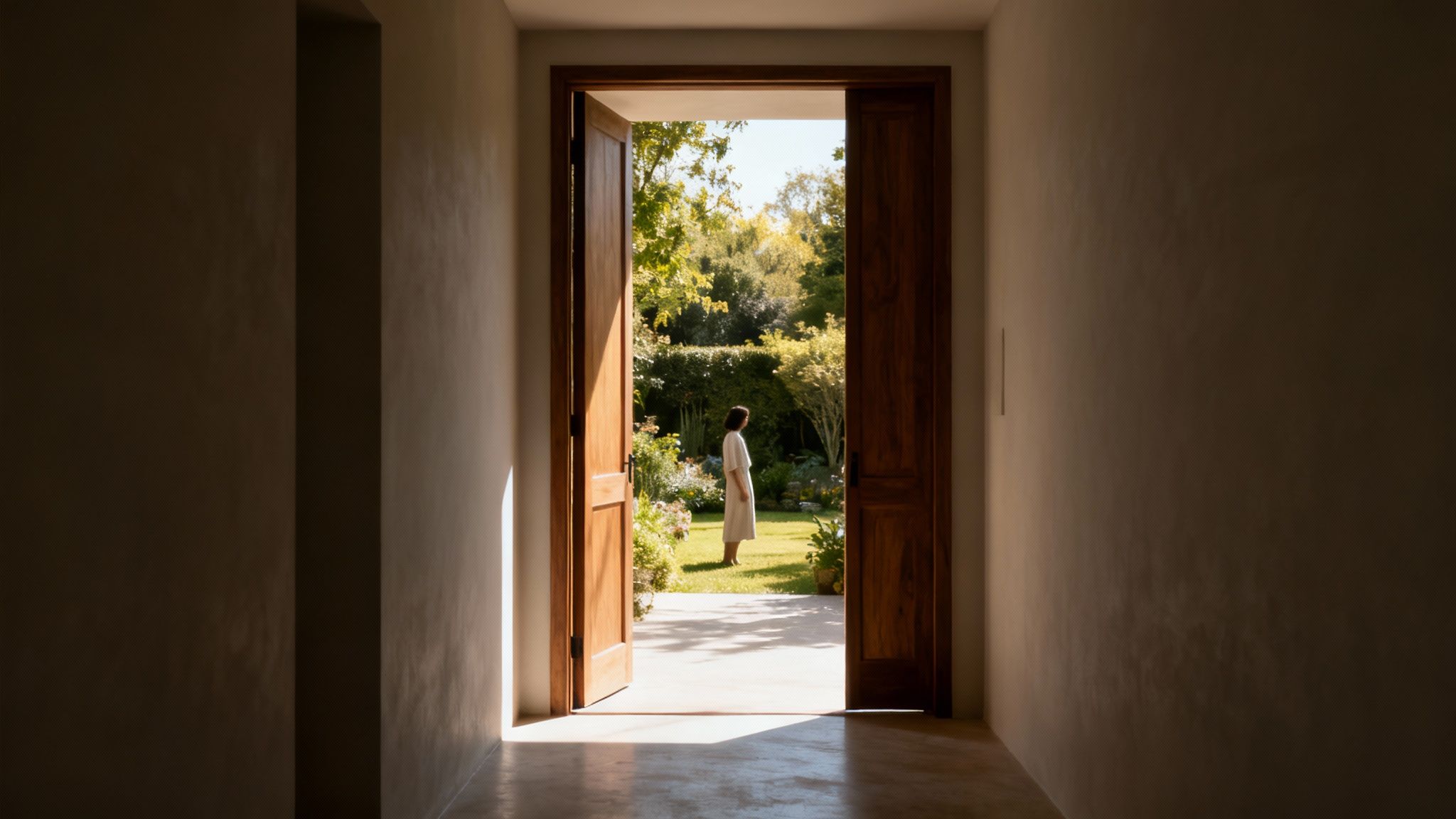
A well-chosen frame does more than just point to the subject; it adds context and emotional weight. For instance, a character seen through a rain-streaked window might feel isolated, while someone framed by a vibrant floral archway could seem joyful or romantic. The frame itself becomes part of the story, making the whole scene richer.
This technique is also incredibly versatile, and you can find frames almost anywhere in your environment. Just look around. You'll start seeing them everywhere.
- Architectural Elements: Doorways, windows, arches, and mirrors are the classic choices. They give you clean, structured frames.
- Natural Surroundings: Overhanging tree branches, the mouth of a cave, or even the gap between two large rocks can create beautifully organic and dynamic frames.
- Abstract Elements: Don't forget about light and shadow. They can form less obvious but highly atmospheric frames that dial up the mood and drama.
A frame within a frame is more than just a compositional trick; it’s a storytelling device. It can turn a flat image into an immersive experience, inviting the viewer to look deeper into the world you’ve created.
For those looking to really get a handle on this, understanding how it plays with other visual elements is key. You can learn more about creating a sense of three-dimensionality in our guide to mastering depth of field. By applying these professional techniques, you can start experimenting with the VirtuallPRO Creative AI OS, a unified workspace where you can seamlessly generate and refine complex compositions across images, video, and 3D assets in a safe and compliant enterprise environment.
How Framing Shapes What We See and Feel
There's a reason the frame within a frame technique feels so powerful—it works on a deep, almost subconscious level. It taps directly into our psychology, skilfully guiding our attention and shaping our emotional response before we've even had a chance to process it. This isn't just about making an image look good; it's about fundamentally changing how we see and connect with it.
At its heart, the technique is a masterclass in creating the illusion of depth. When an artist places a border in the foreground—like a doorway, a window, or even overhanging branches—they instantly separate the scene into different visual planes. This simple act pulls you right into the image, making a flat, two-dimensional surface feel more like a three-dimensional world you could almost step into.

Triggering a Sense of Discovery
Human brains are wired for curiosity. When we see something framed, it’s like being offered a secret glimpse into another space. Think about looking through a keyhole or a pair of binoculars; viewing something through a tight aperture creates an immediate sense of intimacy, discovery, or even a touch of voyeurism.
This psychological trigger makes the subject feel more important and private, as if we’re witnessing a moment not meant for just anyone. The inner frame sets the subject apart from our immediate surroundings, making it feel more special while simultaneously pulling our focus towards it with an undeniable magnetic force.
The frame isolates the subject from its surroundings, effectively telling the viewer, "Look here. This is the most important part of the story." This directed focus eliminates distractions and strengthens the narrative impact of the entire composition.
Artists have understood this effect for centuries, and you can see its influence everywhere from Renaissance paintings to modern digital media. For art directors and marketers, understanding these psychological triggers is key to intentionally shaping an audience's emotional journey.
Creating Emotional and Narrative Layers
The choice of frame itself adds another layer of meaning. A craggy cave opening can evoke danger and adventure, while peering through the delicate branches of a cherry blossom tree suggests romance or tranquillity. The frame becomes a silent narrator, setting the tone of the story.
This technique is particularly powerful in Denmark's creative industries, which impressively contribute 10% to the country's national exports. Here, 'frame within a frame' has become a cornerstone of visual storytelling, especially in the gaming and media sectors—a perfect fit for Virtuall's AI-powered workflows for 3D and video generation. Danish cinematography famously embraced this composition during the 2011 global success of 'The Killing,' where over 15% of the scenes used internal frames to build suspense and heighten the series' international appeal. You can explore more about Danish creative industry trends from Radner.dk.
By carefully choosing the framing element, a creator gains incredible control over the emotional atmosphere of their work. This makes visual narratives far more impactful, ensuring they aren’t just seen, but are felt and remembered long after you’ve looked away. The frame doesn't just hold the picture; it helps tell its story.
Applying Framing Techniques in Your Creative Field
The real magic of the frame within a frame technique is just how versatile it is. This isn't some niche trick; it's a foundational compositional tool that can elevate work across almost any creative field. Whether you're capturing a real-world moment or building an interactive world from scratch, knowing how to apply it is the key to creating more immersive and visually powerful content.
For photographers and cinematographers, the world is practically overflowing with potential frames. Think about it—so many iconic shots use architectural elements like doorways and windows to isolate a subject and add another layer of story. A character seen through a narrow alleyway immediately feels confined, maybe even secretive. Contrast that with a couple framed by a grand archway, which gives them a sense of significance and timelessness. Mirrors are another classic, letting you build complex compositions that can reflect a character’s inner turmoil or even reveal action happening off-screen. And, of course, nature provides endless opportunities: framing a lone hiker with overhanging branches or capturing a distant ship through the mouth of a sea cave.
The very same thinking is crucial in 3D art and game development, where every single visual element is deliberately placed to guide the player's experience.
Building Immersive Digital Worlds
In environmental design, a frame within a frame is a brilliant directional cue. A crumbling stone arch in the foreground can perfectly frame a distant castle, pulling the player's eye toward an objective without needing a clunky UI arrow. It makes the world feel more organic and actually encourages people to explore.
Creators can also use this technique to control the camera and deepen the sense of immersion. Imagine seeing a game world through a character’s helmet visor, or from behind the cracked cockpit window of a starship. These built-in frames instantly narrow your field of view, creating a focused, personal, and sometimes even claustrophobic feeling that puts you right inside the character’s reality. It works on a similar principle to an over-the-shoulder shot, which aligns the audience's perspective with that of a character.
By deliberately placing objects in the foreground, 3D artists and level designers can direct attention, control sightlines, and build a more curated and impactful journey through their digital environments. This turns a simple scene into a guided visual story.
This technique has become a statistical powerhouse in advertising and design, especially within Denmark’s creative industries. Backed by a network of over 12,000 IT firms, the sector is booming. In fact, the Advertising Agencies sector in Denmark grew at a 2.0% compound annual rate from 2020-2025. Data shows that AI-optimised campaigns that use frame within a frame compositions achieve 25% higher engagement rates in digital ads. For teams using VirtuallPRO, this translates into real efficiency; annotating nested frames in collaborative spaces can cut workflow times by up to 35%. You can dig into more data on the Danish advertising industry from IBISWorld.
The choice between a natural or an artificial frame really comes down to the story you’re trying to tell. Each type brings its own mood and visual flavour to the table.
Choosing Between Natural and Artificial Frames
To help figure out which approach fits your project, it’s useful to compare their distinct qualities and how they’re typically used.
| Attribute | Natural Frames (Trees, Archways, Caves) | Artificial Frames (Windows, Mirrors, UI Elements) |
|---|---|---|
| Aesthetic Feel | Organic, rustic, and often unpredictable. Can evoke feelings of adventure, nature, or ancient history. | Structured, clean, and intentional. Often suggests a modern, man-made, or controlled environment. |
| Common Uses | Ideal for fantasy landscapes, adventure games, and outdoor photography to create a sense of discovery. | Perfect for sci-fi scenes, architectural visualisation, and character-driven drama to create focus and intimacy. |
| Narrative Impact | Suggests a world that is wild, untamed, or has a deep, storied past. | Reinforces themes of observation, confinement, reflection, or technological interface. |
In the end, whether you choose the rugged texture of a rock formation or the clean lines of a windowpane, the goal is the same. A well-executed frame doesn't just decorate an image; it directs the eye, builds depth, and enriches the story, making it an indispensable technique for any visual storyteller.
Bringing Framed Compositions to Life with AI
So, you’ve got the theory down. Now for the fun part: putting it into practice and getting technology to do the heavy lifting. The classic frame within a frame technique is a perfect match for AI-powered workflows. It gives creative teams a way to generate stunning, layered visuals with a level of speed and control we could only have dreamed of just a few years ago. With a platform like VirtuallPRO, you can take those abstract ideas and turn them into high-quality assets simply by mastering the art of the text prompt.
The real trick is writing prompts that are both descriptive and structured. Don't just ask for a "knight in a castle." Your prompt needs to clearly define the relationship between the subject and its framing element. You have to spell it out: what's the foreground frame, what's the main subject in the background, and what's the overall vibe you're aiming for?
Think of yourself as a director giving a brief to the AI. You need to be specific about where the "camera" is, what the internal frame is made of, and the story you want to tell inside it.
How to Write AI Prompts That Actually Work for Framing
To get the kind of results you see in your head, your prompts need a few key ingredients. A great starting point is a simple formula: [Subject] + [Framing Element] + [Style/Mood]. But breaking it down even further gives the AI the rich detail it needs to build a powerful, coherent image.
Here are the essential bits and pieces to bake into your prompts:
- Viewpoint: Be crystal clear about the perspective. Kicking off your prompt with phrases like "viewed through," "seen from inside," or "looking out of" instantly tells the AI what's going on.
- The Frame: Get specific about the framing object. Is it an "ornate elven archway," a "cracked cockpit window," or the "mouth of a dark, mossy cave"? The more texture you add, the better the result.
- The Subject: Now, describe what we're supposed to be looking at through that frame. This could be anything from "a serene fantasy landscape at dawn" to "a gritty sci-fi pilot navigating an asteroid field."
- Atmosphere and Lighting: This is where you set the mood. Add keywords like "golden hour lighting," "eerie morning mist," "cinematic," or "hyper-realistic" to steer the AI’s stylistic choices.
Stringing these elements together is how you create prompts that consistently deliver beautifully framed compositions.
Pro Tip: Inside VirtuallPRO, you can use the blueprinting feature to save your most successful prompt structures. This is a game-changer for teams. It lets you reuse and tweak effective formulas, keeping your style consistent and cutting down iteration time dramatically.
Here are a few sample prompts you can adapt for your own projects in VirtuallPRO, whether you're making images, 3D models, or video scenes:
- For a Fantasy Scene: "A serene fantasy landscape with floating islands, viewed through an ornate, glowing elven archway carved from white stone, cinematic lighting, hyper-detailed."
- For a Sci-Fi Character: "A gritty sci-fi pilot seen through the cracked and grimy cockpit window of a starship during a meteor shower, reflections on the glass, dramatic, moody lighting."
- For an Architectural Concept: "A modern minimalist living room with a large picture window looking out onto a stormy sea, interior view, soft ambient light, photorealistic."
This flow diagram shows just how these framing principles get applied across different fields to hit specific goals—from guiding your eye in a photograph to directing a player's attention in a game.
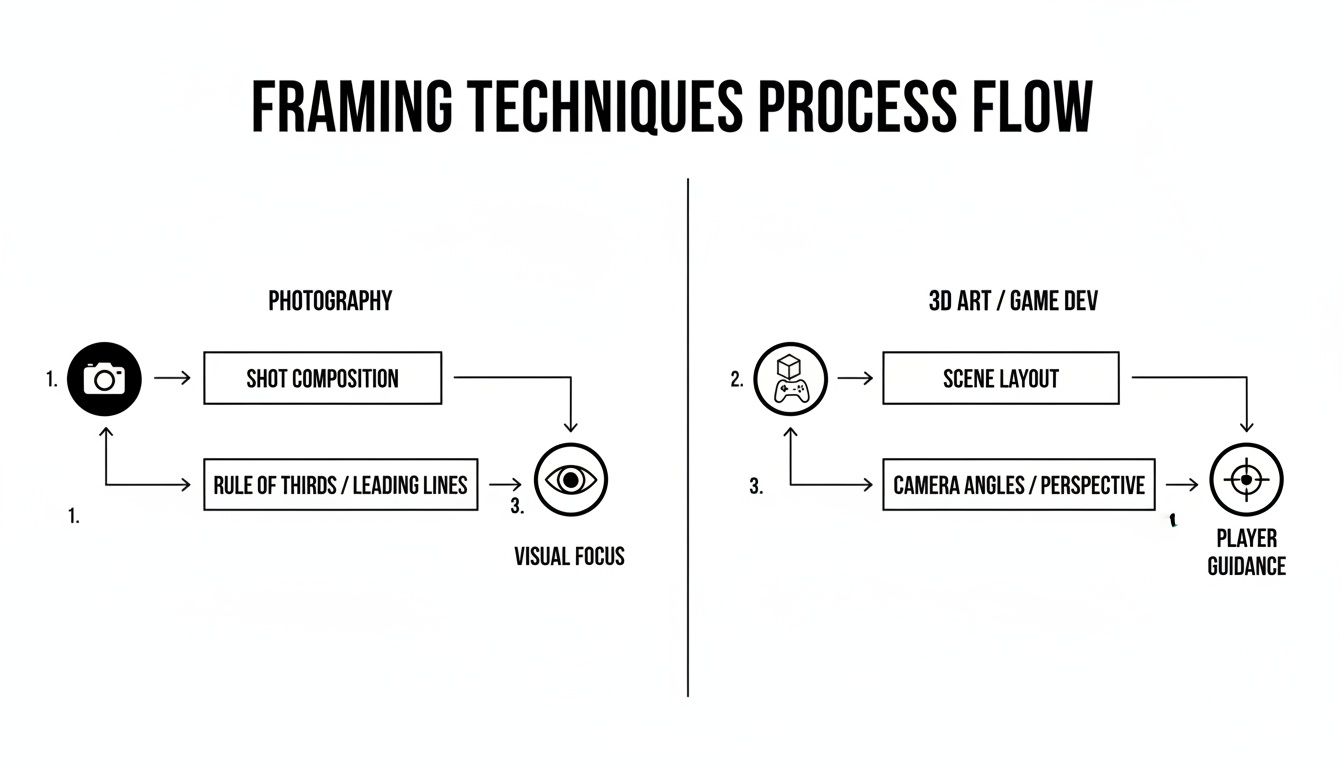
It really highlights how versatile the technique is. At its core, the job of the frame stays the same whether the final piece is a static image or a fully interactive 3D world.
Refining Your AI-Generated Frames
Getting that first image is just step one. The real magic happens when you start refining and iterating. Once VirtuallPRO gives you a starting point, use its collaborative tools to build on it. Maybe you generate a few variations by tweaking the prompt—changing the time of day, the material of the frame, or the expression on your character's face.
For anyone curious about where this technology is heading, exploring generative design for visual compositions offers some great insights into what AI can and can't do right now. Having that broader context helps you understand how the AI "thinks" about space and aesthetics. By combining sharp, precise prompting with a smart iteration process, your team can take a simple concept and efficiently turn it into a finished, compelling asset that tells a great visual story.
Advanced Framing for Deeper Storytelling
Once you’ve got the hang of the basic frame within a frame, the real fun begins. Pushing the technique beyond the obvious and into more abstract territory is how you create visuals that stick with people. It’s time to move past literal doors and windows and start thinking about how to use less tangible elements—light, shadow, and even colour—to build atmosphere and shape how your audience feels.
Think about it this way: instead of a solid border, what if a sharp, dramatic shadow slices across the foreground, isolating your subject in a single pool of light? Right away, you’ve introduced a feeling of mystery or loneliness. Or imagine a vibrant sunset bleeding through a window, bathing your subject in a warm wash of colour. That colour itself becomes an emotional frame, wrapping the scene in nostalgia. These aren't physical barriers; they're atmospheric tools that gently guide the viewer's emotions rather than their eyes.
Layering Multiple Frames for Complexity
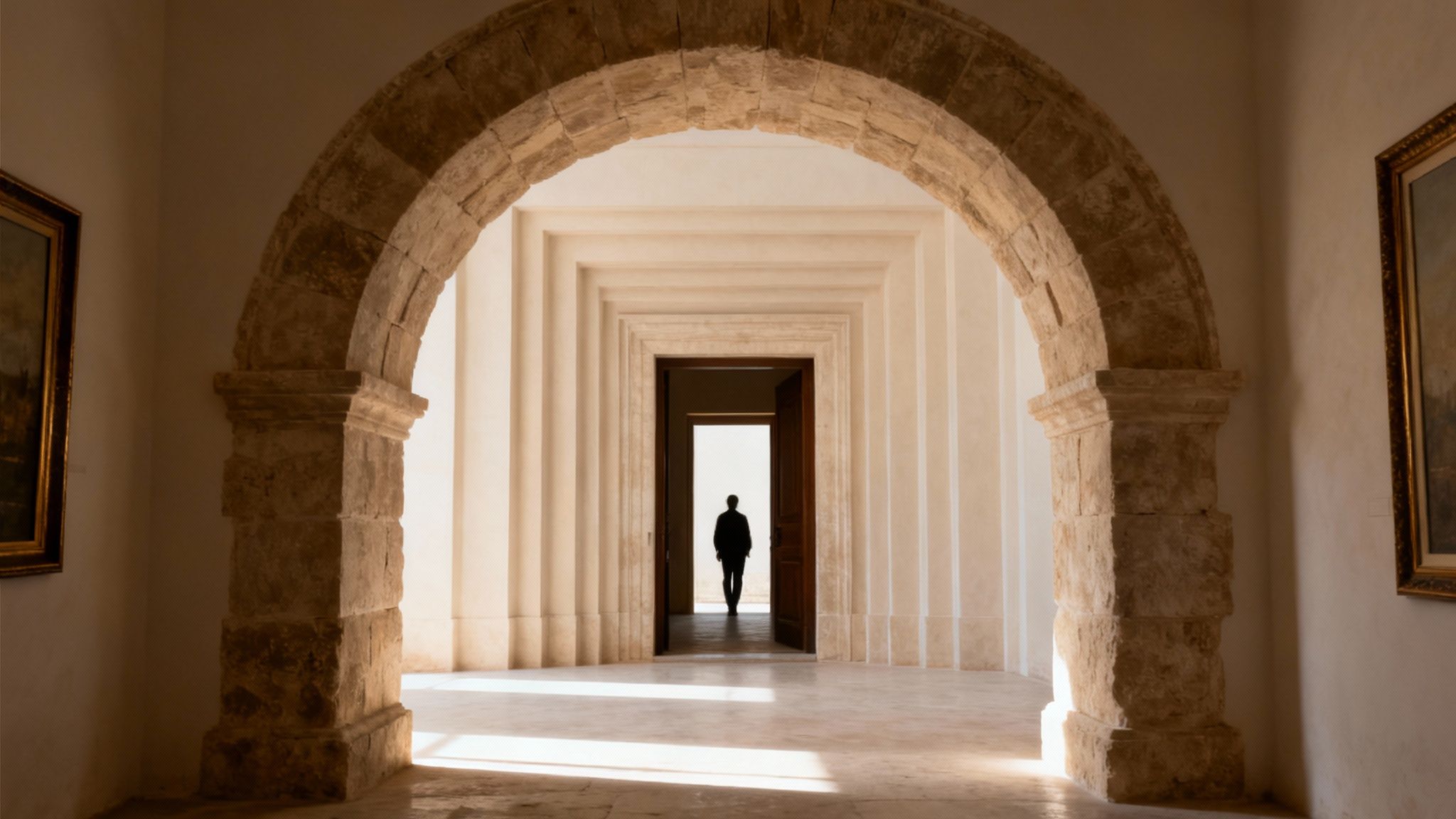
Why settle for one frame when you can use many? When you start layering frames within the same shot, you build incredible depth and turn a simple scene into something far more interesting. Picture a character seen through a doorway, who is then also framed by a mirror on the wall inside. Each layer you add gives the story another dimension, pulling the viewer deeper into the world you’ve created.
This is a fantastic way to hint at complex psychological states or tangled relationships. You could, for instance, shoot a subject through a series of archways, with each arch getting progressively smaller and darker. That creates this powerful sensation of being pulled down a tunnel, suggesting a journey towards an inevitable conclusion. The repetition of the frames sets up a visual rhythm that can be either soothing or deeply unsettling, all depending on your story's needs.
Layering frames transforms a simple composition into a rich visual puzzle. Each frame acts as a chapter in a short story, guiding the viewer from the foreground to the background and adding layers of meaning along the way.
Intentionally Breaking the Frame
Of course, once you know the rules inside and out, you can make a real impact by breaking them. Having a character's hand, foot, or even just their gaze extend beyond the inner frame is a powerful move. It instantly creates a dynamic tension between the subject and their surroundings, grabbing the viewer's attention.
Breaking the frame can serve a few different narrative purposes:
- Creating Connection: When a subject reaches out of their frame, it can feel like they're breaking the fourth wall and connecting directly with the audience.
- Showing Rebellion: A character bursting through their frame is a clear visual shorthand for freedom, defiance, or a rejection of their situation.
- Adding Action: In fast-paced scenes, breaking the frame makes the action feel immediate and chaotic, as if it can't be contained by the composition.
Collaborative Refinement in VirtuallPRO
Pulling off these kinds of intricate compositions is almost always a team sport. A director’s idea for layered framing needs to be perfectly translated by a 3D artist or cinematographer, and that’s where a shared workspace like VirtuallPRO makes a huge difference. Creative teams can use its collaborative tools to fine-tune these advanced techniques with real precision.
For example, an art director could use on-image annotations to suggest shifting a shadow to create a more dramatic abstract frame. A producer could flip through different versions of a scene, using the asset versioning feature to compare how layering frames affects the overall mood. These tools get everyone on the same page, allowing the team to work together to refine complex and innovative visual stories. By making the collaboration smoother, teams can experiment with more confidence and push their creative boundaries, all while keeping the workflow organised and efficient.
Frequently Asked Questions
It’s one thing to understand the ‘frame within a frame’ technique, but it’s another to use it well in your own work. It's a powerful tool, but like any tool, it takes a bit of practice to master. Let's tackle some of the common questions that pop up when you start putting it into action.
A big one is: how do I keep my frames from looking cliché? The trick is to think beyond the obvious. Instead of just defaulting to a perfectly centred doorway, start looking for more subtle or unexpected frames. Maybe it’s a sliver of light cutting across a dark room, a cast shadow, or a blurred object in the foreground.
The frame should always serve the story, not just look cool. Before you commit, ask yourself: what does this frame tell me about the character or the place they're in? If it adds a layer of meaning, you’re on the right path.
Applying Frames to Different Genres
How you use a frame really depends on the kind of story you’re telling. The technique is incredibly versatile, but you need to match the frame to the mood.
Here are a few ideas to get you started:
- Fantasy and Adventure: Go for natural frames. Think ancient archways, the mouth of a cave, or the thick canopy of a forest. These elements create a sense of mystery and make the world feel epic and untamed.
- Science Fiction: This is where artificial frames shine. A character seen through the cockpit of a starship, the visor of a helmet, or even a flickering holographic display immediately grounds the scene in a futuristic setting.
- Horror and Thriller: Use tight, claustrophobic frames to dial up the tension. Peeking through a keyhole, a cracked door, or the gaps between floorboards creates a powerful sense of being trapped or watched.
Can AI Help Discover New Framing Ideas?
Yes, absolutely. AI is a fantastic brainstorming partner, especially when you feel like you're stuck in a creative rut. When you’ve used every doorway and window you can think of, AI tools like VirtuallPRO can help you break out of that box. You can feed it a simple prompt and get dozens of unique framing ideas in minutes.
For example, you could ask the AI to show a scene "viewed through a shattered mirror" to explore a fragmented, psychological shot. Or you could prompt it with "a character framed by bioluminescent fungi in a dark forest" to find new ways to use light as a compositional element. It’s like having a co-creator that can instantly visualise your thoughts, helping you find fresh, compelling ways to tell your story.
Ready to push the boundaries of your visual storytelling? Explore these advanced techniques and discover countless new compositional ideas with Virtuall. Start generating stunning, professionally framed assets today. Try the Creative AI OS for free at Virtuall.pro.