Large Scale AI for Content: Routing, QA, and Cost Control
Large scale AI for content needs smart routing, scalable QA, and cost control. Learn the operating model to ship consistent, compliant creative.
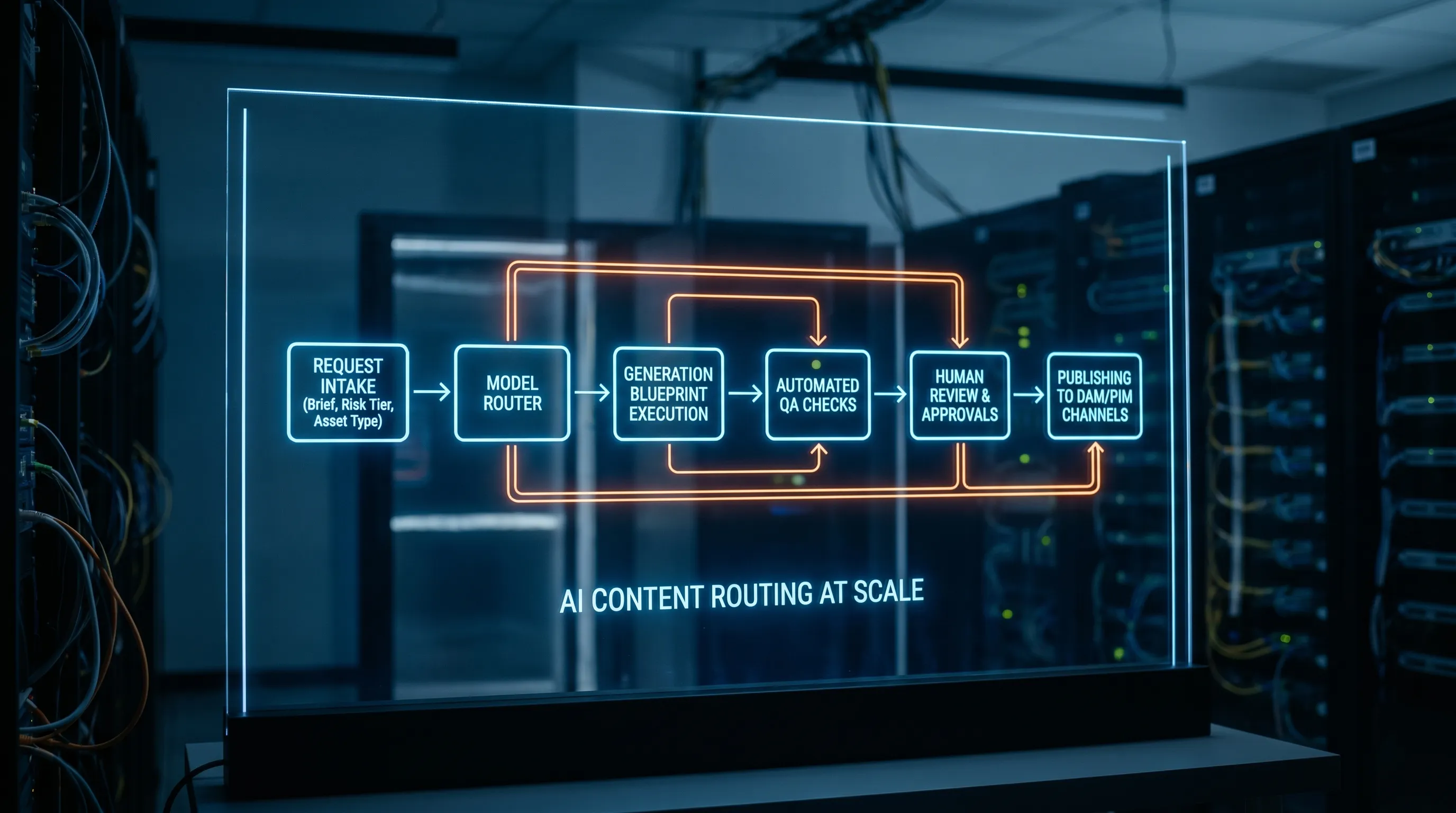
When generative AI is used for one-off assets, quality and cost are easy to “manage” by taste and intuition. The moment you try to produce thousands of images, videos, and 3D variations across brands, regions, and product lines, you need something closer to an operating model: routing rules, QA gates, auditability, and predictable spend.
This guide breaks down the practical mechanics of large scale AI for content with a focus on three systems that determine whether you ship reliably or drown in rework:
- Routing: selecting the right model, settings, and context per request
- QA: verifying outputs for brand, technical, legal, and platform readiness
- Cost control: preventing “creative inflation” where iterations and high-end models quietly blow up budgets
Why “large scale AI for content” fails without an operating layer
At enterprise volume, content generation becomes a pipeline problem, not a prompting problem.
The most common failure modes look like this:
- Teams use different tools and models, resulting in inconsistent style, variable quality, and no audit trail.
- High-risk content (kids, health, regulated industries, copyrighted IP) is generated without the right approvals.
- Expensive models are used by default because it is faster in the moment, then finance asks why costs spiked.
- Outputs are “good enough” visually but fail downstream requirements (aspect ratios, safe areas, naming, licensing notes, 3D topology constraints, platform policies).
The fix is to treat AI like any other production capability: define standards, enforce gates, track throughput, and continuously improve.
Routing: how to send each request to the right model and workflow
“Routing” is the decision logic that determines:
- Which model(s) to use (and in what order)
- Which context to attach (brand rules, product data, mood boards)
- Which generation blueprint (template) to apply
- Which QA checks and approvals are required
In other words, routing turns creative AI from ad hoc experimentation into an industrial process.
Step 1: Classify each generation request
At scale, you cannot rely on humans to remember which model is appropriate. You need request classification that is consistent and machine-enforceable.
A practical classification scheme uses four dimensions:
- Asset type: image, video, 3D, audio, multi-asset campaign kit
- Purpose: concept exploration, production variation, localization, personalization, internal pitch
- Risk tier: low (generic), medium (brand-facing), high (regulated, IP-sensitive, minors, medical, financial)
- Quality target: draft, review-ready, production-ready
This classification becomes the input to routing policies.
Step 2: Define routing policies as rules, not tribal knowledge
Routing policies should be explicit enough that you can audit them later.
Here is a routing matrix you can adapt:
| Decision factor | Low risk, draft | Medium risk, brand-facing | High risk, regulated or IP sensitive |
|---|---|---|---|
| Model choice | low-cost or fast model | higher-quality model | best-quality model plus restricted providers |
| Context | lightweight style prompt | brand kit + mood board | brand kit + product data + legal constraints |
| Workflow | generate, auto QA | generate, auto QA + human review | generate, auto QA + mandatory approvals |
| Logging | standard logs | logs + versioned prompts | full audit trail, reviewer identity, retention |
The important part is not the exact labels, it is the fact that each request gets an enforced path.
Step 3: Use multi-model routing (and avoid “one model for everything”)
At enterprise scale, cost and throughput depend on not using premium inference for tasks that do not need it.
A common multi-model pattern is:
- Draft pass: cheap and fast model to explore composition, copy tone, or rough motion.
- Quality pass: higher-end model for final lighting, fidelity, typography handling, or temporal consistency.
- Specialist pass: dedicated models for upscaling, background removal, voice, 3D generation, or controlled edits.
Routing decides when to escalate from one pass to the next.
Step 4: Preserve intent and context across iterations
A hidden scaling problem is “context drift.” As assets move between people, tools, and model calls, the original intent (brand, campaign objective, product truth) gets lost.
To prevent drift:
- Centralize studio context (brand rules, mood boards, product references)
- Standardize generation through blueprints (templates that encode how you want AI to run)
- Ensure the orchestration layer can keep context consistent across steps
This is where a Creative AI OS approach becomes valuable: it is less about a single model, and more about the system that keeps decisions coherent across tools and teams.
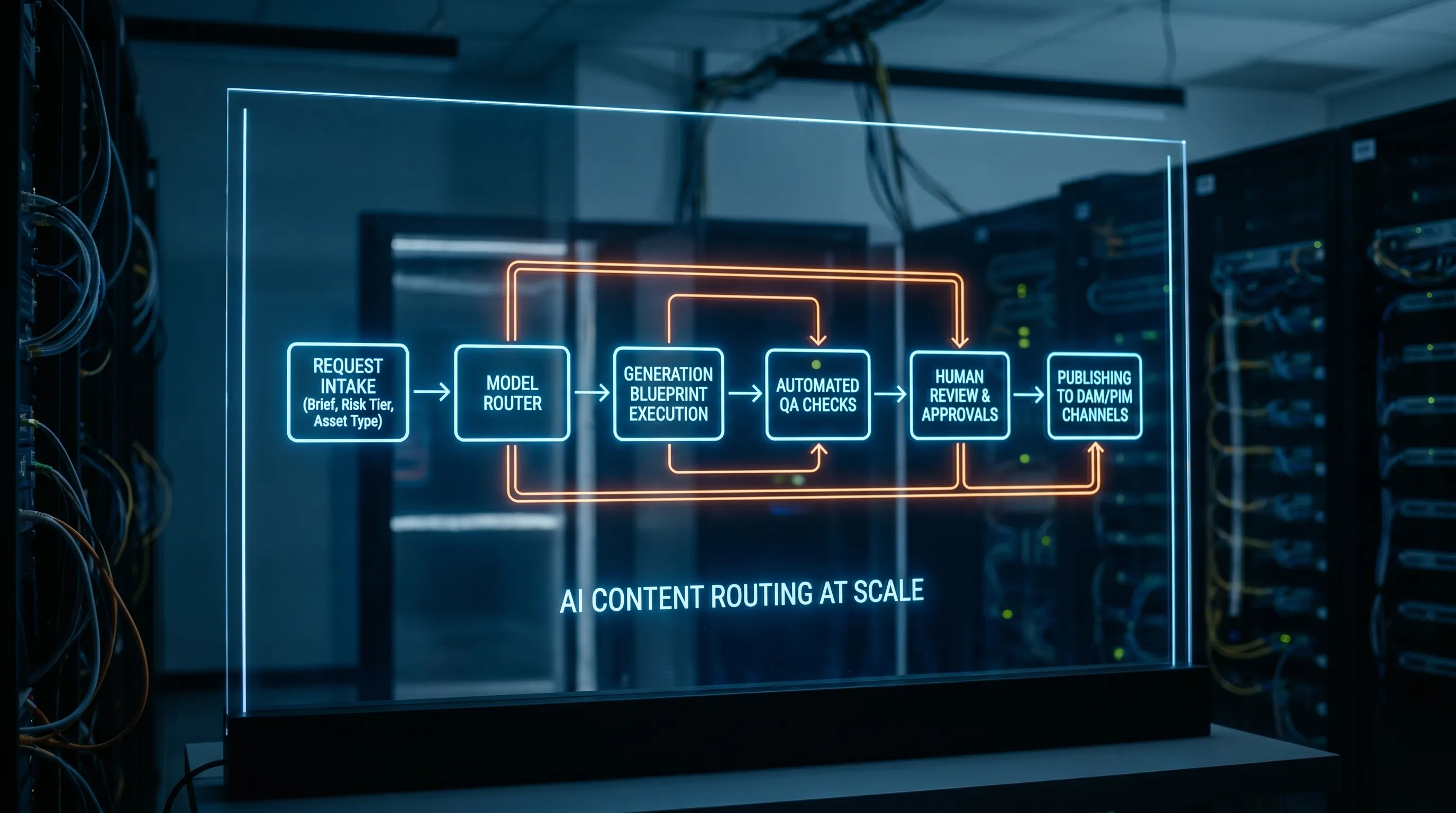
QA: designing quality gates that scale without blocking production
Traditional creative QA relies on expert review and taste. At large scale AI output, you need two layers:
- Automated QA for fast, repeatable checks
- Human QA for judgment calls, brand nuance, and exceptions
What “QA” should include for AI-generated content
Quality is multi-dimensional. Teams often over-focus on visual appeal and miss operational requirements.
A robust QA checklist typically covers:
- Brand consistency: style, tone, safe usage of logos, color palette adherence
- Factual integrity: product claims, counts, specs, prohibited assertions
- Legal and policy: sensitive content categories, usage rights, regional constraints
- Technical readiness: resolution, aspect ratios, bitrates, file formats, alpha channels, naming conventions
- Platform readiness: text safety areas, ad policy compliance, subtitle requirements, accessibility considerations
Automated QA checks that pay off fastest
Automated QA does not need to be perfect to be valuable, it needs to catch the frequent failures early.
High-ROI automated checks include:
- Format validation: “Is this the correct size, codec, and color space for the channel?”
- Prompt and policy linting: detect banned terms, missing disclaimers, restricted categories
- Similarity and duplication checks: avoid near-duplicate variants shipped to different markets
- Brand rule checks: confirm required elements exist (for example, legal footer, product label, safe margins)
You can implement these checks as pipeline steps. The key is that failures are actionable, not just “failed.”
Human-in-the-loop review, but only where it matters
Human review should be a deliberate resource allocation decision.
A scalable model is:
- Auto-approve low-risk, internal, draft assets after automated QA.
- Require a single reviewer for brand-facing assets.
- Require multi-step approvals (creative lead, legal, compliance) for high-risk categories.
The goal is to increase confidence per asset without creating a universal bottleneck.
Make QA traceable (audit trails and annotations)
In enterprise environments, you will eventually be asked:
- Who generated this?
- Which model was used?
- What was the prompt and context?
- What checks were applied?
- Who approved it and when?
If that data is scattered across chat logs and personal accounts, you do not have governance.
Frameworks like the NIST AI Risk Management Framework (AI RMF 1.0) are useful references for thinking about operational controls, documentation, and accountability, even for creative use cases.
Cost control: how to prevent “AI spend creep” in content production
Cost control in creative AI is not just about model pricing. The main drivers of spend are:
- Rework loops (too many iterations because requirements were unclear)
- Overuse of premium models (no routing discipline)
- Unbounded variation generation (teams generate 200 options when 20 would do)
- Lack of reuse (similar briefs repeatedly regenerated from scratch)
The three cost levers that matter most
1) Control variance with blueprints and constraints
Blueprints standardize how assets are generated: required inputs, formatting, style constraints, and expected outputs.
Cost impact:
- Fewer failed generations
- Fewer “back to square one” revisions
- Faster onboarding of new teams
2) Route by value, not by convenience
If every request goes to the highest-quality model “just in case,” costs will track volume linearly.
A better approach is value-based routing:
- Start cheap for exploration
- Escalate only when the asset is likely to ship
- Use specialist models for specific improvements rather than re-running everything
3) Track cost per shippable asset (not per generation)
The metric that matters is not “cost per output,” it is cost per approved, production-ready asset.
Two teams can spend the same amount on inference but produce radically different throughput depending on QA gates and rework.
A practical cost control scorecard
Use a scorecard that ties routing and QA to spend.
| Metric | What it tells you | Why it matters |
|---|---|---|
| Approval rate | how many assets pass QA without rework | high rework drives hidden cost |
| Iterations per approved asset | how many loops you pay for | exposes “prompt thrash” and unclear briefs |
| Premium model share | percentage of calls on top-tier models | indicates routing discipline |
| Time to first review-ready output | pipeline speed | correlates with campaign agility |
| Exception rate | how often teams bypass policy | governance maturity indicator |
If you can measure these consistently, you can improve them.
Putting it together: a reference architecture for large scale AI content operations
A mature setup usually looks like this:
Intake
A standardized brief that captures campaign objective, asset specs, markets, risk tier, and required approvals.
Orchestration
A system routes the job to the right models and workflows, applies generation blueprints, and preserves context.
Governance
Rules determine which tools and models are allowed, where data is processed, and which logs are retained.
For teams operating in Europe or serving EU customers, it is also worth tracking the evolving compliance landscape, including the EU AI Act and how it affects internal controls, transparency, and risk categorization.
QA and review
Automated checks run first, human review happens based on risk tier, and approvals are recorded.
Asset management and downstream delivery
Production-ready assets move into your DAM/PIM and creative toolchain for distribution.
Where Virtuall fits (without changing your studio into a science project)
Virtuall is positioned as a Creative AI operating system designed for studios and teams that need to run AI with control and consistency across image, video, and 3D.
Based on the platform capabilities, Virtuall maps directly to the three scale problems discussed in this article:
- Routing and orchestration: workflow orchestration plus multi-model generation across formats.
- QA and approvals: collaboration features like review workflows, approvals, and content annotation.
- Cost and consistency: generation blueprints (templates) and studio context memory (mood boards) that reduce rework and keep outputs aligned.
- Governance and compliance: AI governance controls and EU-based infrastructure and inference to support enterprise compliance requirements.
- Nyx intelligence layer: Nyx orchestrates multiple industry-leading AI models and helps keep intent and context across studios and teams.
If you already have a stack (DCC tools, DAM/PIM), Virtuall also supports integration via plugins and API, which matters because scaling AI usually fails when it becomes a parallel workflow instead of part of the pipeline.

Common pitfalls to avoid when scaling AI content
Treating “prompting” as the core skill
Prompting matters, but scale comes from system design: policies, templates, QA, and metrics.
No defined definition of “production-ready”
If each team has its own threshold, you will see endless revisions and inconsistent outputs.
No exception handling
At scale, exceptions are normal. Create a documented path for escalations (legal review, model restriction overrides, special approvals) so people do not bypass controls.
Ignoring 3D and video pipeline constraints
Image generation gets attention first, but video and 3D introduce constraints like temporal consistency, topology, UVs, and render pipeline compatibility. Route and QA accordingly.
Frequently Asked Questions
What does “large scale AI for content” actually mean? It means running AI content generation as a repeatable production pipeline across many teams, assets, and markets, with routing rules, QA gates, and cost controls.
How do you choose which AI model to use for each request? Use routing policies based on asset type, risk tier, quality target, and latency needs. Start with low-cost models for exploration, then escalate only for assets likely to ship.
What QA checks are most important for AI-generated creative? Format validation, policy checks, brand consistency checks, duplication detection, and a risk-based human approval process are usually the highest impact.
How can we control AI costs without hurting creative quality? Standardize generation with blueprints, route by value (draft first, premium later), reduce rework with clearer briefs and context, and track cost per approved asset rather than per generation.
Is governance only relevant for regulated industries? No. Any enterprise brand benefits from governance because it enables consistent quality, auditability, and safer collaboration across teams, tools, and regions.
Scale creative AI with control
If you are moving from experiments to real production volume, the next step is building an operating layer that can route requests, enforce QA, and keep spend predictable.
The Creative AI OS is built to help studios and enterprise teams operate creative AI at scale with governance controls, orchestration, blueprints, collaboration workflows, and EU-based compliance. Explore Virtuall at virtuall.pro to see how it can fit into your existing creative pipeline.