What Intelligent Enterprise AI Looks Like in Practice
See what intelligent enterprise AI means in practice, from governance and workflow orchestration to production-ready creative content at scale.
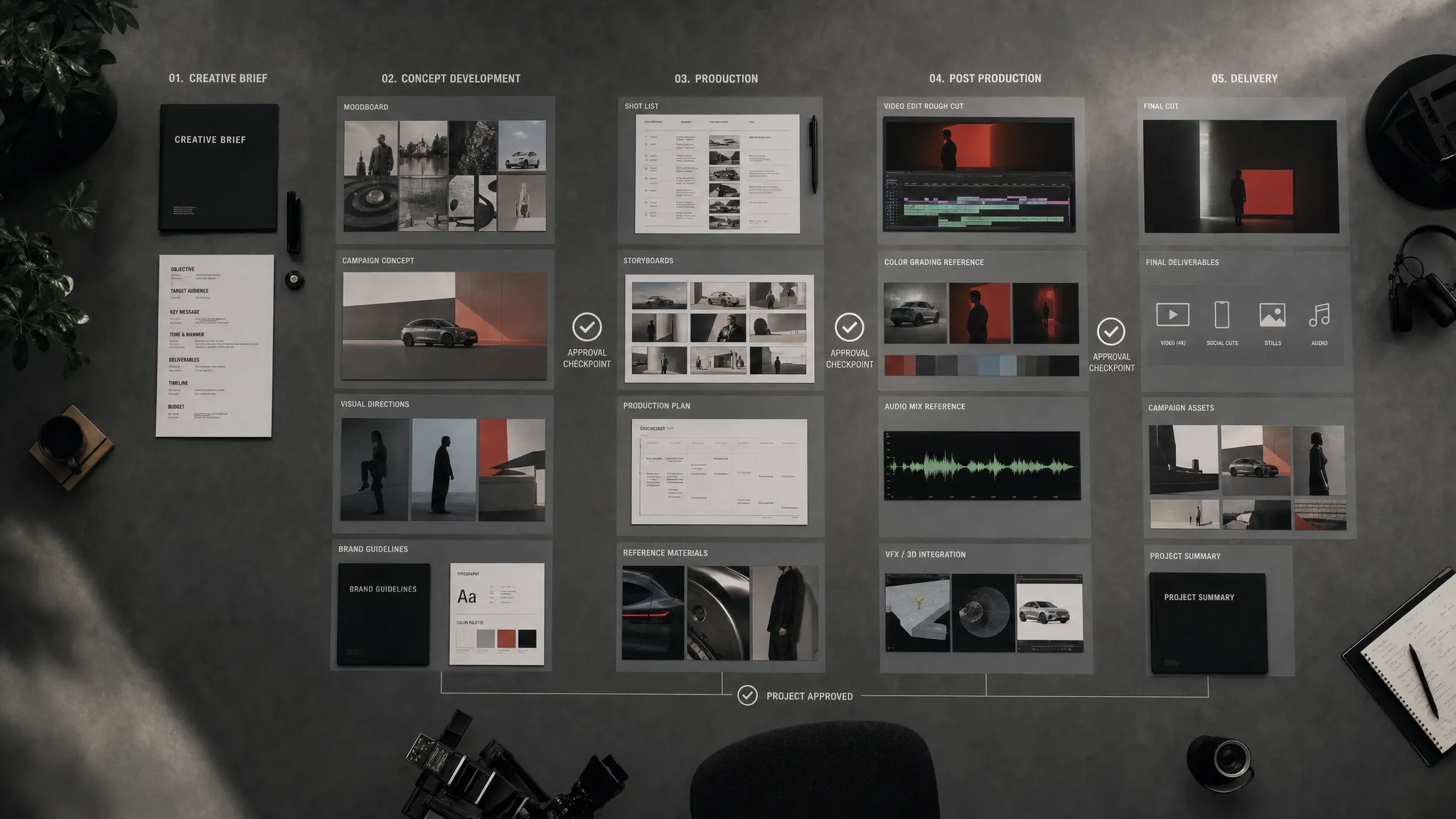
In 2026, the question for enterprise leaders is no longer whether AI can generate content. It can. The harder question is whether an organization can use AI across teams, brands, regions, and production systems without losing control.
That is where intelligent enterprise AI becomes more than a buzzword. In practice, it is not a single chatbot, image model, or automation feature. It is an operating layer that connects AI models, business context, governance, human review, and production workflows so teams can create faster while staying consistent and compliant.
For CMOs, art directors, application managers, and game developers, this matters because creative AI is moving from experimentation to operations. The winners will not simply be the teams with the most tools. They will be the teams that know how to make AI behave predictably inside real creative pipelines.
Intelligent enterprise AI turns AI from tools into infrastructure
Most companies begin with AI at the tool level. One team tests an image generator. Another uses a writing assistant. A product team experiments with video. A 3D team tries model generation. These pilots can be valuable, but they often create fragmentation.
Intelligent enterprise AI works differently. It treats AI as shared infrastructure with rules, memory, workflow logic, and accountability. Instead of every team making isolated decisions, the organization defines how AI should be used, which models are approved, what context should guide generation, who reviews outputs, and where assets go after approval.
In a creative enterprise, that means:
- Brand rules follow the work from concept to output.
- Teams generate from approved workflows instead of starting from blank prompts every time.
- AI can support multiple content formats, such as image, video, 3D, and audio, without breaking the production chain.
- Compliance, permissions, and approvals are built into the workflow rather than handled after the fact.
- Assets remain traceable, reusable, and connected to the systems the business already relies on.
This is the difference between AI as a novelty and AI as an operating capability.
What it looks like in a real creative organization
Imagine a global brand preparing a product launch. The CMO needs campaign variations for multiple markets. The art director needs the same visual identity across every image and video. The game or 3D team may need product environments, props, or interactive assets. The application manager needs everything to fit existing tools, security policies, and content systems.
With disconnected AI tools, each team produces its own outputs, stores files in different locations, and interprets the brand brief differently. Some assets look good but cannot be used. Some are off-brand. Some need legal review that happens too late. Some are impossible to trace back to the prompt, model, or source context.
With intelligent enterprise AI, the same launch starts from a controlled creative foundation. Approved brand references, mood boards, campaign rules, usage policies, and workflow steps are available to the teams that need them. The AI layer can help route tasks to the right model, preserve intent across formats, and keep review and approval steps visible.
A Creative AI OS like Virtuall is designed for this operating challenge: helping teams control, orchestrate, and scale AI-powered content creation across images, video, and 3D while maintaining governance and production readiness.
The core capabilities that make enterprise AI intelligent
The word intelligent should not mean unpredictable. In an enterprise setting, intelligence means the system can apply context, follow constraints, coordinate work, and improve the path from request to result.
| Capability | What it looks like in practice | Why it matters |
|---|---|---|
| Context awareness | AI uses approved brand, campaign, product, or studio context before generating. | Outputs start closer to the intended direction. |
| Orchestration | Tasks can move across models, teams, and formats without manual rebuilding. | Teams avoid fragmented tools and duplicated work. |
| Governance | Permissions, review steps, model policies, and compliance rules are embedded. | AI use becomes safer and easier to audit. |
| Repeatable workflows | Teams use blueprints or templates for recurring creative tasks. | Quality improves without slowing down production. |
| Production handoff | Assets connect to creative tools, DAM, PIM, or other enterprise systems. | AI outputs become usable deliverables, not isolated experiments. |
| Feedback loops | Reviews, approvals, and asset performance inform future work. | The organization learns from production, not just from prompts. |
These capabilities are especially important in creative operations because content quality is subjective, brand-sensitive, and format-dependent. A single impressive image is not enough. Enterprises need systems that can produce consistent, usable content repeatedly.
Intelligence begins with shared creative context
In many AI workflows, the prompt carries too much responsibility. A user tries to compress brand strategy, audience, style, product information, constraints, and desired output into a few sentences. That can work for one-off experimentation, but it does not scale.
Intelligent enterprise AI reduces dependence on individual prompt craft by giving teams access to shared context. For creative teams, that can include mood boards, approved visual references, brand rules, campaign objectives, product details, and previous review decisions.
This does not mean AI replaces creative direction. It means the creative direction is easier to preserve. An art director should not have to restate the same visual system for every asset. A CMO should not have to worry that regional campaign teams are interpreting the brand differently. A game developer should not have to rebuild context every time a 3D asset variation is needed.
When AI remembers the right context at the studio or team level, the work becomes more coherent. The system can support creative intent rather than forcing every user to reinvent it.
Intelligent enterprise AI coordinates multiple models, not just one
No single model is best for every creative task. One may be stronger for image ideation, another for video generation, another for 3D, another for audio, and another for refinement or analysis. Enterprise teams need flexibility, but unmanaged flexibility quickly becomes chaos.
In practice, intelligent enterprise AI sits above individual models and orchestrates them according to the workflow. The user should not always need to know which model is best for which task. The operating layer should help preserve intent, route work, and keep the output connected to the project.
This is where an intelligence layer such as Virtuall’s Nyx becomes relevant. Nyx is described as the intelligence layer of the Creative AI OS, orchestrating multiple industry-leading AI models while keeping intent and context across studios and teams. For enterprises, that kind of orchestration is what turns model access into a scalable production capability.
The goal is not to hide creative control. The goal is to remove unnecessary operational friction so specialists can focus on direction, judgment, and quality.
Governance becomes part of the creative workflow
Enterprise AI cannot succeed if governance is treated as a final checkpoint after teams have already generated hundreds of assets. By then, risk review becomes slow, inconsistent, and frustrating.
A practical intelligent enterprise AI setup builds governance into the workflow from the beginning. Teams know which models are approved, which content types require review, which users can publish, and what metadata needs to follow each asset. Legal, brand, IT, and creative teams do not need to operate in separate worlds.
This aligns with broader AI governance guidance. The NIST AI Risk Management Framework emphasizes governance, mapping, measuring, and managing AI risks as ongoing practices. The EU AI Act also raises expectations around transparency, accountability, and risk-based AI management. For companies operating internationally, these principles are not abstract. They affect procurement, deployment, documentation, and creative production.
For creative teams, governance should feel like guardrails, not handcuffs. Good governance makes it clear what is allowed, what needs review, and what is ready for production. It protects the business while giving creators a safer space to work faster.
Repeatable workflows protect quality at scale
Enterprise content creation depends on repetition. Campaign adaptations, product visuals, seasonal updates, marketplace assets, social variations, video cutdowns, and 3D environment iterations all require speed and consistency.
If each request starts from scratch, AI can actually increase inconsistency. Different users write different prompts. Different models produce different aesthetics. Reviewers spend more time correcting avoidable issues.
Intelligent enterprise AI solves this through workflow orchestration and reusable generation blueprints. A blueprint can define the intended format, creative constraints, review steps, and output requirements for a recurring task. Teams still have room to create, but they are not rebuilding the process every time.
For an art director, this means more time spent refining the creative idea and less time policing preventable deviations. For an application manager, it means AI workflows can be standardized, monitored, and integrated. For a CMO, it means content velocity can increase without sacrificing brand trust.
Production-ready output is the real test
A beautiful AI-generated asset is not automatically a production asset. It may need the right resolution, file format, metadata, rights documentation, review status, version history, and compatibility with downstream tools.
This is where many AI pilots stall. They produce impressive demos but fail to connect with the systems that run the business. Intelligent enterprise AI closes that gap by connecting generation with asset management, pipeline tracking, review workflows, and integrations into creative or enterprise tools such as DCC, PIM, and DAM environments.
The practical question is simple: can the asset move from generation to approval to production without losing context? If the answer is yes, AI becomes part of the operating model. If the answer is no, AI remains a side experiment.
What intelligent enterprise AI changes for each stakeholder
The value of intelligent enterprise AI is different depending on the role. That is why enterprise adoption requires more than a tool rollout. It requires alignment across creative, marketing, technology, and production teams.
| Stakeholder | What they need from AI | What intelligent enterprise AI provides |
|---|---|---|
| CMO | Faster content creation with brand consistency and market adaptability. | Governed workflows that support scale without fragmenting the brand. |
| Art Director | Creative control, visual coherence, and efficient review. | Shared context, mood boards, annotations, approvals, and reusable creative blueprints. |
| Application Manager | Security, integrations, permissions, and operational reliability. | A controlled layer for models, workflows, tools, and compliance requirements. |
| Game Developer | Iteration speed across visual, 3D, and interactive production needs. | Multi-format generation and pipeline support that can fit creative production workflows. |
The common thread is control. Not control in the sense of limiting creativity, but control in the sense of making AI dependable enough for real work.
What to measure when moving from pilot to practice
Enterprises often measure AI success too narrowly. Counting generated assets or prompt usage tells only part of the story. Intelligent enterprise AI should be measured by its impact on production, quality, governance, and collaboration.
| Measurement area | Practical signal to track |
|---|---|
| Speed | Time from brief to approved asset decreases. |
| Consistency | Fewer brand, style, or format corrections are needed. |
| Reuse | Teams adopt approved blueprints and shared context instead of creating one-off workflows. |
| Compliance | Assets have clear review status, usage context, and traceability. |
| Integration | AI outputs move into existing creative and asset systems with less manual handling. |
| Collaboration | Reviewers, creators, and managers work from the same project context. |
These measures shift AI evaluation from novelty to operational value. The question becomes not just whether AI can generate something impressive, but whether it helps the organization deliver better work with less friction.
Common mistakes to avoid
The first mistake is starting with model selection instead of workflow design. Model quality matters, but enterprises get more value when they first identify where AI fits into real production processes.
The second mistake is letting every team define its own rules. Local experimentation is useful, but without shared governance, the organization quickly accumulates risk, inconsistency, and duplicated effort.
The third mistake is separating creative teams from IT and compliance. Intelligent enterprise AI requires all three. Creative teams understand quality and intent. IT understands systems and access. Compliance and legal teams understand risk. The operating model only works when these perspectives are connected.
The fourth mistake is assuming automation is the goal. In creative work, the goal is not to remove human judgment. The goal is to give humans better leverage, better context, and better control over the repetitive parts of production.
How to start building intelligent enterprise AI
A practical starting point is to choose a high-volume creative workflow where speed, consistency, and governance all matter. Product visual variations, campaign localization, 3D asset iteration, or social content adaptation can be strong candidates.
From there, define the operating rules before scaling the toolset. What context should guide generation? Which models are approved? Who can create, review, and publish? What must be documented? Where should final assets live? Which systems need integration?
Once those foundations are clear, teams can introduce workflow blueprints, shared context, approval paths, and production handoff. The goal is to make the first workflow dependable, then expand from there.
This is also where standards such as ISO/IEC 42001, which addresses AI management systems, can help organizations think systematically about responsibilities, controls, and continuous improvement.
Frequently Asked Questions
What is intelligent enterprise AI? Intelligent enterprise AI is AI designed to operate inside business systems with context, governance, workflow orchestration, security, and measurable outcomes. It is not just a model. It is a managed way to use AI across teams and processes.
How is intelligent enterprise AI different from generative AI? Generative AI creates content or responses. Intelligent enterprise AI includes generative capabilities, but adds the operating layer needed for enterprise use, such as permissions, approvals, shared context, integrations, compliance, and production workflows.
Why does intelligent enterprise AI matter for creative teams? Creative teams need speed, but they also need consistency, brand control, review processes, and production-ready assets. Intelligent enterprise AI helps teams scale content creation without turning every output into a disconnected experiment.
Does intelligent enterprise AI replace creative professionals? No. In a healthy enterprise setup, AI supports creative professionals by reducing repetitive work, preserving context, and accelerating iteration. Human judgment remains essential for direction, taste, review, and final approval.
What should enterprises prioritize first? Start with one real workflow where AI can improve speed and consistency while still requiring governance. Define the context, approval path, model policy, and production handoff before expanding to more teams.
Build AI your creative teams can actually operate
Intelligent enterprise AI is not about adding more AI tools to an already complex stack. It is about creating a controlled, contextual, and scalable way for teams to use AI in real production.
For creative organizations, that means connecting models, workflows, governance, collaboration, and asset systems into one operating approach. Virtuall helps studios and enterprises move in that direction with a Creative AI OS built to orchestrate AI-powered content creation across image, video, and 3D while supporting governance, compliance, and production-ready workflows.
If your team is ready to move beyond isolated AI experiments, explore how Virtuall can help you operate creative AI at scale.