Why Standalone AI Generators Fail in Game Art Pipelines (And What Works Instead)
Why one-off AI image generators break game art pipelines, and the four-stage production model studios use to scale asset output while keeping their art direction intact.
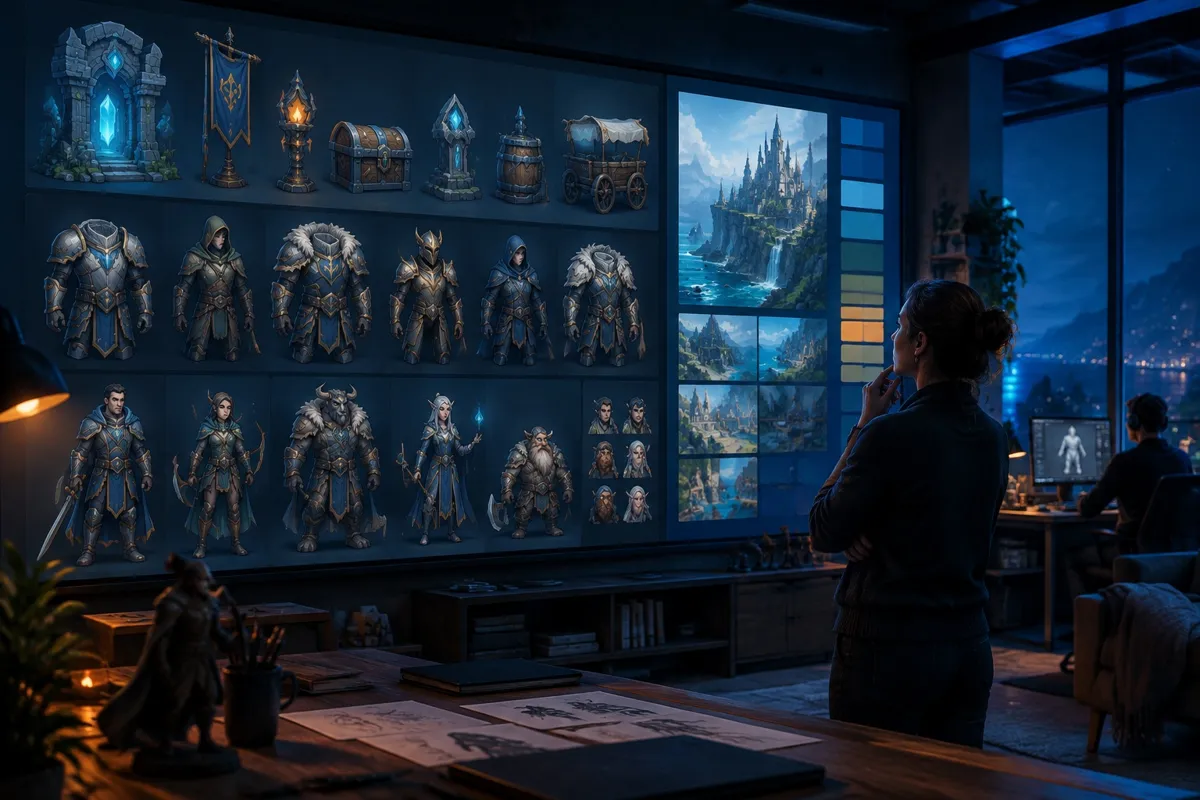
Standalone AI generators fail in game art pipelines because they solve one image at a time, while a game needs hundreds of assets that share one art direction, one lighting logic and one technical specification. The fix is not a better prompt. It is a pipeline: the studio's art bible held as persistent context, generation constrained by that context, and technical artists checking output before it reaches the engine.
The latest GDC State of the Game Industry survey shows the tension clearly. 36% of game industry professionals use generative AI in their work, yet 52% believe it is having a negative effect on the industry, rising to 64% among visual and technical artists [1]. Much of that scepticism is earned. Artists have seen what unmanaged generation produces: assets that look impressive alone and wrong together.
1. One good image is not a production result
A concept piece is judged on its own. A production asset is judged against everything around it. A shield has to match the armour set, the armour set has to match the faction, and the faction has to read clearly against the environment at gameplay camera distance.
That is why the useful question for an art director is not "can AI make this?" but "can AI make the next 400 of these, and will they still belong to our game?"
2. The slot-machine failure mode
Prompt-and-pray generation fails in predictable ways once it meets a pipeline:
- Style drift. Each request starts from zero, so proportions, edge treatment, palette and material response wander between assets.
- Lost decisions. When one detail is wrong, regenerating often loses the parts the art director had already approved.
- Technical debt. Baked lighting, fused silhouettes, missing alpha and unusable topology create clean-up that can cost more than the generation saved.
- Unknown provenance. Assets made in personal accounts with unvetted models carry rights and disclosure questions that surface late, usually before certification or launch [2].
None of these are model problems you can wait out. They are workflow problems. A stronger model in the same disconnected workflow produces the same drift faster.
3. The four-stage pipeline that works
| Stage | What happens | Who owns it |
|---|---|---|
| 1. Art bible intake | Key art, approved references, palettes, silhouette rules and do-not-use examples are collected once | Art director |
| 2. Persistent style context | Those rules stay attached to the project, so every request inherits the same visual DNA | Art director and leads |
| 3. Controlled generation | Approved models produce variants, props, icons, textures and marketing assets within the locked direction | Artists |
| 4. Technical verification and hand-off | Output is checked for separation, alpha, resolution, naming and engine readiness before import | Technical artists |
The difference from a standalone generator is stage 2. When the style context lives in the production environment rather than in one person's prompt history, consistency stops depending on who happens to be generating that day. New team members and outsourcing partners start from the same approved references on day one.
4. Where AI earns its place, and where it does not
Studios getting value from AI apply it to the high-volume middle of production rather than the hero work [3]:
- Prop and environment-dressing variations within an established set
- Character skins, colour variants and faction re-themes
- Icon sheets, UI states and inventory art
- Texture and material exploration
- Live-ops and store assets in every required format
- Reference-led image-to-3D blockouts for review before modelling
Hero characters, key art, the visual identity itself and final creative sign-off stay with artists. That division protects the work that defines the game and removes the work that drains the team.
5. Human judgement is the anchor
In a working pipeline, artists do not become prompt operators. They set direction, choose between options and decide what ships. The system handles repetition. That is the honest answer to the sentiment data: the artists most sceptical of AI are usually right about what unmanaged AI does to quality, and they are the people who should define the rules a pipeline enforces.
6. What to evaluate before you choose a platform
- Does style context persist across projects and people, or only inside a single session?
- Can you restrict teams and partners to approved, commercially cleared models?
- Can you trace every asset back to its references, model and approver?
- Does output arrive in formats your engine and DCC tools accept?
- Can repeatable steps become workflows the whole team can run?
Virtuall's Creative AI OS is built around these requirements: studio memory, approved models, workflows and traceable output in one environment. See how it applies to game development, or read our guide to creating game assets with AI.
Frequently asked questions
Why do AI-generated game assets look inconsistent? Because most generators treat each request independently. Without persistent style context, proportions, palette, lighting and material response drift from asset to asset.
Can AI replace concept artists in a game studio? No. AI is most useful for high-volume variation inside an established direction. Defining that direction, hero work and final approval remain artist responsibilities.
What is a game art AI pipeline? A production process in which approved references and style rules are held as shared context, generation runs on approved models within those rules, and technical artists verify output before it enters the engine.
How do studios keep AI art on style? By storing the art bible, approved references and rules where every request can use them, limiting generation to approved models and reviewing output against the set rather than one image at a time.