Beyond Experimentation: The Best AI 3D Tools of 2026 for Structured Production
Discover the best AI 3D tools 2026 for enterprise. We analyse 12 platforms for game dev, e-commerce, and structured production, from generation to governance.

The excitement around AI-driven 3D asset generation is understandable. For an individual, producing a model from a text prompt or image feels like a breakthrough. However, for professional creative teams in game studios, e-commerce, and enterprise marketing, this initial experimentation phase quickly reveals a deeper, structural problem.
Individual-first tools, while potent, create chaos when deployed across an organisation. AI fails at the team level, leading to inconsistent outputs, siloed knowledge, a lack of governance, and broken production pipelines. Making generative AI work for one person is easy; making it work repeatably, securely, and at scale for a team is the real challenge. As we look towards 2026, the discussion must shift from 'cool AI generators' to integrated operating systems that support structured, multi-format production.
This analysis moves beyond surface-level features to evaluate the best AI 3D tools 2026 through the lens of team collaboration, workflow integration, and enterprise governance. Each profile includes key feature analysis and ideal use cases to help creative and digital leaders select systems built for operational scale. We provide a strategic framework for moving your team from disjointed experimentation to a governed, efficient production environment.
See Virtuall in action — generate production-ready 3D, characters, and key art with full brand and IP governance.
1. Virtuall: The Creative AI Operating System
For teams seeking to move past scattered AI experiments and establish a governed, scalable production pipeline, Virtuall is not another tool but a Creative AI Operating System. It is engineered as a foundational operating layer for professional creative work, unifying image, 3D, and video workflows within a single, collaborative workspace. This system is designed to solve the structural challenges that arise when AI adoption moves from an individual curiosity to a core team function, addressing the critical problems of inconsistency, lack of repeatability, and absent governance that plague most organizations.
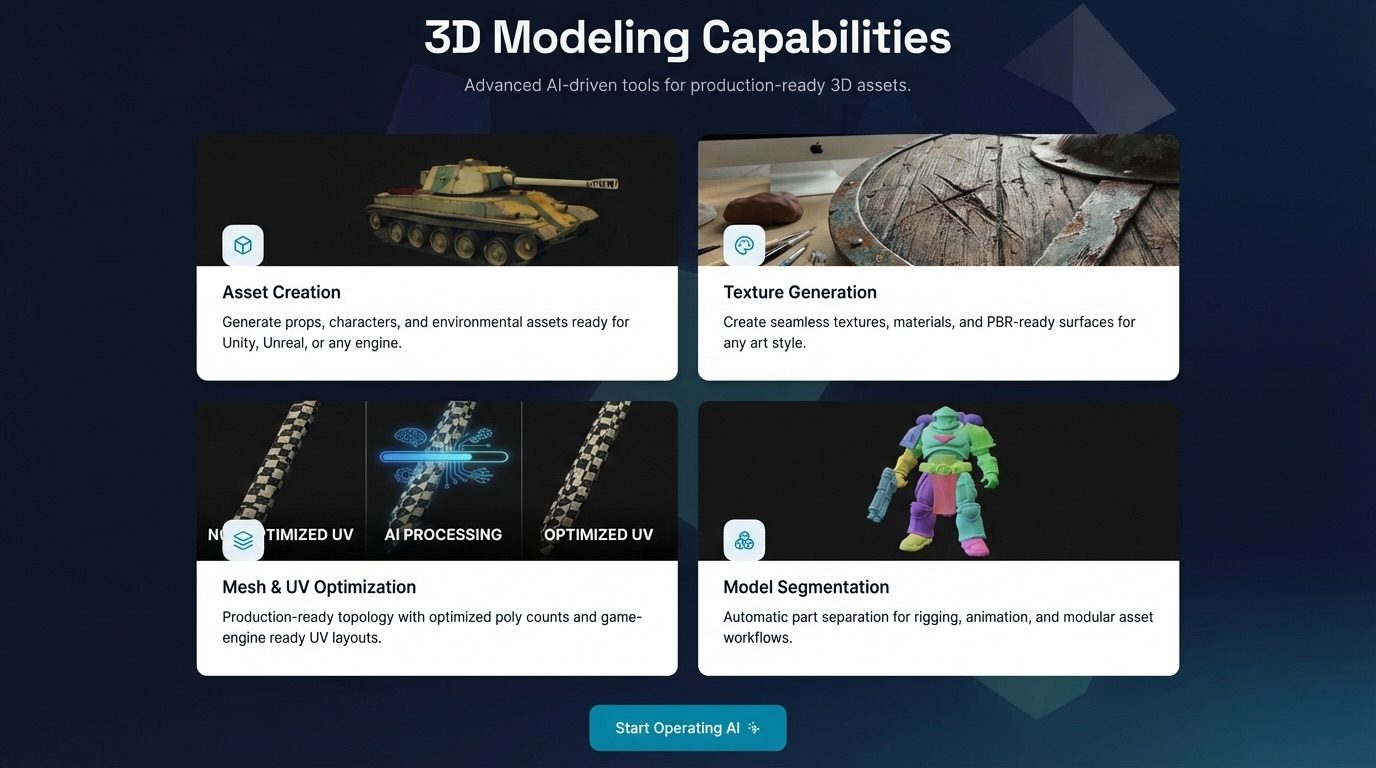
The core distinction of Virtuall is its AI Creative Director, Nyx. This intelligence layer moves beyond the limitations of manual prompt engineering. Instead of requiring users to craft complex inputs, Nyx interprets creative intent through directed conversation. A game studio can simply ask for a pack of sci-fi props in a specific category and style. Nyx then orchestrates the entire process: from idea and concept images, through 3D model generation, segmentation, mesh optimization, texturing, and UV optimization. The resulting models are delivered ready for easy export to standard DCC tools and integrations. This capability positions Virtuall as a strategic replacement for legacy 3D marketplaces, enabling game studios and 3D printing firms to generate entire bespoke, IP-compliant 3D model packs on demand.
Unlike point solutions like Meshy or Tripo, which focus on individual generation tasks, The Creative AI OS provides a structured production system. It is one of the best ai 3d tools 2026 for teams that need to orchestrate complex, multi-asset projects while maintaining stylistic coherence and strict governance. For a deeper dive into how this compares to other solutions, you can explore various AI tools for 3-D modeling.
Key Features & Use Cases
- Nyx - AI Creative Director: A contextual AI that translates creative briefs into production-ready assets, generating entire 3D model packs without complex prompting.
- Multi-Format Orchestration: Manages image, video, and 3D creation within one unified workspace, preventing broken pipelines and tool-hopping.
- Governance by Design: Features include IP awareness, data control, auditability, model transparency, and cost controls, built for controlled enterprise AI adoption.
- Collaborative Intelligence: Provides shared workspaces, version control, and workflow blueprints to move teams from experimentation to repeatable production.
Ideal For: Game studios, e-commerce teams, and enterprise creative departments aiming to move from AI experimentation to structured production.
Pricing & Access
Free to EUR 799/mo; enterprise custom; 20% yearly discount.
Pros & Cons
| Pros | Cons |
|---|---|
| Structured Production: Single system for image, video, and 3D preserves creative intent across formats. | Best at Scale: Designed for team production; solo creators with simple, one-off needs may find single-purpose generators sufficient. |
| Conversational Orchestration: Nyx simplifies complex asset creation, replacing manual prompt engineering. | Newer Entrant: A younger platform compared to established point tools, with the roadmap expanding rapidly. |
| Built-in Governance: Strong compliance and control features are designed for professional, regulated team environments. | |
| Team-Centric Workflow: Shared workspaces and version control enable repeatable, scalable production. |
Website: https://virtuall.pro
2. Meshy
Meshy has matured into a powerful web-based generator, establishing itself as a key component in the production pipeline for many creative teams. It provides a robust workflow for generating low- to mid-poly assets quickly, moving from initial concept (via text, image, or multi-view input) to a fully textured and even rigged model within a single, browser-based environment. This integrated approach makes it one of the best AI 3D tools for teams needing to accelerate asset creation without extensive manual labour.

Its strength lies in its completeness; the platform handles AI texturing and basic auto-rigging, preparing assets for immediate use. For teams working within established ecosystems, Meshy’s plugins for Blender, Unity, Unreal, Godot, and Maya provide a direct bridge, reducing friction between generation and implementation. This is especially useful for game development pre-visualisation and creating placeholder assets that are close to final quality. Teams should note the credit-based system, which requires careful budget management for high-volume production, as higher-quality outputs and concurrent generations consume more credits. For an in-depth look at its features and capabilities, you can visit the Meshy AI tool page.
Key Takeaway for Teams: Meshy excels at rapid, end-to-end asset generation for pipelines that can accommodate browser-based workflows. Its API and DCC plugins make it a practical choice for studios looking to integrate AI generation directly into their existing toolchains. Learn more about the core concepts of generative text-to-3D technology to better understand its place in your workflow.
3. Tripo AI
Tripo AI has established a strong position for teams that prioritise speed and high-volume iteration, particularly for prop generation. It delivers a fast, low-friction text-to-3D and image-to-3D pipeline focused on throughput. This makes it one of the best AI 3D tools for 2026 when the goal is to quickly populate a scene or game level with a large number of mid-quality assets for pre-visualisation or background dressing. The workflow is direct, moving from prompt to a usable 3D asset with minimal steps.

Its feature set is competitive for rapid prototyping. The platform supports batch generation, part segmentation for selective editing, and a "Smart Low-Poly" option that produces optimised meshes suitable for real-time environments. Higher tiers offer HD textures and skeleton export, expanding its utility for animation pipelines. While paid plans provide private, commercially usable models, teams must be aware that the free tier operates under a public license, which is a critical governance consideration. For more details on its offerings, you can visit the Tripo AI website.
Key Takeaway for Teams: Tripo AI is a practical choice for generating a high quantity of props quickly. Its strength is in iterative asset creation, but teams must manage plan limitations regarding storage and model privacy, ensuring it aligns with their intellectual property and production governance policies.
4. Kaedim
Kaedim has carved out a distinct niche by addressing a primary failure point in AI adoption for professional teams: quality control. It offers a 2D-to-3D generation service but stands apart with its hybrid model, blending AI speed with an optional layer of human artist refinement. This co-creation approach allows studios to move from a concept image to a game-ready asset with a predictable level of polish, making it one of the best AI 3D tools for teams that cannot afford the quality variance common in fully automated systems.
The platform’s strength is its pipeline-oriented workflow. Teams can request artist intervention at specific production stages like texturing or UV mapping using an "Artist Credits" system. This provides clear cost separation and governance, allowing managers to budget for AI generation and human oversight independently. While effective, this model means achieving final production quality incurs additional costs via Artist Credits, a factor that must be planned for. Pricing details can change, so teams should confirm current plans directly on the Kaedim website.
Key Takeaway for Teams: Kaedim is ideal for studios needing production-quality assets with the speed benefits of AI. Its human-in-the-loop model offers a practical solution for organisations where governance and predictable quality are non-negotiable, bridging the gap between AI experimentation and reliable production output.
5. 3DFY.ai
3DFY.ai has carved out a specific niche by focusing its text-to-3D and photo-to-3D generation on defined object categories. It’s particularly effective for teams needing props, furniture, and other commonplace items for architectural visualisation, e-commerce catalogues, or synthetic data generation. By constraining its models to certain categories, it often achieves more consistent and usable results for those specific items, making it a pragmatic choice for teams that need to populate scenes with standard assets quickly.

The platform’s strength is its directness, offered through a web playground for quick tests and a Prompt API for programmatic integration. This makes 3DFY.ai a useful component in larger workflows where specific, category-based assets are required on demand. The pay-as-you-go pricing is appealing for teams with intermittent or burst-oriented needs, avoiding commitment to a monthly subscription for occasional use. However, teams must be aware that the quality can be inconsistent outside of its core categories, and generated assets frequently require manual polishing in a separate DCC tool before they are production-ready. For more details, visit the official 3DFY.ai website.
Key Takeaway for Teams: 3DFY.ai is a focused solution for generating common props and furniture via its API. It's cost-effective for targeted, high-volume generation of specific object types but is less suited for general-purpose or high-fidelity character creation.
6. Spline (Spline + Spline AI / Spell)
Spline has carved out a unique position as a browser-native 3D design and interaction tool that prioritises real-time collaboration and web-based delivery. Its core strength is enabling teams to build and ship interactive 3D experiences directly to the web with minimal friction. The addition of the Spline AI add-on extends this capability, offering seat-based access to generative features for creating objects, textures, and scenes, making it one of the best AI 3D tools 2026 for marketing and interactive design teams.

What sets Spline apart is its focus on bridging the gap between design and engineering. With APIs, variables, and webhooks, it allows for the creation of dynamic, data-driven 3D web content. The experimental 'Spell' feature, which generates 3D worlds from images using Gaussian splats, signals a future direction for creating immersive web environments quickly. However, teams must consider that this feature is still early-stage and access is limited, with experimental functionality often carrying higher pricing and potential instability. The platform’s ease of use makes it a strong choice for teams that need to produce high-quality web visuals without deep 3D expertise. Explore its capabilities at spline.design.
Key Takeaway for Teams: Spline is built for teams focused on delivering interactive 3D content for the web. Its collaborative editor and code-based export options make it ideal for product marketing, digital advertising, and web design workflows where speed and interactivity are paramount.
7. NVIDIA Omniverse Audio2Face
For teams working on dialogue-heavy content, NVIDIA's Omniverse Audio2Face stands out as a specialised and powerful application. It is designed to accomplish one critical task exceptionally well: generating high-quality, realistic facial animation directly from an audio track. This functionality automates the traditionally labour-intensive process of lip-syncing and expressing emotion, making it a key production accelerator for character animation in games, film, and virtual assistant development. It operates within NVIDIA's Omniverse ecosystem, which is built on the OpenUSD standard.

The platform's strength is its deep integration into professional pipelines. Audio2Face generates animation data that can be exported as blendshapes and works through connectors for major DCCs and game engines like Blender and Unreal Engine. This makes it more than just a standalone generator; it is a component designed for collaborative, USD-based workflows. While it dramatically speeds up the creation of a first pass, teams should note that achieving final-quality results often requires manual clean-up and artistic tuning. Furthermore, its reliance on the Omniverse platform means it has specific GPU and system requirements that must be met. You can find more details on the NVIDIA Omniverse Audio2Face site.
Key Takeaway for Teams: Audio2Face is an essential utility for studios needing to automate facial animation at scale. Its value is maximised within an established Omniverse and USD-based pipeline, where it can serve as a foundational layer for character performance and dialogue.
8. Epic Games MetaHuman (incl. Animator)
For teams requiring the highest fidelity digital humans, Epic Games' MetaHuman ecosystem has become the industry standard. It offers a complete pipeline for creating, customising, and animating photorealistic characters directly within the Unreal Engine environment. By integrating powerful features like Mesh to MetaHuman and the real-time Animator toolset, it provides a direct path from real-world performance capture to in-engine implementation, making it one of the best AI 3D tools 2026 for film, VFX, and high-end game development.

The platform's main advantage is its deep integration and exceptional quality. The toolset includes advanced systems for hair, grooming, and clothing, allowing for complex character customisation. With recent updates to its licensing under the Unreal EULA, its use has become more accessible for commercial projects that fall below specific revenue thresholds. However, teams must be aware that some creation processes are cloud-assisted, not fully local, and the entire workflow is deeply tied to the Unreal ecosystem. For a complete understanding of the system, visit the official MetaHuman site.
Key Takeaway for Teams: MetaHuman is the definitive solution for studios needing state-of-the-art digital characters and animation within an Unreal Engine pipeline. Its fidelity is unmatched, but its specialised nature means it must be carefully integrated into a broader asset strategy that includes other tools for environmental and prop generation.
9. Polycam
Polycam has secured its place as a go-to platform for high-fidelity 3D capture, turning mobile devices into powerful scanners. It excels at digitising real-world objects and environments using photogrammetry, LiDAR (where available), and now Gaussian Splats. Its core strength is bridging the physical and digital worlds, making it a valuable asset for teams in architecture, e-commerce, and VFX who need to create digital twins of real-world assets. The platform is designed for rapid capture-to-publish workflows.

The introduction of an AI-powered Space Mode, which functions even on non-LiDAR iPhones, expands its accessibility for on-site environmental capture. For teams, the ability to create shared libraries and export in multiple formats is a significant workflow advantage. It’s an excellent choice for creating realistic product visualisations or capturing location data for pre-production. However, teams should carefully verify the entitlements for each subscription tier before committing, as pricing and feature sets can differ across its web and mobile app stores. This makes it one of the best AI 3D tools 2026 for teams that prioritise real-world capture over pure generative creation. For those interested in the reverse process, you can explore the fundamentals of AI image-to-3D model technology to see how 2D concepts become three-dimensional assets.
Key Takeaway for Teams: Polycam is a first-class choice for teams focused on reality capture and digitisation. Its cross-platform support and enterprise options make it a practical system for creating high-quality scans of products, assets, and environments directly from the field.
10. KIRI Engine
KIRI Engine has carved out a distinct niche by mastering mobile and web-based photogrammetry, becoming an essential tool for teams that need to digitise real-world objects with high fidelity. Its standout feature is the combination of traditional photo scanning with advanced modes for featureless or reflective objects, alongside 3D Gaussian Splatting (3DGS) workflows. This flexibility makes it one of the best AI 3D tools for 2026, especially for teams capturing complex assets on-site without specialised hardware.

The platform supports an extensive range of export formats, including OBJ, FBX, GLB, and USDZ, ensuring compatibility with most professional DCC applications and game engines. For technical teams, the KIRI Engine API offers a programmable route to automate capture and processing, integrating scans directly into production pipelines with per-call crediting. While the free tier is generous, allowing unlimited exports for basic projects, access to high-end modes like 3DGS requires a Pro plan. Teams should also factor in the credit-metered API and its minimum recharge requirements when planning for high-volume automation. You can explore its capabilities at the KIRI Engine website.
Key Takeaway for Teams: KIRI Engine is a powerful choice for field-based asset capture and digitisation, offering unmatched scanning flexibility on mobile devices. Its API makes it a prime candidate for studios building automated pipelines for creating digital twins or reality-based game assets.
11. Rokoko Vision & Studio
Rokoko has solidified its place in the animation pipeline by democratising motion capture. The ecosystem, centred around Rokoko Vision and Rokoko Studio, offers a low-barrier entry point for teams needing character animation without the traditional costs and complexities of dedicated mocap stages. Vision’s AI-driven video analysis turns footage from a simple webcam into usable animation data, making it an excellent choice for pre-visualisation, indie game development, and producing placeholder animations quickly.

The platform's strength lies in its scalability. A team can start with the free tier of Vision for quick captures, then progress to multi-camera setups or Rokoko’s own hardware (suits and gloves) for higher-fidelity work, all within a single software environment. Rokoko Studio acts as the central hub for capturing, cleaning up, and live-streaming data directly into tools like Unreal Engine, Unity, and Blender. Teams should note that the free Vision tool has clip length limitations (e.g., up to 15 seconds), and achieving professional accuracy often requires moving to paid plans or hardware. This makes it one of the best AI 3D tools 2026 for teams that need a flexible animation capture solution. You can explore the full ecosystem on the Rokoko website.
Key Takeaway for Teams: Rokoko provides a practical, scalable pathway for integrating motion capture. It allows teams to start with zero hardware investment and grow into a full-body performance capture setup, making it ideal for animation workflows that need to balance budget, speed, and quality.
12. DeepMotion Animate 3D (and SayMotion)
While many tools focus on asset generation, DeepMotion addresses a critical and often time-consuming part of the 3D pipeline: character animation. Its cloud-based platform converts 2D video footage directly into 3D animations, complete with body, hand, and face tracking. This makes it a standout solution for teams needing to produce high volumes of character motion for game cinematics, pre-visualisation, or marketing content without the overhead of traditional motion capture studios. The addition of SayMotion for text-to-animation further expands its utility for rapid prototyping.

DeepMotion's strength is its maturity and the inclusion of post-processing tools. The Rotoscope Pose Editor allows animators to fine-tune the AI-generated output directly in the browser, correcting imperfections and reducing the significant cleanup work often associated with raw mocap data. Export options including FBX, BVH, and GLB ensure compatibility with standard DCC software. Teams should be mindful of the credit-based pricing, where one credit typically equals one second of animation. For any project involving extensive animation, this requires careful cost planning to avoid budget overruns. More details are available at the DeepMotion website.
Key Takeaway for Teams: DeepMotion is a practical, production-ready solution for scaling character animation. It excels at turning simple video recordings into usable 3D motion, making it one of the best AI 3D tools for studios looking to accelerate animation workflows and bypass the complexities of traditional mocap.
Top 12 AI 3D Tools 2026 — Features & Comparison
| Tool | Core features ✨ | UX / Quality ★ | Price & Value 💰 | Target audience 👥 | Unique selling point 🏆 |
|---|---|---|---|---|---|
| Virtuall 🏆 | Multi-format orchestration; Nyx AI Creative Director; shared workspaces; versioning; workflow blueprints | ★★★★★ — enterprise-ready, repeatable pipelines | 💰 Enterprise pricing (custom), free trial, built-in cost control | 👥 CMOs, Studio Leads, Creative Directors, Game dev teams | ✨ Directed conversational briefs + governance for scalable team production |
| Meshy | Text/image-to-3D, AI texturing, auto-rig, DCC & engine plugins | ★★★★ — predictable, end-to-end browser workflow | 💰 Credit-based tiers; paid plans grant commercial rights | 👥 Game & 3D teams needing rapid low‑mid poly assets | ✨ Full pipeline + plugin/API integration for engines |
| Tripo AI | Batch text/image-to-3D, part segmentation, low‑poly + HD textures | ★★★★ — fast throughput, iterative prop focus | 💰 Generous mid-tier credits; free tier public license | 👥 Prop artists, content studios iterating volume assets | ✨ High-speed batch generation for many props |
| Kaedim | 2D→3D AI + optional artist co‑creation (Artist Credits) | ★★★★ — production-grade with human polish | 💰 Hybrid pricing (AI + Artist Credits) — variable | 👥 Studios needing guaranteed production quality | ✨ Hybrid AI+artist workflow for predictable results |
| 3DFY.ai | Text/photo-to-3D, category-optimized models, Prompt API | ★★★ — pragmatic, category-dependent quality | 💰 Pay-as-you-go / burst pricing; API-friendly | 👥 E‑commerce, archviz, dataset teams | ✨ Cost-effective burst/AI dataset generation |
| Spline (incl. Spell) | Browser 3D editor, real-time collaboration, AI add-on | ★★★★ — interactive web-first UX | 💰 Seat-based editor; AI add-on paid | 👥 Designers, web/marketing teams shipping web 3D | ✨ Interactive export + experimental image→world (Spell) |
| NVIDIA Audio2Face | Audio-driven facial animation, emotion control, USD workflow | ★★★★ — fast lip‑sync passes; requires cleanup | 💰 Part of Omniverse stack; enterprise hardware needs | 👥 VFX/animation studios, virtual assistants | ✨ High-quality audio→blendshape pipeline for dialogue |
| Epic MetaHuman | High-fidelity digital humans, real-time capture, UE integration | ★★★★★ — industry-leading fidelity & tools | 💰 Free tools; licensing governed by Unreal EULA | 👥 Game studios, film, high‑fidelity character teams | ✨ Top-tier realism + real-time capture & Animator tools |
| Polycam | Photogrammetry/LiDAR capture, AI Space Mode, team libraries | ★★★★ — mobile-first, fast capture & exports | 💰 Tiered plans; enterprise options available | 👥 Product/space capture teams, architects | ✨ Mobile LiDAR + AI spatial features for quick digitization |
| KIRI Engine | Photo scan, 3DGS (Gaussian splats), wide export & API | ★★★ — flexible capture modes; API integration | 💰 Free tier with exports; pro modes credit-metered | 👥 Teams needing programmable scanning + integrations | ✨ Pro capture modes for featureless/reflective objects |
| Rokoko Vision & Studio | Video AI mocap, Studio editing, hardware ecosystem | ★★★★ — low‑barrier mocap; scales to hardware | 💰 Free Vision; paid Studio/hardware tiers | 👥 Indie animators → studios needing mocap pipeline | ✨ Webcam AI mocap + progression to hardware capture |
| DeepMotion (Animate 3D / SayMotion) | Video→3D animation (body/hand/face), editor, text-to-animation | ★★★★ — mature cloud mocap & editing tools | 💰 Credit-based model; free tier + enterprise | 👥 High-volume character animation & game cinematics | ✨ Scalable cloud mocap + text-to-animation option |
From Tools to Systems: The Strategic Imperative for a Creative AI OS
This review of the best AI 3D tools 2026 reveals a distinct pattern: the market is crowded with powerful, specialised point solutions. We have explored a range of remarkable technologies, from Meshy's rapid text-to-3D capabilities to Epic Games' advanced MetaHuman character creation and Rokoko's accessible motion capture. Each tool, whether it is Tripo AI for high-volume asset generation or Kaedim for image-to-model conversion, offers a specific, potent function. These advancements demonstrate that the technical capacity to generate, manipulate, and animate 3D assets with AI is a present-day reality.
However, for creative directors, studio leads, and heads of innovation, a critical organizational problem emerges. While many of these tools offer 'team plans', these often amount to little more than shared billing. They fail to address the fundamental challenges that arise when AI is deployed at an enterprise level:
- Process Silos: Teams are forced to bounce between disconnected applications, breaking creative intent and losing context with each export and import.
- Lack of Governance: Without a central system, managing intellectual property rights, controlling costs, and ensuring asset compliance becomes nearly impossible.
- No Repeatability: Successful experiments remain isolated successes. There is no structured way to replicate a style, a process, or a production pipeline at scale.
- Fragmented Orchestration: Creative production is inherently multi-format, spanning concept images, 3D models, and video. A stack of individual tools cannot unify this process.
The strategic error is to view AI as just another tool to be added to the existing stack. True enterprise adoption requires a new mental model: AI is not a tool; it is a new operating layer for creative production. Without a central system—a Creative AI OS—to orchestrate these powerful but disconnected applications, organisations are simply scaling chaos, not creativity.
This is precisely the gap Virtuall was designed to fill. It acts as the operating system, allowing a studio to manage production within a single, governed workspace. With our intelligence layer, Nyx, teams can move beyond simple prompting to orchestrate complex, multi-step productions, from generating entire 3D model packs to ensuring stylistic consistency across different formats. While the tools we have discussed represent important components, the real work lies in building a coherent, auditable, and scalable production system. For teams looking to expand their understanding of AI applications in a business context, it's also useful to see how these principles apply in other domains. To broaden the perspective on AI solutions tailored for professional environments, you might find value in exploring the comprehensive list of the 12 Best AI Automation Tools for Business in 2026.
The critical takeaway for 2026 is this: the challenge is no longer about finding the single 'best' AI 3D generator. Instead, the strategic imperative is to implement an operating system that makes your creative workflows work together intelligently. For leaders responsible for digital transformation and creative output, the choice is between procuring more tools or investing in the system that unifies intent, manages production, and provides governance across your entire creative pipeline. The former leads to fragmented experimentation; the latter leads to repeatable, scalable, and controlled production.
Stop buying more tools and start building a system. Virtuall is the Creative AI OS that moves your team from siloed experimentation to structured, collaborative production. See how our operating layer can unify your workflow, govern your AI usage, and connect your entire creative pipeline. Explore Virtuall.