Creative Automation for Game Studios: Protect the Hero Work, Automate the Rest
How game studios can automate banners, CRM, trailer cutdowns, localization and 20+ channel formats while protecting key art and creative direction.
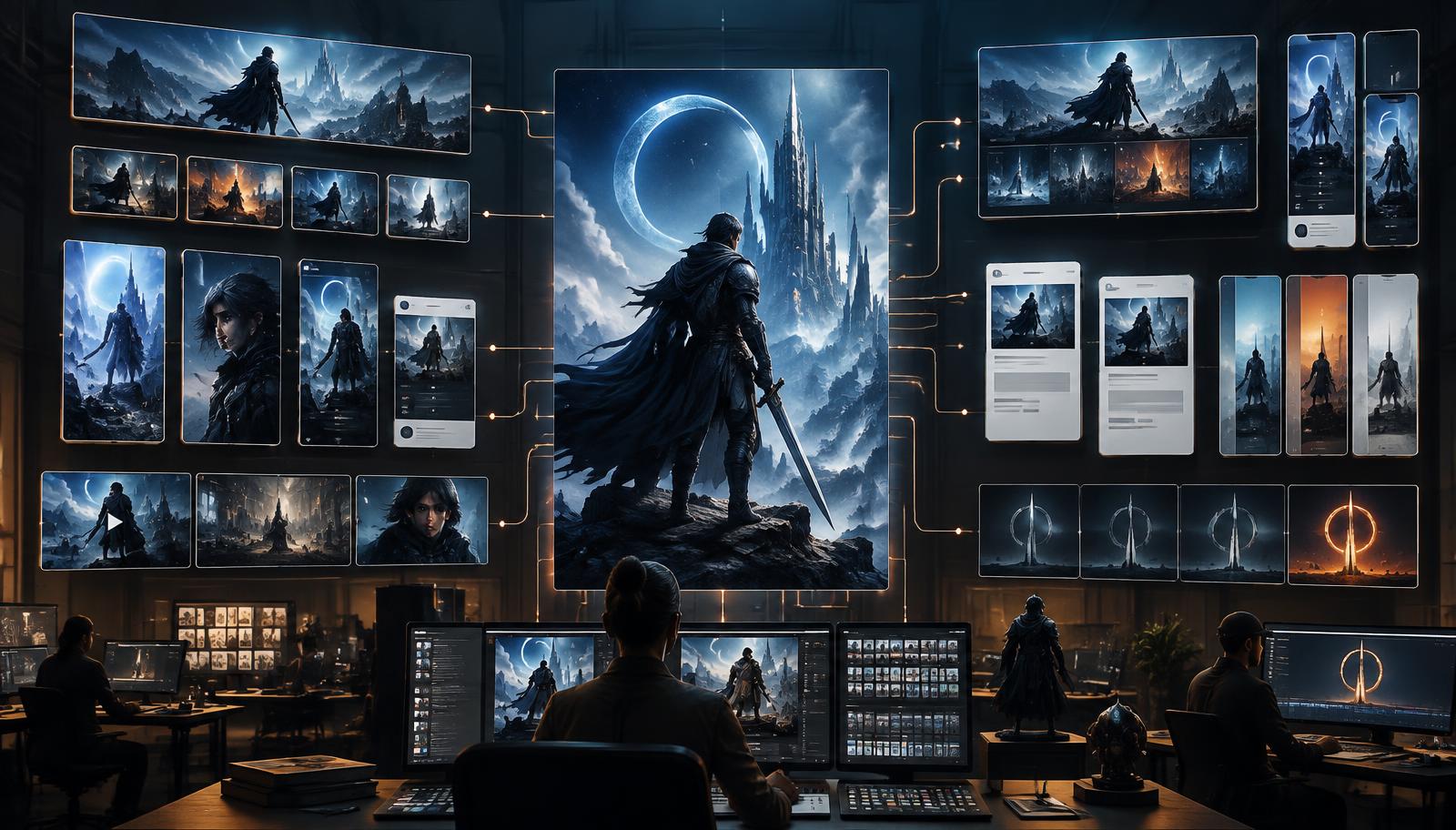
Every major game campaign has two very different kinds of creative work.
The first is the work audiences remember: the key art, launch trailer, campaign idea, visual identity and moments that define the title. This work depends on taste, judgment and close collaboration between artists, directors, marketing leaders and studio teams.
The second is everything that has to be made from it.
Store capsules. CRM banners. Trailer cutdowns. Companion banners. Social profile images and headers. Thumbnails. Animated logos. Launcher packages. Email modules. Top-module video loops. Regional versions. Language versions. Revisions for every placement and platform.
None of these outputs is unimportant. Together, they determine whether a campaign reaches its audience clearly and on time. But producing them manually is a poor use of scarce senior creative capacity.
The strongest case for creative automation in video game marketing is not replacing the hero work. It is protecting that work—and the people who make it—from the long tail of repetitive production.
Done well, a game studio can turn one approved creative system into controlled, channel-ready packages without asking every employee to become a prompt expert. The user experience can be as direct as selecting a title, campaign, market and package; waiting about two minutes; reviewing the result; and downloading the complete set.
The hero asset is not the automation target
A launch campaign needs creative risk. It needs ideas that are surprising, emotionally specific and worthy of the game. The defining key art or trailer should remain a high-attention collaboration led by people with the authority and craft to make difficult decisions.
Automation becomes valuable after those decisions have been made.
Once an approved master, motion language, typography system, logo treatment and channel strategy exist, much of the remaining workload is governed adaptation. A 16:9 master becomes a 15-second vertical cutdown. Key art becomes store capsules, paid-social formats and CRM headers. A source package becomes localized variants with safe zones, legal lines and market-specific ratings.
This boundary matters. If a studio tries to automate creative direction, it risks generic work and brand drift. If it automates deterministic transformations and tightly constrained variants, it gives artists more time for the work only they can do.
The hidden production list behind every release
Top AA studios commonly use more than 20 channels and surfaces to reach players around a release. That is an operating reality we see in studio planning, not a universal industry benchmark. Count the actual destinations and the scale becomes easy to understand:
Stores: Steam, Epic, PlayStation, Xbox, Nintendo. Owned: Launcher, website, landing pages, email, in-launcher CRM. Social: YouTube, TikTok, Instagram, Facebook, Reddit, Discord, Twitch. Paid and partner: Display, programmatic video, press and creator kits, retail and regional publishers.
That list is before languages, territories, editions, ratings, device crops, paid-media tests and live-service updates multiply the output again.
Platform requirements are concrete. Steam requires multiple graphical asset types across store, library and community surfaces, each with its own dimensions and content rules. Its official graphical asset documentation is a useful example of how one destination can create a substantial production package. Add social, CRM, video and localization, and the work hidden behind a single campaign image becomes significant.
Why the long tail costs so much
The cost is not just editing time. It is the coordination around editing.
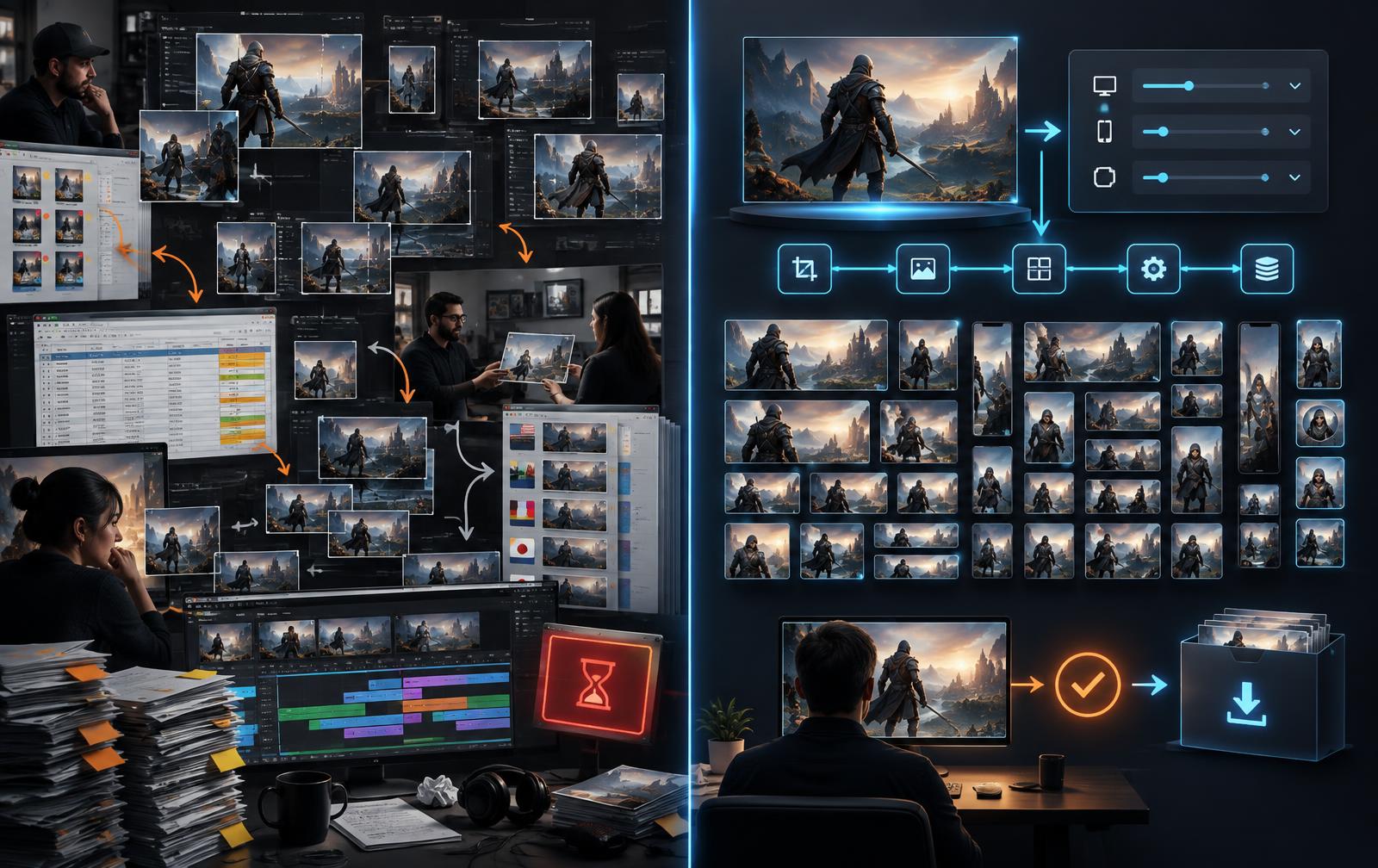
A request is briefed, scoped and handed to an internal team or external agency. Source files and fonts are located. Someone interprets a placement specification. The first version is exported, uploaded and reviewed. Feedback arrives across messages, presentations and spreadsheets. A late logo, date or rating change triggers another round. Localization starts after the master, then discovers that several layouts cannot hold the translated copy.
Each task may be small. The queue is not.
Industry research supports the wider capacity problem. Cella’s 2024 intelligence report found that nearly half of marketing and creative teams considered themselves inadequately staffed for demand. IntelligenceBank reported a 54.4% year-over-year rise in content creation volume in an analysis of more than 800,000 users. These are cross-industry findings, but the pressure is familiar to game studios managing many placements, languages and release beats.
External agencies remain valuable for campaign concepts, specialist craft, market insight and surge capacity. They are expensive when used as a manual resizing and reversioning layer. The work incurs briefing, project management, review and procurement overhead without necessarily adding creative value.
What to automate—and what to keep human-led
| Keep human-led | Use assisted workflows | Automate when rules are stable |
|---|---|---|
| Campaign idea and positioning | Alternative trailer selects | Resizing and safe-zone crops |
| Hero key art and launch film | Regional copy adaptation | Format and codec exports |
| Visual identity and art direction | Background extension | Logo, rating and legal placement |
| Sensitive cultural decisions | Subtitle timing and layout | Template-based CRM packages |
| Final brand and market approval | Thumbnail and cutdown options | Naming, packaging and delivery |
The right-hand column is the clearest starting point because it is governed by known inputs and acceptance criteria. The middle column benefits from models but still needs judgment. The left-hand column should remain close to the studio’s best creative leaders.
The modelled 70% opportunity
More than 70% of suitable repetitive production work and cost can be freed up in a well-designed workflow. This is a modelled opportunity, not a guaranteed universal result.
Leaders should calculate it against their own production mix. A simple model is:
Addressable capacity = repetitive production volume » automation suitability × successful first-pass rate.
Imagine a release package requires 1,000 production hours after the hero assets are approved. If 80% is repetitive adaptation, and a governed workflow completes 90% of that suitable work without manual rebuilding, the addressable capacity is 720 hours: 1,000 × 0.80 × 0.90.
That does not mean 720 hours of employment disappear. It means those hours can return to campaign thinking, better source capture, stronger motion design, market nuance, experimentation and player-facing quality. It can also reduce external production spend where agencies are currently performing mechanical adaptation.
Top line, bottom line and time to market
The bottom-line case is direct: fewer manual production hours, fewer agency handoffs, fewer revision cycles and less duplicated work across regions.
The top-line case is about readiness. A market cannot use an asset it does not have. A channel cannot test a format that is still in a queue. A regional team cannot respond to a moment if every variation requires a new brief.
Faster production gives teams more time for testing and optimization before a fixed launch date. It lets more regions participate in a campaign beat and reduces the gap between an approved idea and a complete set of usable assets. That is how creative automation can improve time to market without lowering the quality bar.
Localization offers a useful adjacent benchmark. In a published case study, FunPlus reported that a 17-person localization team handled 30% more content across ten live titles and more than 30 languages, with 20% less manual effort per task, after integrating systems and automating repetitive work. It is one company’s case, not a universal forecast, but it shows the operating pattern.
The quality-of-life case
CMOs and Art Directors often arrive at the same conclusion from different directions.
The CMO sees production spend, missed placements, slow market response and a campaign that cannot fully activate. The Art Director sees senior creatives cropping the same composition for the twelfth time, repairing avoidable errors and reviewing work that should have followed established rules.
Both see the cost of interruption.
Removing repetitive production improves creative quality of life because it protects focused time. It also changes studio operations: roles become clearer, source assets are prepared for reuse, approvals happen at defined gates, and teams stop rebuilding institutional knowledge for every campaign.
Not a chatbox: a self-service production portal
Many organizations picture AI adoption as a chat window and a workforce learning how to write prompts. That model moves complexity onto employees and makes output quality depend on individual technique.
A production workflow can look very different.
An authorized user opens a branded internal portal. They select the title, campaign, market, language and package—perhaps “launch CRM”, “social release set” or “store refresh.” The portal already knows the approved sources, templates, models, dimensions, naming rules and review requirements. The user confirms a few choices and starts the run.
Roughly two minutes later, the package is ready for review. Routine outputs can pass automatically defined checks. Sensitive outputs wait for the assigned approver. Once approved, a download button provides the organized package for the whole organization.
No one has to choose among hundreds of models. No one has to remember every platform dimension. No one has to expose protected IP to an unapproved service. The complexity is handled behind a simple interface.
How the Creative AI OS runs behind the portal
A portal is only the visible layer. Reliable production needs foundations beneath it.
- Studio memory: approved visual context, terminology, references and historical decisions.
- Blueprints: reusable instructions for each package, including inputs, transforms, checks and destinations.
- Model orchestration: the right image, video, audio or 3D model selected for each step rather than one model forced onto every task.
- Governance: permissions, approved providers, data boundaries, provenance and audit records.
- Human gates: named owners for creative, brand, legal and market review.
- Integration: connections to DAM, PIM, DCC, review, CR and delivery systems.
This is the role of the Creative AI OS: making many models and production steps behave as one governed operating system. Virtuall’s workflow approach combines memory, orchestration and controlled delivery so teams interact with a repeatable service rather than a collection of disconnected tools.
Start with one package
Do not begin with every channel and market. Choose one package that is frequent, measurable and frustrating enough to matter.
A launch CRM package is a strong candidate: approved key art, several banner sizes, email modules, launcher placements, languages and known output rules. A trailer cutdown package or store capsule refresh can work equally well.
- Measure current hours, calendar time, external cost, revision count and error rate.
- Separate defining creative decisions from repeatable transformations.
- Document source requirements, channel rules and approval owners.
- Build and test the workflow against past campaigns.
- Run it alongside the current process for one live package.
- Compare quality, first-pass acceptance, time and cost.
- Expand only when the controls and economics are proven.
For larger organizations, Virtuall builds and manages these automated content production workflows on future-proof Enterprise foundations.
FAQ
Will creative automation replace game artists or agencies?
It should replace low-value repetition, not art direction. Studios still need artists and agencies for defining ideas, specialist craft, market insight and judgment. Automation is best applied to controlled adaptation, packaging and delivery.
Which game marketing assets should be automated first?
Start with high-volume formats governed by stable rules: store capsules, CR modules, social variants, trailer cutdowns, subtitles, localized layouts, thumbnails, launcher packages and exports.
Can one system support more than 20 marketing channels?
Yes, if each destination is represented by a versioned template and specification. The system should generate only requested packages, apply current rules and route exceptions to people.
Is the 70% figure guaranteed?
No. It is a modelled opportunity for suitable repetitive work. The result depends on production mix, source quality, workflow design, first-pass acceptance and how much work is already standardized.
Does every employee need to learn prompting?
No. A mature implementation can present approved workflows through a self-service portal with a few controlled selections. Prompting and model routing remain behind the interface.
How do studios protect IP and brand quality?
Use approved models and providers, permissioned source libraries, fixed brand rules, audit records and human approval gates. Sensitive IP should never depend on unmanaged personal tools.
Protect the work that makes the game distinctive
The goal is not more content for its own sake. It is to give every strong creative idea the production system it deserves.
Keep the hero work close to the people with the taste and authority to define it. Turn the repeatable work around it into governed infrastructure. Then let studio teams request complete, approved production packages without adding another queue, another agency handoff or another week to the release plan.