Most Popular AI Tools and Why Teams Still Need Governance
Explore the most popular AI tools for creative teams and learn why enterprise governance is essential for brand, compliance, and scale.
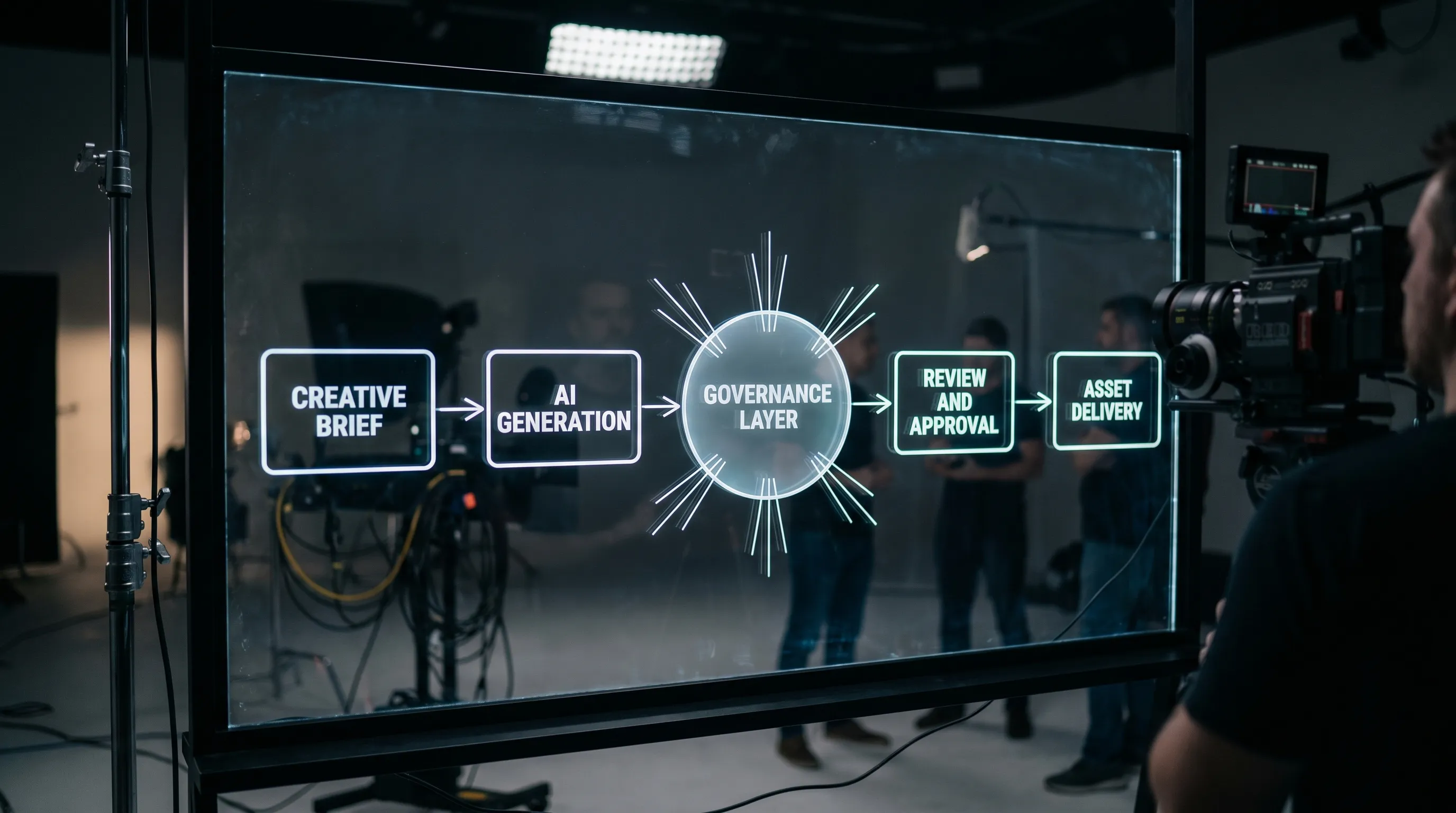
AI adoption has moved from experimentation to everyday production. Marketing teams use assistants to draft campaign concepts, art directors test visual territories in minutes, game studios prototype assets, and application managers are asked to connect all of it to existing systems without creating risk.
That is why searches for the most popular AI tools keep growing. Teams want to know which tools are worth trying, which ones can support creative output, and which ones are safe enough for professional workflows.
The short answer is simple: popular AI tools are useful, but popularity is not the same as operational readiness. Once AI-generated images, videos, 3D assets, copy, or audio enter real production pipelines, teams need governance. Without it, tool adoption can quickly turn into brand drift, duplicated work, unclear rights, data exposure, and compliance gaps.
According to McKinsey’s 2024 State of AI report, 65% of surveyed organizations said they were regularly using generative AI, nearly double the share from ten months earlier. The question is no longer whether teams will use AI. The question is how they will control it.
What “most popular AI tools” means for creative teams
The most popular AI tools vary by team, budget, region, industry, and output format. A CMO may think first of AI writing assistants and campaign ideation. An art director may think of image generation and brand visualization. A game developer may focus on 3D, textures, animation, or rapid prototyping. An application manager may care most about APIs, permissions, security, and integration.
For enterprise creative teams, popularity usually comes down to a few categories:
| AI tool category | Common examples | Why teams use them | Governance challenge |
|---|---|---|---|
| General-purpose assistants | ChatGPT, Claude, Gemini, Microsoft Copilot | Briefing, research, ideation, prompt drafting, summaries | Sensitive data may enter tools outside approved workflows |
| Image generation and editing | Midjourney, Adobe Firefly, DALL-E, Stable Diffusion-based tools | Concept art, mood boards, campaign visuals, product visualization | Brand consistency, rights, prompt control, approval tracking |
| Video generation and editing | Runway, Pika, Luma AI, Adobe video AI features | Storyboards, social clips, motion tests, previsualization | Version control, likeness rights, production quality, review processes |
| 3D and asset generation | Meshy, Tripo, Scenario, Luma AI | Game assets, product mockups, environment prototypes | Mesh quality, pipeline compatibility, licensing, asset lineage |
| Audio and voice AI | ElevenLabs, Suno, Udio, Adobe audio tools | Voiceover drafts, music exploration, localization, sound concepts | Voice consent, copyright, regional usage rights, approval history |
| Creative productivity tools | Canva, Notion AI, Figma AI features, Adobe Creative Cloud AI | Faster design iteration, content repurposing, collaboration | Fragmented assets and inconsistent standards across teams |
These tools can be excellent for exploration. The problem starts when every team member uses different models, different prompts, different settings, and different storage locations. One person may create a strong campaign visual in a browser tool, another may generate a similar asset in a local model, and a third may edit it in a design suite. If nobody knows which source model, prompt, license, or approval path was used, the organization has speed but not control.
Why popular AI tools are not enough on their own
Most AI tools are designed to make an individual user faster. Enterprise production requires something broader: consistent outputs, repeatable workflows, permissions, auditability, integration, and compliance.
This gap matters because AI-generated content is no longer just internal inspiration. It can influence ads, product pages, pitch decks, game environments, packaging, ecommerce imagery, social campaigns, and brand systems. Once creative AI touches customer-facing work, the risks become business risks.
1. Tool sprawl creates shadow AI
When a company does not define approved AI workflows, teams create their own. Designers may subscribe to one image tool. Producers may use another for video. Developers may test 3D tools with separate accounts. Marketing may use an AI assistant for campaign messaging.
This is understandable. People need to work quickly. But unmanaged adoption creates shadow AI, meaning AI use that happens outside IT, legal, security, or brand oversight. Application managers then face a familiar problem: multiple tools, unknown data flows, inconsistent permissions, and no centralized view of what is being generated.
Shadow AI also makes procurement harder. Leaders may pay for overlapping subscriptions while still lacking a reliable production pipeline.
2. Brand consistency breaks down quickly
Creative AI can generate many variations fast. That is valuable, but it also increases the risk of inconsistency. A model may interpret a brand mood board differently from one prompt to another. A campaign look may change between markets. A product texture may appear slightly off. A character style may drift across assets.
For an art director, this is not a small issue. Brand consistency is often the difference between a useful AI output and a file that needs to be rebuilt manually. Teams need shared context, reusable generation rules, and approval workflows that preserve creative intent from the first prompt to final delivery.
3. Rights and licensing are not always obvious
Enterprise teams need to know whether an AI-generated asset can be used in a campaign, commercial product, game, or client project. They also need to know what inputs were used. Was the prompt based on confidential product data? Did the output include a recognizable person, logo, trademark, or protected style? Was a generated voice based on proper consent?
The legal landscape is still evolving. The U.S. Copyright Office and other regulators continue to examine how copyright applies to AI-generated works. In the EU, the AI Act introduces phased obligations around transparency, risk management, and oversight for certain AI systems and providers.
Even when a tool provider offers commercial terms, enterprise teams still need internal records. Who generated the asset? Which model was used? What was the prompt? What source files were included? Who approved the output? Where was it published?
4. Data governance becomes harder with creative assets
AI governance is often discussed in relation to text or code, but creative workflows introduce additional complexity. A single production workflow may include product renders, unreleased packaging, character concepts, location scans, customer data, celebrity likenesses, agency materials, and licensed brand assets.
If those inputs are uploaded into tools without clear controls, teams may expose confidential information. This is especially important for enterprises working across regions, agencies, franchise partners, or regulated categories.
IBM’s Cost of a Data Breach Report 2024 found that the global average cost of a data breach reached $4.88 million. Not every AI governance failure becomes a breach, but the figure illustrates why enterprise leaders are cautious about uncontrolled data movement.
5. Production teams need repeatability, not just novelty
A one-off AI image may impress stakeholders. A production pipeline needs repeatable quality. Teams need to recreate variations, localize assets, generate follow-up scenes, adapt aspect ratios, update product details, and preserve the same creative direction across hundreds or thousands of outputs.
Popular AI tools are often great at generating something interesting. Enterprise teams need systems that can generate something aligned, approved, traceable, and production-ready.
What AI governance actually means in creative production
AI governance is not about slowing creative teams down. Done well, it gives them clearer rules, better tools, and fewer last-minute blockers.
In creative production, governance usually includes:
- Approved models and tools, so teams know what they can use for each type of output.
- Access controls, so the right people can generate, review, approve, or publish assets.
- Prompt and workflow standards, so outputs are repeatable across teams and markets.
- Brand context, so AI generation reflects approved visual direction, mood boards, product details, and creative rules.
- Review and approval workflows, so creative, legal, brand, and production stakeholders can sign off before assets move forward.
- Asset lineage, so teams can trace inputs, prompts, model choices, versions, and final outputs.
- Compliance controls, so AI use aligns with regional, industry, and company requirements.
- Integration with existing systems, so AI outputs do not sit outside the DAM, PIM, DCC tools, or production pipeline.
The goal is to make AI usable at scale. Governance turns AI from a collection of disconnected tools into an operating model.
Where the most popular AI tools fit in an enterprise AI stack
Enterprises do not need to reject popular AI tools. In many cases, these tools are valuable and will remain part of the creative ecosystem. The better question is where they fit.
A mature creative AI stack usually has three layers.
| Layer | Purpose | Typical owner | Key question |
|---|---|---|---|
| AI models and point tools | Generate or edit text, images, video, audio, or 3D assets | Creative teams, studios, developers | Which tool produces the best result for this task? |
| Workflow and governance layer | Orchestrate tools, rules, approvals, context, and compliance | Creative operations, IT, legal, brand | How do we control AI use across teams? |
| Enterprise systems | Store, publish, manage, and distribute final assets | Application managers, DAM/PIM owners, production teams | How do outputs enter the official pipeline? |
Most organizations start with the first layer. They test tools, compare output quality, and identify use cases. The scaling problem appears when AI work needs to connect to the second and third layers.
This is where a Creative AI OS becomes important. Rather than forcing every team into a single model or allowing uncontrolled tool sprawl, an operating system approach gives teams a governed way to orchestrate multiple AI models, preserve context, and move outputs through production workflows.
Why governance matters to each stakeholder
AI governance is often treated as an IT or legal topic, but creative AI affects many roles. Each stakeholder sees the problem differently.
| Stakeholder | What they want from AI | What governance protects |
|---|---|---|
| CMO | Faster campaign production, content localization, lower production bottlenecks | Brand consistency, reputational risk, measurable process control |
| Art Director | More visual exploration without losing creative direction | Style consistency, approved references, review quality |
| Application Manager | Secure, integrated, manageable AI adoption | Permissions, APIs, data flow, tool rationalization |
| Game Developer | Faster prototyping and asset iteration | Asset lineage, technical compatibility, IP clarity |
| Legal and compliance teams | Safe use of AI across markets and projects | Documentation, audit trails, regional compliance |
| Creative operations | Scalable production workflows | Handoffs, approvals, status tracking, asset reuse |
This is why governance should not be positioned as a blocker. For creative leaders, it protects the quality of the work. For technical leaders, it protects systems and data. For executives, it protects the business case for AI.
From AI experimentation to creative AI operations
Many teams go through the same maturity curve.
First, individuals experiment. They test prompts, generate concepts, and share impressive outputs in meetings. This stage is useful because it builds enthusiasm and reveals practical use cases.
Second, teams standardize. They identify which tools work best for image, video, audio, 3D, copy, or ideation. They begin to create internal prompt libraries, reference boards, and guidelines.
Third, organizations operationalize. They connect AI generation to review workflows, asset management, production tracking, legal approvals, and existing creative tools. This is where governance becomes essential.
The companies that succeed with creative AI usually do not ask, “Which single AI tool should replace our workflow?” They ask, “How do we make AI work inside our creative operating model?”
How Virtuall helps teams govern creative AI at scale
The Creative AI OS is built for teams that need to move beyond isolated AI experiments and operate creative AI across real production workflows.
As a Creative AI OS, Virtuall helps studios and enterprise teams control, orchestrate, and scale AI-powered content creation across image, video, audio, and 3D formats. It is designed around governance, workflow orchestration, and production-ready outputs rather than one-off generation.
Key capabilities include AI governance controls, multi-model content generation, generation blueprints, studio context memory through mood boards, review workflows, approvals, content annotation, asset management, pipeline tracking, and integrations with creative tools such as DCC, PIM, and DAM systems through plugins and API.
Virtuall also includes Nyx, the intelligence layer of the Creative AI OS. Nyx orchestrates multiple industry-leading AI models and helps keep intent and context across studios and teams. For enterprise organizations, this matters because different use cases may require different models, but the workflow still needs one coherent layer of control.
Virtuall’s EU-based infrastructure and inference capabilities also support teams that need stronger control over compliance requirements and regional data considerations.
A practical governance checklist before scaling AI tools
Before rolling out more AI tools across creative teams, leaders should ask a few practical questions.
- Which AI tools are officially approved for each content type?
- What data, references, or source assets can teams upload into AI systems?
- Who owns prompt standards, generation templates, and brand context?
- How are AI-generated assets reviewed and approved before use?
- Can we trace the model, prompt, inputs, edits, and approvals behind each output?
- How do generated assets move into our DAM, PIM, DCC tools, or production pipeline?
- Do we have different rules for internal concepts, client work, commercial campaigns, and game assets?
- How do we handle regional compliance, especially for EU operations?
- Are we measuring AI productivity without sacrificing quality or control?
If the answer to most of these questions is unclear, the team is probably still in experimentation mode. That is not a failure. It simply means the next step is governance.
The future is multi-tool, but governed
The most popular AI tools will keep changing. New models will appear, existing platforms will improve, and creative teams will continue to test whatever gives them an edge. That is healthy. Creative AI is moving too quickly for enterprises to depend on a single static tool forever.
But the need for governance will not disappear. In fact, governance becomes more important as AI quality improves. The closer AI outputs get to production, the more teams need control over brand rules, source assets, approvals, rights, security, and compliance.
The winning model is not “one tool for everything.” It is a governed creative AI ecosystem where teams can use the right model for the job while the organization maintains visibility and control.
For CMOs, that means faster content at scale without losing brand trust. For art directors, it means more creative range without chaos. For application managers, it means fewer unmanaged tools and cleaner integration. For game developers, it means faster prototyping with clearer asset lineage.
Popular AI tools create possibilities. Governance turns those possibilities into production.
Frequently Asked Questions
What are the most popular AI tools for creative teams? Popular AI tools for creative teams include general assistants such as ChatGPT, Claude, Gemini, and Copilot, image tools such as Midjourney, Adobe Firefly, DALL-E, and Stable Diffusion-based platforms, video tools such as Runway and Pika, plus 3D, audio, and design tools used for specialized workflows.
Why do teams need AI governance if the tools already have enterprise plans? Enterprise plans can help with security and administration, but internal governance is still needed to define approved use cases, review workflows, brand rules, asset lineage, permissions, and compliance requirements across the organization.
Does AI governance slow creative teams down? Good governance should reduce friction, not add it. Clear rules, reusable templates, shared context, and approval workflows help teams generate assets faster because they spend less time fixing inconsistent outputs or resolving compliance questions late in production.
What is the difference between an AI tool and a Creative AI OS? An AI tool usually performs a specific task, such as generating an image or drafting text. A Creative AI OS helps orchestrate multiple tools, workflows, governance rules, approvals, assets, and integrations so creative AI can operate across teams and production pipelines.
How should enterprises start governing AI-generated content? Start by mapping current AI usage, defining approved tools and data rules, creating review workflows, documenting asset lineage, and integrating AI outputs into existing creative systems. From there, teams can scale with stronger orchestration and governance.
Bring governance to your creative AI stack
If your team is already testing the most popular AI tools, the next step is making them work safely and consistently across production.
Virtuall helps enterprise creative teams operate AI at scale with governance controls, workflow orchestration, multi-model generation, studio context, approvals, asset management, and integrations for modern creative pipelines.
Explore how Virtuall can help your studio move from AI experimentation to governed creative AI operations.