What NVIDIA AI Enterprise Software Means for Creative Pipelines
Learn what NVIDIA AI Enterprise software means for creative pipelines, from GPU-backed AI deployment to governance, consistency, and studio scale.
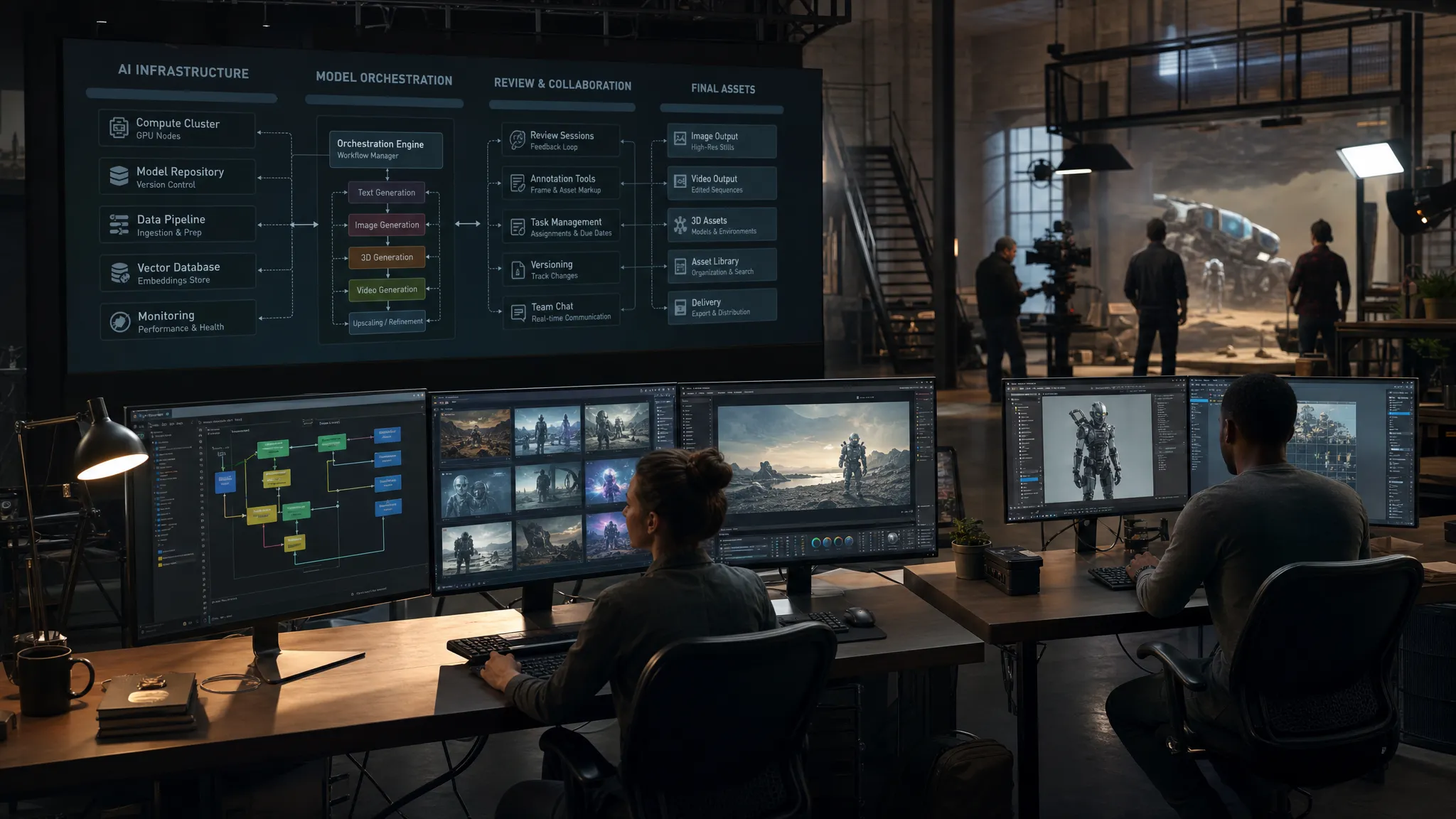
Generative AI is no longer a side experiment for creative teams. It is becoming part of campaign production, game asset iteration, product visualization, cinematic preproduction, and 3D content workflows. That shift raises a practical question for enterprise teams: how do you move from impressive AI demos to a controlled, repeatable creative pipeline?
That is where NVIDIA AI Enterprise software becomes relevant. It is not a creative tool in the same sense as a digital content creation application, a DAM, or a campaign management platform. Instead, it provides enterprise-grade AI software for deploying, running, and supporting AI workloads on accelerated infrastructure.
For creative organizations, the implication is important: AI generation can become more reliable, scalable, and governable, but only if the infrastructure layer is connected to the workflow, review, compliance, and brand-control layer that studios actually use every day.
What is NVIDIA AI Enterprise software?
NVIDIA AI Enterprise is NVIDIA’s enterprise software platform for building and running AI applications in production. It brings together optimized AI frameworks, deployment tools, inference capabilities, and enterprise support for organizations that need AI systems to operate reliably across data centers, private cloud, public cloud, and certified hardware environments.
In practical terms, it helps IT and AI teams answer questions such as:
- How do we deploy AI models in a supported enterprise environment?
- How do we accelerate inference and training workloads on NVIDIA GPUs?
- How do we standardize AI infrastructure across teams rather than letting every department improvise?
- How do we support AI applications with security, lifecycle management, and operational reliability?
For creative teams, this matters because image, video, audio, and 3D generation can be computationally demanding. A single prototype may run on a local workstation or a hosted API. A production pipeline serving multiple brands, markets, product lines, and creative teams needs something more robust.
NVIDIA AI Enterprise software is part of that foundation. It gives enterprises a more controlled way to operationalize AI, especially when GPU acceleration, model serving, and production support are non-negotiable.
Why creative pipelines need enterprise AI infrastructure
Creative AI workflows are different from general business AI workflows. A marketing team is not just classifying documents. A game studio is not just summarizing text. Creative teams often need to generate, review, refine, version, and approve visual assets across many formats.
That introduces several production challenges:
| Creative pipeline challenge | Why it becomes difficult at scale | What enterprise AI infrastructure helps with |
|---|---|---|
| High compute demand | Image, video, and 3D generation can require significant GPU resources | Accelerated inference, optimized runtimes, and infrastructure standardization |
| Model fragmentation | Teams may use different models for concepts, textures, product images, animation, or audio | More consistent deployment patterns and model lifecycle management |
| Security and compliance | Creative assets can include confidential products, licensed IP, or unreleased campaigns | Enterprise controls, supported environments, and governance alignment |
| Repeatability | One-off prompts do not create reliable campaign or production output | Standardized execution environments and reusable workflow components |
| Collaboration | Creative decisions involve art directors, producers, marketers, legal, and technical teams | Integration with broader operating systems, approvals, and asset tracking |
The key phrase is “helps with.” NVIDIA AI Enterprise software can strengthen the AI infrastructure layer, but it does not automatically define the creative process, enforce brand rules, manage approvals, or remember the visual intent of a studio. Those functions live in the creative operating layer above the infrastructure.
What it means for CMOs, art directors, application managers, and game teams
The impact of enterprise AI software depends on the role you play in the creative organization.
For a CMO, the promise is not simply faster image generation. It is the possibility of scaling campaign content across regions, channels, and segments without losing governance. Enterprise AI infrastructure helps reduce the risk of ad hoc experimentation becoming an unmanaged brand liability.
For an art director, the value is consistency. AI-generated outputs are only useful if they can follow a visual direction, respect a mood board, and support the creative standard of the studio. Infrastructure alone does not guarantee that, but reliable model deployment makes it easier to build repeatable creative systems on top.
For an application manager, NVIDIA AI Enterprise software is relevant because it fits into the world of enterprise IT. AI workloads need to be deployed, monitored, secured, upgraded, and integrated. Creative AI becomes another production system, not a collection of disconnected tools.
For a game developer or technical artist, the impact is especially practical. AI may be used for concept exploration, texture variation, environment ideation, animation references, audio drafts, or 3D support workflows. The more these use cases move into production, the more teams need controlled access to models, compute, and pipeline integrations.
The difference between AI infrastructure and a creative AI operating layer
A common mistake is assuming that enterprise AI infrastructure and creative workflow orchestration are the same thing. They are related, but they solve different problems.
NVIDIA AI Enterprise software focuses on the environment in which AI workloads run. It supports the technical foundation for AI applications, including optimized GPU usage, AI software components, deployment patterns, and enterprise support.
A creative AI operating layer focuses on how creative work gets done. It defines who can generate what, which models are allowed, what brand or studio context should guide outputs, how reviews and approvals happen, where assets are stored, and how production-ready results move into downstream tools.
This distinction becomes clearer when you look at the full stack:
| Layer | Primary question | Example responsibility |
|---|---|---|
| Compute and infrastructure | Where do AI workloads run? | GPU resources, cloud or on-premises environments, performance |
| AI software platform | How are AI workloads deployed and supported? | Model serving, optimized frameworks, inference services, lifecycle support |
| Creative AI operating system | How does the studio control creative AI work? | Governance rules, workflow orchestration, context memory, approvals, asset flow |
| Creative tools and channels | Where does the final work happen? | DCC tools, DAM, PIM, campaign systems, game engines, publishing platforms |
For enterprise creative teams, the opportunity is not choosing one layer and ignoring the rest. The opportunity is connecting them so that AI generation becomes part of a governed production pipeline.
How NVIDIA AI Enterprise software can improve creative pipelines
The biggest benefit is not that every designer suddenly uses the same AI model. In fact, creative teams will likely continue to use multiple models, because different models are better suited for different tasks. The bigger benefit is that enterprises can create a more stable foundation for running AI across teams.
More predictable AI deployment
Creative AI often starts with experimentation. A team tests a model, likes the results, and begins using it informally. That approach works for prototypes, but it becomes risky when outputs influence paid campaigns, licensed products, or customer-facing experiences.
With enterprise AI software, organizations can create more predictable deployment environments. This matters when models need to run with defined access controls, performance expectations, security reviews, and upgrade paths.
Faster iteration without uncontrolled sprawl
Creative teams need speed. They also need control. Without a shared AI foundation, teams often adopt tools independently, which can lead to duplicated costs, inconsistent outputs, unclear rights management, and fragmented vendor risk.
NVIDIA AI Enterprise software can help centralize the technical AI foundation, while a creative AI operating layer can help standardize the workflows around that foundation. Together, they make it easier to give teams freedom inside clear boundaries.
Better support for multimodal production
Creative pipelines are increasingly multimodal. A campaign may start with text briefs, move into visual territories, generate product compositions, create video cutdowns, and end with 3D assets or interactive experiences. Game and entertainment teams may move between concept art, 3D models, textures, animation references, and audio.
NVIDIA’s broader ecosystem, including technologies such as NVIDIA Omniverse, shows how important 3D and simulation workflows are becoming for enterprise content creation. AI infrastructure that can support multimodal workloads is increasingly relevant as creative teams move beyond isolated image generation.
Stronger governance posture
Governance is no longer optional. Enterprise teams need to know which models are being used, what data is entering the system, who approved an output, and whether content follows internal policy. External guidance such as the NIST AI Risk Management Framework has also made AI risk management a board-level topic for many organizations.
NVIDIA AI Enterprise software can support a more controlled technical environment. Creative governance, however, still requires rules that are specific to the studio: brand constraints, client permissions, content policies, model access, approval roles, and asset lineage.
What NVIDIA AI Enterprise software does not solve by itself
It is important to be precise. NVIDIA AI Enterprise software can be a powerful part of the AI production stack, but it is not a complete creative pipeline solution by itself.
It does not automatically decide which visual direction is on-brand. It does not replace the role of an art director. It does not create campaign approval processes out of the box. It does not automatically connect every DCC, DAM, PIM, or game production tool in a way that reflects your studio’s process. It also does not remove the need for legal, procurement, data protection, and creative operations teams to define AI policies.
In other words, it helps answer “how do we run AI reliably?” It does not fully answer “how do we operate creative AI across our studio?”
That second question is where creative AI operating systems become important.
The role of a Creative AI OS
A Creative AI OS is the layer that turns model capability into controlled production work. It sits closer to the creative team’s daily needs: briefs, templates, mood boards, approvals, assets, annotations, and integrations.
For example, Virtuall is built around the idea that enterprise teams need to operate creative AI at scale, not just access more models. Based on the platform’s positioning, Virtuall focuses on AI governance controls, workflow orchestration, multi-model content generation across formats such as image, video, audio, and 3D, generation blueprints, studio context memory through mood boards, collaboration workflows, asset management, pipeline tracking, and integrations through plugins and API.
This type of layer matters because creative quality depends on context. A model may generate an image, but a studio needs to preserve intent across briefs, teams, approvals, revisions, and production systems. Virtuall’s Nyx intelligence layer is described as orchestrating multiple industry-leading AI models while keeping intent and context across studios and teams.
That is a different job from GPU infrastructure. It is the job of making AI usable, governable, and consistent inside real creative operations.
A practical adoption roadmap for enterprise creative teams
If your organization is evaluating NVIDIA AI Enterprise software for creative pipelines, the best starting point is not a tool comparison. It is a pipeline assessment.
Begin by mapping the creative workflows where AI already appears, even informally. Look for concept generation, localization, product imagery, storyboarding, texture ideation, video adaptation, or 3D support tasks. Then identify where those workflows touch sensitive assets, brand rules, approvals, or downstream production systems.
From there, evaluate the operating requirements:
- Which AI workloads need enterprise-grade infrastructure, support, and GPU acceleration?
- Which models are approved for internal use, client work, or commercial output?
- Which teams can generate assets, approve them, and move them into production?
- Which creative tools, DAMs, PIMs, DCC applications, or game pipelines need integration?
- Which audit, compliance, and security requirements apply to creative AI outputs?
Once those questions are clear, the architecture becomes easier to define. NVIDIA AI Enterprise software may support the AI deployment foundation. A Creative AI OS can define the rules, workflows, context, and collaboration that make the foundation useful for production teams.
How to measure success
Creative AI success should not be measured only by the number of images generated. That metric can encourage volume without quality. Enterprise teams should measure whether AI improves the reliability, speed, and governance of creative production.
Useful success metrics include time from brief to approved concept, percentage of outputs that meet brand standards, reduction in manual rework, reuse of approved generation blueprints, review cycle duration, asset traceability, and the number of workflows moved from experimentation into governed production.
For game studios, additional metrics may include iteration speed for environment concepts, texture exploration time, consistency across art direction references, and the efficiency of moving approved AI-assisted work into engine or DCC workflows.
For marketing organizations, the most meaningful metrics often connect to campaign velocity, localization efficiency, compliance review time, and the ability to create channel-specific variations without compromising brand identity.
Frequently Asked Questions
Is NVIDIA AI Enterprise software a creative AI tool? Not exactly. It is enterprise AI software for deploying and running AI workloads on accelerated infrastructure. Creative teams still need workflow, governance, approval, and asset-management layers to use AI effectively in production.
Can NVIDIA AI Enterprise software help with image, video, and 3D pipelines? It can support the underlying AI infrastructure for demanding creative workloads, especially where GPU acceleration and enterprise deployment matter. The creative workflow itself still needs orchestration through studio tools and operating systems.
Does this replace creative directors or artists? No. Enterprise AI software does not replace creative judgment. It can make AI systems more reliable and scalable, but art direction, taste, brand interpretation, and production decisions remain human-led.
What is the biggest risk of adopting creative AI without an operating layer? The biggest risk is uncontrolled sprawl. Teams may use different tools, models, prompts, and approval methods, which can lead to inconsistent outputs, compliance gaps, duplicated work, and unclear asset lineage.
Where does Virtuall fit in relation to NVIDIA AI Enterprise software? NVIDIA AI Enterprise software addresses the enterprise AI infrastructure layer. Virtuall addresses the creative operating layer, including governance, workflow orchestration, studio context, collaboration, assets, and multi-model creative production.
Build a governed creative AI pipeline
NVIDIA AI Enterprise software can make AI infrastructure more production-ready for creative organizations. But infrastructure is only the beginning. To scale creative AI responsibly, teams also need rules, context, approvals, orchestration, and integration with the tools where creative work actually happens.
If your studio or enterprise team is moving from AI experimentation to AI-powered production, Virtuall helps operate creative AI at scale across image, video, audio, and 3D workflows while keeping governance, consistency, and production readiness at the center.