AI Operating System: What Enterprises Should Standardize
AI operating system guide for enterprises: what to standardize across governance, workflows, models, compliance, integrations, and measurement to scale safely.
Enterprises are quickly moving from “trying AI” to running AI as a reliable production capability across teams, tools, and geographies. The hard part is not getting a model to generate something impressive. The hard part is making AI outputs repeatable, brand safe, compliant, and measurable at scale.
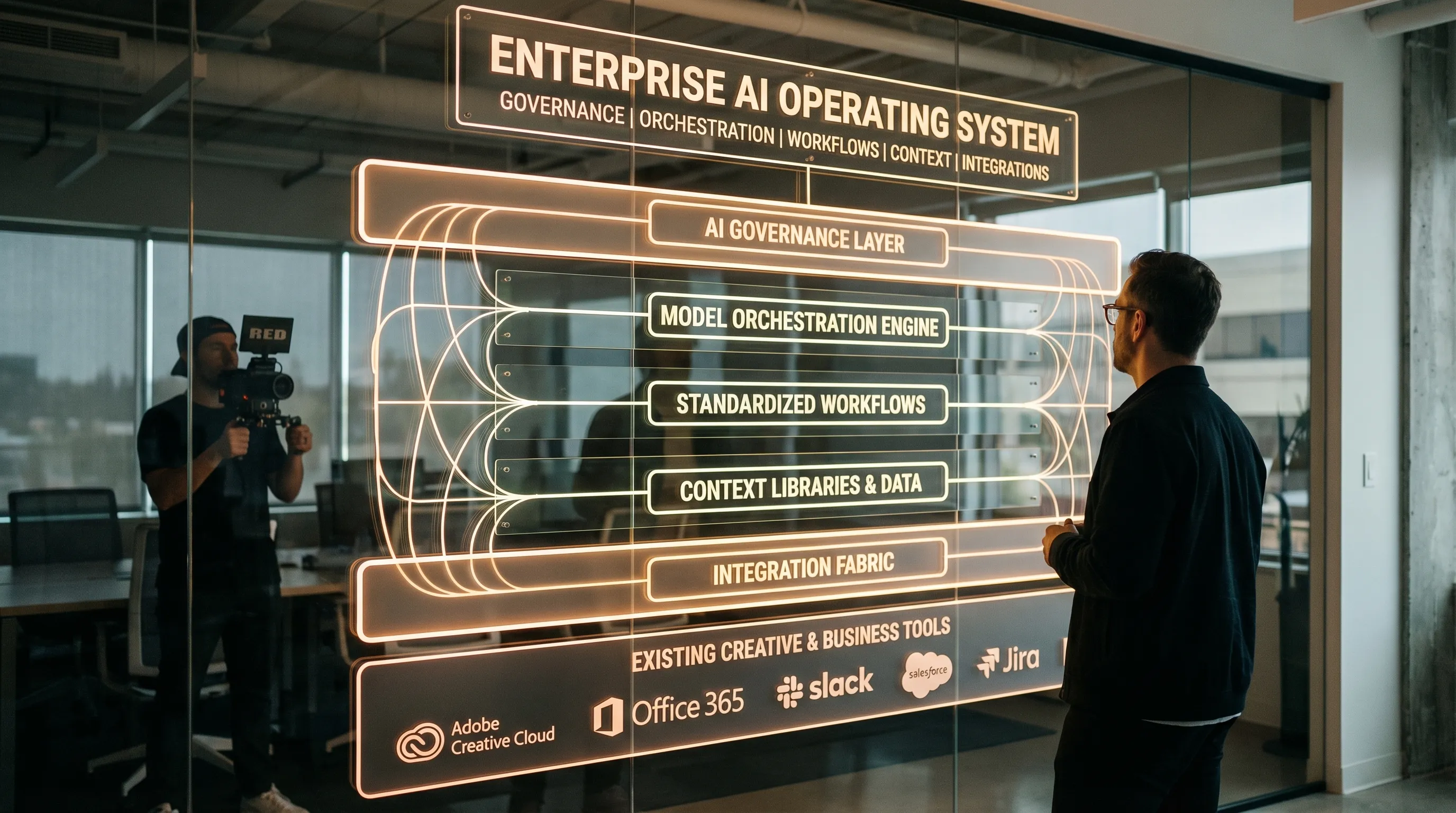
That is where an AI operating system comes in, not as a new model, but as the control layer that standardizes how AI is used across your organization.
What is an AI operating system (AI OS)?
An AI operating system is the set of platform capabilities, policies, and workflows that lets an enterprise:
- Orchestrate multiple AI models and tools across teams
- Standardize inputs, outputs, and quality gates
- Apply governance, security, and compliance consistently
- Track usage, cost, performance, and risk
- Integrate AI into existing production pipelines (creative, product, engineering, marketing)
Think of it as the difference between “we have AI tools” and “we have AI operations.”
For creative and content-heavy organizations, an AI OS is increasingly about coordinating image, video, 3D, and audio generation across studios and vendors while preserving intent, context, and approval trails.
Why enterprises need standardization now (not later)
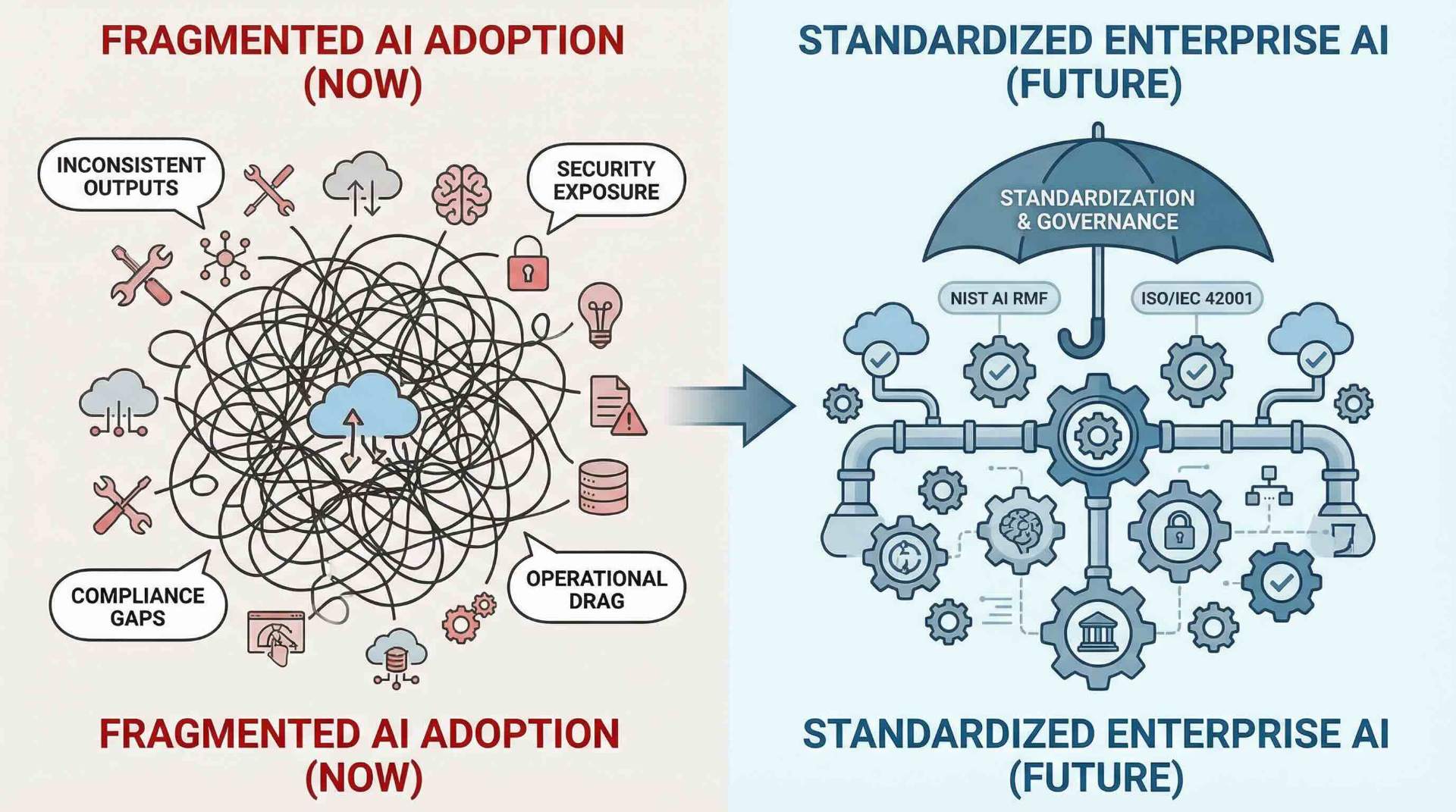
AI adoption tends to fragment fast. Different teams choose different tools, prompts, models, storage locations, and review processes. That creates predictable enterprise risks:
- Inconsistent outputs (style drift, brand violations, uneven quality)
- Unclear IP and data handling (what went into training, what assets were uploaded, where outputs are stored)
- Compliance gaps (audit trails, retention, regional requirements)
- Security exposure (data leakage, plugin risks, vendor sprawl)
- Operational drag (rework, bottlenecks, hard-to-reproduce results)
This is why leading frameworks emphasize governance and risk management as part of deployment, not afterthoughts. For example, the NIST AI Risk Management Framework focuses on mapping, measuring, managing, and governing AI risks across the lifecycle. On the management system side, ISO/IEC 42001 establishes a structured approach to managing AI responsibly.
Standardization is how you turn AI from scattered experimentation into an industrialized capability.
The enterprise AI OS checklist: what to standardize
Below are the core areas enterprises should standardize first. The goal is not bureaucracy. The goal is repeatability, safety, and scale.
1) Governance policies that are enforceable in tooling
Many organizations have AI policies on paper that do not exist in the workflow. An AI OS should make governance executable.
Standardize:
- Allowed use cases and prohibited tasks by function (marketing, product, HR, support)
- Approved model and vendor list (and a process to add or remove providers)
- Data handling rules (what can be pasted into prompts, what must stay internal)
- IP and rights guidance (especially for creative generation and training data)
- Human accountability (who signs off, who owns incidents)
If you operate in or sell into the EU, you should also align these controls with the requirements and risk classification concepts introduced by the EU AI Act.
2) Model portfolio and routing (multi-model reality)
Enterprises rarely use a single model. Teams need different capabilities for different tasks (copy, image generation, video, 3D, code, translation, summarization), and providers evolve quickly.
Standardize:
- Model tiers (experimentation, approved production, restricted)
- Routing rules (which model for which job, quality level, region, or cost target)
- Fallback behavior (what happens if a model fails, changes, or becomes unavailable)
- Evaluation criteria (quality benchmarks, bias tests, safety tests, latency, cost)
This prevents “model chaos” and makes switching providers far less disruptive.
3) Inputs and context, the fastest way to improve quality
In production, most AI quality problems are context problems.
Standardize:
- Context sources (brand guidelines, product catalogs, style guides, lore bibles, SKU data)
- What constitutes a “source of truth” (and who updates it)
- How context is attached to a generation task (project, campaign, product line)
- Memory boundaries (what can be persisted, what must not)
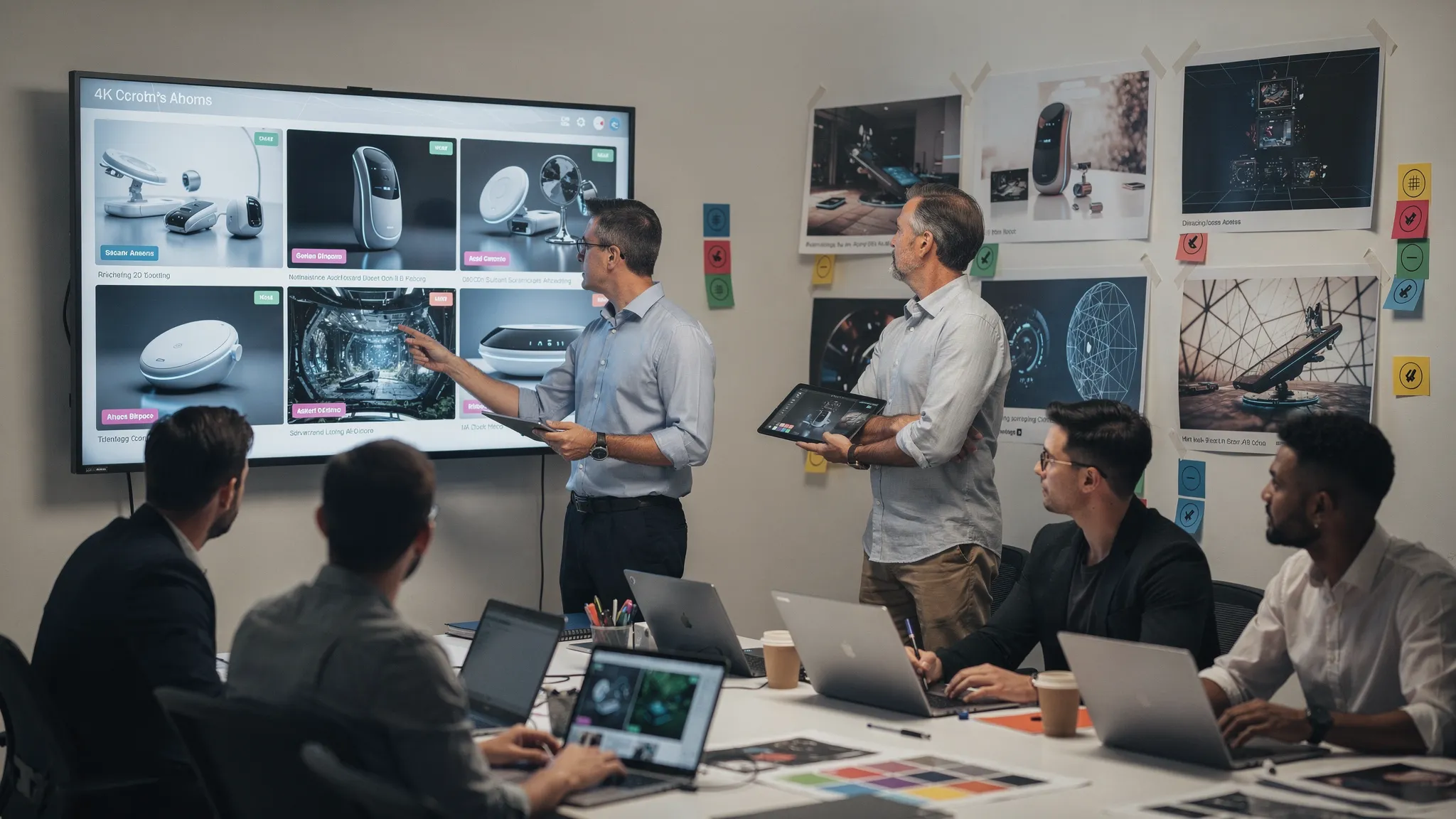
For creative teams, this often looks like standardized “mood boards,” references, and style constraints that persist across iterations.
4) Blueprints, templates, and reusable workflows
If every prompt is handcrafted, you cannot scale safely.
Standardize:
- Generation blueprints (templates for common tasks like product renders, campaign variations, key art, thumbnails)
- Parameter boundaries (what users can change and what must remain fixed)
- Quality checklists embedded into the workflow
- Versioning for prompts, templates, and reference sets
Templates are not about limiting creativity. They protect critical elements (brand, compliance, formatting) while allowing controlled variation.
5) Review, approvals, and audit trails (especially for creative AI)
Enterprises already have production approvals for a reason. AI increases throughput, which increases review pressure.
Standardize:
- Review stages (draft, internal review, legal review, final)
- Approval authority by content type and risk level
- Annotation standards (how feedback is captured so iterations improve)
- Audit trails (who generated what, using which model, with what inputs)
This becomes essential when you need to explain why a certain output was published, or why it should be withdrawn.
6) Asset management and provenance
AI content without strong asset management becomes unsearchable and ungovernable.
Standardize:
- Naming conventions and metadata requirements (campaign, region, product, usage rights)
- Storage locations (what goes into your DAM/PIM, what stays in experimental sandboxes)
- Provenance fields (model used, prompt version, reference set version, approvals)
- Retention policies for inputs and outputs
If your teams cannot reliably find the latest approved asset, you will pay for AI twice, once to generate it, and again to recreate it.
7) Security controls and risk mitigations for LLMs and generative tools
An AI OS must work with your security posture, not around it.
Standardize:
- Access control (SSO, least privilege, role-based permissions)
- Data loss prevention patterns for prompts and uploads
- Logging and monitoring for anomalous usage
- Third-party risk assessments for plugins and vendors
For practical risk categories, security teams often reference resources like the OWASP Top 10 for LLM Applications.
8) Compliance-by-design (regional infrastructure, policies, evidence)
Compliance is easier when it is built into the operating layer.
Standardize:
- Where inference happens (regional requirements, customer commitments)
- Evidence collection (logs, approvals, model selection, input sources)
- Policy enforcement at runtime (not only in training)
For global enterprises, the “where” matters. Some organizations require EU-based infrastructure for specific workloads or client commitments.
9) Integration standards (APIs, plugins, and pipeline hooks)
An AI OS should integrate into what you already run: creative tools, content systems, and production pipelines.
Standardize:
- Integration points (DAM, PIM, DCC tools, ticketing, CI/CD, identity)
- APIs and event formats (so teams can automate reliably)
- Handoff rules between generation, review, and publishing systems
This is the difference between AI as a side tool and AI as part of the pipeline.
10) Observability: quality, cost, throughput, and risk metrics
If you cannot measure it, you cannot improve it.
Standardize:
- Cost metrics (per asset, per campaign, per team)
- Cycle time metrics (time from request to approved output)
- Quality metrics (rejection rate, rework rate, brand compliance checks)
- Risk metrics (policy violations, restricted-data attempts, vendor usage drift)
A good AI OS makes these metrics visible to the right stakeholders without exposing sensitive content broadly.
A practical standardization map (owners and artifacts)
Use the table below to align on what “standardization” means in practice.
| Standardization area | What to define | Example artifacts | Typical owner(s) |
|---|---|---|---|
| Governance | Allowed use cases, model/vendor approval, policy enforcement | AI policy, model registry, risk tiers | CISO, Legal, AI governance lead |
| Workflow orchestration | How work moves from brief to output to approval | Workflow templates, approval gates | Ops lead, Studio lead, PMO |
| Context management | What context is used and how it is updated | Brand kit, product data connections, style references | Brand, Product marketing, Creative ops |
| Templates and blueprints | Repeatable generation patterns and constraints | Prompt/template library, versioning rules | Creative ops, Art direction |
| Asset management | Storage, metadata, provenance, retention | DAM taxonomy, naming standards | Content ops, IT |
| Security | Access, logging, DLP, vendor controls | RBAC model, audit logs, vendor assessments | Security, IT |
| Compliance | Regional requirements, evidence, auditability | Compliance playbooks, audit exports | Legal, Compliance |
| Integrations | APIs, plugins, pipeline hooks | Integration specs, connectors | Enterprise architecture |
| Observability | KPIs, dashboards, alerting | Metrics definitions, reporting cadence | Finance, Ops, Governance |
Common anti-patterns (and how to avoid them)
“We standardized the policy, not the system”
A PDF does not block risky behavior. If governance is not implemented in tools and workflows, it will be bypassed under deadline pressure.
“One model for everything”
This creates lock-in and forces teams to accept poor fit for key tasks (for example, high-fidelity image work versus fast ideation). Standardize routing and evaluation instead.
“Prompts are tribal knowledge”
If only one person can reliably get good results, you do not have a capability, you have a bottleneck. Use templates, versioning, and shared context.
“We cannot audit how this asset was made”
This becomes a brand and legal problem quickly, especially with external distribution. Build audit trails and asset provenance early.
How Virtuall fits an enterprise AI OS for creative production
Virtuall is positioned as a Creative AI operating system for teams producing content across image, video, 3D, and audio, with an emphasis on operating AI at scale with control.
Based on the public product description, Virtuall focuses on the core elements enterprises typically need from an AI OS in creative environments:
- Governance controls to define rules and keep workflows compliant
- Workflow orchestration, including review and approvals
- Multi-model generation orchestration through Nyx, its intelligence layer that keeps intent and context across teams
- Reusable generation blueprints (templates)
- Studio context memory (for example, mood boards)
- Asset management and pipeline tracking
- EU-based infrastructure and inference options for compliance-sensitive workloads
- Integrations via plugins and API into existing creative and enterprise systems
If your organization is already producing at scale, the key question is often not “Can AI generate this?” but “Can we generate it consistently, with governance, inside our pipeline?” An AI OS is the operating answer to that.
Frequently Asked Questions
What is an AI operating system in enterprise terms? An AI operating system is the control and orchestration layer that standardizes how AI is used across teams, including governance, workflows, integrations, and measurement.
What should enterprises standardize first when adopting an AI OS? Start with governance that can be enforced in tooling, model portfolio and routing, standardized workflows with approvals, and context sources that improve output consistency.
How is an AI OS different from an MLOps platform? MLOps typically focuses on training, deploying, and monitoring ML models. An AI OS focuses on running AI across the business, including multi-model orchestration, workflows, governance, and user-facing production pipelines.
Do creative teams really need an AI OS? If you need repeatable, production-ready outputs across many assets, regions, or teams, yes. Standardized templates, context, approvals, and asset provenance reduce rework and brand risk.
How do compliance requirements affect AI OS design? Compliance influences where inference happens, what data can be used, what logs must be retained, and how audit evidence is produced. Building these controls into the operating layer is usually cheaper than retrofitting later.
Build an AI operating system that scales with your studio
If you are standardizing creative AI across teams and tools, Virtuall is designed to help you operate creative AI at scale with governance, orchestration, and production workflows.
Explore Virtuall at virtuall.pro to see how a Creative AI OS can support compliant, consistent image, video, and 3D generation across your enterprise pipelines.