Artificial Intelligence for Enterprise Applications in Creative Ops
Explore artificial intelligence for enterprise applications in creative ops, from governance and workflows to scaling image, video, and 3D.
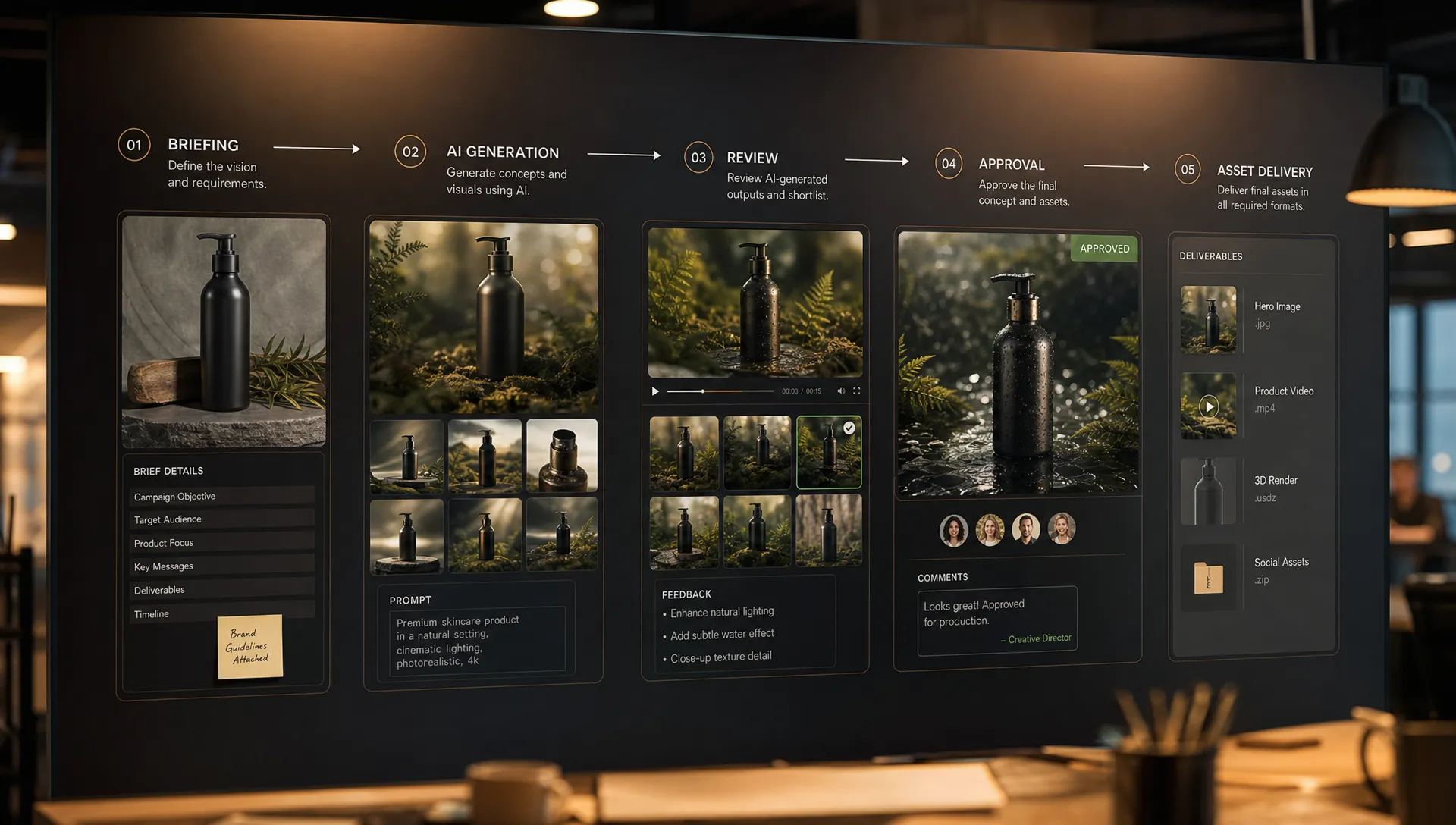
Artificial intelligence for enterprise applications is no longer limited to back-office automation, support chatbots, or analytics dashboards. In creative organizations, AI is becoming part of the operating layer that shapes how teams plan, generate, review, adapt, and deliver content across channels.
For Creative Ops leaders, the question has changed. It is not simply, “Can AI create an image?” Most teams have already seen that it can. The bigger question is, “Can AI produce consistent, compliant, brand-safe, production-ready work inside the systems our enterprise already depends on?”
That is where enterprise creative AI becomes more than a set of tools. It becomes an operating model.
What artificial intelligence for enterprise applications means in Creative Ops
In Creative Ops, enterprise AI applications sit at the intersection of creative production, governance, brand management, and technical integration. They help teams move from isolated experimentation to repeatable workflows that can support real campaigns, product launches, localization programs, game assets, and content pipelines.
A consumer AI tool may be useful for a quick concept. An enterprise AI application must handle a wider set of requirements: permissions, approvals, asset traceability, model selection, prompt consistency, data protection, integration with existing tools, and clear accountability.
For CMOs, this means brand consistency and speed to market. For art directors, it means creative control without starting from a blank page every time. For application managers, it means fewer unmanaged tools and clearer governance. For game developers, it means faster asset exploration while keeping production pipelines structured.
Creative Ops is the natural proving ground for enterprise AI because creative work is both high-volume and high-context. A single campaign may require hundreds of image variants, multiple video edits, localized copy and visuals, product-specific rules, legal review, and channel-specific formats. AI can accelerate this work, but only if it understands the rules of the studio.
Why creative AI pilots often fail to scale
Many enterprises begin with a few motivated users testing AI tools in small pockets of the organization. These pilots can be exciting, but they often struggle to become operational systems.
The most common reason is not lack of model quality. It is lack of orchestration.
Teams quickly run into practical limitations. Different departments use different tools. Prompts are stored in personal documents. Brand context is recreated manually. Approvals happen outside the generation workflow. Legal and compliance teams see outputs late in the process. Assets are downloaded, renamed, duplicated, and moved across folders without a reliable audit trail.
This creates a gap between AI as a creative assistant and AI as an enterprise application.
A useful enterprise AI system must solve for repeatability. It should allow teams to define how work gets generated, reviewed, approved, stored, and reused. Without that structure, AI may increase activity but not necessarily increase operational quality.
High-value AI use cases across the creative lifecycle
Creative Ops covers much more than final asset delivery. AI can create value across the entire production lifecycle when it is embedded thoughtfully.
Early-stage ideation is one obvious use case. Teams can generate mood directions, visual territories, concept boards, and campaign explorations faster than traditional manual research cycles. This helps art directors and brand teams compare creative routes before committing resources.
During production, AI can help generate image variations, product-context visuals, video concepts, audio elements, and 3D asset explorations. For teams working in gaming, retail, fashion, entertainment, or consumer goods, this can reduce the friction between idea and prototype.
Post-production and adaptation are equally important. Enterprises rarely need one asset. They need many versions of the same creative idea: by market, language, format, audience segment, product line, or channel. AI can help produce structured variants while preserving the strategic intent behind the original work.
Review workflows are another major opportunity. AI-generated content still needs human judgment, especially in enterprise environments. The advantage is not replacing review, but making it easier to annotate, compare, route, approve, and track creative decisions.
The enterprise creative AI stack
To scale creative AI responsibly, organizations need to think in layers. A model alone is not a stack. The model is only one component in a broader operating system.
| Layer | What it does | Why it matters in Creative Ops |
|---|---|---|
| Governance | Defines rules, permissions, approval gates, and usage policies | Keeps AI activity aligned with brand, legal, and compliance requirements |
| Context memory | Stores brand direction, mood boards, references, and project intent | Reduces repetitive briefing and improves consistency across teams |
| Model orchestration | Routes work across different AI models and formats | Lets teams use the right model for image, video, 3D, or audio tasks |
| Workflow orchestration | Connects briefs, generation, review, approval, and delivery | Turns experimentation into repeatable production processes |
| Asset management | Organizes outputs, versions, metadata, and approved assets | Prevents asset chaos and supports reuse |
| Integrations | Connects AI workflows with DCC, PIM, DAM, and other tools | Keeps AI inside the existing enterprise ecosystem |
| Compliance and infrastructure | Supports security, residency, inference controls, and traceability | Reduces operational risk, especially in regulated or global organizations |
This layered view is useful because it helps enterprises avoid the “one tool solves everything” trap. Creative AI at scale requires both intelligence and control.
Governance is not a blocker, it is how AI scales
Governance often gets framed as the opposite of creativity. In enterprise AI, it is the condition that allows creativity to move faster without creating unacceptable risk.
The NIST AI Risk Management Framework is a helpful reference point because it encourages organizations to manage AI across dimensions such as reliability, safety, transparency, accountability, privacy, and bias. For creative organizations, those principles translate into practical questions: Who can use which model? What data can be used in prompts? Which outputs require approval? How are rejected assets handled? What records are kept?
The regulatory environment also matters. The EU AI Act introduced a risk-based framework for AI systems, with obligations phased in over time. Even when a creative AI use case is not classified as high risk, enterprises still need clear policies for transparency, copyright-sensitive workflows, data handling, and supplier accountability.
Governance should show up inside the workflow, not as a separate spreadsheet. If users must leave their creative tools to understand what is allowed, adoption will suffer. The better approach is to encode rules into the operating environment so teams can create with confidence.
The role of multi-model orchestration
No single AI model is best for every creative task. One model may be stronger for photorealistic product imagery. Another may be more useful for video exploration, stylized artwork, audio generation, or 3D asset creation. Enterprise teams need flexibility, but flexibility can become complexity if each model sits in a separate tool with its own interface and rules.
Multi-model orchestration helps solve this problem. Instead of asking users to manually choose and manage every model, the enterprise layer can coordinate models according to the task, workflow, and required output type. This is especially important for studios producing across image, video, 3D, and audio.
The strategic value is not only access to more models. It is the ability to preserve intent across them. A campaign concept, product identity, or visual direction should not be lost each time the work moves from image exploration to video adaptation or 3D prototyping.
This is where systems like Virtuall’s Nyx, described as the intelligence layer of the Creative AI OS, become relevant. Nyx is designed to orchestrate multiple industry-leading AI models while keeping intent and context across studios and teams. For enterprise Creative Ops, that kind of orchestration is essential because the production process rarely fits neatly inside one model or one format.
From prompts to generation blueprints
Prompts are useful, but they are not enough for enterprise creative production. A prompt written by one designer may produce a strong result once, but it may not be reusable by another team, region, or campaign.
Generation blueprints are a more operational approach. They turn creative instructions into reusable templates that can encode brand rules, output requirements, visual direction, and workflow logic. This helps teams standardize repeatable content tasks without eliminating creative judgment.
For example, a retail team might need seasonal product visuals that always respect product framing, background rules, lighting direction, and marketplace specifications. A game studio might need environment concept variations that preserve a defined art style. A marketing team might need paid social variants that follow campaign identity while adapting to different aspect ratios and audiences.
Blueprints make these patterns easier to repeat. They also help application managers and operations leaders reduce dependency on tribal knowledge.
How enterprise AI changes team collaboration
Creative work is collaborative by nature. AI does not remove that collaboration. It changes where collaboration happens.
Instead of waiting for a fully developed asset before reviewing it, teams can align earlier around AI-generated directions. Art directors can evaluate visual territories. Brand teams can confirm fit. Legal teams can flag sensitive themes. Product teams can check accuracy. Marketing leaders can compare campaign options before committing production budget.
The strongest enterprise applications support this with review workflows, approvals, content annotation, and pipeline tracking. These capabilities matter because creative AI produces volume. More outputs are not helpful if teams cannot decide which ones are usable.
This is particularly important for global organizations. A central brand team may define the rules, while regional teams adapt creative for local markets. Without collaboration controls, AI can fragment the brand. With the right operating system, it can help scale brand expression while preserving oversight.
What different enterprise stakeholders should care about
Enterprise creative AI succeeds when it solves real problems for multiple stakeholders. Each group has a different lens.
| Stakeholder | Primary concern | What enterprise AI should deliver |
|---|---|---|
| CMO | Faster campaign execution with brand consistency | Scalable content production, governance, and measurable operational efficiency |
| Art Director | Creative quality and control | Context-aware generation, reusable directions, review tools, and consistent outputs |
| Application Manager | Tool governance and integration | Centralized controls, APIs, plugins, compliance, and manageable workflows |
| Game Developer | Asset exploration and pipeline fit | Support for 3D, image, video, and production-oriented iteration |
| Legal or Compliance Lead | Risk management | Clear usage policies, traceability, approval records, and infrastructure controls |
The key is to avoid positioning AI as only a creative tool or only an IT tool. In enterprise Creative Ops, it is both. It must respect creative nuance and enterprise architecture at the same time.
Integration with the existing creative ecosystem
Large creative organizations already have established systems: DAM platforms, PIM systems, design tools, digital content creation software, review platforms, and project management workflows. AI must connect to that ecosystem rather than forcing teams to rebuild everything from scratch.
This is why plugins, APIs, and integrations matter. They allow AI-generated work to move into the places where teams already manage product information, approved assets, production files, and delivery processes.
For application managers, this is often the difference between a pilot and a deployable enterprise application. A tool that cannot integrate may still be interesting, but it will create operational debt. A connected AI operating layer can support adoption without fragmenting the stack.
For creative teams, integrations reduce context switching. The goal is not to make every user become an AI systems expert. The goal is to bring controlled AI capabilities into the flow of work.
A practical roadmap for adopting AI in Creative Ops
Enterprises do not need to transform every creative workflow at once. A staged approach is usually more effective.
- Define the production problem: Start with a specific bottleneck, such as campaign localization, product visual variation, concept development, or 3D asset ideation.
- Map the current workflow: Document who briefs, creates, reviews, approves, stores, and publishes each asset.
- Set governance requirements early: Clarify data rules, model access, approval stages, infrastructure needs, and compliance expectations before scaling usage.
- Create reusable blueprints: Convert repeatable creative tasks into templates so teams can generate consistently without reinventing instructions.
- Connect asset and review systems: Make sure generated outputs can be tracked, annotated, approved, and stored in the right enterprise systems.
- Measure operational impact: Track cycle time, revision rounds, output consistency, reuse, approval speed, and stakeholder satisfaction.
- Scale by workflow, not by hype: Expand to adjacent use cases only when the first workflow is reliable and governed.
This roadmap keeps the focus on business value. It also gives creative and technical teams a shared implementation language.
Choosing the right enterprise AI platform for Creative Ops
When evaluating platforms, leaders should look beyond the quality of a single generated asset. A great demo image does not prove enterprise readiness.
A stronger evaluation asks whether the platform can support the full operating model: governance, orchestration, context, collaboration, compliance, and integration. It should also support the formats your team actually uses. For many creative organizations, that means images, video, 3D, and sometimes audio.
Important evaluation criteria include:
- Governance controls that can be configured around team, project, brand, or workflow needs
- Multi-model support so teams are not locked into one generation approach
- Context memory for brand direction, mood boards, and studio knowledge
- Review and approval workflows for human oversight
- Asset management and pipeline tracking to prevent output sprawl
- Integration options for DCC, PIM, DAM, and other enterprise systems
- Compliance posture, including infrastructure and inference considerations
A platform does not need to replace every creative tool. In many cases, the best enterprise AI layer is the one that orchestrates tools, models, rules, and workflows around the way the studio already operates.
Where Virtuall fits
Virtuall is built for this operating-system view of creative AI. Rather than treating AI generation as a disconnected activity, Virtuall is designed to help teams control, orchestrate, and scale AI-powered content creation across image, video, 3D, and audio workflows.
Its Creative AI OS approach is especially relevant for enterprises that need production-ready outputs, governance controls, workflow orchestration, team collaboration, asset management, and compliance. The platform supports generation blueprints, studio context memory through mood boards, review workflows, approvals, content annotation, pipeline tracking, and integrations with creative tools such as DCC, PIM, DAM, plugins, and APIs.
Virtuall also emphasizes EU-based infrastructure and inference, which is an important consideration for organizations with strict compliance, data residency, or supplier governance requirements.
For teams moving from creative AI experimentation to enterprise deployment, the core value is control. You define the rules. The system helps creative teams operate within them.
Frequently Asked Questions
What is artificial intelligence for enterprise applications in Creative Ops? It refers to AI systems designed to support creative production inside enterprise workflows. In Creative Ops, this can include content generation, workflow orchestration, approvals, asset management, compliance controls, and integrations with existing creative systems.
How is enterprise creative AI different from consumer AI tools? Consumer tools are often optimized for individual experimentation. Enterprise creative AI must support governance, permissions, traceability, collaboration, security, repeatability, and integration with production workflows.
Can AI be used for brand-safe creative production? Yes, but only when the organization defines clear rules and uses systems that support governance, context, review, and approval. Brand safety depends on both model quality and operational control.
Why does multi-model orchestration matter? Creative teams often work across image, video, 3D, and audio. Different models may be better suited to different tasks. Orchestration helps teams use the right model while maintaining workflow consistency and creative intent.
What should enterprises measure when scaling AI in Creative Ops? Useful metrics include production cycle time, revision rounds, approval speed, asset reuse, output consistency, compliance incidents, and adoption across teams. The goal is not just more content, but better controlled creative throughput.
Bringing enterprise control to creative AI
AI is becoming a core part of creative operations, but scale requires more than access to models. Enterprises need governance, context, workflows, integrations, and collaboration systems that make AI usable in real production environments.
If your team is ready to move from isolated AI experiments to controlled creative production, explore how Virtuall’s Creative AI OS can help you orchestrate AI across your studio, workflows, and tools while keeping creative intent, compliance, and production quality at the center.