Enterprise Cloud AI for Secure Creative Production
Learn how enterprise cloud AI helps studios scale secure creative production with governance, orchestration, compliance, and consistent outputs.
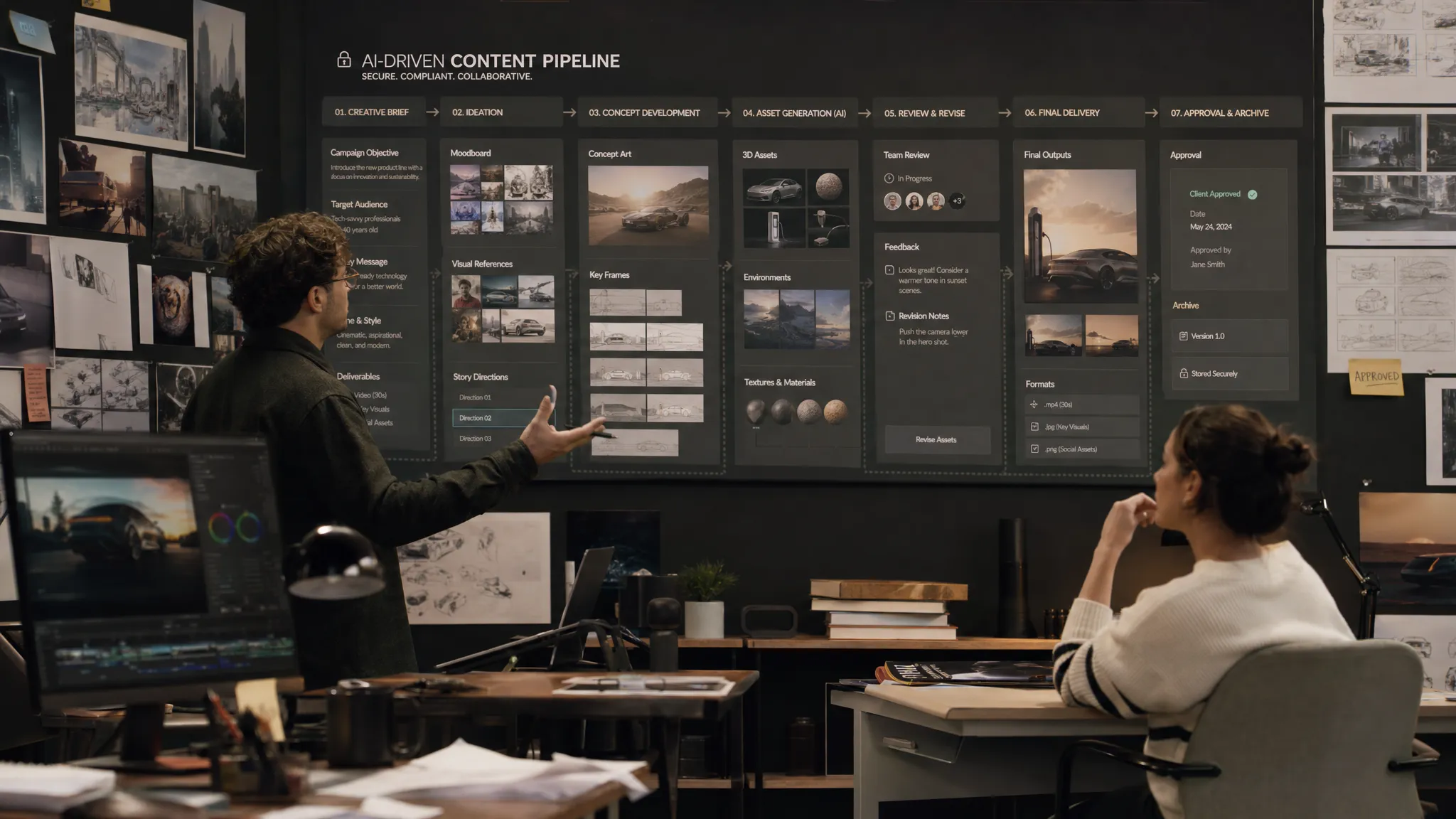
Creative teams are no longer asking whether AI can produce useful images, videos, environments, or 3D assets. In 2026, the harder question is how to use AI safely, consistently, and at enterprise scale without losing control of brand, intellectual property, data, or production quality.
That is where enterprise cloud AI becomes more than a technology choice. For CMOs, art directors, application managers, and game development leaders, it is the operating layer that determines whether AI stays a promising experiment or becomes secure production infrastructure.
The opportunity is significant. AI can accelerate concepting, localization, product visualization, game asset ideation, campaign variation, and production handoff. But creative production is not only about generating more content. It also depends on approvals, context, compliance, asset reuse, model governance, and repeatable workflows. Without those controls, scale can quickly turn into risk.
Why enterprise cloud AI matters for creative production
Creative AI adoption often starts with individual experimentation. A designer tests an image model. A marketing team generates campaign concepts. A game studio prototypes props or environments. These tests are useful, but they usually happen outside the systems that enterprises rely on for governance, brand consistency, and security.
Production is different. Once AI-generated content enters a commercial pipeline, teams need to know which tools were used, who approved the output, what source assets informed the generation, where files are stored, and whether the process complies with internal and external rules.
Enterprise cloud AI helps by creating a controlled environment for AI-powered production. Instead of letting each team choose disconnected tools and processes, an enterprise platform can centralize access, orchestrate workflows, enforce policies, and connect AI generation to existing creative systems.
For creative organizations, this matters because AI work is inherently cross-functional. Marketing wants speed and brand consistency. Art direction needs creative control. Application managers need secure integrations and governance. Game teams need efficient iteration without breaking pipeline standards. The cloud AI layer must serve all of them.
The NIST AI Risk Management Framework highlights governance, measurement, and risk management as core parts of responsible AI adoption. In creative production, those principles translate into practical questions: who can generate, which models are allowed, what data can be used, and how outputs are reviewed before they reach customers or players.
What secure creative production requires
Secure creative production is not just a cybersecurity issue. It is a production design issue. If the workflow is poorly designed, teams may upload confidential assets into unmanaged tools, lose track of prompt history, generate inconsistent assets, or skip approval stages because the AI process sits outside the normal pipeline.
A secure approach should cover the full lifecycle of creative work, from brief to final asset. The goal is to give creative teams enough flexibility to experiment while giving the organization enough control to protect its brand and IP.
| Production requirement | Risk without governance | Enterprise cloud AI control |
|---|---|---|
| Brand and creative context | Outputs drift from visual identity or campaign direction | Shared mood boards, context memory, and approved creative references |
| Model usage | Teams use unapproved or inconsistent AI models | Multi-model orchestration with defined rules and access controls |
| Confidential assets | Sensitive product, character, or campaign files are exposed | Secure asset management and controlled generation environments |
| Review and approval | AI content bypasses quality, legal, or brand review | Collaboration tools, annotations, approvals, and workflow tracking |
| Compliance | Regional, contractual, or internal requirements are missed | Governance controls, auditability, and infrastructure aligned with policy |
| Pipeline handoff | Outputs are hard to reuse in production tools | Integration with DCC, PIM, DAM, and other creative systems |
This is why AI adoption in creative production should not be treated as a collection of separate prompts. It should be treated as an operating model.
The architecture of an enterprise cloud AI creative stack
A mature creative AI environment usually includes four layers: governance, orchestration, context, and integration. Each layer solves a different problem, and all four are needed if AI is expected to support production work rather than one-off experimentation.
Governance: define what AI is allowed to do
Governance is the foundation. It determines who can access AI tools, what types of assets can be used, which workflows require approval, and how outputs are tracked.
For a CMO, governance protects brand reputation and campaign compliance. For an application manager, it reduces shadow IT and helps align AI tools with enterprise security policies. For an art director, it creates clarity around approved references, styles, and review gates rather than leaving every generation to individual interpretation.
Good governance should feel enabling, not restrictive. The objective is not to slow creative teams down. It is to make the safest path also the easiest path.
Orchestration: connect models, workflows, and teams
No single AI model is best for every creative task. Image ideation, video generation, 3D asset exploration, audio, and production variation may require different systems. Enterprise creative teams need a way to orchestrate multiple models while keeping the workflow understandable and controlled.
Orchestration also helps prevent tool fragmentation. Instead of asking teams to manually move assets between different AI platforms and production tools, a centralized system can coordinate generation steps, approvals, and handoffs.
In Virtuall, Nyx acts as the intelligence layer of the Creative AI OS. It is designed to orchestrate multiple industry-leading AI models while preserving intent and context across studios and teams. For enterprise teams, that continuity is critical because the original creative direction often matters as much as the generated asset itself.
Context: preserve creative intent across production
AI output quality depends heavily on context. A prompt alone rarely captures the full nuance of a brand platform, product launch, game world, visual language, or art direction system. Teams need persistent context that can travel across projects and workflows.
Studio context memory, such as mood boards and approved references, helps teams keep generation aligned with the work already approved by the organization. This is especially important when multiple studios, agencies, or departments contribute to the same campaign or content universe.
For example, a game development team may need consistent environmental motifs across concept art and 3D exploration. A retail marketing team may need product imagery that stays aligned across seasonal campaigns. A global brand team may need regional adaptation without losing the core identity. In each case, context is not optional. It is the difference between AI-assisted production and AI-generated noise.
Integration: make AI part of the production pipeline
Enterprise creative work already depends on systems such as DAM, PIM, DCC tools, review platforms, and internal asset libraries. If AI remains separate from those systems, it creates manual work, versioning problems, and security gaps.
A production-ready enterprise cloud AI platform should connect with existing creative tools through plugins, APIs, and workflow integrations. This helps teams move from generation to review, asset management, and final delivery without losing traceability.
For application managers, integration is often the deciding factor. A tool that produces impressive outputs but cannot fit into enterprise architecture may create more operational burden than value. A platform that supports controlled integration can become part of the creative technology stack rather than an isolated experiment.
Security and compliance considerations for 2026
AI regulation and enterprise expectations are both becoming more demanding. The European Commission’s AI Act framework entered into force in 2024, with obligations phased in over time. Even when creative AI use cases are not classified as high risk, enterprise teams still need policies around transparency, data handling, vendor management, and output review.
For companies operating in Europe, or serving European customers, cloud AI decisions should consider data residency, infrastructure, inference location, contractual obligations, and internal compliance policies. EU-based infrastructure and inference can be important for organizations that need stricter control over where AI processing takes place.
Security should also address the everyday behavior of creative teams. The biggest risks do not always come from advanced attacks. They often come from practical gaps, such as uploading unreleased product imagery to unmanaged tools, reusing unapproved model outputs, or losing track of which assets informed a final campaign image.
A secure creative AI operating model should make the following clear:
- Which teams and roles can access each generation workflow
- Which asset types are approved for AI use
- Which models can be used for which production tasks
- Which outputs need human review before publication
- Where generated assets, prompts, references, and approvals are stored
- How AI workflows connect to existing compliance and asset management systems
This level of control is especially important in industries where creative assets are commercially sensitive, such as gaming, fashion, retail, entertainment, automotive, and consumer products.
How enterprise teams can build repeatable AI workflows
Repeatability is one of the main differences between experimentation and production. A single impressive AI output is useful, but enterprise teams need workflows that can reliably produce on-brand, reviewable, and reusable results.
Generation blueprints, or templates, are one way to achieve this. Instead of asking every user to start from a blank prompt, a blueprint can define the creative task, input requirements, model behavior, review steps, and output format. This allows teams to standardize common AI workflows while preserving creative flexibility.
A typical secure creative AI workflow may include:
- Brief intake with campaign, product, or game context
- Approved references, mood boards, and brand direction
- Controlled generation using selected models and templates
- Team review with comments, annotations, and approval gates
- Asset storage, version tracking, and pipeline handoff
- Compliance checks before external use or production delivery
For an art director, this makes creative direction easier to maintain across iterations. For a CMO, it supports brand consistency at scale. For a game developer, it helps AI-generated concepts move closer to production requirements. For an application manager, it creates a workflow that can be governed, integrated, and supported.
What to look for in an enterprise cloud AI platform
The right platform should match both creative ambition and enterprise requirements. It should not force teams to choose between speed and control. It should help them work faster because the rules, context, and handoffs are already built into the environment.
| Capability | Why it matters for secure creative production |
|---|---|
| AI governance controls | Helps define permissions, approved workflows, and compliant usage |
| Multi-model generation | Allows teams to use the right model for image, video, 3D, or audio tasks |
| Workflow orchestration | Connects generation, review, approval, and handoff into one controlled process |
| Generation blueprints | Standardizes repeatable creative tasks and reduces prompt inconsistency |
| Studio context memory | Preserves visual direction, mood boards, and project intent across teams |
| Collaboration tools | Supports reviews, annotations, approvals, and cross-functional decision-making |
| Asset and pipeline tracking | Keeps generated work traceable and easier to reuse in production |
| Integrations and API access | Connects AI workflows to DCC, PIM, DAM, and existing enterprise systems |
| Compliance-focused infrastructure | Supports enterprise requirements around data handling, residency, and inference |
When evaluating platforms, leaders should also consider adoption. Creative teams are more likely to use a governed AI system if it respects the way they already work. The platform should support experimentation, but within a structure that protects the organization.
Where Virtuall fits
Virtuall is built as a Creative AI OS for teams that need to operate AI-powered content creation at scale. It brings governance, workflow orchestration, multi-model content generation, studio context, collaboration, asset management, pipeline tracking, compliance-oriented infrastructure, and integrations into one operating layer.
For enterprise creative teams, the value is not just generating more assets. It is controlling how AI runs across studios, workflows, and tools. Teams can define rules, preserve context, coordinate production, and work toward consistent outputs across image, video, 3D, and audio workflows.
This operating system approach is especially relevant as organizations move from individual AI pilots to enterprise-wide adoption. The more teams use AI, the more important it becomes to coordinate the process. Without a shared operating layer, AI can fragment creative production. With one, it can become a secure, scalable advantage.
Frequently Asked Questions
What is enterprise cloud AI for creative production? Enterprise cloud AI for creative production is a governed cloud environment that helps teams generate, review, manage, and deliver creative assets using AI while maintaining security, compliance, and workflow control.
Why is security important for AI-generated creative assets? Creative assets often include confidential product imagery, brand systems, campaign concepts, game worlds, character designs, and commercial IP. Secure workflows reduce the risk of exposing sensitive files or publishing unapproved outputs.
How does enterprise cloud AI help art directors and creative teams? It helps preserve creative context, standardize workflows, manage approvals, and keep outputs aligned with brand or project direction. This gives creative teams more control over AI-assisted production.
What should application managers look for in a creative AI platform? Application managers should look for governance controls, integration options, asset tracking, compliance support, API access, and a clear way to manage users, workflows, and approved AI tools.
Can enterprise cloud AI support game development workflows? Yes, when the platform supports secure iteration, 3D and visual asset workflows, review processes, and integration with production tools. The key is making AI part of the pipeline rather than a disconnected concepting tool.
Bring creative AI under control
AI can expand creative capacity, but only if teams can trust the process. Enterprise cloud AI gives organizations a way to scale generation while protecting brand integrity, IP, compliance, and production quality.
If your team is moving from AI experimentation to secure creative production, explore how Virtuall’s Creative AI OS can help you define the rules, orchestrate workflows, and deliver consistent creative outputs at scale.