Creating AI Models That Match Brand and Production Needs
Creating AI models that fit your brand and production needs starts with governance, data, evaluation, and scalable workflows. Learn how.
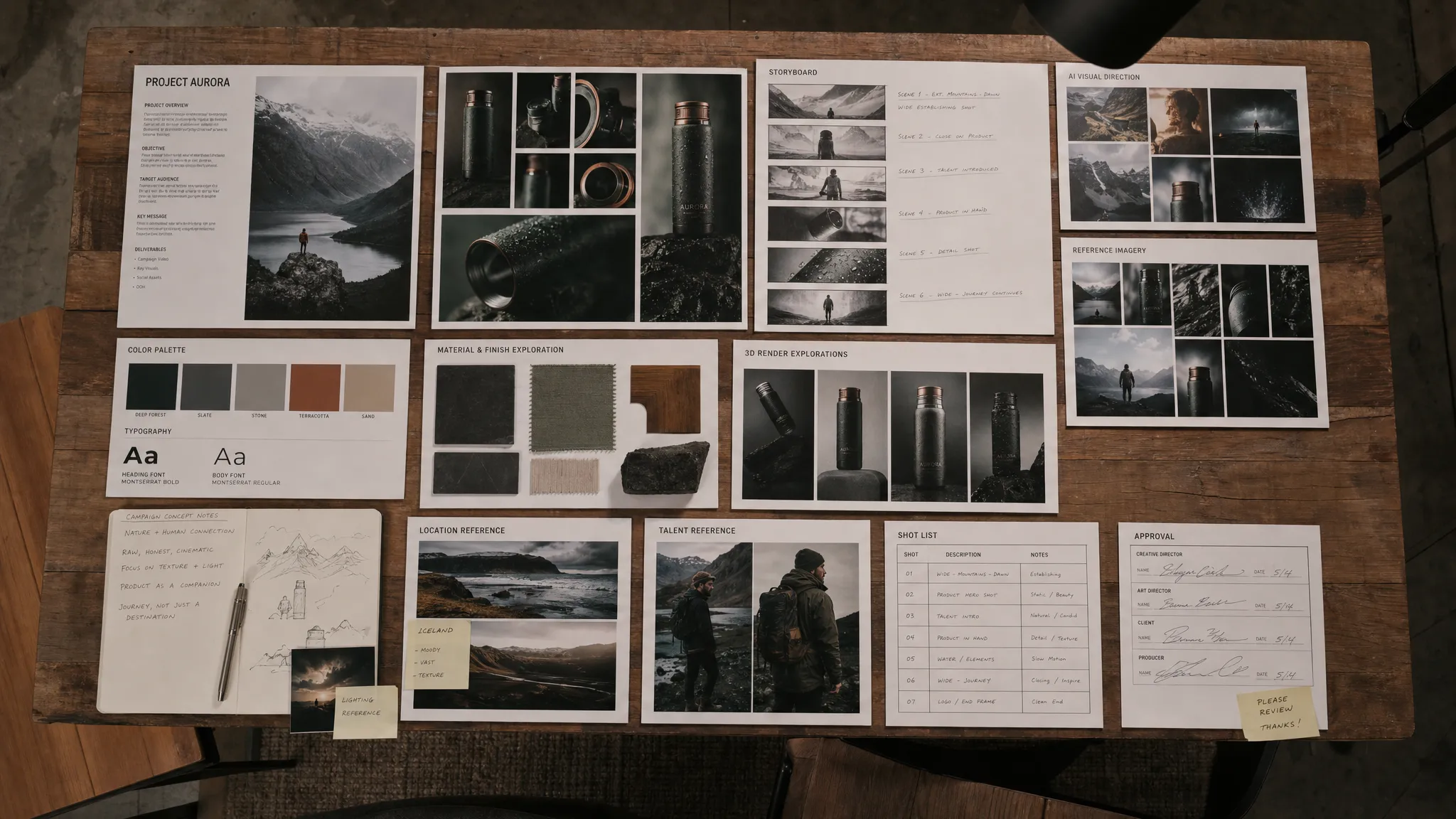
For many creative teams, “creating AI models” sounds like a technical project owned by data science. In practice, the best enterprise outcomes come when brand, production, legal, and technology teams shape the model together.
A model that can generate a beautiful image is not automatically useful. It becomes useful when it understands your visual language, respects product constraints, fits approval workflows, and produces assets that downstream teams can actually use. That is the difference between an impressive demo and a repeatable creative AI production system.
The goal is not always to train a model from scratch. In most organizations, the right approach is a managed combination of foundation models, brand context, fine-tuning where justified, governance rules, and workflow orchestration. The following framework explains how to create AI models and model-based workflows that match both brand identity and production needs.
Start with the production outcome, not the model
The first mistake teams make is choosing a model before defining the job it must perform. A model for campaign ideation has very different requirements from a model that generates product imagery, localized video variants, 3D props, or e-commerce assets.
Before evaluating model options, define the production outcome in concrete terms. What asset type is needed? Who will use it? What quality threshold is acceptable? Which systems need to receive the final output? What approvals are required before publication?
For example, a CMO may care about message consistency across markets. An art director may care about composition, lighting, and brand tone. An application manager may care about integration, permissions, auditability, and vendor risk. A game developer may care about topology, texture consistency, export formats, and pipeline compatibility.
A strong creative AI model strategy starts by aligning these expectations early. Otherwise, the team may optimize for the wrong benchmark, such as prompt responsiveness, while ignoring the constraints that actually determine whether the output can ship.
| Production need | What the AI system must understand | Typical success criteria |
|---|---|---|
| Brand campaign visuals | Brand codes, art direction, composition, forbidden styles | Consistent look, fast iteration, approval readiness |
| Product imagery | Product geometry, materials, colors, usage context | Accuracy, reproducibility, channel-specific formats |
| Video variants | Narrative structure, pacing, aspect ratios, localization rules | Coherent sequences, compliant messaging, export readiness |
| 3D asset generation | Shape language, scale, topology, material references | Usable meshes, clean textures, compatibility with tools |
| Game content ideation | World rules, character style, level themes, technical limits | Creative breadth, style continuity, pipeline fit |
This table also shows why a single “best model” rarely solves every production need. Enterprise creative AI usually requires a model portfolio, with governance and orchestration on top.
Translate the brand into model-readable context
Brands are often documented for humans, not machines. A brand book may describe the tone as “premium, optimistic, and modern,” but an AI model needs more specific signals to reproduce that identity reliably.
To make brand identity usable in AI workflows, translate it into structured creative context. This includes visual references, approved and rejected examples, color systems, composition rules, product usage constraints, tone of voice, market-specific variations, and legal restrictions.
The most effective teams create a brand context layer that sits between human strategy and AI generation. This layer can include mood boards, annotated assets, prompt templates, negative prompts, reference libraries, review criteria, and reusable generation blueprints.
A good brand context layer answers questions such as:
- What visual elements make the brand recognizable even without a logo?
- Which styles, camera angles, materials, or environments should never be used?
- Which product details must remain exact?
- Which creative variables can be adapted by market, channel, or campaign?
- What does “on brand” look like in images, video, audio, and 3D?
This step is essential because brand consistency is not created by the model alone. It is created by the relationship between the model, the source material, the instructions, the governance rules, and the approval process.
Choose the right model strategy
Creating AI models for production does not always mean building a proprietary foundation model. In many cases, that would be expensive, slow, and unnecessary. The right strategy depends on how specific the task is, how much control is required, and how much approved training or reference data is available.
A practical model strategy may combine several approaches.
| Strategy | Best suited for | Benefits | Watchouts |
|---|---|---|---|
| Prompting and reference inputs | Early ideation, concept exploration, mood directions | Fast to test, low setup cost | Limited repeatability without strong controls |
| Workflow templates or blueprints | Recurring asset types, campaign variants, product scenes | Consistent process, easier governance | Requires clear creative rules |
| Retrieval of brand context | Teams with approved asset libraries and guidelines | Keeps outputs aligned with current brand material | Depends on asset quality and metadata |
| Fine-tuning or adapters | Distinct visual styles, recurring characters, product aesthetics | Stronger consistency for narrow use cases | Requires curated data and evaluation |
| Custom model training | Highly specialized domains or proprietary generation needs | Maximum control in specific scenarios | High cost, operational complexity, governance burden |
| Multi-model orchestration | Complex pipelines across image, video, 3D, and audio | Uses the best model for each step | Requires coordination, tracking, and policy controls |
For most enterprise teams, the best starting point is not full custom training. It is a governed workflow that combines foundation models, reusable blueprints, brand context, and human review. Fine-tuning becomes valuable when the team has a repeatable need, enough high-quality data, and measurable gaps that prompting cannot solve.
Build a data foundation that reflects the brand and the real pipeline
Models learn patterns from data and context. If your source material is inconsistent, outdated, poorly labeled, or legally unclear, the AI system will amplify those problems.
A production-ready data foundation should include approved brand assets, campaign imagery, product references, 3D files, material libraries, tone guidelines, usage rights, market rules, and examples of both accepted and rejected outputs. Rejected examples are particularly valuable because they teach the system and reviewers what to avoid.
Metadata matters as much as the assets themselves. An image labeled only as “hero shot” is less useful than one tagged with product line, market, campaign, lighting direction, composition type, usage rights, approval status, and output channel. For 3D workflows, metadata may include scale, mesh quality, material type, polygon constraints, and compatible tools.
Data governance should be addressed before creative teams scale usage. The NIST AI Risk Management Framework recommends a structured approach to governing, mapping, measuring, and managing AI risks. For creative AI, that translates into clear ownership of datasets, model usage policies, review checkpoints, and records of how assets were generated.
Legal and compliance teams should also clarify whether assets can be used for training, fine-tuning, reference, or only human viewing. These categories are not interchangeable. A licensed image might be approved for a campaign mood board but not for model training. Treating these distinctions carefully protects both the brand and the production process.
Define evaluation criteria before scaling
A creative AI model should not be evaluated only by whether someone likes the output. Subjective review matters, but enterprise teams need repeatable evaluation criteria that connect creative quality to production requirements.
An evaluation framework can include brand fit, technical correctness, legal safety, usability, consistency, and downstream compatibility. For each dimension, define what passes, what fails, and who has authority to approve exceptions.
| Evaluation dimension | What to check | Example review question |
|---|---|---|
| Brand fit | Style, tone, composition, recognizable identity | Would this feel native in a major brand campaign? |
| Product accuracy | Shape, color, materials, proportions, claims | Does the asset represent the product truthfully? |
| Technical quality | Resolution, artifacts, file format, 3D usability | Can this move into the next production step? |
| Compliance | Rights, restricted content, market rules, disclosures | Can this be used in the intended channel and region? |
| Consistency | Repeatability across variants and teams | Can another team reproduce a similar result? |
| Traceability | Inputs, model used, approvals, version history | Can we explain how this asset was created? |
This type of framework helps teams avoid “AI taste drift,” where outputs gradually move away from brand standards because each person accepts small deviations. It also gives procurement, IT, and legal teams a clearer basis for approving AI use at scale.
Add governance without slowing creativity
Governance is sometimes perceived as a blocker, especially by creative teams that value speed and experimentation. But in production AI, good governance is what allows experimentation to scale safely.
The key is to embed governance into the workflow rather than adding it at the end. Teams should define which models can be used for which asset types, which data sources are approved, who can publish outputs, and when human review is mandatory. Governance controls should also reflect regional requirements, client restrictions, and brand-specific rules.
The regulatory environment is becoming more formal. The EU AI Act introduced a phased framework for AI obligations in Europe, and organizations operating internationally need to monitor how transparency, risk management, and accountability requirements apply to their use cases. For companies building AI management practices, ISO/IEC 42001 also provides a recognized management system standard for AI governance.
Creative AI governance should be practical. A concept sketch may not need the same approval path as a product claim in a paid campaign. A 3D prototype for internal exploration may not require the same review as a game asset entering production. The goal is to match the level of control to the level of risk.
Connect models to real creative workflows
Even a well-tuned model will fail if it sits outside the tools and processes your teams use every day. Production needs continuity from brief to generation, review, revision, asset management, and delivery.
This is where workflow orchestration becomes critical. Creative teams need repeatable paths for common tasks, such as generating campaign variations, adapting assets for multiple regions, creating product scene concepts, or producing 3D references for development. Application managers need integrations with existing creative tools, DAM, PIM, DCC tools, and internal systems. Leadership needs visibility into usage, approvals, and risk.
A Creative AI operating system such as Virtuall is designed for this operational layer, helping teams control, orchestrate, and scale AI-powered content creation across image, video, audio, and 3D while keeping governance and workflow structure in place.
For enterprise teams, this operating layer is often more important than any single model. Models will change. New providers will appear. Capabilities will improve. The durable advantage is the system that preserves brand context, production rules, approvals, and traceability as models evolve.
Use human review as a quality system, not a bottleneck
Human review remains essential in brand and production workflows. The challenge is to make review structured enough to improve consistency without slowing every iteration.
Art directors and creative leads should define review rubrics that separate personal preference from brand requirements. Legal reviewers should focus on claims, rights, disclosures, and restricted content. Production reviewers should check files against technical requirements. Each reviewer should have a clear role, and feedback should be captured in a way that improves future generations.
Review workflows become more valuable when annotations are linked to the asset, the prompt or blueprint, the model used, and the approval status. Over time, this creates a learning loop. The team can identify which prompts produce weak results, which models perform best for specific asset types, and which brand rules need clearer definition.
This also helps reduce dependence on individual prompt experts. Instead of one person holding the “magic words,” the organization builds reusable creative intelligence that teams can share, review, and improve.
Plan for model lifecycle management
Creating AI models is not a one-time project. Models, brand platforms, campaigns, regulations, and production requirements all change. A model that works well for one season or product line may become outdated six months later.
Model lifecycle management should include version control, performance monitoring, access permissions, retraining or refresh criteria, retirement rules, and documentation. Teams should know which model or workflow version generated each asset, especially for regulated categories or high-visibility campaigns.
A lightweight model card can help. It should summarize the intended use, approved data sources, known limitations, review requirements, output formats, and owner. This does not need to be bureaucratic. It simply gives teams a shared reference for responsible use.
The same principle applies to generation blueprints. If a workflow template is used to create hundreds of localized assets, it should have an owner, version history, approval status, and clear rules for modification.
A practical roadmap for the first 90 days
The fastest path to value is usually a focused pilot, not a broad rollout. Choose a use case with high creative demand, clear brand rules, and measurable production pain. Examples include social campaign variants, product concept scenes, internal mood boards, or 3D ideation assets.
In the first month, align stakeholders, document production needs, audit available assets, and define governance boundaries. This is also the time to decide what data can be used, which tools need to be connected, and which outputs are in scope.
In the second month, create reusable prompts, blueprints, brand context libraries, and evaluation criteria. Test multiple models if needed, but compare them against real production requirements rather than isolated samples.
In the third month, run the workflow with real users, capture review data, measure cycle time, and identify failure patterns. At the end of the pilot, decide whether the use case is ready to scale, needs more data, requires fine-tuning, or should remain an exploratory workflow.
The best pilots produce more than assets. They produce operating knowledge: what the model can do, where humans must stay involved, which governance rules matter, and how AI fits into the studio’s production rhythm.
Common mistakes to avoid
Many AI initiatives struggle because they focus too heavily on generation and not enough on production. The following mistakes are especially common:
- Treating brand guidelines as static PDFs instead of operational context for AI workflows.
- Fine-tuning too early, before testing whether workflow design and better context solve the problem.
- Ignoring rights and data permissions until after assets have been generated.
- Evaluating models with isolated demos rather than real production briefs.
- Letting each team create its own AI process without shared governance or asset tracking.
- Assuming human review will fix every issue without structured feedback loops.
Avoiding these traps keeps the initiative grounded. AI should help teams create faster and more consistently, but speed only matters if the final outputs are usable, compliant, and aligned with the brand.
Frequently Asked Questions
What does creating AI models mean for a creative team? It can mean training a custom model, but more often it means designing a governed AI system around foundation models, brand context, reusable templates, approved data, and production workflows.
Do we need to train a model from scratch to get brand consistency? Usually not. Many teams can achieve strong consistency with curated brand context, reference assets, generation blueprints, model orchestration, and structured review. Fine-tuning is useful when repeatable gaps remain.
How much data is needed to create a brand-aligned AI model? It depends on the goal. A workflow powered by references and templates may need a smaller set of high-quality approved examples. Fine-tuning or custom training typically requires more curated, rights-cleared, consistently labeled data.
Who should own creative AI model governance? Ownership should be shared. Brand and creative leaders define quality standards, IT and application teams manage systems and access, legal and compliance teams define risk boundaries, and production teams validate usability.
How do you know if an AI model is production-ready? It is production-ready when it repeatedly meets brand, technical, compliance, and workflow requirements, not just when it creates attractive outputs. Traceability, approvals, and integration with production tools are key signs of readiness.
Build models that your studio can actually use
Creating AI models that match brand and production needs is not about chasing the newest generator. It is about building a controlled creative system where models, data, people, and workflows work together.
For enterprise teams, the winning approach is clear: define the production outcome, structure brand context, choose the right model strategy, govern data and usage, evaluate outputs consistently, and connect everything to the creative pipeline.
When that foundation is in place, AI becomes more than an experimental tool. It becomes a scalable creative capability that helps teams move from idea to approved asset with greater consistency, control, and confidence.