How Generative AI Websites Differ From Creative AI OS
Learn how generative AI websites differ from a Creative AI OS, and when enterprise teams need governance, workflows and scale.
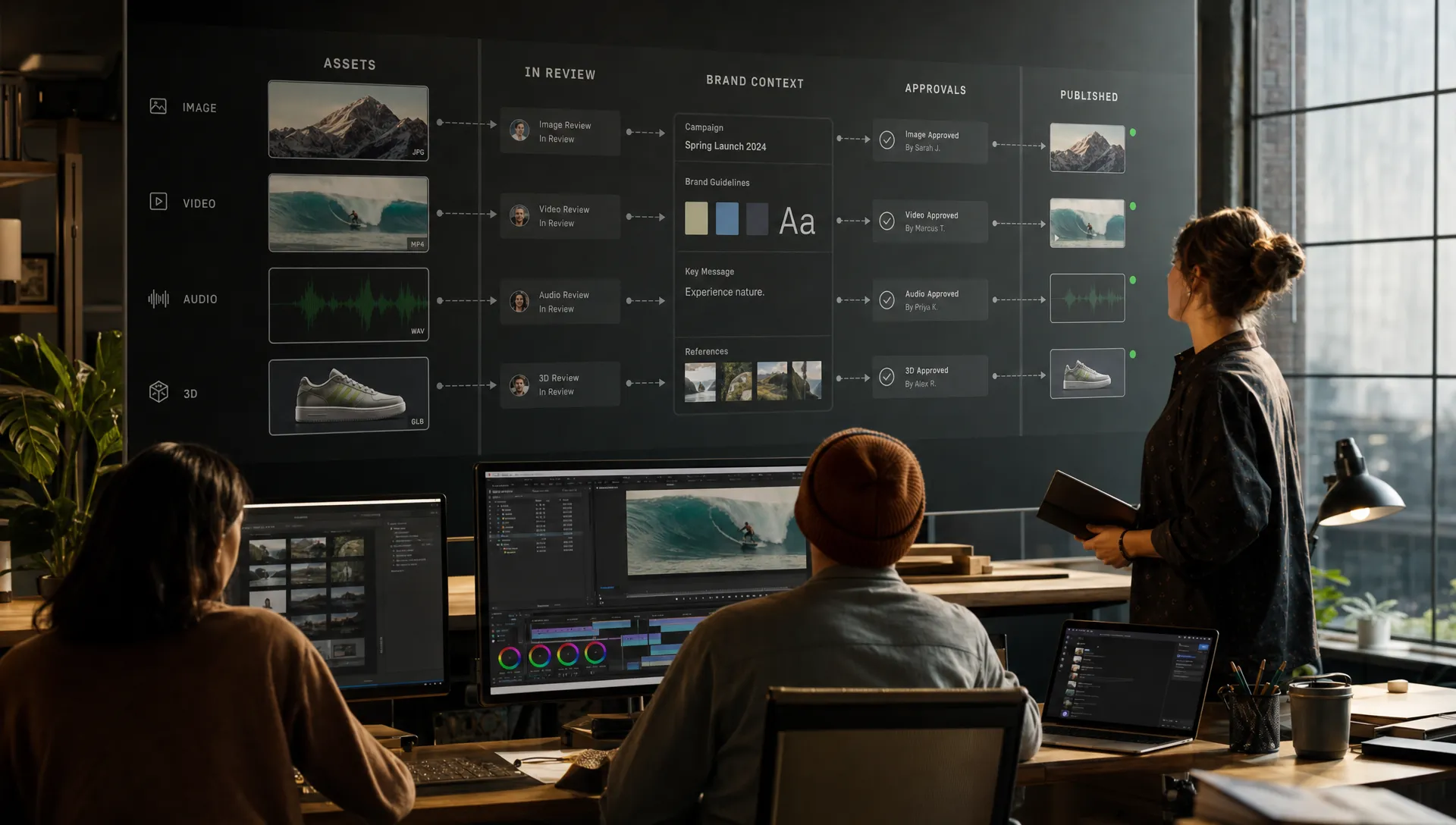
Search for generative AI websites and you will find a fast-growing landscape of tools that can produce images, video clips, copy, voiceovers, music, textures, avatars and 3D concepts from prompts. For individual creators, these websites are often enough. They are accessible, quick to test and useful for ideation.
Enterprise creative teams face a different problem. They do not only need to generate assets. They need to run AI across campaigns, brands, regions, products, studios and approval chains without losing control. That is where the gap appears between a generative AI website and a Creative AI OS.
A generative AI website is usually a destination where a user creates an output. A Creative AI OS is an operating layer that controls how creative AI is used across teams, tools and production workflows. The difference matters for CMOs managing brand consistency, art directors protecting creative intent, application managers responsible for governance and game developers connecting AI to production pipelines.
What generative AI websites are built to do
Most generative AI websites are designed around a simple interaction: the user enters a prompt, adjusts a few settings and receives an output. That output might be an image, a video sequence, a 3D object, a music loop or a block of text.
This model is valuable because it lowers the barrier to creation. A marketer can sketch campaign concepts without waiting for a full production cycle. A designer can explore visual territories before committing to a direction. A game artist can generate mood references or texture ideas in minutes. For early exploration, that speed is hard to ignore.
The strength of generative AI websites is usually one of the following: ease of access, model quality in a narrow domain, fast experimentation or a simple creative interface. They are excellent for answering the question, can this idea work?
They are less equipped to answer a harder question: can this idea be produced, reviewed, reused, localized, governed and integrated across the organization?
That is the point where teams often start to feel friction. Prompts live in browser histories or personal documents. Outputs are downloaded manually. Model settings vary from person to person. Review happens in separate tools. Brand rules are interpreted inconsistently. Legal, IT and compliance teams struggle to understand what is being generated, where data goes and who approved what.
For one creator, this may be manageable. For an enterprise studio, it becomes operational risk.
What a Creative AI OS does differently
A Creative AI OS is not just another generator. It is the control layer for creative AI production. Instead of asking each user to manage models, prompts, context, reviews and handoffs independently, the OS defines how AI runs across the creative organization.
In practice, that means it can coordinate multiple AI models, preserve studio context, support governed workflows, connect to existing tools and help teams produce consistent outputs across image, video, audio and 3D.
Virtuall, for example, describes this category as a Creative AI operating system for operating AI at scale across studio workflows, tools and production rules. The focus is not only generating content, but controlling how AI is used so teams can stay compliant and produce consistent, production-ready results.
If you want a broader foundation before comparing categories, this guide to what creative AI means for professional workflows explains why creative AI should be treated as a coordinated production system rather than a single prompt box.
The key shift is from creation as an isolated event to creation as a managed workflow. A Creative AI OS helps define who can generate what, which models can be used, what brand context applies, how assets are reviewed and how outputs move into downstream systems such as DAM, PIM, DCC tools or game development pipelines.
The core difference: output versus operating model
The simplest way to compare generative AI websites and a Creative AI OS is to look at what each one optimizes for.
| Dimension | Generative AI websites | Creative AI OS |
|---|---|---|
| Primary goal | Generate individual outputs | Operate AI-powered creative production |
| User model | Individual users or small teams | Studios, departments and enterprise teams |
| Context | Prompt-based, often session-specific | Shared brand, project and studio context |
| Governance | Limited or tool-specific | Centralized rules, permissions and controls |
| Model strategy | Usually one tool or model family | Multi-model orchestration across formats |
| Workflow | Manual downloads and handoffs | Structured review, approval and pipeline tracking |
| Integration | Often export-based | API, plugins and connections to creative systems |
| Compliance | Depends on each website | Designed for auditable enterprise use |
This does not make generative AI websites obsolete. It places them in the right category. They are useful creative tools, but they are not always sufficient operating infrastructure.
A Creative AI OS becomes relevant when the organization needs repeatability. If a CMO wants campaign assets across markets, the team needs more than a beautiful first image. It needs version control, brand rules, approval paths, rights awareness, localization logic and traceability. If an art director wants to maintain a visual world across hundreds of outputs, prompt memory alone is not enough. The team needs shared creative context that travels through the workflow.
For application managers, the distinction is even sharper. A browser tool might solve an immediate creative need, but it can create shadow AI if each team signs up for its own preferred website. A Creative AI OS gives IT and operations teams a clearer way to manage access, policies, integrations and compliance.
Why enterprise teams outgrow standalone generative AI websites
The first wave of AI adoption in creative teams often starts informally. Someone tests a website, shares impressive outputs and the tool spreads through the team. That is normal. It is also where fragmentation begins.
Different teams may use different models for similar tasks. Prompts and settings are not standardized. Brand guidance sits outside the generation process. Approved assets are mixed with experiments. Nobody has a complete view of what was created, what was used or what should be archived.
This is especially difficult in regulated or brand-sensitive environments. The NIST AI Risk Management Framework emphasizes governance, mapping, measurement and risk management as core parts of responsible AI use. For enterprise creative production, those concepts become practical questions: who approved this asset, what data informed it, which model generated it and does it meet internal policy?
The European Union has also moved AI governance from a theoretical topic to a compliance reality. The European Commission’s AI Act overview explains the EU’s risk-based framework for AI systems, with obligations applying in phases. Even when creative tools are not the highest-risk use case, enterprise teams still need to understand procurement, data handling, documentation and vendor governance.
A scattered set of generative AI websites makes this harder. A Creative AI OS gives organizations a more structured foundation for adoption, especially when AI moves from experimentation to production.
Creative consistency requires more than better prompts
Many teams try to solve AI inconsistency by writing better prompts. That helps, but it only goes so far.
Creative consistency depends on shared context. A prompt is only one part of that context. Brand guidelines, campaign strategy, product truth, audience, visual references, lighting language, character rules, material constraints and regional requirements all shape the final asset.
In a generative AI website, that context often has to be re-entered, summarized or manually reconstructed. The user becomes the memory layer. This works for small experiments, but it breaks down when teams need a consistent output style across many creators and formats.
A Creative AI OS treats context as part of the production environment. In Virtuall’s case, this includes studio context memory through mood boards and Nyx, the intelligence layer that orchestrates multiple AI models while keeping intent and context across studios and teams. The benefit is not magic automation. It is operational consistency: the system helps teams carry creative direction through the work instead of depending on each person to recreate it from scratch.
For art directors, this is critical. Their job is not just to produce assets, but to protect a creative vision as it passes through concepting, iteration, review and delivery. If every generated asset starts from a blank prompt box, the creative system becomes fragile.
Workflow orchestration is the hidden enterprise requirement
The biggest difference between generative AI websites and a Creative AI OS may not be visible in the output itself. It appears in everything around the output.
Enterprise creative work involves briefs, roles, approvals, comments, variants, rights checks, localization, technical specifications and handoffs. A standalone AI website might generate a good image, but it does not necessarily know where that image sits in a campaign, whether it has been approved, which product data it relates to or which team should receive it next.
A Creative AI OS is designed to orchestrate that surrounding workflow. Instead of separating generation from production management, it connects the two. This is important because AI does not remove the need for process. It increases the volume and speed of creative options, which makes process more important.
Teams evaluating enterprise AI should look closely at governance, workflow control and integration. Virtuall’s article on generative AI platforms enterprise teams can actually govern goes deeper into how those evaluation criteria change when AI becomes part of production.
For a CMO, orchestration supports brand reliability. For an application manager, it supports operational control. For a game developer, it supports pipeline fit. For an art director, it supports creative continuity.
Multi-model orchestration versus single-tool dependency
Generative AI websites often specialize. One tool may be excellent for cinematic video, another for image generation, another for 3D prototyping and another for audio. Specialization is useful, but it can lead to tool sprawl.
A Creative AI OS does not need to replace every model. Its role is to orchestrate them. This matters because creative teams increasingly need to combine formats. A campaign might require product imagery, short videos, localized social variations and 3D assets. A game team might need concept art, material studies, environment references and early mesh exploration.
If every format sits in a separate website with separate settings, accounts, policies and exports, production becomes fragmented. Multi-model orchestration gives teams a way to use the right model for the right task while maintaining shared workflow rules and context.
This also reduces strategic lock-in. Instead of building the entire creative process around one model’s interface, teams can define their creative operating model first and connect models underneath it. As model quality changes, the operating layer remains stable.
When generative AI websites are enough
Not every team needs a Creative AI OS on day one. Generative AI websites are often the right choice for early exploration, personal productivity and low-risk creative experimentation.
They are usually enough when the work is informal, the asset will not enter a production pipeline, brand risk is low and the creator can manage context manually. A freelancer exploring styles, a small team testing a pitch concept or a designer generating inspiration boards may not need enterprise orchestration.
The warning sign is not the use of websites. The warning sign is when business-critical work starts depending on unmanaged websites. If generated assets are used in campaigns, product pages, games, client deliverables or internal brand systems, the organization should ask whether the workflow is still controllable.
Useful questions include:
- Can we track which assets were generated, approved and used?
- Can we enforce brand, legal and compliance rules before outputs leave the workflow?
- Can teams reuse context across projects instead of rebuilding it manually?
- Can AI outputs connect to our existing creative tools and asset systems?
- Can we manage permissions, models and policies centrally?
If the answer to several of these questions is no, the team is probably moving beyond what standalone generative AI websites were designed to support.
How a Creative AI OS supports different enterprise roles
The value of a Creative AI OS changes depending on the stakeholder.
For CMOs, the priority is brand consistency, speed to market and responsible scaling. AI can increase asset volume, but without governance it can also increase brand drift. A Creative AI OS helps marketing leaders scale production while keeping creative rules attached to the workflow.
For art directors, the priority is visual integrity. They need AI to respect creative direction across iterations, teams and formats. Shared context, review workflows and generation blueprints help preserve intent from concept to final output.
For application managers, the priority is control. They need to understand access, integration, data flows and compliance. A Creative AI OS gives them a more manageable architecture than a patchwork of independent AI subscriptions.
For game developers, the priority is pipeline relevance. AI-generated content has to fit into real production constraints, including 3D workflows, asset management, iteration cycles and review. A Creative AI OS can connect generation to broader pipeline tracking and creative tool integrations rather than leaving outputs isolated in downloads folders.
Choosing between a website and an operating layer
The decision is not binary forever. Many organizations start with generative AI websites to learn what is possible. The mistake is assuming that the same setup will scale into professional production unchanged.
A practical approach is to separate experimentation from operationalization. Let teams explore, but define a threshold where AI-generated work must move into a governed environment. That threshold might be campaign use, client delivery, product representation, paid media, game asset development or any workflow involving sensitive data.
Once AI work crosses that threshold, the organization needs policies, repeatable workflows, approved models, context management and review processes. This is where a Creative AI OS becomes the more appropriate layer.
If your team is already moving in that direction, Virtuall’s guide to mastering AI production with a Creative AI OS explains the operating layer in more detail.
Frequently Asked Questions
Are generative AI websites the same as AI platforms? Not always. Many generative AI websites are single-purpose tools accessed through a browser. AI platforms can be broader, but the important question is whether they support governance, workflow, integration and repeatability for production use.
Can enterprise teams still use generative AI websites? Yes. They can be useful for exploration, ideation and low-risk experimentation. The challenge is making sure production work does not depend on unmanaged tools, undocumented prompts or isolated accounts.
What makes a Creative AI OS different from a DAM or PIM? A DAM manages digital assets and a PIM manages product information. A Creative AI OS controls and orchestrates AI-powered creation workflows, then can connect generated outputs and context to systems such as DAM, PIM, DCC tools and other production environments.
Why does multi-model orchestration matter? Different AI models are better at different tasks. Multi-model orchestration lets teams use specialized models for image, video, audio or 3D while keeping shared rules, context and workflows in place.
When should a company consider moving beyond generative AI websites? A company should consider an operating layer when AI outputs become part of campaigns, games, product content, client work or regulated workflows. At that point, governance, approval, traceability and integration become as important as generation quality.
From AI experimentation to controlled creative production
Generative AI websites are excellent entry points into AI-assisted creation. They make new ideas visible quickly and give teams a practical way to experiment. But enterprise creative production needs more than access to generators.
A Creative AI OS provides the operating layer around generation: governance, orchestration, context, collaboration, asset management, pipeline tracking and integration with the tools teams already use. That is the difference between making AI outputs and operating creative AI at scale.
If your organization is ready to move from scattered AI experiments to governed, repeatable creative production, explore how Virtuall helps teams control and scale AI-powered content creation across image, video, audio and 3D.