How Search Enterprise AI Changes Knowledge Access at Scale
Learn how search enterprise AI improves knowledge access at scale with semantic, multimodal, governed search for creative teams.
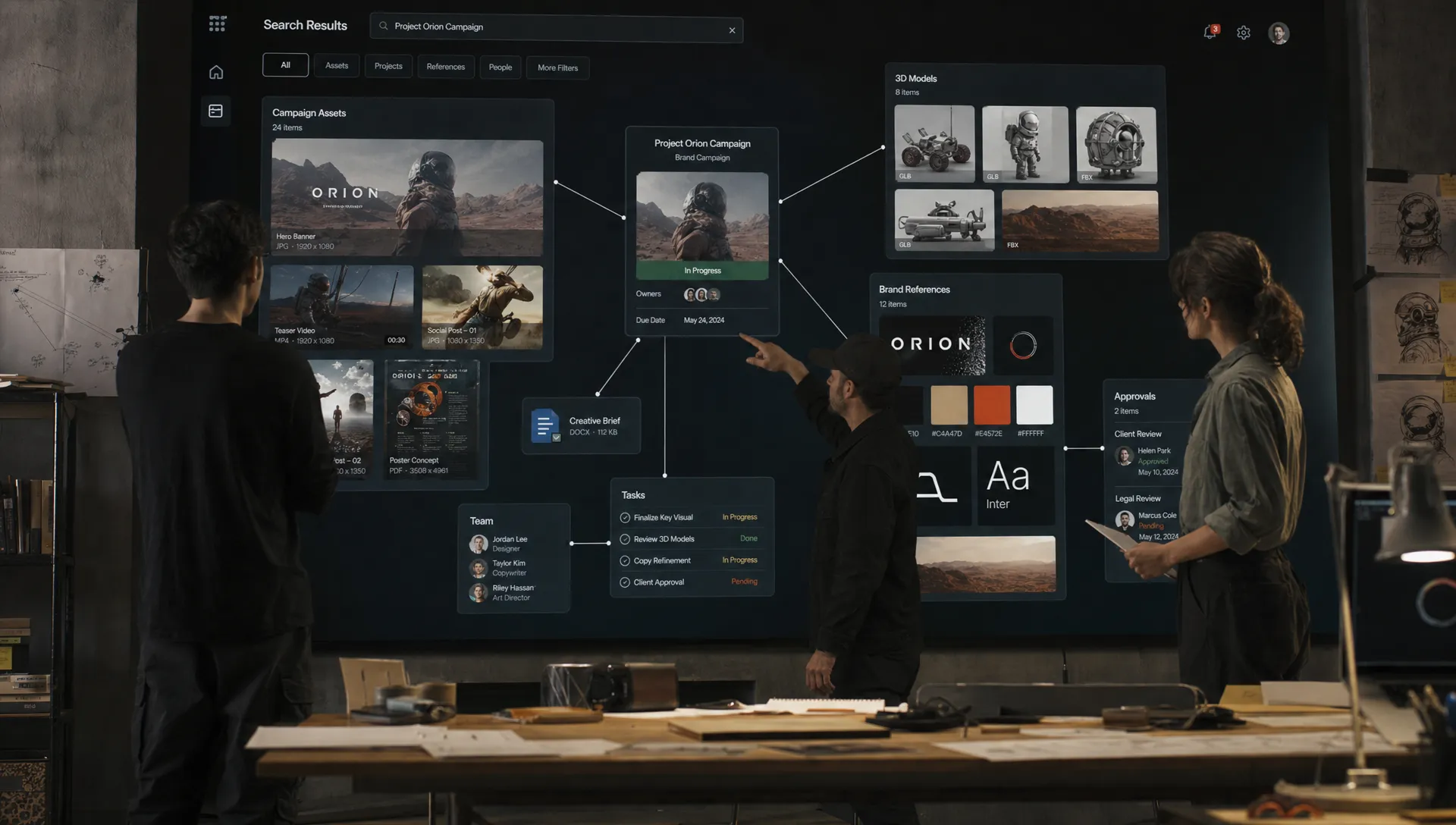
Enterprise knowledge has never been more valuable, or harder to find.
A global creative team may have campaign briefs in one tool, product data in a PIM, brand guidelines in a DAM, 3D assets in a studio pipeline, legal notes in email, approvals in project management software, and model outputs scattered across experimental AI tools. Everyone is technically “connected,” yet the right answer still depends on who knows where to look.
That is the problem search enterprise AI is beginning to solve. It does not simply make a search bar smarter. It changes how organizations access, govern, and reuse knowledge across people, tools, formats, and workflows.
For CMOs, art directors, application managers, and game developers, this shift matters because the bottleneck is no longer only content generation. It is finding the right context before generating anything at all.
What search enterprise AI means
Search enterprise AI refers to AI-powered systems that help people retrieve, understand, and act on organizational knowledge across enterprise data sources. Instead of relying only on exact keywords, folders, and manually maintained tags, these systems use natural language processing, embeddings, semantic search, retrieval augmented generation, and access controls to return relevant information in context.
In practice, a user might ask:
“Show me the latest approved visual direction for the spring campaign, including rejected concepts and the legal notes that explain why.”
A traditional search tool may look for matching words. A search enterprise AI system should understand the intent, search across connected sources, respect the user’s permissions, retrieve the most relevant items, and summarize what matters.
This is especially important in creative operations because knowledge is not only text. It can live inside:
- Image references and mood boards
- Video cuts, subtitles, and frame annotations
- 3D models, texture libraries, and scene files
- Product attributes and localization rules
- Review comments, approvals, and rejected variants
- Brand guidelines, legal constraints, and campaign strategy
Search enterprise AI is therefore not just an IT productivity upgrade. For creative organizations, it becomes part of the production infrastructure.
Why knowledge access breaks at scale
Knowledge access tends to work informally when a team is small. People know who created a file, which campaign used a visual idea, and why a certain direction was approved. As the organization grows, that informal memory becomes fragile.
The problem compounds when teams add more tools. A marketing team may use one platform for briefs, another for assets, another for analytics, another for approvals, and several AI tools for generation. Game studios and 3D teams face the same issue with DCC tools, asset repositories, builds, concept libraries, and production trackers.
At scale, knowledge access breaks for four common reasons.
First, data is fragmented. The answer exists, but it is split across systems that do not speak the same language.
Second, metadata is inconsistent. One team tags an asset as “luxury,” another as “premium,” and another as “hero visual.” Traditional search treats those as different things, even if the creative intent is similar.
Third, permissions are complex. Enterprise knowledge includes sensitive information, unreleased campaigns, licensed materials, partner assets, and regulated data. A system that ignores access rights creates risk.
Fourth, context disappears. A final asset may be easy to find, but the reasoning behind it, such as why one version was rejected or which legal constraint shaped the final edit, is often buried in comment threads.
This is why AI search is becoming more strategic. It helps organizations preserve context, not just retrieve files.
From keyword search to intent-aware knowledge access
The first major change search enterprise AI brings is the move from keyword matching to intent matching.
In traditional enterprise search, users often need to know the exact term used by the person who uploaded the asset. If they search for “winter product render,” they may miss files tagged “holiday 3D pack” or “seasonal ecommerce visual.” The system returns what matches the words, not necessarily what matches the need.
AI search uses semantic understanding to connect related concepts. It can interpret that “cinematic sci-fi corridor,” “futuristic industrial hallway,” and “spaceship interior” may describe overlapping creative references. For teams producing high volumes of images, videos, and 3D assets, this reduces the time spent translating one team’s language into another team’s taxonomy.
The second change is conversational access. Instead of filtering through dozens of folders, users can ask follow-up questions:
“Which of these assets are approved for North America?”
“Do we have a version without the licensed character?”
“Which campaign used a similar visual treatment last year?”
The goal is not to replace structured metadata. Good metadata still matters. The goal is to make enterprise knowledge easier to use when people do not know the exact file name, tag, or system of record.
The role of retrieval augmented generation
Retrieval augmented generation, often called RAG, is one of the core patterns behind modern AI search. Instead of asking a model to answer only from what it learned during training, RAG retrieves relevant enterprise information first, then uses that context to generate an answer.
This distinction matters. Without retrieval, an AI assistant may produce plausible but unsupported answers. With retrieval, it can ground responses in approved documents, asset records, policy notes, or production data. The IBM overview of retrieval augmented generation explains the basic principle clearly: connect generative AI to external knowledge sources so outputs can be more relevant and current.
For enterprise teams, RAG is useful only when paired with governance. The system must know which sources are authoritative, which documents are outdated, which users have access, and how to cite or trace retrieved information.
A creative example makes this clear. If an art director asks an AI system for “approved visual references for the next luxury skincare campaign,” the answer should not pull from a random experiment, an expired brand book, or an unauthorized image library. It should retrieve the current guideline, approved mood boards, rights-cleared references, and relevant campaign history.
That is the difference between AI as a clever interface and AI as an enterprise knowledge layer.
What changes for creative teams
Search enterprise AI changes day-to-day work because it makes knowledge available at the moment decisions are made. Instead of interrupting a workflow to hunt for context, teams can retrieve context inside the workflow.
For CMOs, this can mean faster visibility into campaign history, brand consistency, and regional variations. For art directors, it can mean finding prior concepts, rejected routes, and approved references before starting a new creative direction. For application managers, it can mean reducing tool sprawl by connecting search across systems with clear governance. For game developers, it can mean locating assets, lore, design decisions, and technical constraints without relying on tribal knowledge.
| Team role | Knowledge access challenge | How search enterprise AI helps |
|---|---|---|
| CMO | Campaign history, brand consistency, market localization, approval visibility | Surfaces approved assets, strategic context, and performance-relevant knowledge across teams |
| Art Director | Finding visual references, past concepts, and decision rationale | Retrieves mood boards, annotations, rejected variants, and brand rules through natural language |
| Application Manager | Fragmented tools, permissions, integrations, and compliance requirements | Connects knowledge sources while enforcing access controls and traceability |
| Game Developer | Assets, lore, design specs, build constraints, and reusable production elements | Makes 3D, image, and documentation knowledge easier to discover across pipelines |
For organizations already exploring broader enterprise AI, this is a natural next step. The strategic foundation is discussed in Virtuall’s guide to enterprise AI in 2026, but search adds a specific capability: making the company’s existing knowledge usable at production speed.
Why multimodal search matters
Most enterprise search systems were built around documents. Creative work is not built around documents.
A campaign may begin with text briefs, but it quickly becomes visual, spatial, temporal, and collaborative. The same idea may exist as a prompt, a mood board, a storyboard, a product render, a video edit, a 3D scene, and a review comment. If search only understands filenames and text fields, it misses much of the organization’s real knowledge.
Multimodal search expands access across formats. It can help users search using text to find images, images to find similar visuals, or asset metadata to locate related 3D and video outputs. In a production environment, this is not just convenient. It can reduce duplicated work and help teams reuse approved material.
For example, a game studio could search for “damaged medieval wooden gate with snow” and retrieve related concept art, 3D assets, texture sets, and level notes. A retail creative team could search for “approved ecommerce render with warm lighting and neutral background” and find prior product visuals that match the intended direction.
This is where generic enterprise search often falls short. Creative knowledge requires awareness of assets, approvals, rights, style, format, and production status.
Governance is the difference between useful and risky AI search
AI search becomes powerful when it can access many systems. That also makes governance non-negotiable.
At enterprise scale, search should not mean “everything is available to everyone.” It should mean the right person can access the right knowledge, with the right context, under the right rules. This includes permissions, auditability, source attribution, data residency, model usage policies, and review workflows.
The NIST AI Risk Management Framework is a useful reference for organizations building AI systems that need to be valid, reliable, safe, secure, accountable, and transparent. In Europe, the EU AI Act also reinforces the importance of risk management, transparency, and responsible AI deployment.
For creative teams, governance has practical implications:
- A junior designer should not see unreleased acquisition campaign materials if they are outside the project scope.
- A regional marketing team should not use an asset whose rights are limited to another territory.
- A generative AI workflow should not reuse a reference that legal has rejected.
- A model-generated output should be traceable to the brief, source context, and approval path that shaped it.
In other words, search enterprise AI must understand both meaning and boundaries.
Search becomes an orchestration layer
The most mature use of search enterprise AI is not limited to retrieving answers. It becomes an orchestration layer between knowledge and action.
A user should be able to move from “find the approved reference” to “generate compliant variations” to “send for review” to “store the final asset with the correct metadata.” Search becomes the entry point into a governed production flow.
This matters because AI content creation is increasingly multi-step. A team may need to locate brand context, choose a generation blueprint, select approved source assets, create variations, annotate outputs, route them for approval, and publish them into a DAM or PIM. If these steps remain disconnected, the organization gets speed in one place and chaos everywhere else.
Virtuall approaches this problem through a Creative AI OS designed to operate AI across studio workflows, tools, and production formats. Its capabilities include governance controls, workflow orchestration, multi-model content generation, generation blueprints, studio context memory, review workflows, approvals, asset management, and integrations with creative tools through plugins and APIs. For a deeper view of how these disciplines fit together, see the enterprise playbook on operating creative AI at scale.
The key point is that search should not be isolated from production. When knowledge access connects to workflow orchestration, teams can turn retrieved context into consistent, production-ready output.
What application managers should evaluate
For application managers and technology leaders, search enterprise AI is not just a feature request. It is an architecture decision.
Before adopting or expanding AI search, evaluate how it will connect to the systems where knowledge actually lives. That may include DAM, PIM, PLM, DCC tools, project management software, shared drives, chat platforms, design tools, and internal documentation. The value of search increases with coverage, but the risk also increases if permissions and source quality are not handled correctly.
Important evaluation criteria include:
- Source connectivity and API readiness
- Permission inheritance and role-based access control
- Support for text, image, video, audio, and 3D asset metadata
- Retrieval quality, citation, and answer traceability
- Data residency and infrastructure requirements
- Model governance and audit logs
- Integration with review, approval, and asset management workflows
- Evaluation methods for hallucination, relevance, and freshness
Creative teams should also evaluate whether the system understands production states. An asset may be a draft, approved, expired, rights-restricted, localized, or archived. A search result that ignores production status can create downstream errors.
This is why enterprise creative AI requires more than access to a model. It needs a governed operating layer that connects context, tools, people, and approvals.
How to start without boiling the ocean
A successful search enterprise AI initiative does not need to index the entire company on day one. In fact, starting too broadly can make results noisy and governance difficult.
A practical approach is to begin with a high-value knowledge domain where search friction is obvious. For a creative organization, that could be brand guidelines, campaign assets, product imagery, approved prompts, 3D libraries, or review history.
Start with a clear use case, such as “help art directors find approved visual references faster” or “help regional marketing teams locate rights-cleared campaign assets.” Then connect only the required sources, define access policies, and measure whether the system improves the workflow.
Once the first use case works, expand to adjacent workflows. Search for approved assets can lead to search for rejected variants. Search for campaign history can lead to search for performance learnings. Search for visual references can lead to generation workflows that use approved context.
This staged approach is especially useful for creative AI adoption. As Virtuall’s article on artificial intelligence for enterprise applications in Creative Ops explains, enterprise value comes from combining AI capability with orchestration, governance, and operational fit.
Metrics that show whether AI search is working
Search enterprise AI should be measured like an operational capability, not a novelty. The goal is not simply to deliver impressive answers. The goal is to improve access, reduce waste, and support better decisions.
Useful metrics include:
- Search success rate, measured by whether users find what they need without escalation
- Time to locate approved assets, references, or policy information
- Reuse rate of existing assets, prompts, templates, or creative directions
- Reduction in duplicated asset creation
- Percentage of answers with cited, authoritative sources
- Number of permission or rights-related search incidents
- User adoption across teams and regions
- Approval cycle speed when retrieved context is used in production
For creative organizations, one of the most important metrics is consistency. If AI search helps teams retrieve the same approved brand context before producing new assets, it can reduce drift across markets, channels, and formats.
The future of knowledge access is contextual
The long-term impact of search enterprise AI is not that employees will use a better search box. It is that knowledge will become more contextual, more governed, and more actionable.
People will expect to ask complex questions across formats. They will expect results that respect their permissions. They will expect summaries that cite sources. They will expect search to understand whether an asset is approved, expired, localized, or ready for production. They will also expect search to connect directly to the next step in the workflow.
For creative organizations, this changes the role of enterprise knowledge. It is no longer a passive archive. It becomes active production intelligence.
That is a major shift. The teams that benefit most will be the ones that treat search, governance, and creative AI workflows as one operating system, not separate experiments.
Frequently Asked Questions
What is search enterprise AI? Search enterprise AI is the use of AI to retrieve, interpret, and summarize knowledge across enterprise systems. It typically combines semantic search, retrieval augmented generation, permissions, and integrations so employees can find relevant information faster and with more context.
How is search enterprise AI different from traditional enterprise search? Traditional enterprise search usually depends on keywords, metadata, and filters. Search enterprise AI can understand intent, connect related concepts, search across multiple formats, and generate contextual answers grounded in retrieved sources.
Can search enterprise AI work with creative assets? Yes, if the system supports multimodal knowledge and production metadata. Creative teams need search across images, video, 3D assets, mood boards, briefs, approvals, and rights information, not only documents.
Is AI search safe for enterprise knowledge? It can be, but only with strong governance. Enterprises should require permission-aware retrieval, source attribution, auditability, data residency controls, and clear rules for how models can use internal knowledge.
Where should a company start with search enterprise AI? Start with one high-value workflow where knowledge access slows teams down, such as finding approved brand assets, retrieving campaign history, or locating reusable 3D assets. Prove value, then expand to adjacent workflows.
Turn enterprise knowledge into governed creative production
Search enterprise AI is most valuable when it does more than retrieve information. It should help teams access the right context, apply the right rules, and move confidently into production.
Virtuall helps creative teams operate AI at scale across images, video, 3D, and studio workflows, with governance, orchestration, context memory, approvals, and integrations designed for enterprise creative production.
If your organization is ready to move from scattered AI experiments to governed creative AI operations, explore how Virtuall can support knowledge access, content generation, and production workflows at scale.