What to Expect From an AI Creatives Company in Enterprise Deals
What to expect from an AI creatives company in enterprise deals: governance, compliance, integrations, SLAs, and a practical vendor evaluation checklist.
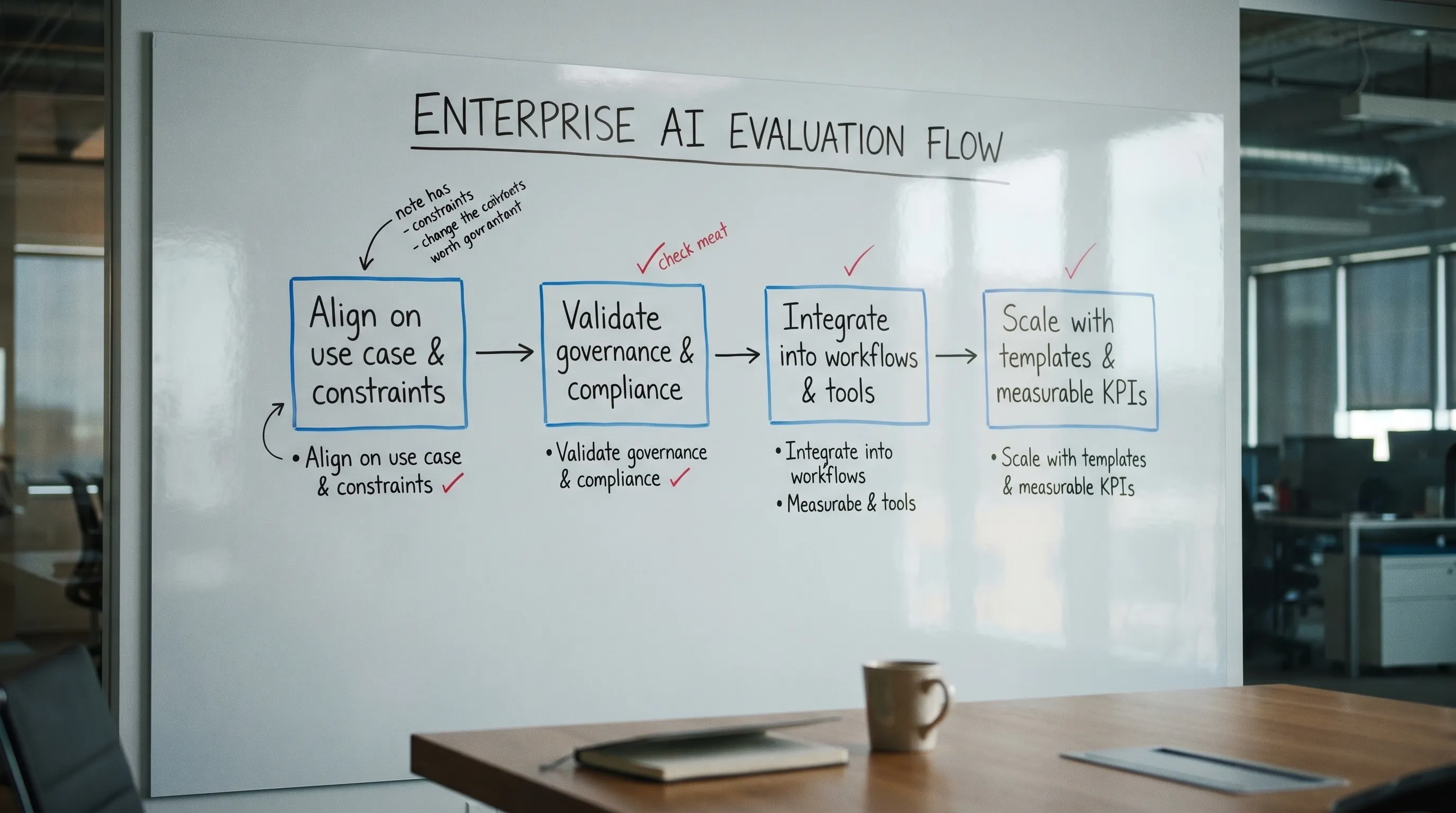
Enterprise buyers are no longer asking whether AI can generate content. They are asking whether AI can generate on-brand, compliant, production-ready assets reliably, across teams, tools, and regions.
That is the difference between a demo that impresses and an enterprise deal that closes.
If you are evaluating an AI creatives company for a large rollout (marketing, product content, game art, or studio production), here is what you should expect from the vendor, what they should expect from you, and how to structure the deal so the outcomes are measurable.
Why enterprise AI creative deals are different
In enterprise environments, creative AI is rarely a standalone “generate an image” workflow. It touches regulated data, brand governance, IP ownership, vendor risk, and operational continuity.
Common enterprise realities that change the evaluation:
- Multiple stakeholders: CMO, Art Direction, Legal, Security, Procurement, IT/Application Management, and the teams shipping assets.
- Multiple systems: DAM/PIM, creative suites, ticketing systems, pipeline tooling, render infrastructure, and approval workflows.
- Multiple risk surfaces: brand safety, training data questions, data residency, auditability, and model behavior drift.
So the right expectation is not “which model is best,” but “which operating approach keeps AI output consistent, traceable, and controllable at scale.”
What an AI creatives company should bring to the table
1) Governance and control, not just generation
At enterprise scale, you need controls that define how AI is allowed to run.
You should expect:
- Policy-based governance (who can generate what, with which models, in which projects)
- Audit trails that answer what was generated, when, by whom, with which inputs
- Role-based access control and approval paths aligned to your org chart
This is where many “AI tools” fail enterprise procurement: they generate output, but they cannot prove how or why it was produced, and they cannot enforce rules consistently.
If you operate in or sell into regulated environments, look for alignment with broadly recognized frameworks. A good vendor will be fluent in how their controls map to your risk posture, not defensive or vague. Helpful references include the NIST AI Risk Management Framework and GDPR requirements around processing and access controls.
2) Workflow orchestration across teams and tools
Creative work is a pipeline. Enterprises rarely want another isolated interface.
You should expect orchestration capabilities that fit into how work already ships:
- Brief to generation to review to approval workflows
- Handoffs between roles (creative, brand, legal, localization)
- Queueing, versioning, and pipeline tracking so scale does not break accountability
For Application Managers and IT, this is the difference between “a tool some people use” and “a system we can operate.”
3) Multi-model strategy (and a plan for model change)
Enterprise creative needs shift by use case: product imagery, campaign concepts, video variants, 3D ideation, audio, or game asset exploration.
A credible AI creatives company should:
- Support multiple models so you can choose the right engine per task
- Provide a way to standardize outputs even when the underlying model changes
- Have a clear approach to model updates, regression risk, and reproducibility
Model churn is real. If the vendor cannot explain how they prevent “output drift” when models update, you will feel it in brand inconsistency and rework.
4) Reusable templates and “blueprints” for consistency
Enterprises win on repeatability.
Expect a serious vendor to offer templating mechanisms such as:
- Prompt and parameter templates for consistent styling
- Pre-approved workflows for common deliverables (for example, e-commerce variants, campaign cutdowns, game concept batches)
- Guardrails that constrain outputs to your brand or production rules
This is what turns AI from experimentation into an operational capability.
5) Context management for creative intent
Creative is not only prompts. It is references, mood boards, prior decisions, and campaign context.
A strong enterprise solution should preserve context so teams do not restart from zero every time:
- Project-level memory (references, style direction, constraints)
- Shared creative context across collaborators
- Controlled reuse of approved assets and instructions
This reduces the biggest hidden cost in enterprise AI adoption: prompt tribal knowledge locked in individual users.
6) Collaboration features that match real review cycles
In enterprise creative, “done” means approved.
Expect collaboration features that support:
- Review workflows and approval routing
- Commenting and annotation on outputs
- Clear status transitions and ownership
If the vendor’s review story is “export and discuss elsewhere,” you should assume friction, slower cycles, and compliance gaps.
7) Asset management and integration into your content stack
Enterprises cannot treat outputs as disposable. They need to store, find, reuse, and govern them.
At minimum, expect:
- Asset capture (metadata, versions, lineage)
- Integration paths to DAM/PIM systems and creative tooling
- APIs or plugins to reduce manual downloading, renaming, and re-uploading
This is also where procurement and IT will ask: “How does this fit into our architecture?” A good AI creatives company will have a concrete integration plan and references.
What to expect in security, privacy, and compliance reviews
Enterprise deals often slow down here, and for good reason. Plan for this phase early.
Core items procurement and security teams will request
Most enterprises will require some combination of:
- SSO support (often SAML or OIDC)
- Fine-grained access control and least-privilege roles
- Audit logs and retention options
- Data processing terms (DPA) and subprocessors list
- Vulnerability management and incident response process
- Clear data handling: what is stored, where, for how long, and who can access it
If you operate in Europe or handle EU personal data, data residency and GDPR posture can be central. If you are building forward-looking governance, monitor EU regulatory direction such as the EU AI Act (informational resource with links to primary texts).
Creative-specific compliance questions you should ask
Enterprise creative AI introduces a few questions that are not typical for standard SaaS:
- IP and usage rights: What do you own, and what does the vendor retain (if anything)?
- Training and retention: Are your prompts, inputs, or outputs used to train models, and can you opt out?
- Brand safety controls: How do you prevent disallowed content categories, unsafe outputs, or off-brand variation?
- Provenance and traceability: Can you document the generation chain for audits, disputes, or client requirements?
A serious vendor will have crisp answers, written terms, and technical controls, not just marketing statements.
What “enterprise-ready” delivery should look like
Enterprise buyers should expect a structured rollout, not a loose pilot.
A proof-of-value that mirrors production
Avoid proofs of concept that only test “quality of one output.” Instead, test whether the system holds up under real constraints.
A strong proof-of-value typically includes:
- A defined use case with throughput goals (for example, create X variants per week)
- Brand and legal constraints that reflect reality
- Review and approval steps
- Integration touchpoints (even if limited)
- Measurable baselines: time, cost, revisions, and rework
Change management and enablement
AI creative success is partly operational.
Expect the vendor to support:
- Role-based onboarding (creatives, approvers, admins)
- Governance setup workshops (rules, templates, workflows)
- A model for continuous improvement (what gets standardized next)
If adoption depends on a few power users, enterprise impact will be fragile.
Support and reliability commitments
For enterprise deals, you should expect clarity on:
- Support channels and response targets
- Escalation path for production-blocking issues
- Platform uptime expectations
- Release management (how changes are communicated and controlled)
These are not “nice-to-haves” when creative output feeds revenue-generating campaigns or production schedules.
Commercial expectations: pricing, scope, and ownership
Enterprise AI creative pricing can be complex because usage and value are not always linear.
You should expect transparent answers on:
- What is considered usage (generations, compute, seats, projects)
- What happens with spikes (campaign launches, seasonal content)
- How costs map to business value (throughput, speed, fewer revisions)
Also ensure the contract is explicit on ownership and permitted usage of outputs. If you need a starting point for internal conversations, the U.S. Copyright Office has published guidance and updates on AI-related copyright topics (see the Copyright Office AI initiative). Your counsel should interpret applicability to your specific workflows.
Deal terms checklist (practical, not theoretical)
Use the table below as a concrete checklist for procurement alignment.
| Deal area | What “good” looks like | Why it matters in creative AI |
|---|---|---|
| Data handling | Clear storage, retention, access controls, and residency options | Reduces privacy and client risk, supports audits |
| IP and outputs | Explicit ownership and permitted usage of generated assets | Avoids downstream disputes, protects commercial rights |
| Model policy | Controls for which models can be used, by whom, and where | Prevents rogue usage and inconsistent output |
| Auditability | Logs for generation events and approvals | Enables governance, investigations, client requirements |
| Integration | API/plugin strategy and implementation support | Prevents “download and re-upload” inefficiency |
| Reliability | Support SLAs, uptime targets, incident response | Keeps production pipelines predictable |
A vendor evaluation framework you can actually use
Most enterprise teams benefit from separating evaluation into four categories: output quality, operational control, integration, and risk.
Here is a lightweight scoring framework that works well in enterprise RFPs.
| Category | Key questions to ask an AI creatives company | Evidence you should request |
|---|---|---|
| Output quality | Can it meet your bar across image, video, 3D needs (as relevant)? Is it consistent across users? | Side-by-side samples on your briefs, variance analysis, template approach |
| Governance | Can you define rules and enforce them across teams? | Admin console walk-through, role matrix, policy examples, audit log sample |
| Workflow | Does it match your review and approval reality? | End-to-end demo including approvals, annotations, versioning |
| Integration | Can it fit your DAM/PIM/DCC stack without manual workarounds? | API docs, plugin list, reference architectures, integration plan |
| Compliance | Can it satisfy security and privacy requirements? | Security package, DPA, subprocessors, residency options |
| Operability | Can IT and studio ops run it day-to-day? | Monitoring approach, release process, support model |
If a vendor excels only at output quality but cannot meet the other categories, the deal risk stays high.
What different stakeholders should expect
For CMOs and marketing leaders
Expect the vendor to tie AI to measurable marketing outcomes:
- Faster variant production without quality collapse
- Brand consistency across regions and teams
- Better reuse of approved creative building blocks
Ask for a plan to measure cycle time, revision counts, and speed to launch.
For Art Directors and creative leads
Expect tools that protect creative intent:
- Strong reference handling and context continuity
- Templates that preserve style without forcing sameness
- Review workflows that support iteration, not just output dumping
Also insist on controllability, because “more outputs” can become “more curation work” if the system is not governed.
For Application Managers and IT
Expect an enterprise-grade operating posture:
- Identity and access integration
- Audit logs and traceability
- Configuration management for policies and templates
You should not have to rely on informal process to keep the system safe.
For game developers and studios
Expect support for pipelines and production realities:
- Orchestration across concepting, iteration, and asset management
- Collaboration that fits how art reviews happen
- Multi-format support when your work spans 2D, video, and 3D
The key question: can the system scale without breaking style consistency and team coordination?
Frequently Asked Questions
What is an AI creatives company in an enterprise context? An AI creatives company provides tools and infrastructure to generate and manage creative content with AI, plus governance, workflows, collaboration, and compliance features required by large organizations.
What should be included in an enterprise AI creative proof-of-concept? It should replicate production conditions: real briefs, brand constraints, review and approval steps, integration touchpoints, and KPIs such as time-to-deliver and revision rate.
How do we evaluate governance for creative AI? Look for role-based controls, policy enforcement, audit logs, approval workflows, and the ability to standardize outputs with templates while keeping traceability.
Why does multi-model support matter for enterprise creative teams? Different tasks often require different models, and model capabilities change over time. Multi-model support reduces vendor lock-in and improves fit across image, video, and 3D workflows.
What are the biggest procurement risks in AI creative deals? Unclear IP ownership, unclear data usage and retention, lack of auditability, weak access controls, and poor integration that forces manual workarounds.
Where Virtuall fits
Virtuall is positioned as a Creative AI operating system for teams that need to operate AI at scale across image, video, and 3D with enterprise governance. It focuses on control (governance), orchestration (workflows), collaboration (review and approvals), and integration into existing creative stacks, with EU-based infrastructure and inference for compliance needs.
If your enterprise evaluation criteria include consistent production-ready outputs, reusable generation blueprints, studio context memory (mood boards), and an orchestration layer (Nyx) that can coordinate multiple models while keeping intent and context across teams, Virtuall is designed for that operating model.
To explore fit for your workflows and security requirements, visit Virtuall and align on a proof-of-value that mirrors your real pipeline, not just a demo prompt.