AI Creative Jobs: The New Roles Emerging in 2026
AI creative jobs are changing fast in 2026. Discover the new roles, skills, and team structure enterprises need to scale compliant AI content.

Creative teams spent 2023 to 2025 experimenting with generative tools. In 2026, the conversation has shifted from “Can we make it?” to “Can we operate it, repeatedly, safely, and at scale?” That shift is why AI creative jobs are no longer centered on one “prompt person.” The fastest-growing roles sit at the intersection of brand standards, production pipelines, governance, and cross-team delivery.
For CMOs, Art Directors, Application Managers, and Game Developers, this matters for one reason: creative output is becoming partially software-operated. New roles are emerging to make AI content production consistent, compliant, and compatible with the rest of your organization.
Why AI creative jobs are changing in 2026
Three forces are converging:
First, volume and speed expectations have risen. Creative is now expected to deliver more variants, more localization, more channel formats, and faster iteration, without compromising quality.
Second, risk has become operational, not theoretical. Copyright disputes, data usage questions, disclosure requirements, and model behavior issues show up as production blockers. This is especially true for regulated industries and global brands.
Third, tool sprawl is collapsing into systems. Enterprises are moving from individual AI tools to governed platforms that can orchestrate models, manage assets, enforce rules, and preserve context across teams.
This is the environment that produces “2026 roles”: jobs designed around repeatability, governance, and integration, not one-off generation.
The 2026 creative AI org: from “makers” to “operators”
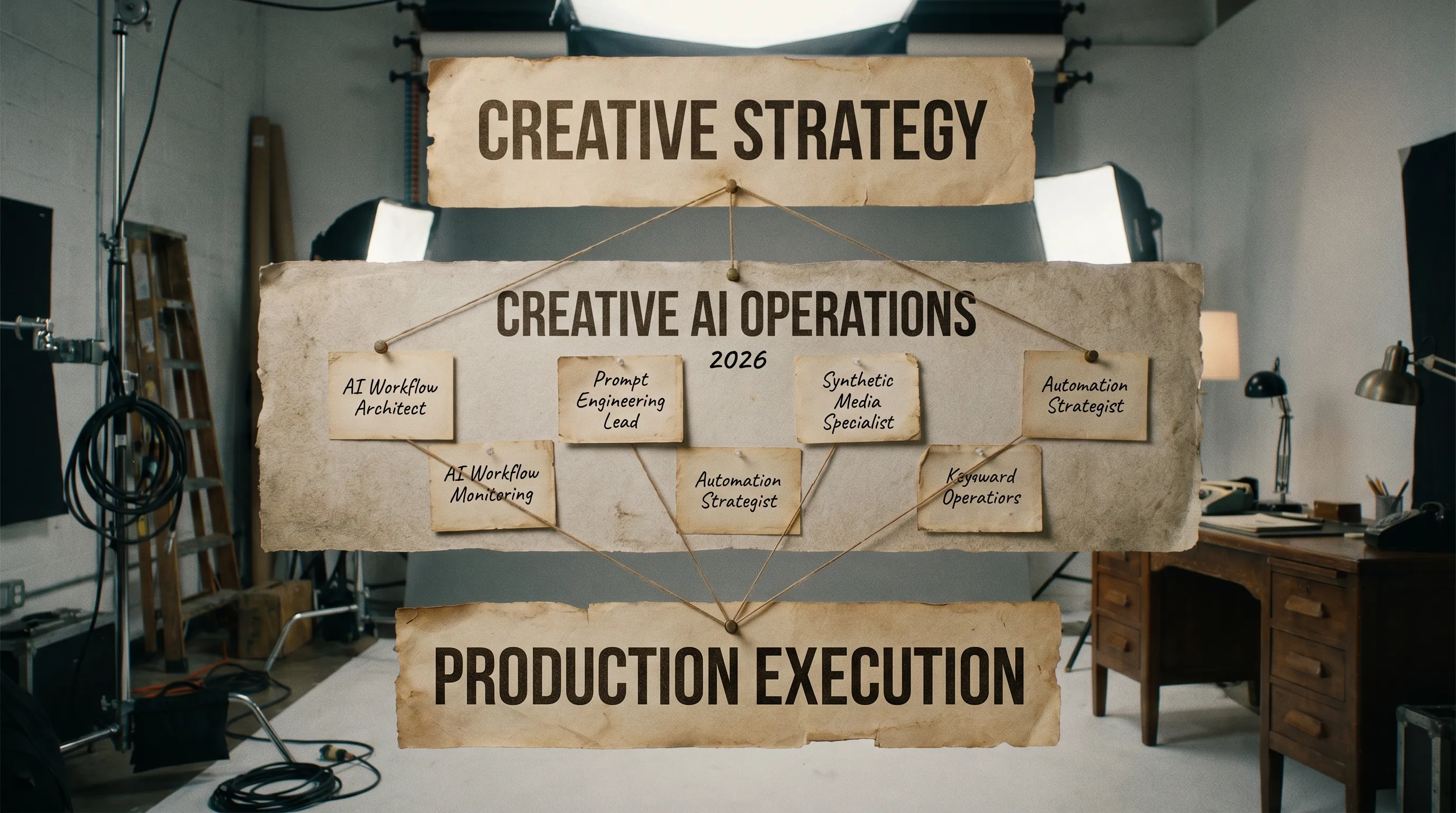
A useful mental model is that teams are adding a new layer between strategy and execution.
- Strategy layer: brand, campaign direction, creative leadership
- Operating layer: governance, orchestration, templates, approvals, asset flows
- Execution layer: designers, editors, 3D artists, motion, game art, content ops
The operating layer is where many of the new AI creative jobs sit.
New AI creative jobs emerging in 2026 (and what they actually do)
Below are roles that are showing up in enterprise studios, in-house agencies, and game teams. Titles vary, but the responsibilities are converging.
Creative AI Operations Lead (Creative AI Ops)
Mission: Run AI like a production capability, not a set of experiments.
Typical responsibilities include defining how AI is used across workflows, setting runbooks, choosing which models are allowed for which tasks, and coordinating across creative, security, and legal. This role often owns “how work moves” through the AI-enabled pipeline.
What success looks like: shorter cycle times, higher reuse of approved templates, fewer compliance escalations, predictable output quality.
AI Governance and Compliance Producer
Mission: Make creative AI usage auditable and policy-driven.
This role turns policy into practice: what data can be used, what outputs need review, what disclosures apply, what’s stored and for how long, and which teams can access which capabilities. In Europe, teams increasingly reference the direction of travel set by the EU AI Act, and enterprise legal teams expect documented controls (see the European Commission’s overview of the EU AI Act).
What success looks like: documented workflows, fewer “unknown provenance” assets, approvals that do not bottleneck production.
Generation Blueprint Designer (Template and System Prompt Architect)
Mission: Convert creative intent into repeatable, scalable “recipes.”
Instead of prompting from scratch, this role builds reusable generation blueprints (templates) for common use cases like product angles, lifestyle variants, character turnarounds, key art explorations, or cinematic shot styles.
What success looks like: higher consistency across outputs, less variance between teams, faster onboarding of new creatives.
Studio Context Librarian (Moodboard and Style Memory Curator)
Mission: Maintain “what good looks like” as living context.
As teams scale AI generation, the differentiator is not access to models, it’s preserving context: brand style, visual language, and creative constraints. This role curates moodboards, style references, do-not-use patterns, and approved exemplars, then keeps them current.
What success looks like: fewer off-brand outputs, faster alignment in reviews, less rework.
AI Output QA Specialist (Creative Quality and Safety)
Mission: Catch subtle failures before they ship.
This job blends creative judgment with structured QA. It includes reviewing for anatomy issues, text artifacts, brand guideline violations, culturally sensitive mistakes, “uncanny” motion problems, or 3D topology issues depending on the medium.
What success looks like: lower defect rates, fewer late-stage fixes, clearer acceptance criteria for AI outputs.
Synthetic Media Producer (Image, Video, Audio)
Mission: Produce final, production-ready media from AI-assisted workflows.
Unlike early “prompt-only” roles, this producer understands the full pipeline: generation, compositing, color, sound, editorial timing, deliverable specs, and versioning. In many teams, this is the person who can take AI outputs and make them ready for distribution.
What success looks like: AI outputs that meet technical specs, consistent deliverables across channels, less handoff friction.
3D Generative Artist / Procedural AI Artist
Mission: Use AI to accelerate 3D creation while protecting downstream usability.
In games, retail, and product visualization, “pretty” is not enough. The role focuses on meshes, materials, UVs, and compatibility with engines and DCC tools. The best candidates understand both creative intent and technical constraints.
What success looks like: assets that can be rigged, animated, optimized, and shipped.
Creative AI Pipeline Integrator (Plugins, APIs, Toolchain)
Mission: Connect creative AI to the systems enterprises already run.
This is often owned by Application Managers, creative technologists, or pipeline engineers. The work is about identity and access, asset metadata, integration with DAM/PIM/DCC tools, and getting AI outputs into the right repositories with the right tags.
In some organizations, this integration scope also touches ERP and automation. If your team is aligning creative operations with back-office workflows, a specialist partner can help accelerate that bridge, for example AI & NetSuite consulting designed to connect automation, systems integration, and measurable delivery.
What success looks like: fewer manual transfers, reliable metadata, traceable assets, smoother handoffs from creation to commerce.
Human-in-the-Loop Review Producer (Approvals and Collaboration)
Mission: Orchestrate review workflows so AI increases throughput instead of increasing review chaos.
AI increases the number of variants, which can overload stakeholders. This role designs review stages, annotations, approval rules, and escalation paths so feedback stays actionable and the team does not drown in options.
What success looks like: faster approvals, fewer subjective loops, clear audit trails of decisions.
Where these roles sit (and how to avoid org confusion)
A common failure pattern in 2024 to 2025 was placing “AI creative” entirely inside marketing or entirely inside IT. In 2026, the effective model is shared ownership: creative leads own taste and outcomes, operations owns repeatability, IT/security owns controls and integrations.
This table can help you map roles to likely homes and KPIs.
| Role (2026) | Likely home | Primary KPI focus | Works closely with |
|---|---|---|---|
| Creative AI Operations Lead | Creative Ops or Studio Ops | Cycle time, adoption, reuse | CMO org, Art Directors, IT |
| AI Governance and Compliance Producer | Risk, Legal Ops, or Creative Ops | Auditability, policy adherence | Legal, Security, Procurement |
| Generation Blueprint Designer | Studio, Creative Tech | Consistency, time saved | Art Direction, Brand, Production |
| Studio Context Librarian | Brand Studio or Creative Ops | Brand adherence, rework reduction | Art Directors, Content Leads |
| AI Output QA Specialist | Production or QA | Defect rate, acceptance pass rate | Producers, Localization, QA |
| Synthetic Media Producer | Production | Deliverable quality, throughput | Editors, Motion, Design |
| 3D Generative Artist | 3D team / Game art | Asset usability, iteration speed | Tech art, Engine, Art Direction |
| Creative AI Pipeline Integrator | IT / Creative Technology | Integration reliability, metadata completeness | DAM/PIM owners, Security, Studio Ops |
| Human-in-the-Loop Review Producer | Creative Ops | Approval time, stakeholder satisfaction | Marketing, Legal, Brand |
Skills that matter more than “prompting” in 2026
Prompting is still useful, but it is table stakes. The differentiating skills show up in how people design systems.
- Operational design: turning a subjective creative process into a repeatable workflow without killing creativity
- Taste plus measurement: defining acceptance criteria and using structured review to improve consistency
- Governance literacy: understanding permissions, policies, data handling, and audit needs
- Pipeline thinking: how assets move through tools, repositories, and stakeholders
- Context management: keeping creative intent consistent across teams, models, and time
For hiring, this means your best candidates might come from creative operations, production, pipeline engineering, QA, or brand governance, not only from “AI enthusiasts.”
What this means for each target persona
For CMOs
Your advantage is not “we used AI,” it is “we can reliably ship on-brand creative at high volume.” The key is investing in operating roles that reduce variability and risk. Without them, AI often increases rework and review burden.
Look for clear ownership of:
- Brand consistency across variants
- Approval workflows and accountability
- Compliance and disclosure practices
- Integration into campaign operations and asset libraries
For Art Directors
Art direction becomes more like designing a creative system: you define constraints, references, and acceptance criteria that a team can execute repeatedly. The biggest unlock is partnering with blueprint and context roles so your intent survives scale.
For Application Managers
Your world is where “creative AI” becomes enterprise software. Expect to evaluate identity and access controls, data residency requirements, integration patterns (plugins, APIs), asset metadata, and lifecycle management.
The strongest teams treat AI generation as one part of a governed pipeline, not a separate sandbox.
For Game Developers
The opportunity is iteration speed, but the risk is unusable output. New roles like 3D generative artists and AI QA specialists help ensure assets are engine-ready, stylistically consistent, and technically compliant (topology, LODs, rigging constraints).
How Virtuall aligns with the 2026 role shift
Many of the roles above exist because teams need a way to control, orchestrate, and scale creative AI across image, video, and 3D, with enterprise-grade governance.
Virtuall is positioned as a Creative AI operating system that supports this operating layer through capabilities such as AI governance controls, workflow orchestration, generation blueprints (templates), studio context memory (mood boards), collaboration tools for review and approvals, asset management, pipeline tracking, and integrations via plugins and API. Virtuall also highlights EU-based infrastructure and inference for teams that need a strong compliance posture.
Nyx, Virtuall’s intelligence layer, is designed to orchestrate multiple industry-leading AI models while keeping intent and context across studios and teams, which directly supports roles like Creative AI Ops, blueprint designers, and context librarians.
Frequently Asked Questions
Are AI creative jobs replacing designers and artists in 2026? Most enterprises are hiring for AI creative jobs to increase throughput and consistency, not to remove creative leadership. The new roles focus on operations, governance, QA, and pipeline integration so creatives can spend more time on direction and craft.
What is the difference between a prompt engineer and a generation blueprint designer? A prompt engineer typically optimizes individual prompts. A generation blueprint designer builds reusable templates and workflows that teams can apply consistently, including context, constraints, review steps, and output specs.
Which AI creative job is most important for an enterprise to hire first? If you are moving beyond experimentation, a Creative AI Operations Lead (or equivalent) is often the highest-leverage first hire because they establish workflows, ownership, and guardrails that make other roles effective.
How do we keep AI outputs on-brand across teams and regions? Teams are increasingly using curated context (mood boards, approved exemplars) plus reusable generation blueprints and structured reviews. Centralizing these practices reduces drift and helps enforce standards.
What should Application Managers prioritize when operationalizing creative AI? Governance (access control, auditability, data handling), integrations (DAM/PIM/DCC), metadata and asset lifecycle, and reliability in production workflows. Without these, creative teams tend to rebuild the process in ad hoc ways.
Build an operating layer for creative AI
If your organization is hiring for AI creative jobs in 2026, that is a strong signal you are ready to treat AI as a production capability. The next step is giving those roles a system that can enforce rules, preserve context, and orchestrate workflows across teams and tools.
Explore how Virtuall helps studios operate creative AI at scale, with governance, orchestration, and production-ready outputs across image, video, and 3D: https://virtuall.pro.