Why Centralized Creative Operations Systems Win at Scale
Explore why centralized creative operations systems improve workflow visibility, approvals, asset governance, and campaign throughput at scale.
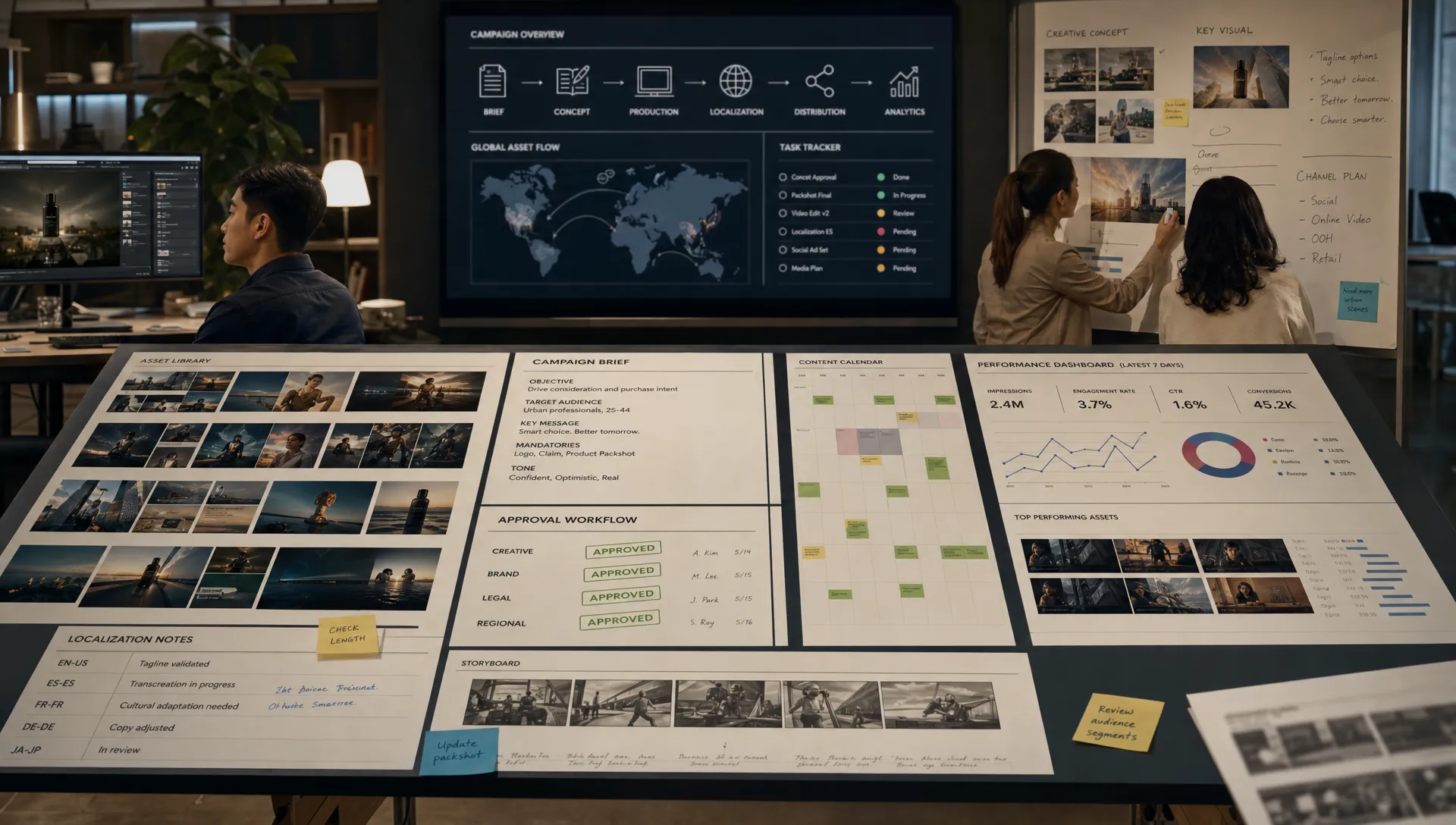
For enterprise creative teams, scale is rarely blocked by talent alone. The harder problem is operational: too many briefs in too many places, too many reviews happening outside the workflow, too many assets without clear ownership, and too little visibility into what is slowing production down.
That is why centralized creative operations systems matter. They do not simply organize projects. They connect the full creative lifecycle, from briefing and production to approvals, localization, publishing, analytics, and asset governance, so teams can produce more work without losing control of quality, brand consistency, or compliance.
For CMOs, this means clearer throughput and faster campaign execution. For art directors, it means fewer context gaps and less repetitive rework. For application managers, it means a cleaner operating layer across tools. For game developers and content teams, it means repeatable pipelines across image, video, 3D, and other production formats.
Creative operations is now an integrated ecosystem
Creative operations used to be treated as the coordination layer around creative work. It covered requests, timelines, task assignments, and approvals. That definition is no longer enough.
Modern creative operations is an integrated ecosystem. It connects the people, tools, assets, rules, and data required to move creative work from idea to production-ready output. In a mature environment, a brief is not just a document. It becomes the source of production requirements, review criteria, localization needs, channel constraints, asset dependencies, and success metrics.
This ecosystem typically includes:
- Intake and briefing, so requests arrive with the right context.
- Planning and resourcing, so teams can prioritize work against capacity.
- Production workflows, so creators know what to make and how it will be used.
- Review and approval paths, so feedback is structured and accountable.
- Localization and versioning, so campaigns can scale across markets.
- Publishing handoffs, so assets reach the right CMS, DAM, PIM, commerce platform, game engine, or channel.
- Analytics and performance feedback, so future creative decisions improve.
- Asset governance, so rights, usage rules, versions, and compliance are visible.
When these stages operate separately, leaders only see fragments. When they are connected, creative operations becomes a control system for scale.
Why fragmentation becomes expensive at scale
A small team can survive with shared folders, chat threads, spreadsheets, and occasional manual chasing. An enterprise studio cannot. As volume increases, fragmentation turns into hidden cost.
The most common symptoms are easy to recognize. Briefs arrive incomplete, so production starts late. Feedback lives in email or messaging apps, so approvals become ambiguous. Asset libraries contain duplicates, so teams remake work that already exists. Localization teams receive files too late, so market launches slip. Analytics never flow back into planning, so teams repeat the same creative assumptions campaign after campaign.
At scale, these are not minor annoyances. They directly affect turnaround time, approval delays, campaign throughput, and the amount of work a team can deliver without burning out.
Fragmented operations also create leadership risk. A CMO may ask why a campaign is delayed, but the answer is scattered across a project board, an email thread, a DAM, and a meeting recap. An art director may need to enforce visual consistency, but source files, references, and approved assets are spread across tools. An application manager may be asked to integrate AI tools, publishing platforms, and asset systems, but there is no shared operational model connecting them.
Centralization solves this by making the workflow visible, measurable, and governable.
What centralization actually means
Centralization does not mean forcing every creative task into one rigid tool. The best centralized creative operations systems work as an operating layer across the creative stack. They connect existing systems of work and systems of record, including DAMs, PIMs, CMS platforms, design tools, DCC tools, AI generation tools, approval systems, and publishing destinations.
The goal is not to remove specialist tools. It is to give distributed teams a shared workspace, shared rules, and shared context.
A useful way to think about this is the difference between a collection of tools and an operating system. Individual tools help people complete tasks. An operating system defines how work flows, how context is preserved, how permissions are enforced, and how outputs move from one stage to the next. Virtuall explores this idea in more depth in its guide to the Creative OS, which is especially relevant for teams bringing AI into professional production.
In practice, centralization usually includes four foundations.
First, centralized workspaces give teams one place to see briefs, tasks, references, comments, versions, approvals, and dependencies. Second, standardized intake flows make sure requests arrive with the right business, creative, technical, and compliance information. Third, shared asset libraries prevent teams from recreating approved work or using outdated material. Fourth, workflow automation moves work forward based on rules, status changes, approvals, and required handoffs.
That combination is what makes creative scale repeatable.
The creative operations lifecycle in one connected system
A centralized system becomes powerful when it connects the full lifecycle, not just one step of production. The table below shows how each stage contributes to operational visibility.
| Lifecycle stage | What needs to be connected | Visibility gained |
|---|---|---|
| Briefing and intake | Request forms, campaign goals, channel needs, brand requirements, target markets | Which requests are ready, incomplete, urgent, or misaligned |
| Planning and resourcing | Priorities, deadlines, workload, skills, dependencies | Where capacity is constrained and which work should move first |
| Production | Tasks, source files, creative tools, AI generation steps, versions | What is in progress, what changed, and who owns the next action |
| Review and approvals | Stakeholders, comments, annotations, decision history, approval rules | Where approval delays happen and which feedback is blocking launch |
| Localization | Market requirements, language versions, regional regulations, adapted assets | Which variants are ready for each market and which are at risk |
| Publishing | CMS, DAM, PIM, e-commerce, ad platforms, app stores, game pipelines | Whether the approved asset reached the correct destination |
| Analytics | Campaign performance, engagement data, conversion signals, creative learnings | Which creative decisions should inform the next brief |
| Asset governance | Rights, metadata, versions, expiration dates, usage rules, provenance | Which assets are approved, compliant, reusable, or retired |
The value is not only operational neatness. It is decision speed. When every stage feeds the next, teams spend less time reconstructing context and more time improving the work.
Metrics that prove creative operations are scaling
Creative leaders cannot improve what they cannot see. Centralized creative operations systems make performance measurable across the workflow, not just at the final delivery date.
The most useful metrics are operational rather than vanity-based. They show whether the system is flowing or stuck.
| Metric | How to measure it | Why it matters |
|---|---|---|
| Turnaround time | Time from approved brief to approved final asset | Shows whether production speed is improving across comparable work types |
| Approval delay | Time spent waiting in review or approval statuses | Reveals stakeholder bottlenecks and unclear decision ownership |
| Bottleneck time | Time work items spend blocked, queued, or awaiting input | Helps operations teams identify where capacity or process design fails |
| Campaign throughput | Number of campaigns, asset sets, or deliverables completed per period | Shows whether the team can scale output without adding chaos |
| Rework rate | Percentage of work returned for major changes after review | Signals brief quality, feedback clarity, and brand alignment issues |
| Asset reuse rate | Percentage of deliverables built from approved existing assets | Indicates whether the asset library is reducing duplication |
| Localization cycle time | Time from master approval to localized market-ready versions | Shows whether global activation is keeping pace with launch needs |
These metrics become more valuable when tracked by work type, market, channel, and team. A global campaign video, a product render, a social variant, and a game environment asset should not be judged by the same timeline. Centralization allows leaders to compare like with like.
It is also important to look beyond averages. Average turnaround time can hide serious variability. If most assets move quickly but executive approvals delay the highest-value campaigns, the average may look healthy while the business impact remains high. Percentiles, bottleneck reports, and aging work-in-progress views give a more honest picture.
Teams that are still formalizing their approach to briefs, workflows, and approvals may also benefit from strengthening creative team project management before adding more automation. Automation works best when the underlying process is already clear.
How central workspaces change the day-to-day
A centralized workspace gives distributed creative teams a common operating environment. This is especially important when strategy, art direction, production, localization, legal review, and publishing happen across different time zones.
Instead of asking where the latest brief lives, the team sees one current brief. Instead of reviewing five versions of the same asset, stakeholders review the version attached to the active workflow. Instead of guessing whether an asset is approved for use in a specific region, teams can see its status, metadata, and usage rules.
Standardized intake flows are one of the highest-leverage improvements. A good intake process captures the goal, audience, required formats, channels, markets, deadline, references, constraints, legal requirements, and success criteria before production begins. This prevents downstream teams from discovering missing information after work has already started.
Shared asset libraries create another scaling effect. When teams can easily find approved source files, variants, templates, references, product visuals, and reusable components, they spend less time recreating work. This is especially valuable for enterprise brands with recurring campaigns, seasonal launches, product updates, or multi-market content needs.
Workflow automation then keeps the system moving. Status changes can notify the right reviewer. Approved assets can trigger localization tasks. Missing metadata can block publishing until corrected. Expiring usage rights can generate alerts before an asset is reused incorrectly. None of this removes human judgment. It removes repetitive coordination work that slows creative teams down.
The AI multiplier: more output requires stronger control
AI has changed the volume and velocity of creative production. Teams can generate more concepts, variants, product visuals, videos, 3D assets, and campaign adaptations than before. That creates opportunity, but it also increases operational complexity.
Without central governance, AI production can introduce new forms of fragmentation. Prompts live with individuals. Model choices vary by team. Brand context is recreated manually. Generated assets may lack approval history, usage rights, or provenance. Similar variants may be produced repeatedly because teams cannot see what already exists.
Centralized operations make AI usable in production by defining how generation fits into the wider workflow. The question is not whether a team can generate an image or video. The question is whether that output was created from the right brief, used the right context, followed the right policy, passed the right review, and entered the right asset library with the right metadata.
This is where a Creative AI operating system becomes relevant. Virtuall is designed to help studios and teams control, orchestrate, and scale AI-powered content creation across image, video, audio, and 3D formats. Its approach includes AI governance controls, workflow orchestration, generation blueprints, studio context memory through mood boards, team review workflows, approvals, asset management, pipeline tracking, and integrations through plugins and API.
For enterprise teams, this matters because production-ready AI is not only about generation quality. It is about repeatability, compliance, and operational control.
What to look for in centralized creative operations systems
Not every platform that manages tasks is a centralized creative operations system. At scale, the system must connect creative intent, workflow execution, asset governance, and performance learning.
| Capability | Operational question it should answer |
|---|---|
| Standardized intake | Did the request arrive with enough information to start production confidently? |
| Centralized workspace | Can every stakeholder see the current brief, status, files, comments, and next step? |
| Workflow orchestration | Does the system route work based on rules, dependencies, approvals, and handoffs? |
| Asset governance | Are versions, rights, metadata, usage rules, and approval status visible? |
| Review and annotation | Can feedback be collected in context and tied to accountable decisions? |
| Localization support | Can master assets become market-ready variants without losing traceability? |
| Integration layer | Can the system connect with DAM, PIM, CMS, DCC, publishing, and AI tools? |
| Analytics | Can leaders see turnaround time, bottlenecks, throughput, and approval delays? |
| AI governance | Can teams control model use, context, compliance, and production standards? |
For application managers, integration depth is often the deciding factor. A centralized system should not become another isolated application. It should reduce fragmentation by connecting the tools teams already depend on.
For art directors, the deciding factor is context preservation. Mood boards, references, approved examples, campaign direction, brand rules, and version history need to travel with the work. Otherwise, centralization becomes administration rather than creative enablement.
For CMOs, the deciding factor is operating visibility. The system should make it easier to understand whether the organization can deliver more campaigns, more variants, and more localized experiences without sacrificing consistency.
A practical path to implementation
Centralizing creative operations does not require a big-bang transformation. In most enterprise environments, the safest path is staged.
- Map the real workflow first: Document how work actually moves today, including unofficial handoffs, approval loops, asset searches, and publishing steps.
- Standardize intake around business outcomes: Replace vague requests with structured briefs that capture goals, audiences, formats, deadlines, markets, constraints, and success criteria.
- Centralize active work before historical archives: Focus first on live briefs, current production, active approvals, and launch-critical assets.
- Connect approvals to the workflow: Move feedback out of scattered channels and into review steps with clear owners, deadlines, and decision history.
- Govern assets at the point of creation: Capture metadata, rights, versions, and approval status before assets enter broader reuse.
- Automate repeatable handoffs: Add automation after the workflow is stable, especially for review routing, localization triggers, metadata checks, and publishing handoffs.
- Measure and refine continuously: Use turnaround time, bottlenecks, throughput, and rework data to improve the operating model over time.
The key is to centralize around flow, not bureaucracy. If the system makes teams feel slower, the design is wrong. If it reduces ambiguity, protects quality, and helps people move work forward with less chasing, it is doing its job.
Where centralized operations create strategic advantage
The strongest argument for centralized creative operations is not only efficiency. It is the ability to scale creative ambition safely.
| Team or leader | Advantage at scale |
|---|---|
| CMO | More predictable campaign throughput, better visibility into delays, and stronger brand consistency across markets |
| Art Director | Clearer creative context, fewer version conflicts, and more control over quality standards |
| Application Manager | Cleaner integrations, reduced tool sprawl, and stronger governance across the creative stack |
| Game Developer | More repeatable pipelines for concepts, 3D assets, environments, localization, and review cycles |
| Creative Operations Lead | Better workload visibility, measurable bottlenecks, and more reliable planning |
As content demand grows, the winners will not simply be the teams with the most tools. They will be the teams that can connect tools, people, rules, and assets into one visible operating model.
Centralized creative operations systems win at scale because they turn creative production from a collection of disconnected tasks into a measurable, governed, repeatable ecosystem.
Frequently Asked Questions
What is a centralized creative operations system? A centralized creative operations system is an operating layer that connects briefing, planning, production, approvals, localization, publishing, analytics, and asset governance. It gives teams shared visibility into creative work and helps standardize how work moves from request to final output.
Is a centralized creative operations system the same as a DAM? No. A DAM manages assets, usually after or during production. A centralized creative operations system manages the wider workflow around those assets, including briefs, tasks, reviews, approvals, localization, publishing handoffs, performance data, and governance rules.
How do centralized systems reduce approval delays? They make approval ownership, deadlines, feedback, and decision history visible inside the workflow. Instead of chasing comments across email and chat, teams can see who needs to review, what feedback is blocking progress, and how long work has been waiting.
Do distributed creative teams need centralized operations more than in-house teams? Distributed teams benefit heavily from centralization because they rely on shared context across time zones, functions, and locations. A centralized workspace reduces ambiguity and keeps briefs, files, comments, versions, and approvals aligned.
How does AI change creative operations? AI increases the speed and volume of creative production, which makes governance more important. Teams need clear rules for model use, context, review, approvals, metadata, provenance, and asset reuse so AI-generated content can become production-ready work.
Build creative scale with control
If your team is producing more campaigns, more variants, more localized assets, or more AI-assisted creative work, disconnected workflows will eventually become the bottleneck.
Virtuall helps studios and enterprise teams operate creative AI at scale with governance controls, workflow orchestration, shared context, review workflows, asset management, and integrations across creative production environments. The result is a more controlled path from creative intent to production-ready output.