How One Platform Unifies AI for Image, Video, and 3D
Learn how one AI image, video, and 3D platform unifies models, workflows, governance, and assets for scalable creative production.
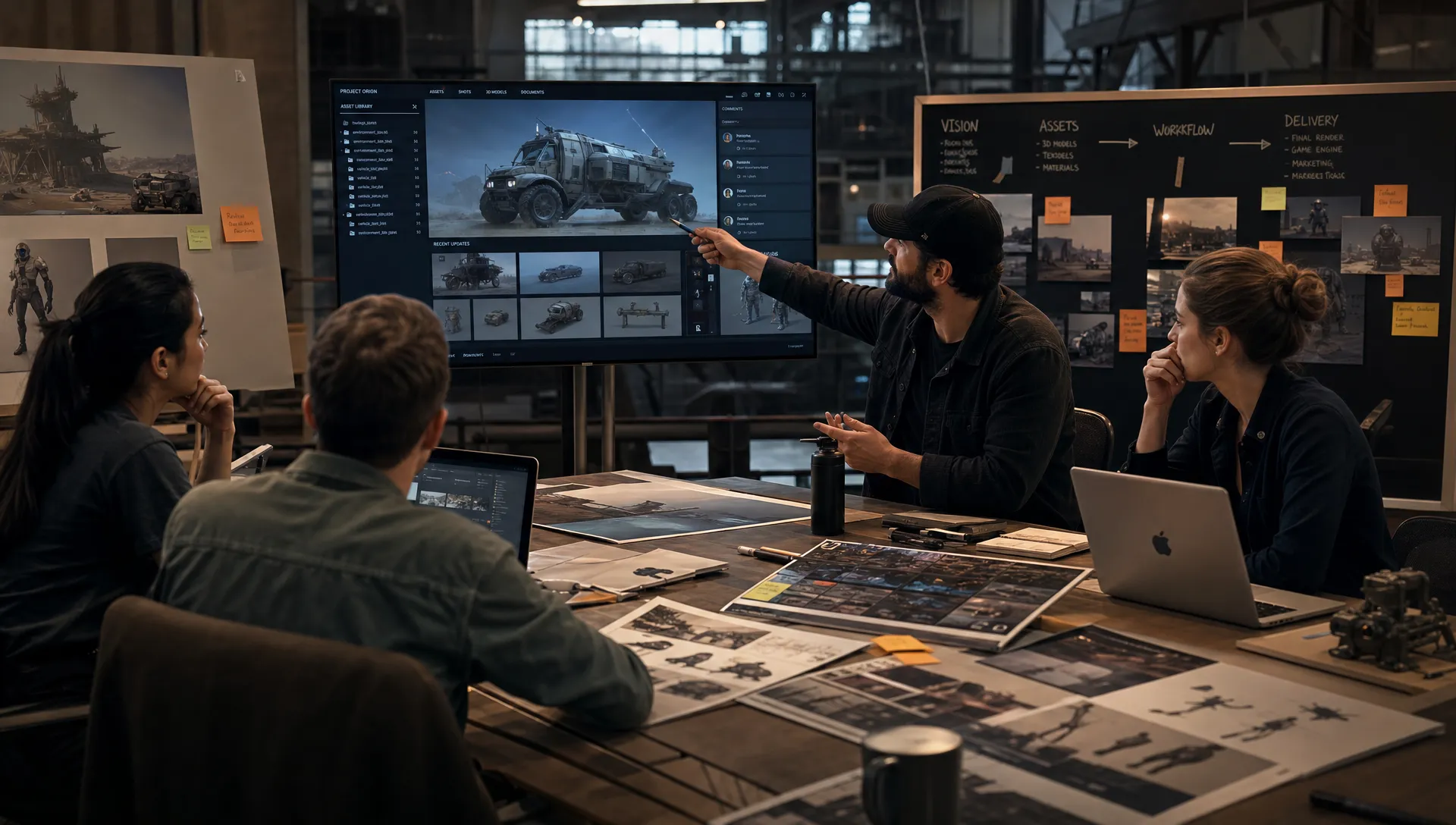
For years, creative teams adopted AI one tool at a time. A designer used one model for campaign visuals, a video team tested another for motion concepts, a 3D artist experimented with text-to-asset generation, and an innovation lead tracked everything in a spreadsheet. The results were exciting, but the operating model was fragile.
An enterprise studio does not only need more generation. It needs continuity. The same concept has to move from image exploration to video storyboard to 3D product asset without losing brand intent, legal constraints, approval history, or production context.
That is where one unified AI image, video, and 3D platform changes the equation. It gives creative organizations a shared operating layer for AI, so teams can use multiple models and formats while keeping governance, context, collaboration, and asset flow in one place.
Why unified creative AI matters now
Generative AI has moved beyond novelty. It is now part of creative production, marketing operations, game development, retail visualization, and product content pipelines. But many organizations are discovering a gap between successful experiments and reliable production.
The issue is rarely that individual tools are not powerful enough. Many are impressive in isolation. The problem is that each tool often carries its own interface, prompt structure, model behavior, licensing considerations, file outputs, storage habits, and approval process. At scale, that creates operational drag.
A campaign team may generate still images in one environment, video variations in another, and 3D assets somewhere else. If there is no shared context, the same product, character, lighting style, camera language, and brand rule must be re-explained every time. If there is no shared governance, it becomes hard to know which model was used, who approved an asset, what data informed it, and whether the output can be reused safely.
A unified platform does not mean forcing every team into one model or one creative method. In fact, the best approach is usually the opposite. It means giving teams access to multiple AI capabilities through one controlled operating layer.
This is especially important for enterprise users. CMOs need speed without brand fragmentation. Art directors need creative control, not random variation. Application managers need secure integrations and manageable workflows. Game developers need assets that can move toward real pipelines, not just beautiful previews.
What one platform actually unifies
When people hear the word platform, they often think of a dashboard. In creative AI, the real value is deeper. A unified platform connects the decisions and context behind the output, not just the output itself.
Intent and creative direction
Every generation begins with intent. That intent may be a product launch concept, a character style, a room environment, a brand campaign, a gameplay prop, or a cinematic sequence.
In disconnected tools, intent is usually trapped in prompts, screenshots, chat histories, or informal notes. A unified platform can turn that intent into reusable creative context, such as generation blueprints, mood boards, references, approved style directions, and production rules.
This matters because professional creative work depends on iteration. A first image concept might later become a video scene, a 3D asset, or a localized product visual. If the original creative intent is preserved, teams can build on it instead of starting from scratch.
Model orchestration across formats
No single AI model is best at everything. One model may be strong for photorealistic images, another for stylized video, another for 3D geometry, and another for audio or annotation tasks. A unified platform should make this diversity usable without creating chaos.
This is where orchestration becomes central. Rather than asking every user to know which model to use, how to format prompts, and where outputs should go, an operating layer can route tasks through defined workflows. For a deeper look at this concept, Virtuall has explored why enterprises increasingly need an AI control layer for routing, governance, and traceability across creative tools.
In practice, orchestration can help teams decide when to generate an image, when to animate it, when to convert or extend it into 3D, and when to hand the result to a specialist for refinement.
Shared context and memory
Creative consistency is one of the hardest problems in generative AI. A team may get a strong result once, then struggle to reproduce the same tone, character, product proportions, or visual system across variants.
A unified platform helps by keeping context available across workflows. That context can include mood boards, brand references, project assets, previously approved outputs, annotations, and review decisions. Instead of relying only on a prompt, the system can work from a broader studio memory.
This does not replace creative judgment. It gives creative judgment a stronger operating environment.
Asset lifecycle and approvals
Enterprise content does not end when something is generated. It must be reviewed, annotated, approved, stored, adapted, and often connected to other systems such as DAM, PIM, DCC, commerce, or production tools.
If AI outputs stay scattered across personal accounts or isolated apps, the asset lifecycle becomes difficult to manage. Teams lose track of versions, approvals, source references, and downstream usage.
A unified platform brings AI closer to the way studios already work. It supports collaboration, review workflows, asset management, and pipeline tracking, so generated content can move toward production instead of remaining an experiment.
| Fragmented AI setup | Unified AI platform |
|---|---|
| Separate tools for image, video, and 3D | One operating layer across multiple formats |
| Prompts and references stored informally | Shared context, mood boards, and reusable blueprints |
| Manual handoffs between teams | Orchestrated workflows and pipeline visibility |
| Limited traceability | Governance controls and approval history |
| Outputs managed in personal folders | Centralized asset management and collaboration |
From concept to approved asset across image, video, and 3D
The strongest argument for unification is the way creative ideas actually evolve. A concept rarely stays in one format.
Imagine a product launch for a new consumer device. The marketing team needs campaign visuals. The creative director wants moving concepts for social and retail media. The commerce team needs consistent product angles. The 3D team needs assets for interactive experiences. Later, regional teams may need localized versions with different environments, copy spaces, or formats.
In a fragmented AI stack, every stage introduces friction. The image team creates a look. The video team tries to recreate it. The 3D team rebuilds the product style manually. Reviewers compare files across tools. Legal and brand teams ask which outputs are approved. Application managers are left trying to connect systems that were never designed to work together.
In a unified platform, the same project context can follow the work. The initial campaign direction can inform image generation. Approved stills can guide video exploration. Product references can support 3D workflows. Review comments can remain connected to the asset, rather than disappearing into a message thread.
This is also relevant for game studios. A concept artist may explore prop silhouettes as images, a 3D artist may use those directions to generate or refine model candidates, and a technical artist may evaluate whether the result can enter the game pipeline. If you are specifically exploring 2D-to-3D production, Virtuall has a practical guide to AI image to 3D model workflows for professional teams.
Governance is not optional at enterprise scale
The more AI enters production, the more governance matters. Governance is not about slowing teams down. It is about giving them confidence to move faster without creating avoidable risk.
Enterprise teams need answers to practical questions. Which AI models are approved for which use cases? What content can be generated by whom? How are prompts, references, and outputs tracked? What is the approval path before an asset goes live? Where is inference happening? How are brand, IP, and compliance requirements enforced?
Frameworks such as the NIST AI Risk Management Framework emphasize the importance of mapping, measuring, managing, and governing AI risk. In Europe, the EU AI Act has also increased attention on transparency, accountability, and compliance obligations around AI systems.
For creative organizations, this creates a clear lesson. Governance cannot be bolted on after every team has already adopted separate AI tools. It needs to be part of the operating layer.
A unified platform can help define rules for how AI is used across the studio. It can support approved workflows, review steps, access controls, asset traceability, and compliance requirements. For global organizations, infrastructure and inference location may also matter, especially when policies require specific data handling standards.
What unification means for each team
Different stakeholders care about different outcomes. A single creative AI platform is valuable because it gives each team what it needs without forcing everyone to work in the same way.
| Role | What they need from unified AI | Why it matters |
|---|---|---|
| CMO | Brand consistency, speed, localization, campaign scalability | AI can increase content volume without fragmenting brand identity |
| Art Director | Creative control, reference continuity, review workflows | Teams can iterate faster while protecting the visual direction |
| Application Manager | Governance, integrations, user management, system reliability | AI becomes manageable as part of the enterprise technology stack |
| Game Developer | 2D, video, and 3D workflow continuity | Concepts can move more cleanly toward production assets |
For CMOs, the value is operational leverage. A unified platform makes it easier to scale creative output across channels, markets, and formats while keeping brand rules visible.
For art directors, the value is consistency. AI can produce many options, but the challenge is guiding those options toward a coherent visual system. Shared context, annotations, approvals, and blueprints make that guidance repeatable.
For application managers, the value is control. Instead of managing dozens of disconnected subscriptions, they can support a governed layer with integrations into existing creative and asset systems.
For game developers, the value is pipeline direction. AI outputs must eventually become usable in production environments. That means format continuity, review, refinement, and technical handoff matter as much as the initial generation.
The difference between a tool and a Creative AI OS
A single AI tool helps a person complete a task. A Creative AI OS helps an organization run AI as part of production.
That distinction matters. Enterprise creative teams do not only need image generation, video generation, or 3D generation. They need a way to coordinate all of them across people, models, approvals, assets, and systems.
This is why the idea of an AI studio is becoming more relevant. A professional AI studio provides the shared workspace and operational structure needed for production teams, not just individual experimentation. Virtuall covers this shift in more detail in its article on the Creative AI OS for enterprise production.
The same principle applies across formats. Image, video, and 3D should not live in separate islands. They should be connected by common project context, reusable generation patterns, model orchestration, and clear governance.
How to evaluate an AI image, video, and 3D platform
Choosing a platform is not just about comparing output quality. Output quality matters, but enterprise adoption depends on the operating model around the output.
When evaluating a platform, look for the following capabilities:
- Multi-format support: The platform should support creative work across image, video, 3D, and related media where relevant.
- Multi-model orchestration: Teams should not be locked into one model if different tasks require different AI strengths.
- Reusable workflows: Blueprints or templates can help teams repeat successful creative patterns across campaigns and projects.
- Shared creative context: Mood boards, references, and project memory help maintain consistency across iterations.
- Review and approval workflows: AI outputs need clear paths from draft to approved asset.
- Asset and pipeline management: Generated content should be trackable, organized, and ready for downstream production.
- Governance and compliance: Access controls, traceability, infrastructure considerations, and policy enforcement should be built into the workflow.
- Integration readiness: API and plugin support matter when AI must connect to DCC, PIM, DAM, and other enterprise systems.
The most important question is simple: will this platform help your team produce better work more reliably, or will it add another disconnected layer to the stack?
A good platform should reduce operational complexity. It should allow creative specialists to stay creative, while giving technology and business leaders the control they need.
Where Virtuall fits
Virtuall is built around the idea that creative AI needs an operating system, not just more isolated tools. It helps studios and teams control, orchestrate, and scale AI-powered content creation across image, video, 3D, and other formats with enterprise-grade governance and compliance.
The platform brings together governance controls, workflow orchestration, multi-model content generation, generation blueprints, studio context memory, review workflows, content annotation, asset management, pipeline tracking, and integrations with creative systems through plugins and API.
Virtuall also includes Nyx, the intelligence layer of the Creative AI OS. Nyx orchestrates multiple industry-leading AI models and helps keep intent and context consistent across studios and teams.
For enterprise teams, this means AI can be operated as part of a real production environment. For individual creators and game studios, it means experimentation can grow into repeatable workflows without losing control.
Frequently Asked Questions
What is an AI image, video, and 3D platform? It is a platform that supports AI-powered creation across multiple media formats, while helping teams manage context, workflows, governance, collaboration, and assets in one operating environment.
Does one platform mean using only one AI model? No. A strong unified platform can orchestrate multiple models. The point is not to reduce creative choice, but to manage model diversity through a controlled workflow.
Why not let every team choose its own AI tools? Individual tools can be useful, but unmanaged adoption creates problems with consistency, approvals, compliance, cost visibility, and asset tracking. A unified layer helps teams innovate without losing control.
How does unification help 3D workflows? It allows 3D work to connect with earlier creative stages, such as image concepts, mood boards, product references, and review comments. This makes it easier to move from idea to model refinement and production handoff.
Is this only for large enterprises? No. Enterprise teams often feel the governance need first, but game studios, agencies, and individual creators can also benefit from repeatable workflows, shared context, and better asset organization.
Bring image, video, and 3D AI into one operating layer
Creative AI is most powerful when it is connected. Images, videos, and 3D assets should not be separate experiments with separate rules, contexts, and approval paths. They should be part of a governed production system that helps teams create faster, stay consistent, and move work into real pipelines.
If your team is ready to operate creative AI at scale, explore how Virtuall unifies multi-model generation, workflow orchestration, governance, context memory, and production-ready asset management in one Creative AI OS.