Content Generation AI for Teams That Need Consistent Output
Explore content generation AI for teams that need consistent, compliant, production-ready creative output across image, video, audio, and 3D.
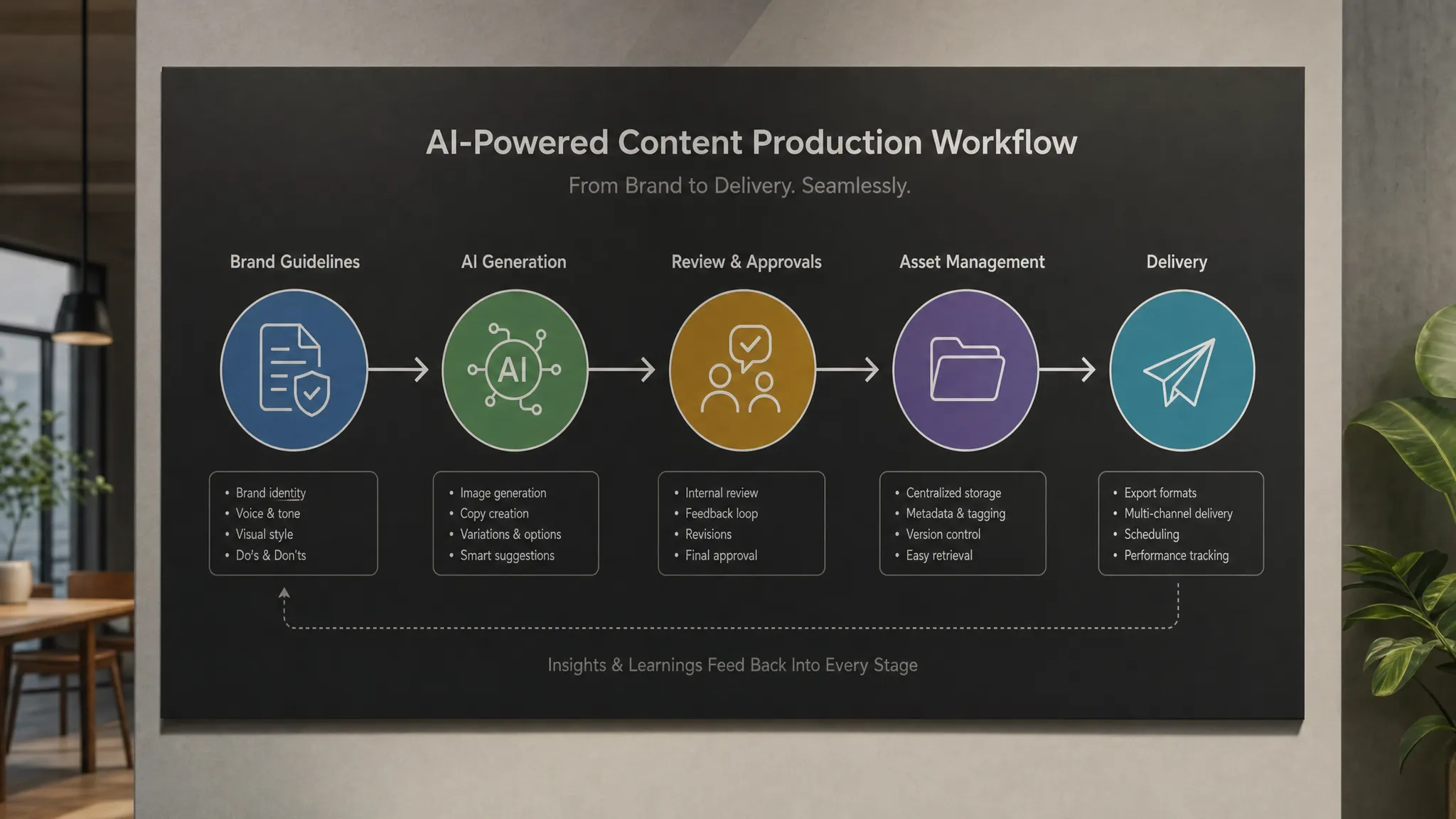
AI is now capable of producing product visuals, campaign concepts, game assets, social variations, video drafts, 3D objects, audio elements, and more. The bottleneck is no longer whether a team can generate content. The harder question is whether a team can generate content that is consistent, usable, compliant, and aligned with the creative intent across every brief, market, channel, and stakeholder.
That is where content generation AI becomes a team operating challenge, not just a tool choice.
For a solo creator, a prompt and a model may be enough. For a CMO, art director, application manager, or game studio lead, the stakes are different. Output needs to match brand systems, respect legal constraints, support review cycles, integrate with production pipelines, and scale without turning every asset into a manual correction project.
Why consistency is the real test of content generation AI
Most teams discover the same pattern quickly. The first AI experiments feel impressive. A few prompts produce interesting images, concepts, or variations in minutes. Then the team tries to repeat the result across a campaign, a product line, a game environment, or a global content calendar.
That is when inconsistency appears.
One image follows the brand style, another feels off. One video frame uses the right product color, another introduces an artifact. A 3D asset looks promising, but the topology or format is not ready for downstream use. A regional team generates content that conflicts with approved messaging. A model update changes the output style overnight.
For enterprise teams, this is not just an aesthetic issue. Inconsistent AI output creates operational risk:
- Creative teams spend more time fixing assets than producing them.
- Brand teams lose control over visual identity and messaging.
- Legal and compliance teams struggle to verify what was generated, how, and by whom.
- Application managers face tool sprawl, shadow AI usage, and integration gaps.
- Game and 3D teams receive outputs that are visually interesting but difficult to use in production.
In other words, the value of AI depends less on one impressive generation and more on the ability to repeat quality at scale.
What “consistent output” actually means
Consistent output does not mean every asset looks identical. It means every output stays within the right creative, technical, and governance boundaries for its intended use.
For a marketing team, consistency may mean that every AI-generated campaign visual follows the brand’s tone, color palette, product representation rules, and regional compliance requirements.
For an art director, it may mean preserving a visual language across concept art, mood boards, character references, environments, and final production assets.
For a game developer, it may mean generating 3D assets or visual concepts that fit a defined world, style bible, and production pipeline.
For an application manager, it may mean ensuring that AI tools work within approved systems, user permissions, data policies, and audit requirements.
A useful way to evaluate consistency is to look at five dimensions.
| Dimension | What it means for teams | Why it matters |
|---|---|---|
| Creative consistency | Outputs match brand, style, mood, and art direction | Protects identity and reduces rework |
| Technical consistency | Files, formats, quality, and metadata fit the production pipeline | Makes AI output usable beyond ideation |
| Process consistency | Teams follow approved workflows, reviews, and approvals | Prevents fragmented work and unclear ownership |
| Compliance consistency | AI usage follows company, legal, and regional rules | Reduces risk and supports responsible adoption |
| Context consistency | AI understands the project, audience, references, and intent | Improves relevance across repeated generations |
The most mature teams treat these dimensions as part of the system, not as after-the-fact checks.
Why prompt libraries alone are not enough
Prompt libraries can help teams document what works. They are useful for repeatable language, style references, and onboarding. But prompt libraries are not a full operating model for content generation AI.
A prompt does not automatically enforce brand rules. It does not manage permissions, track approvals, connect to asset management, verify compliance, or preserve context across a multi-step production workflow. It also cannot fully control how different AI models behave, especially when teams use multiple tools for image, video, audio, and 3D.
This is why many enterprise teams move from “everyone uses their favorite AI tool” to a more structured approach. They need orchestration, governance, and integration.
A prompt may define the instruction. A system defines the operating conditions.
The shift from AI tools to a Creative AI operating system
Content generation AI is becoming part of the creative stack. That means it has to operate like other enterprise systems: with roles, governance, workflow controls, traceability, integrations, and measurable output quality.
A Creative AI operating system provides a layer above individual models and tools. Instead of asking each user to manage every detail manually, the organization defines how AI should run across teams, workflows, and production environments.
This matters because creative production is rarely linear. A single campaign or game asset may involve strategy, mood boards, concept generation, legal review, art direction, versioning, localization, asset management, and final delivery. AI must fit that process rather than forcing teams into isolated generation sessions.
Virtuall is built around this idea. It helps studios and teams operate creative AI at scale across image, video, audio, and 3D workflows, while maintaining governance, compliance, and production focus.
The core capabilities teams need for reliable AI content generation
If your team is evaluating content generation AI, the feature list should go beyond “which model creates the best image.” Model quality matters, but consistent team output depends on the environment around the model.
Governance controls
Governance is the foundation for scalable AI adoption. Teams need to define who can generate, what they can generate, which models can be used, what content rules apply, and how outputs are reviewed.
This aligns with broader responsible AI guidance. The NIST AI Risk Management Framework emphasizes governance, measurement, and risk management as key parts of trustworthy AI deployment. For creative teams, that translates into practical controls over data, usage, approvals, and accountability.
Good governance should not slow creative teams down. It should give them clear boundaries so they can move faster with confidence.
Workflow orchestration
Creative AI work involves more than generation. Teams need workflows that connect briefs, references, generation steps, review rounds, annotations, approvals, and final assets.
Without orchestration, AI output often gets lost in chat threads, local folders, and disconnected tools. With orchestration, teams can turn AI generation into a repeatable production process.
This is especially important for enterprise studios, where multiple stakeholders may need to review or approve content before it reaches market.
Multi-model generation
No single AI model is best for every task. A team may need one model for product imagery, another for video, another for 3D assets, and another for audio. The challenge is not only accessing these models, but coordinating them while preserving creative intent.
A multi-model approach allows teams to use the right model for the right job. The key is orchestration, so the process remains coherent rather than fragmented across separate tools.
Virtuall’s intelligence layer, Nyx, is designed to orchestrate multiple industry-leading AI models while keeping intent and context across studios and teams.
Generation blueprints
Templates are essential when teams need repeatable output. In Virtuall, generation blueprints help teams standardize how certain types of content are created.
A blueprint can support consistency by capturing the structure of a repeatable creative task: the type of asset, expected inputs, style references, production constraints, and review requirements. This allows teams to move from one-off prompting to controlled creative workflows.
For example, a marketing team might use blueprints for product launch visuals, while a game studio might use them for environment concept variations or asset ideation.
Studio context memory
AI output improves when the system understands context. Mood boards, visual references, brand systems, previous decisions, and project intent all shape the quality of the result.
The Creative AI OS supports studio context memory through mood boards, helping teams preserve creative direction across workflows. This is important because consistency rarely comes from a single prompt. It comes from shared context that stays available as work moves between people, models, and production stages.
Collaboration and review workflows
AI generation can produce many options quickly. That makes review and decision-making even more important.
Teams need ways to annotate assets, compare versions, manage feedback, and approve work. Otherwise, speed at the generation stage becomes confusion at the review stage.
For art directors and creative leads, this is where AI becomes manageable. Instead of chasing files and screenshots, they can guide output through structured feedback and approvals.
Asset management and pipeline tracking
Once AI-generated content is approved, it needs to be stored, tracked, and delivered. Asset management matters because production teams need to know which version is final, where it came from, what it can be used for, and how it connects to the broader project.
Pipeline tracking also helps managers see where work is moving, where reviews are blocked, and how AI-generated assets are progressing toward production-ready outputs.
Integrations with existing creative tools
Enterprise teams already have systems in place: DCC tools, PIM platforms, DAM systems, production trackers, and internal workflows. A content generation AI platform should not require teams to abandon their stack.
Through plugins and API-based integrations, Virtuall is designed to connect with creative tools and production systems. This matters for application managers who need AI adoption to fit within approved architecture rather than creating another disconnected layer.
Consistency by role: what different teams should prioritize
The same AI platform can serve different stakeholders, but each role has a different definition of success.
| Role | Primary concern | What to prioritize |
|---|---|---|
| CMO | Brand consistency, speed, campaign scale, compliance | Governance, blueprints, approvals, asset traceability |
| Art Director | Visual coherence, creative intent, quality control | Mood boards, context memory, review workflows, annotations |
| Application Manager | Security, integrations, control, adoption | Permissions, APIs, plugins, approved infrastructure, auditability |
| Game Developer | Production usability, style continuity, 3D workflows | Multi-model generation, pipeline tracking, production-ready outputs |
This is why buying AI only at the individual user level often creates friction. The team needs a shared operating layer where each role can work within the same controlled environment.
Compliance is becoming part of creative operations
Creative teams are not separate from AI regulation and data governance. As AI becomes embedded in content production, organizations need clearer policies around model usage, data handling, transparency, intellectual property review, and regional requirements.
The EU AI Act has increased attention on AI governance in Europe and beyond. While obligations vary by use case and organization, the direction is clear: companies need more visibility and control over how AI systems are used.
For enterprise creative teams, this makes infrastructure and inference choices more important. The Creative AI OS supports compliance with EU-based infrastructure and inference, helping organizations align AI-powered content creation with enterprise governance expectations.
Compliance should not be treated as a final checkpoint after content is generated. It should be built into the workflow from the beginning.
How to evaluate content generation AI for team consistency
When comparing platforms, it is tempting to focus only on demo quality. But a beautiful demo does not guarantee reliable production output.
A more practical evaluation should include questions like:
- Can the platform preserve creative context across multiple users, projects, and models?
- Can teams define approved workflows, roles, and review steps?
- Does it support the formats your team actually produces, such as image, video, audio, and 3D?
- Can it connect to your existing creative tools, DAM, PIM, or production systems?
- Can you track asset versions, approvals, and pipeline status?
- Does it support governance and compliance requirements for your organization?
- Can repeatable generation tasks be turned into templates or blueprints?
- Does the system help produce assets that are usable in production, not only interesting in concept?
The strongest platforms make AI generation feel less like isolated experimentation and more like an extension of the studio’s existing operating model.
A practical rollout path for enterprise teams
Teams do not need to transform every workflow at once. The best AI adoption usually starts with a controlled use case, then expands as governance and confidence improve.
Start by choosing a workflow where consistency matters and where AI can reduce repetitive production effort. Good candidates include campaign visual variations, product content adaptation, concept exploration, mood board development, localization support, or early-stage 3D ideation.
Define the rules before scaling. Establish which inputs are allowed, which outputs require review, who approves final assets, and how generated content is stored. Then create reusable blueprints so the workflow can be repeated by more people without losing control.
Measure success beyond speed. Time savings are important, but teams should also track rework reduction, approval cycle time, brand alignment, asset usability, and stakeholder confidence.
Finally, integrate the workflow into the tools and systems teams already use. AI becomes more valuable when it sits inside the production environment rather than outside it.
Frequently Asked Questions
What is content generation AI? Content generation AI refers to AI systems that create or assist with creative outputs such as images, videos, 3D assets, audio, text, and variations for marketing, production, or entertainment workflows.
Why do teams struggle with consistent AI output? Teams often struggle because AI tools are used in isolation, without shared context, approved workflows, governance controls, or repeatable templates. This leads to output that varies by user, prompt, model, and project.
How can enterprises control AI-generated content quality? Enterprises can improve quality by using governance controls, generation blueprints, review workflows, mood boards, asset tracking, and integrations with existing production systems.
Is content generation AI only for marketing teams? No. Marketing teams use it for campaign and brand content, but art departments, game studios, product teams, and creative operations teams can also use it for images, video, audio, 3D workflows, and production support.
What makes a Creative AI operating system different from a standalone AI tool? A standalone tool helps users generate content. A Creative AI operating system helps teams control, orchestrate, review, manage, and scale AI-powered creation across workflows, models, formats, and compliance requirements.
Build consistent AI content production with Virtuall
Content generation AI can accelerate creative work, but only if teams can control the process. Consistent output requires shared context, governance, workflow orchestration, collaboration, and production-ready delivery.
Virtuall helps studios and enterprise teams operate creative AI at scale across image, video, audio, and 3D. With governance controls, generation blueprints, studio context memory, multi-model orchestration through Nyx, review workflows, asset management, and integrations with creative tools, The Creative AI OS gives teams a controlled way to bring AI into real production.
If your organization is ready to move beyond isolated AI experiments, explore how Virtuall can help you scale creative AI with consistency, compliance, and control at virtuall.pro.