Designing a Model Fallback Plan for Critical Campaigns
Learn how to build a model fallback plan for critical campaigns, from triggers and governance to testing backup AI models before launch.
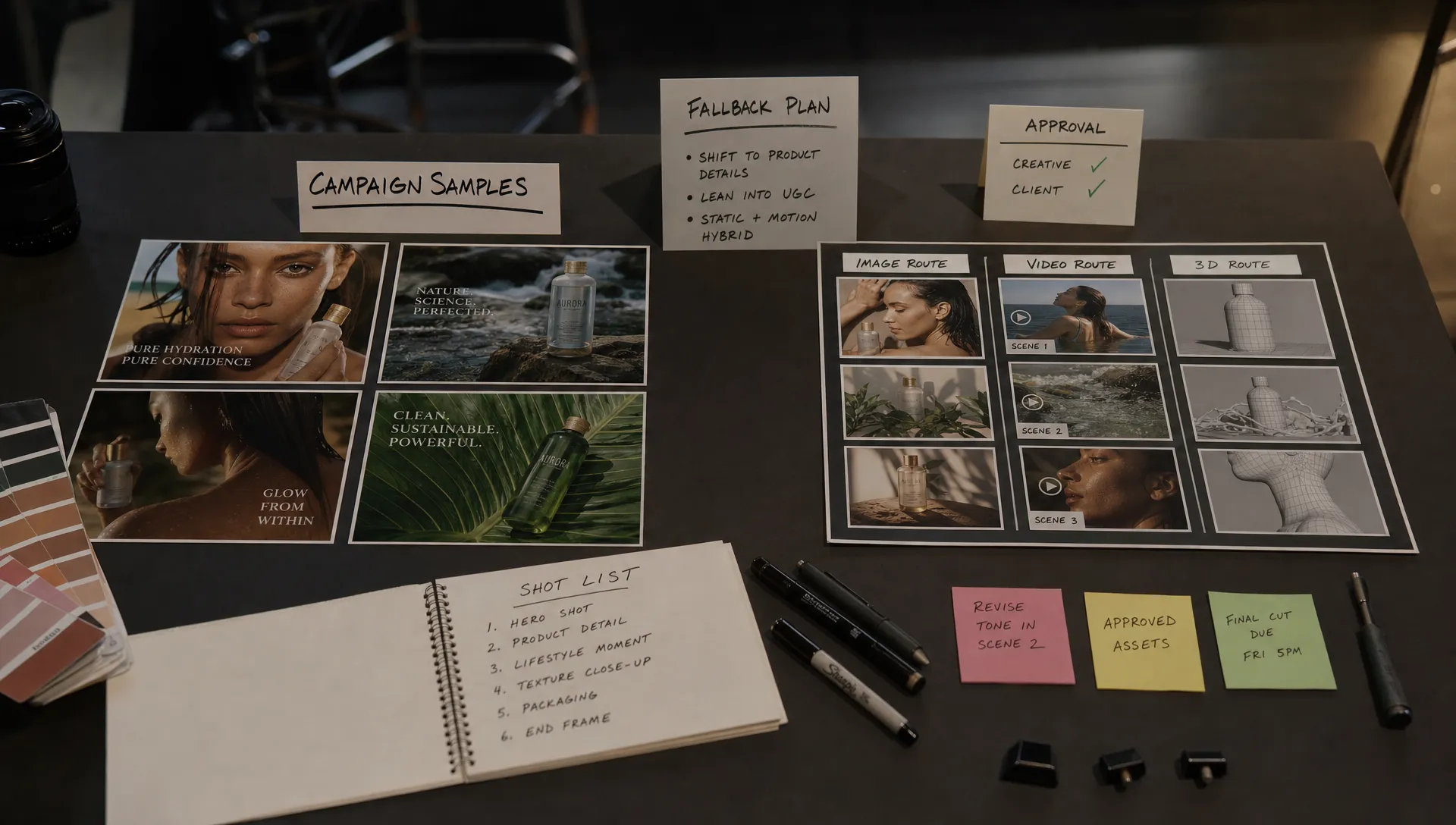
Critical campaigns do not fail only because a server is down. They fail when a model changes behavior, a provider hits a rate limit, a safety filter blocks an approved concept or a production team discovers too late that the backup path cannot meet brand standards. A model fallback plan gives creative, marketing and technical teams a controlled way to keep delivering campaign assets when the preferred AI model is unavailable or no longer fit for the job.
For enterprise teams using AI for image, video and 3D production, fallback planning is not a technical afterthought. It is part of campaign risk management. The goal is not to switch models randomly. The goal is to know, before launch week, which alternatives are approved, what quality gates apply and who can authorize a change.
Why critical campaigns need fallback planning
A critical campaign usually has fixed media dates, legal approvals, paid placements, retailer commitments or launch dependencies that cannot move easily. If AI-generated content is part of that campaign, the model itself becomes a production dependency.
That dependency can break in several ways. A provider may be temporarily unavailable. A new model version may shift visual style. A prompt that worked in testing may trigger stricter content filters at scale. A 3D generation model may produce geometry that looks acceptable in previews but fails inside a game engine or product configurator.
The NIST AI Risk Management Framework recommends mapping, measuring, managing and governing AI risks. For creative teams, a model fallback plan is a practical way to apply those principles to content operations, not only to abstract AI policy.
What a Model Fallback Plan Should Cover
A model fallback plan should define what happens when the primary model cannot deliver the required output within the campaign’s quality, compliance, timing or cost constraints. It needs enough detail that an art director, application manager or creative operations lead can make a fast decision without reopening the entire AI strategy.
At minimum, the plan should cover four areas: campaign criticality, fallback triggers, approved fallback routes and validation rules. These should be documented before production begins, ideally during the campaign briefing or pre-production phase.
| Planning area | What to define | Why it matters |
|---|---|---|
| Criticality | Which assets are launch-blocking, high value or replaceable | Prevents overreacting to low-risk asset issues |
| Triggers | What counts as failure, degradation or unacceptable drift | Removes ambiguity during live production |
| Fallback routes | Which models, workflows or human paths can replace the primary route | Speeds up execution when time is limited |
| Validation | Who approves fallback output and against which standards | Protects brand, rights and production quality |
The best plans are simple enough to use under pressure. If the plan requires a meeting with ten people every time a batch fails, it is not a fallback plan. It is a delay disguised as governance.
Start by classifying campaign assets by risk
Not every asset deserves the same fallback investment. A global hero visual for a product launch needs stricter controls than a social variant used for a short test. A playable 3D asset in a game pipeline has different failure modes than a moodboard image for concept exploration.
Campaign asset tiers help teams decide where fallback planning must be rigorous and where a lighter process is acceptable.
| Asset tier | Examples | Fallback expectation |
|---|---|---|
| Tier 1, launch-critical | Hero images, paid media masters, product visuals, in-game promotional assets | Pre-approved backup model, documented validation and named approver |
| Tier 2, important but flexible | Social adaptations, CRM visuals, retail variants, internal campaign videos | Approved fallback options and expedited review |
| Tier 3, exploratory | Concepts, moodboards, early storyboards, style tests | Flexible model switching with basic brand checks |
This classification gives CMOs and creative leaders a useful tradeoff. They can focus governance where a failure would affect revenue, reputation or launch timing while leaving experimentation space for lower-risk work.
Define fallback triggers before production pressure hits
The most common mistake is waiting until people feel something has gone wrong. By then, the team may argue over whether the issue is a model problem, a prompt problem, an approval problem or a temporary provider issue.
A strong model fallback plan uses observable triggers. Some are technical, such as availability, latency or rate limits. Others are creative, such as repeated brand drift, loss of product accuracy or unacceptable artifacts. Governance triggers matter too, especially when a campaign involves rights-sensitive references, regulated categories or regional data rules.
| Trigger type | Example signal | Suggested response |
|---|---|---|
| Availability | Primary model fails or times out repeatedly | Switch to approved equivalent model |
| Output quality | More than an agreed share of outputs fail review | Use constrained prompts, then fallback model if quality remains low |
| Brand drift | Visual language moves away from approved direction | Reapply brand context and route through art director validation |
| Compliance | Output violates usage, rights or data policy | Stop generation and use a governed alternative |
| Cost or quota | Run costs exceed forecast or provider quota is reached | Move lower-tier assets to a cheaper approved route |
| Version change | Model update alters style, composition or behavior | Freeze approved outputs and retest the new version |
The exact thresholds should match your organization’s tolerance for risk. For a launch film, one unresolved compliance failure may be enough to stop. For internal concepting, the threshold may be far more flexible.
Choose fallback routes for each creative format
Fallback does not always mean replacing one model with another. In creative production, it can mean changing the level of automation, narrowing the prompt space, using a template, pulling from approved assets or routing work to a specialist. The right answer depends on the output format.
For enterprise teams, model choice should be handled through a controlled layer rather than by letting every user pick tools independently. Virtuall’s article on a multi-model abstraction layer for creative workloads explains why this matters when teams need flexibility without losing control.
Image generation fallback
For campaign imagery, the fallback route should preserve brand direction, product accuracy and required aspect ratios. Common options include switching to an approved alternate image model, using generation blueprints with tighter constraints or combining AI generation with manual retouching for final production.
The plan should also state which inputs travel with the fallback: prompt structure, reference assets, negative prompts, moodboards, product rules, rights restrictions and final delivery specs. If those inputs live in personal notes, fallback speed will suffer.
Video generation fallback
Video fallback is more complex because motion, timing, continuity and editability matter. A backup video model may create acceptable clips but fail on camera movement or temporal consistency. For critical campaign videos, fallback planning should include shorter clip generation, storyboard-level regeneration, human edit support and approved stock or 3D-rendered alternatives.
Teams should also decide when video generation is no longer the right path. If a deadline is close, it may be safer to generate stills, animate in a traditional tool or adapt an existing approved asset.
3D generation fallback
For 3D, the fallback plan must cover more than appearance. Mesh quality, topology, scale, texture resolution, rigging needs and engine compatibility can all break production. A visually strong 3D asset that cannot enter the pipeline is not production-ready.
Fallback options might include a different 3D model, a simpler proxy asset, manual cleanup, procedural generation or reuse of approved asset library components. Game developers and 3D leads should define acceptance criteria early, not after generated assets reach integration.
Preserve brand context when switching models
Model switching often creates subtle drift. A product still looks correct, but the lighting feels off. A character keeps the right silhouette, but the expression changes. A background respects the brief, but the campaign no longer feels like the brand.
A reliable model fallback plan treats context as a reusable production asset. Brand memory, moodboards, approved references, prompt patterns, composition rules and style constraints should move with the job. If only the text prompt moves, the fallback model is being asked to guess too much.
This is especially important for multi-market campaigns. A fallback model may interpret cultural cues, product packaging, seasonal settings or category conventions differently. Persistent context management helps teams maintain the campaign’s creative intent across model changes, teams and tools.
Generation blueprints can help by turning successful prompt structures, references, output specs and review criteria into repeatable templates. They reduce the chance that a fallback model creates something technically acceptable but strategically wrong.
Add governance without slowing every decision
Governance should make the fallback path safer and faster, not heavier. For critical campaigns, the key is to pre-approve enough of the path that teams can move quickly when a trigger fires.
Useful governance controls include model whitelisting, role-based access, approved data handling rules, prompt logging, rights checks and audit trails. If a campaign uses confidential product information or unreleased assets, the fallback route must respect the same security and compliance rules as the primary model.
Virtuall’s guide to an AI governance framework for enterprise creative teams goes deeper on policy foundations such as access, model approval, prompt handling and auditability. Those foundations are what prevent fallback decisions from becoming ad hoc tool switching.
For organizations operating in regulated markets or across regions, governance also includes infrastructure choices. Data residency, inference location and vendor terms can determine whether a technically strong model is acceptable for a specific campaign.
Test the fallback path before launch week
A model fallback plan that has never been tested is a document, not an operating capability. Testing should happen early enough that failures can be fixed before media deadlines become immovable.
A practical test does not need to simulate every possible issue. It should prove that the team can detect a problem, choose the correct fallback, regenerate or adapt assets, validate outputs and record the decision.
| Test | What to check | Success signal |
|---|---|---|
| Prompt portability test | Can the same creative intent work across approved models? | Alternate model outputs pass basic brand review |
| Quality comparison | Do fallback outputs meet asset-specific standards? | Reviewers approve within agreed rework limits |
| Compliance test | Are rights, data and regional rules preserved? | No policy exceptions in fallback route |
| Pipeline test | Can files move into DAM, PIM, DCC or engine workflows? | Assets arrive in the required format and metadata state |
| Incident rehearsal | Can the team execute the runbook quickly? | Clear owner, decision record and usable output |
Testing also builds trust. Art directors become more confident that fallback does not mean lowering the creative bar. Application managers can verify integrations and permissions. CMOs get a clearer view of campaign resilience.
Write a live incident runbook
When a critical campaign is active, people need a short operational runbook. It should state who detects the issue, who decides to switch, who performs the fallback and who approves the output.
Keep the runbook direct and role-based:
- Detect: The production owner or system monitor flags a trigger such as repeated failure, review rejection, compliance block or quota risk.
- Assess: The creative lead and technical owner confirm whether the issue is temporary, asset-specific or model-related.
- Decide: The named approver selects the fallback route based on the campaign tier and pre-approved options.
- Execute: The production team regenerates, adapts or routes the asset through the alternate workflow.
- Validate: The reviewer checks brand, rights, specs and production readiness before release.
- Record: The team logs the trigger, route, approver, model version and final asset status.
The runbook should fit on one page. If it becomes a long policy manual, teams will bypass it when pressure rises.
Track metrics after every fallback event
Fallback events are learning moments. After the campaign ships, review the data to improve model strategy, budget planning and governance.
Useful metrics include time to detect, time to usable output, approval pass rate, cost variance, number of manual fixes, compliance exceptions and recurrence by model or asset type. These metrics help distinguish a one-off provider issue from a systemic workflow problem.
They also help leaders make better investment decisions. If video fallback repeatedly requires heavy manual editing, the team may need different generation blueprints, more pre-approved assets or a stronger model orchestration layer. If 3D fallback keeps failing at integration, the acceptance criteria may need to move earlier in the workflow.
A model fallback plan should evolve with every major campaign. The more it reflects real production data, the more useful it becomes.
How Virtuall supports governed fallback at scale
Virtuall is built for teams that need to operate creative AI across models, formats, workflows and governance requirements. A Creative AI OS approach helps enterprises move beyond isolated AI experiments and toward controlled production operations.
For fallback planning, that means teams can define rules, orchestrate multi-model generation, preserve studio context with moodboards, use generation blueprints, manage review workflows and track assets through the pipeline. Nyx, Virtuall’s intelligence layer, is designed to orchestrate multiple industry-leading AI models while keeping intent and context across teams.
The practical value is resilience. Instead of treating a model issue as a campaign emergency, teams can route work through governed alternatives while protecting brand consistency, compliance and production-ready output standards.
Frequently Asked Questions
What is a model fallback plan for creative AI? A model fallback plan defines what a team will do if the primary AI model cannot produce acceptable campaign assets. It covers triggers, approved alternative models or workflows, validation rules, owners and documentation.
When should a team create the fallback plan? The plan should be created during campaign planning or pre-production, before large-scale generation begins. Waiting until launch week usually leads to rushed tool choices and inconsistent approval decisions.
Does fallback always mean using another AI model? No. Fallback can include constrained generation, templates, approved asset reuse, manual retouching, procedural workflows, stock assets or traditional production methods. The best route depends on the asset tier and deadline.
Who should own the fallback decision? Ownership should be shared but explicit. Creative leads usually own brand and quality judgment, application or platform owners manage technical feasibility and governance or legal teams define compliance boundaries. One named approver should make the final live decision.
How often should fallback routes be tested? Test them before every critical campaign and whenever a primary model, vendor policy, production tool or compliance requirement changes. For high-volume teams, regular incident rehearsals make fallback execution faster and less stressful.
Build campaign resilience before the deadline is at risk
Critical campaigns need creative ambition, but they also need operational discipline. A model fallback plan gives enterprise teams a practical way to protect launch dates without compromising brand, rights or production quality.
If your studio is scaling AI across image, video and 3D workflows, Virtuall can help you bring model orchestration, governance, approvals and production context into one operating system for creative AI.