EU AI Act and C2PA
EU AI Act and C2PA explained for creative teams: see how Content Credentials support AI labels, provenance and governed production workflows.
The EU AI Act has moved AI-generated content disclosure from a trust-and-safety debate into an operational requirement. For enterprise creative teams, the question is no longer whether to label AI-assisted content. The question is how to do it consistently across image, video, audio, 3D, campaign, product and studio workflows.
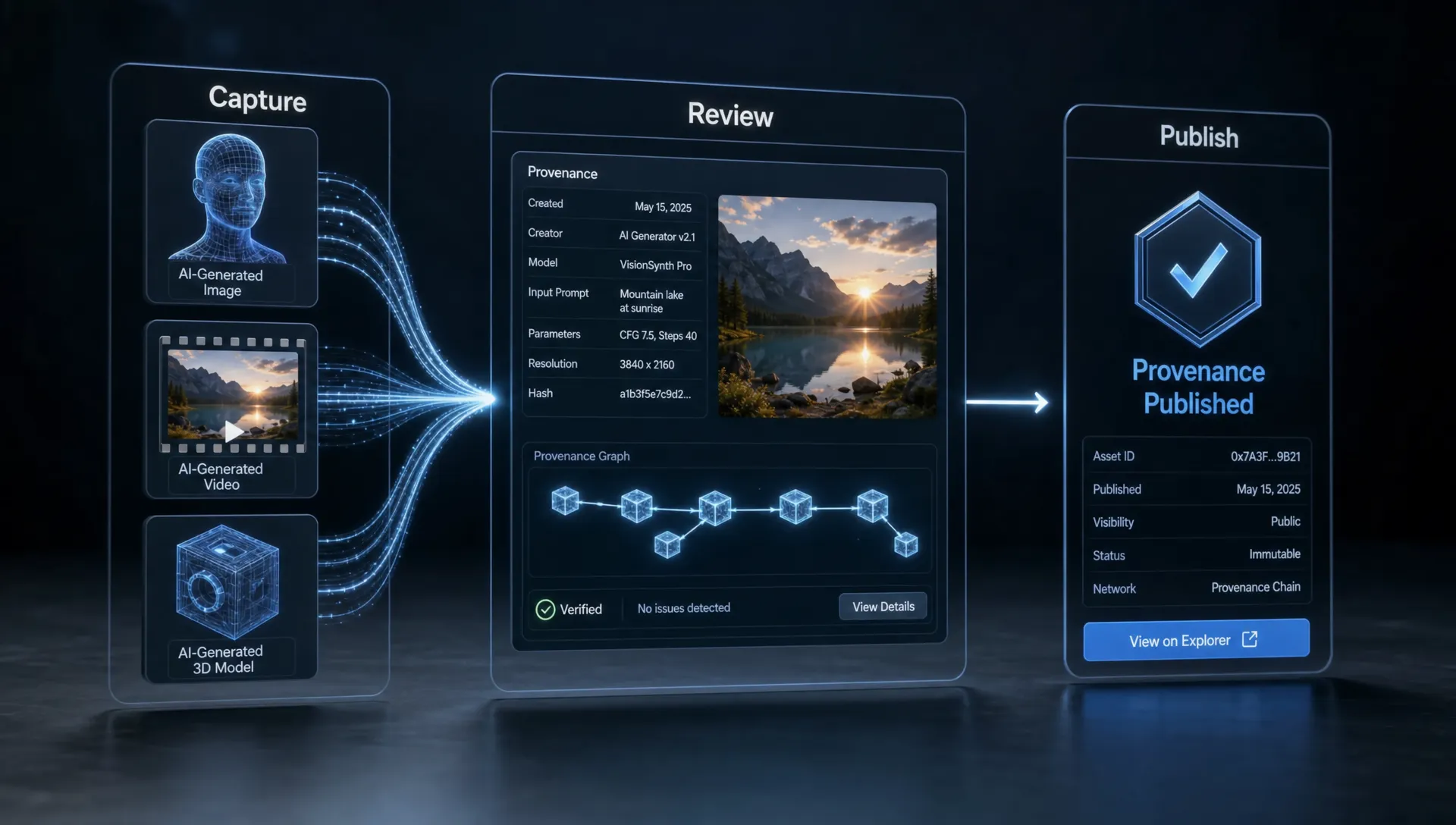
That is where C2PA enters the conversation. C2PA, and the Content Credentials built on top of it, gives teams a practical way to attach provenance data to digital assets. It can help answer questions such as who created or edited an asset, what tools were involved, whether AI generation was used and whether the file has been changed since the credential was signed.
C2PA is not the EU AI Act. It is not a legal shield on its own. But for creative operations that need machine-readable provenance, visible disclosure and auditable approval trails, it is one of the most important technical standards to understand.
Why EU AI Act and C2PA belong in the same discussion
The EU AI Act creates transparency obligations for certain AI systems and AI-generated or manipulated content. Article 50 is especially relevant for marketing, entertainment, gaming, retail, media, public communications and any team publishing synthetic or AI-modified assets in the EU market.
As of August 2026, Article 50 transparency duties are no longer a distant planning item for EU-facing creative organizations. These requirements sit alongside broader enterprise needs: brand safety, rights management, auditability, vendor control, reputational risk and consumer trust.
C2PA addresses the technical side of this challenge. It provides a standard way to bind provenance metadata to content through cryptographically signed manifests. In plain terms, it can help a file carry trustworthy information about its origin and editing history.
For a creative team, that matters because AI disclosure should not depend on someone remembering to add a note at the end of production. It should be built into the workflow from the moment an asset is generated, edited, approved and exported.
What the EU AI Act requires for AI-generated content
The EU AI Act separates responsibilities between providers and deployers. A provider develops or places an AI system on the market. A deployer uses an AI system under its own authority. In enterprise creative work, a brand, studio, agency or publisher is often a deployer, even when the underlying model is supplied by someone else.
Article 50 includes several transparency duties, but three are especially relevant for content operations.
First, providers of AI systems that generate synthetic audio, image, video or text content must ensure outputs are marked in a machine-readable format and detectable as artificially generated or manipulated, where technically feasible. The Act refers to solutions that should be effective, interoperable, robust and reliable, taking into account technical limitations and the state of the art.
Second, deployers must disclose when image, audio or video content constitutes a deep fake, meaning artificially generated or manipulated content that resembles existing persons, objects, places, entities or events and would falsely appear authentic or truthful. There are specific nuances for artistic, creative, satirical or fictional works, where disclosure should be appropriate and not unnecessarily hamper enjoyment of the work.
Third, deployers using AI to generate or manipulate text published to inform the public on matters of public interest must disclose that the text was AI-generated or AI-manipulated, unless human review or editorial responsibility applies under the conditions set out in the Act.
The table below translates these concepts into creative operations language.
| EU AI Act concept | Who it affects | Creative operations meaning | Practical control |
|---|---|---|---|
| Machine-readable marking of synthetic outputs | AI system providers | Generated outputs should carry technical signals that software can read | Metadata, provenance manifests, watermarking or other detection mechanisms |
| Deep fake disclosure | Deployers | Published synthetic or manipulated media may need audience-facing disclosure | Visible label, caption, icon, asset-level approval rule |
| AI-generated public-interest text disclosure | Deployers | Public-facing informational content may need disclosure unless human editorial responsibility applies | Editorial review record, approval workflow, disclosure policy |
| Creative and artistic context | Deployers | Fictional or artistic works may still need disclosure, but the format can differ | Context-sensitive labelling policy approved by legal and creative leads |
This is why AI compliance cannot live only in a PDF policy. It has to become part of asset creation, review and distribution. Virtuall has a separate guide on what creative teams should document for EU AI compliance, which is a useful companion to the labelling and provenance questions covered here.
What C2PA and Content Credentials actually do
C2PA stands for the Coalition for Content Provenance and Authenticity. It is an open technical standard for recording and verifying provenance information attached to digital content. Content Credentials are a user-facing way to present that information, often showing details such as the creator, editing tools, AI involvement, capture source or export history.
A C2PA credential usually contains a manifest. That manifest can include assertions about the asset, such as what application created it, what actions were performed, what ingredients were used and whether the credential was signed by a trusted identity or tool. The cryptographic signature helps detect whether the credential has been altered after signing.
The C2PA Viewer article on the EU AI Act and Content Credentials frames this connection clearly: Content Credentials can support transparency by making AI-related information more portable and verifiable. They are especially relevant because the AI Act points to machine-readable marking and interoperability, not just human-readable captions.
C2PA is most mature for images and increasingly relevant for video and other media formats. For 3D assets, pipelines may need additional metadata strategies because 3D production often involves source meshes, textures, generated variants, rigging files, exports and engine-specific formats. The principle is the same: provenance needs to survive the production chain, not just the first export.
C2PA is not the same as a watermark or a visible label
Teams sometimes collapse every AI disclosure mechanism into one word: label. In practice, different mechanisms solve different problems. A mature enterprise approach will often need more than one.
| Mechanism | What it does | Strength | Limitation |
|---|---|---|---|
| C2PA Content Credentials | Attaches signed provenance metadata to a file or associated manifest | Machine-readable, interoperable, useful for audit trails | Can be stripped if platforms or tools do not preserve it |
| Visible label or icon | Tells a human viewer that content was AI-generated or manipulated | Easy for audiences to understand | Can be copied, cropped, removed or applied inconsistently |
| Watermarking | Embeds a signal into the content itself | Can remain even when metadata is removed | Detection quality varies by media type and transformation |
| Asset management metadata | Stores internal production, rights and approval data | Strong for governance inside an enterprise | May not travel with the published file |
| Review and approval record | Shows who approved publication and under what policy | Useful for accountability and audits | Does not inform the end viewer unless connected to disclosure |
For EU AI Act readiness, the safest mindset is layered disclosure. Use machine-readable provenance where feasible, audience-facing labels where required or appropriate and internal records that prove the team followed a controlled process.
The European Commission is pushing toward consistent AI labels
The European Commission has been working on common approaches to icons, labels and practical implementation. Its page on EU icons and labelling for AI-generated content signals an important direction: disclosure should become recognizable, consistent and easier for citizens to understand.
The Commission has also published material on a Code of Practice for AI-generated content. For enterprise teams, the takeaway is not to wait for every design detail to settle before building governance. The direction is clear enough: AI-generated and AI-manipulated content needs traceable origin data and transparent communication when it reaches people.
That means brands should avoid inventing disconnected disclosure systems for every campaign or market. A one-off “Made with AI” stamp may be better than nothing, but it is not enough for an enterprise pipeline. The disclosure approach should be linked to asset provenance, model approvals, rights checks, channel requirements and regional legal review.
A practical operating model for creative teams
The hardest part of EU AI Act and C2PA readiness is not understanding the standard. It is making it work across real production environments where assets move through AI tools, creative suites, DAMs, PIMs, agencies, localization workflows and publishing channels.
A workable model starts with policy, but it cannot end there. Teams need enforceable rules in the systems where creative work happens.
Define what must be disclosed
Not every use of AI carries the same audience or legal risk. A background texture, a synthetic spokesperson, a product render, a game environment concept and a public-service announcement each raise different questions.
Create a disclosure matrix by asset type and use case. The matrix should define which assets need machine-readable credentials, which need visible labels, which require legal review and which can use internal-only provenance. It should also clarify who decides: legal, brand, art direction, compliance, product or communications.
For example, a fictional game trailer using AI-assisted environments may need different disclosure handling than a synthetic video of a real executive or an AI-generated product image used in an ecommerce listing. The policy should be specific enough that production teams do not have to guess.
Capture provenance at the point of generation
Provenance is weakest when added at the end. By that stage, source prompts, reference images, model versions, license terms and intermediate edits may already be scattered across individual workstations or vendor tools.
A stronger workflow captures provenance at generation. That means recording the model or approved system used, the generation blueprint or template, the human owner, the source inputs and the intended use. For enterprises using multiple models, this is where orchestration becomes critical. The organization needs to know not only that AI was used, but which approved route produced the asset.
This is one reason teams are moving toward a Creative AI OS rather than disconnected model access. In Virtuall, creative teams can use governance controls, workflow orchestration, multi-model generation and review processes to make AI production more controlled across image, video, audio and 3D workflows.
Preserve metadata through editing and export
C2PA only helps if credentials survive the journey. In many organizations, files are resized, compressed, localized, converted, copied into presentation decks, uploaded to social platforms or passed through agency systems that may strip metadata.
Teams should test their most common export paths. If Content Credentials are removed during compression or publication, the workflow needs a backup pattern, such as a sidecar manifest, internal asset record, visible disclosure or platform-specific label. The point is not to assume metadata persistence. It is to verify it.
This is also where DAM, PIM and creative tool integrations matter. Provenance should be part of the asset lifecycle, not an afterthought. If your assets spread across channels before classification and review, governance becomes much harder. Virtuall’s guide on how to govern AI-generated assets before they spread covers that early-control problem in more detail.
Connect C2PA to human approval
C2PA can tell you what a credential says. It cannot decide whether the asset is lawful, on brand or ready to publish. For enterprise work, provenance needs to connect with human judgment.
That means approval workflows should include questions such as:
- Does the credential show the expected tool, model or generation source?
- Were reference assets approved for this use?
- Does the asset include a person, product, logo, protected style or public-interest message?
- Is a visible AI disclosure required for this market and channel?
- Has legal, brand or editorial review approved the final disclosure format?
These questions should not sit in a spreadsheet that nobody opens. They should appear where work is reviewed, annotated, approved and exported.
Keep vendor and agency workflows aligned
Many enterprises do not create every asset internally. Agencies, freelancers, localization partners, CGI vendors and game outsourcing studios may all touch files. If those partners use AI tools without consistent provenance practices, the brand inherits uncertainty.
Contracts and production briefs should specify approved AI use, prohibited inputs, disclosure expectations, provenance requirements and delivery formats. If C2PA credentials are required, say so. If sidecar metadata is acceptable for certain formats, define the schema. If vendors must disclose model use, make it part of delivery acceptance, not a post-launch questionnaire.
This is part of a broader AI governance framework for enterprise creative teams, where policies, tooling, rights management and auditability reinforce one another.
What this means for image, video and 3D production
Image generation is the most straightforward starting point for C2PA because tooling and viewer support are more mature. Marketing teams can attach credentials to campaign visuals, ecommerce imagery, concept art and editorial graphics, then pair them with visible labels where required.
Video is more complex because editing workflows involve timelines, clips, audio, effects, color grading, exports and platform transformations. A video may contain AI-generated segments, AI-assisted edits, synthetic voices or manipulated footage. Provenance needs to track meaningful changes without overwhelming reviewers with noise.
3D generation raises another layer of complexity. A production-ready 3D asset may include mesh geometry, UVs, materials, textures, rigs, animations, simulations and engine exports. Some parts may be AI-generated, while others are human-modeled or procedurally created. For 3D, a practical approach may combine asset management metadata, generation records, rights documentation and credentials on rendered outputs or packaged deliverables.
Worth noting for planning: marking 3D models is not a regulatory requirement today. Current transparency and marking duties focus on synthetic image, audio and video content, so 3D provenance is best treated as an internal governance and rights-tracking practice rather than a compliance obligation.
The goal is not to label everything with the same blunt phrase. The goal is to preserve enough context that viewers, customers, regulators, partners and internal teams can understand what matters for that asset and use case.
Common mistakes to avoid
The most common failure is treating C2PA as a checkbox. A signed credential is valuable, but it does not replace a policy, an approval workflow or a legal assessment. If the credential contains incomplete or inaccurate assertions, the signature only proves that the incomplete record was signed.
Another mistake is relying only on visible labels. A visible label helps the audience, but it does not preserve the production history of the asset. It also does not help downstream systems verify where the content came from.
A third mistake is assuming platforms will preserve provenance. Social networks, marketplaces, CMS tools and ad platforms may handle metadata differently. Teams need to test real publishing paths and update the workflow when platforms change their behavior.
Finally, many organizations forget derivatives. A master image may have credentials, but cropped banners, localized variants, thumbnails and edited videos may not. If the published asset differs materially from the approved master, the disclosure and provenance logic must follow the derivative too.
How The Creative AI OS supports governed creative AI operations
EU AI Act and C2PA readiness is not only a compliance issue. It is an operating model for creative AI at scale.
Virtuall's Creative AI OS is built for teams that need to control how AI runs across studios, workflows and tools. Its governance controls, generation blueprints, review workflows, asset management, pipeline tracking, multi-model orchestration and integrations are designed to help teams move from experimental AI use to production-ready creative operations.
Nyx, Virtuall’s intelligence layer, orchestrates multiple industry-leading AI models while preserving intent and context across studios and teams. For enterprises, that control layer matters because provenance, disclosure and approval cannot be separated from the way assets are generated in the first place.
C2PA is running inside the Creative AI OS. Content generated in Virtuall can be marked with Content Credentials as part of the production flow, so provenance and machine-readable disclosure are attached where the asset is created rather than bolted on afterwards.
Virtuall also supports EU-based infrastructure and inference, which can be important for organizations aligning AI content operations with European governance and compliance expectations.
Frequently Asked Questions
Does the EU AI Act require C2PA specifically? No. The EU AI Act does not mandate C2PA by name. It requires certain transparency and marking outcomes, including machine-readable marking for synthetic outputs from relevant AI systems. C2PA is one practical standard that can help support those outcomes.
Are Content Credentials enough for EU AI Act compliance? Not by themselves. Content Credentials can support provenance and machine-readable disclosure, but compliance also depends on policies, visible disclosures where required, human review, vendor controls, records and legal interpretation for each use case.
Do all AI-generated images need a visible label? Not necessarily. The requirement depends on the content, context, audience and whether the asset falls under specific AI Act transparency duties, such as deep fake disclosure. Many enterprises will still choose broader labelling for trust and consistency.
What happens if a platform strips C2PA metadata? The organization should have fallback controls, such as internal provenance records, sidecar metadata, visible labels or platform-native disclosure features. Teams should test common export and publishing routes rather than assuming metadata will survive.
How should creative teams handle AI-assisted 3D assets? For 3D, teams should track generation records, source inputs, rights information, human edits, approvals and exported deliverables. C2PA may apply to rendered outputs, while internal asset metadata can preserve production history for meshes, textures and project files.
Build disclosure into the workflow, not the last mile
EU AI Act and C2PA readiness should not be treated as a final export task. The organizations that manage this well will capture provenance early, preserve it through production, apply labels consistently and connect every published asset to a clear approval trail.
If your team is scaling AI across campaigns, product content, video, 3D or studio pipelines, Virtuall can help you operationalize creative AI with governance, orchestration and production-ready workflows built for enterprise use.