The Future of Game Development: Three Markets Emerging from AI
Research from GDC, Bain, BCG, Deloitte and Stanford points to a games market split between authored stories, creator platforms and prompt-built play.
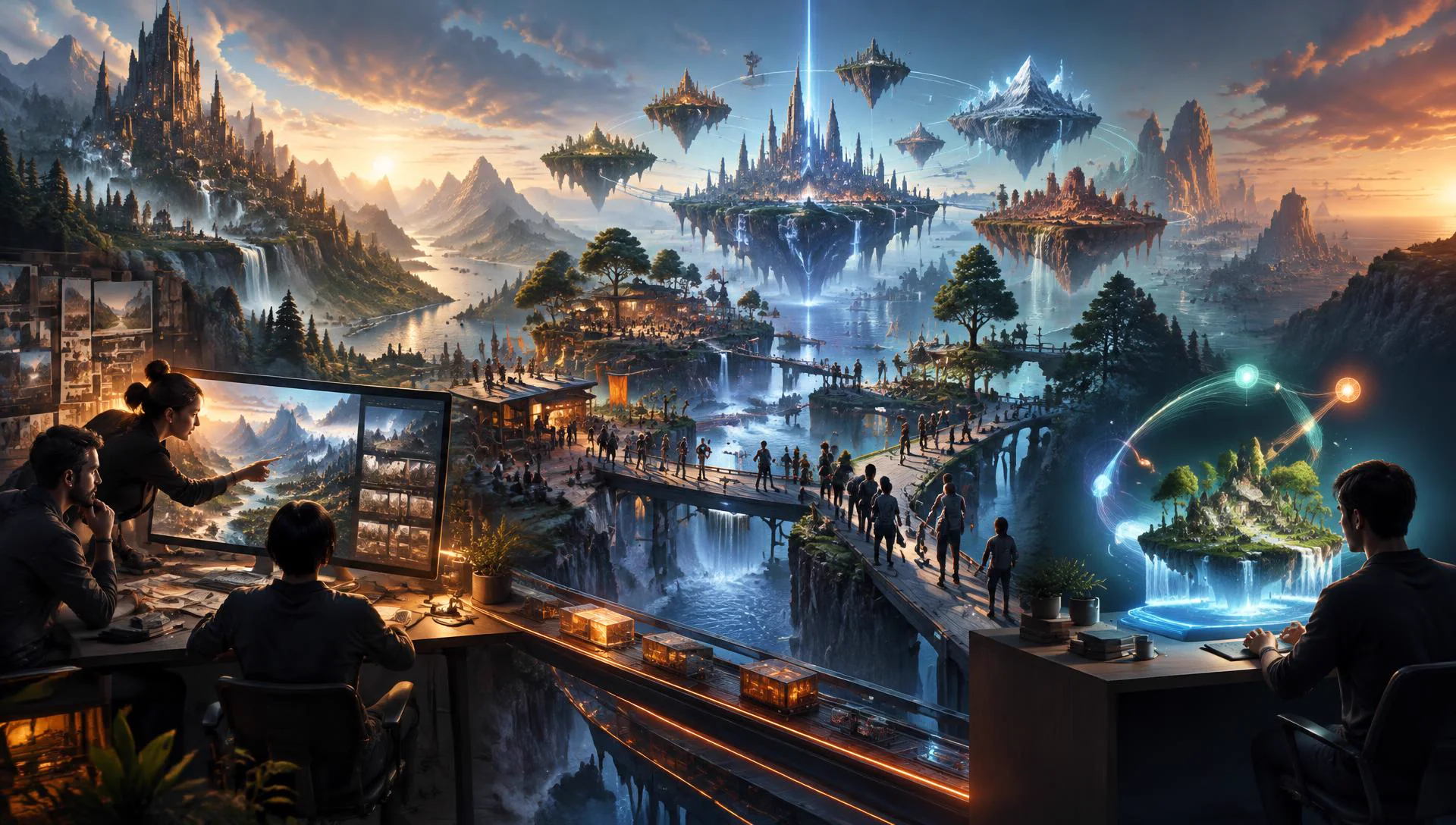
The short answer: AI is unlikely to produce one new games market. It is more likely to strengthen three overlapping ones: studios making authored games for increasingly specific audiences; companies operating games as platforms where communities build alongside them; and players creating small, personal games from natural-language instructions.
That does not mean professional studios disappear. It means the economics around them change. When more people can make more interactive content, production becomes less scarce. Attention, trust, cultural relevance and discovery become more valuable.
This distinction matters because much of the current discussion starts in the wrong place. It asks whether AI can make a texture, write code or generate a character. Those are production questions. The larger strategic question is what happens to the market when the cost and time required to test an idea continue to fall.
The evidence is still early, and it does not support confident predictions about exact cost reductions or release schedules. It does, however, show several forces moving at once: AI adoption inside studios, sharply rising game supply, growing creator economies, pressure on traditional AAA economics and a discovery system already struggling with abundance.
What the evidence already shows
The industry has moved beyond isolated experiments, but adoption remains uneven. The 2025 GDC State of the Game Industry report, based on a survey of more than 3,000 developers and industry professionals with Omdia, found that one in three developers used generative AI at work. A separate BCG survey of 178 game companies found smaller publishers further ahead in experimentation than large AAA publishers.
Across the wider economy, the technical conditions are moving quickly. The Stanford AI Index 2025 reported that organizational use of generative AI in at least one business function rose from 33% in 2023 to 71% in 2024. The same research found that the cost of querying a model at roughly GPT-3.5 capability fell from $20 per million tokens in late 2022 to $0.07 by late 2024. That is not a measure of game-production cost, but it explains why increasingly capable tools can reach smaller teams.
At the same time, game supply is already expanding. Bain reports that annual PC releases more than doubled over five years to almost 19,000 in 2024. SteamDB-based analysis counted roughly the same number, up about 32% from 2023. Yet more supply has not meant evenly distributed success. Bain's 2025 gamer research estimates that the top 10 games on each major platform capture roughly 50% to 60% of revenue among active titles.
These facts should be read together. The market is becoming easier to enter at the same time as it becomes harder to be noticed.
Our thesis: three games markets will grow side by side
The following is not a forecast with fixed market shares. It is a strategic framework built from the direction of current research. The three categories will overlap, and many successful companies will participate in more than one.
1. Authored games become more specific
Studios will continue to create remarkable stories, worlds and systems. AI does not remove the value of authorship. It can make a clear point of view more economically viable.
For decades, rising production costs pushed large publishers toward fewer, larger bets. BCG's Gaming Report describes an industry in which development costs have risen, publishers place fewer bets and each miss carries greater consequences. AI-assisted development could move some of that risk in the opposite direction: faster prototypes, more variations tested before full production, less repetitive work and smaller viable teams for some forms of game.
There is no rigorous industry-wide study yet proving that AI reduces a complete game's budget or schedule by a particular percentage. Claims of that kind should be treated carefully. The opportunity is better understood through break-even economics. If a studio can test ten directions before committing to one, or make a focused title without carrying the cost structure of a mass-market production, it may no longer need the broadest possible audience to justify the work.
That creates room for games built around a specific culture, profession, place, age group, play style or emotional need. A historical strategy game can go deeper into one decade. A cooperative title can be designed for parents with limited time. A narrative game can serve a language community that once looked too small for full localization. A simulation can model an enthusiasm that would never survive a conventional greenlight process.
This does not guarantee a new golden age of niche games. Lower barriers also create more weak products and more noise. But they can let disciplined studios exchange scale for specificity. In that market, taste, research and an authentic relationship with an audience become stronger advantages, not weaker ones.
2. More studios become game-building platforms
A second market is already visible in Roblox, Fortnite and Minecraft: the game is not only a finished experience. It is a place where others create experiences, objects, communities and businesses.
Bain's 2025 analysis describes traditional AAA studios caught between nimble independent developers and large games-as-a-platform businesses. Its global survey of more than 5,000 players found that people in platform-style games value social and creative elements alongside gameplay, sometimes above graphical fidelity.
The economic engine is substantial. Roblox reported that creators earned more than
AI strengthens this model because every reduction in creative friction can increase participation. A player who would never learn a full game engine may still describe an object, revise a level, define a quest or adapt an existing world. Professional creators can work faster. Studios can expose controlled systems rather than every technical layer.
But operating a platform is a different business from making a title. It requires creator economics, moderation, discovery, safety, technical standards, live operations and governance. A studio must decide whether it wants to tell a story, provide the stage on which others tell stories, or combine both. The last option can be powerful, but it is not free.
3. Gamers become game creators
The third market is more speculative, but the technical direction is clear. Natural language is becoming an interface for game creation.
Researchers are already testing systems that turn high-level instructions into playable structures. DreamGarden, a research system for Unreal Engine, breaks a prompt into a hierarchy of design and implementation tasks. A text-to-game research framework has generated multimodal role-playing experiences from text. Roblox's Cube research has introduced text-to-3D generation while describing interactive scene generation as a longer-term direction.
These are early signals, not proof that anyone can reliably make a commercial game from one sentence. Current systems still struggle with consistency, complex logic, originality, safety and persistent control. Research published in Nature on gameplay ideation identified consistency, diversity and the ability to preserve user changes as essential capabilities. Those requirements are much harder than producing a plausible first image.
Even so, the likely consumer opportunity does not require a full commercial title. A child might describe a short game for friends. A tabletop group might turn a campaign into an explorable scene. A fan community might build a temporary experience around an event. A player might generate a personalized challenge that lasts twenty minutes and is never published broadly.
This is closer to the relationship between social video and cinema than a simple replacement story. Billions of short videos did not remove professionally made film. They created another creative market, changed audience expectations and redirected a large share of attention. Prompt-built play could do the same to games.

Will AI mean more games?
Almost certainly, although “more games” needs qualification.
We should expect more prototypes, more short experiences, more modifications, more community-built content and more titles aimed at smaller audiences. We should also expect more abandoned projects, derivative work and low-quality releases. The number of available experiences will grow faster than the number of experiences any person can meaningfully evaluate.
The current Steam market shows the shape of that problem before widespread prompt-to-game creation. Nearly 19,000 games appeared in 2024, but a large share remained below Valve's engagement and sales thresholds. Volume alone does not create a healthy market.
The important change may be a wider range of viable scales:
- Premium authored titles with major budgets, strong IP and cross-media reach.
- Focused AA and independent games built for well-understood communities and lower break-even points.
- Persistent platforms whose value comes from creators, social systems and continuous participation.
- Personal and ephemeral games created for a small group, a moment or a single player.
The category “game” becomes broader. Comparing every personal creation with a premium studio title will make as little sense as comparing a private photo story with a feature film.
Distribution becomes the real battleground
If production becomes abundant, distribution does not simply become easier. It changes form.
Storefront placement remains important, but discovery is moving outward. Bain reports that creators and social media now account for a much larger share of game discovery, while the share of top-grossing mobile games with their own web shops nearly quadrupled from 12% to 44% over five years. Direct relationships help studios retain customer knowledge, improve margins and communicate without depending entirely on a platform's algorithm.
For niche games, distribution may become more precise rather than simply larger. A studio does not need to reach everyone. It needs to know where a particular audience gathers, who it trusts, which formats explain the game and how interest travels through that community. Community leaders, streamers, specialist media, Discord groups, newsletters and cross-media collaborations can become part of the product strategy from the beginning.
Localization also changes. When creative and production systems can adapt trailers, store assets, community material and launch packages more efficiently, a focused game can address several small language markets as one viable global audience. The constraint moves from producing every format to understanding which message belongs in each market.
Platforms will respond to abundance with stronger ranking, recommendation, moderation and curation systems. That may improve relevance, but it also increases gatekeeper power. Studios that own audience relationships and recognizable creative identity will be less exposed than those whose strategy begins and ends with uploading to a store.
What should studios do now?
The correct response is not to predict which category wins. It is to decide which business the studio intends to build.
- Choose the role. Are you an authored-game studio, a platform operator, an enabler for player creation, or a deliberate combination? Each model requires different talent, technology and economics.
- Use AI to increase the number of informed bets. The strategic value is not merely doing the same production plan faster. It is testing more mechanics, visual directions and audience propositions before the most expensive commitments.
- Protect the creative system. When tools become widely available, a studio's accumulated context matters more: its worlds, design rules, references, approvals, assets and lessons from previous projects. That knowledge should remain owned, portable and governed.
- Build distribution into development. Audience research, creator relationships, localization and channel formats should influence what gets made, not arrive as a launch-week service request.
- Set a production-clearance standard. Faster experimentation cannot come at the cost of rights, provenance or accountability. Our guide to AI cleared for game production outlines the questions legal, security and creative teams should settle before scaling.
- Measure outcomes, not tool usage. Track prototype cycles, rework, approval time, asset reuse, audience conversion and quality. The number of prompts or generated files says little about whether the studio improved.
Studios also need to keep the human impact in view. GDC's research shows strong developer concern about the ethics of generative AI. The World Economic Forum argues for human-centred adoption, transparent governance and new collaboration between companies, workers and policy-makers. Creative teams should be involved in deciding which work to automate and which work defines the craft.
For a practical view of where AI adds value and where risk begins, see AI in Gaming: Where Studios Win and Where Risk Starts. For the operating model, explore the Creative AI OS for game development.
The lasting advantage is not access to AI
AI access will become common. Models will improve, prices will fall and creation interfaces will become easier. Those changes are important, but they are not a durable studio strategy.
The durable advantages are a point of view worth following, creative knowledge that compounds, a trusted relationship with a community and the ability to reach the right audience repeatedly. AI can reduce the distance between an idea and a playable expression. It cannot decide which idea deserves years of attention or why a particular group of people should care.
The future games market may therefore be both larger and more divided: global authored experiences with extraordinary production values; focused games that serve audiences previously considered too small; vast platforms where professional and player creation merge; and millions of personal games that exist briefly for the people who asked for them.
Creation becomes abundant. Meaning and discovery do not. That is the market studios need to prepare for.
Frequently asked questions
Will AI lead to more games being released?
Yes. AI lowers friction in prototyping, asset creation and other production tasks, while creator platforms bring more people into development. However, current market data shows that more releases do not automatically attract players or generate revenue. Discovery and quality filtering become more important as supply grows.
Will gamers be able to create complete games from prompts?
Research systems can already turn natural-language instructions into limited game structures, 3D objects and playable experiments. Reliable one-prompt creation of a polished commercial game is not established. Near-term growth is more likely in small personal games, modifications, levels, objects and assisted creation.
Does AI mean AAA studios will disappear?
No. Premium storytelling, world-building, craft and trusted IP remain valuable. Large studios do face pressure from rising costs, independent developers and platform-style games. AI may help them test more ideas and improve production, but it does not remove the need for strong creative direction or audience demand.
How will game distribution change?
Discovery will depend more on creators, communities, direct player relationships, specialist channels and recommendation systems. As game supply rises, studios will need clearer positioning and earlier audience development rather than relying only on storefront visibility at release.