How to Measure Creative AI ROI Across Teams
Learn how to measure Creative AI ROI across marketing, art, IT, and game teams with metrics for cost, speed, quality, and governance.
Creative AI ROI is hard to measure because the value rarely belongs to one team. Marketing sees faster campaign launches. Art directors see fewer review rounds. Application managers see better control over model access and spend. Game developers see faster prototyping and more visual options earlier in production.
If you measure only how many images, videos, or 3D assets were generated, you will get a noisy number that looks impressive but says little about business impact. The real question is whether AI helped the organization produce more approved, compliant, on-brand work with less waste and better speed.
That question is becoming urgent. McKinsey reported that generative AI adoption rose sharply in 2024, with 65% of surveyed organizations regularly using gen AI in at least one business function. As creative AI moves from experimentation to production, executives need a practical way to connect AI usage to financial outcomes, quality, governance, and team productivity.
Start with the right ROI question
The wrong question is: How much content did AI generate?
The better question is: How much production value did governed creative AI create across the workflow?
A useful enterprise formula is:
Creative AI ROI = (incremental value + avoided cost + risk-adjusted savings - AI operating cost) / AI operating cost x 100
Each part should be defined clearly before you start measuring.
| ROI component | What it includes | Example in creative production |
|---|---|---|
| Incremental value | Additional revenue, contribution margin, or business impact enabled by faster or broader content production | More localized campaign variants launched on time across markets |
| Avoided cost | External production spend, manual adaptation work, rework, reshoots, or redundant tools that are reduced | Fewer agency hours for first-round concept exploration |
| Risk-adjusted savings | Reduced legal, brand, rights, or compliance exposure | More assets generated through approved models with audit records |
| AI operating cost | Platform, model usage, inference, storage, integrations, training, human review, and governance overhead | Total cost of running an AI-assisted campaign workflow |
The most important shift is to measure approved deliverables, not raw generations. A prompt that creates 100 unused visuals is not equal to a campaign image that passes brand review, rights review, and channel formatting. If you want a deeper cost model for this, Virtuall has a detailed guide on budgeting creative AI from tokens to deliverables.
Define the production unit first
Creative AI ROI becomes measurable only when teams agree on what counts as a unit of value. This unit should be specific enough to compare before and after AI adoption.
For an enterprise marketing team, the unit might be an approved product image variant. For an art department, it might be a concept direction accepted for campaign development. For a game studio, it might be a 3D prop concept approved for prototyping, not a final production asset.
| Production unit | Acceptance criteria | Useful ROI metrics |
|---|---|---|
| Campaign hero image | Approved by brand, creative, and legal stakeholders for a defined channel | Cost per approved image, review rounds, launch readiness |
| Product image variant | Approved for a SKU, market, and commerce channel | Variant throughput, localization speed, cost per approved variant |
| Social video cutdown | Approved for platform specs and campaign use | Edit cycle time, approval lead time, performance by creative version |
| 3D concept or game prop | Accepted for pre-production, prototyping, or further modeling | Concept approval rate, time to usable direction, iteration count |
| Moodboard or visual direction | Accepted by the art director as a valid creative route | Time to first review, reuse across teams, alignment with brief |
This prevents teams from celebrating volume while ignoring usability. AI can create many outputs quickly, but ROI depends on how many of those outputs move the project forward.
Build a baseline for each team
Before measuring improvement, capture the current state. A 4 to 8 week baseline is often enough for repeatable workflows such as campaign adaptation, product visualization, social asset creation, concept exploration, and localization.
The baseline should include time, cost, quality, and governance data. If you skip the baseline, every ROI discussion becomes anecdotal.
| Team | What to baseline | ROI signal to watch |
|---|---|---|
| CMO and marketing leadership | Campaign launch time, number of approved assets per campaign, localization coverage, paid creative refresh rate | Faster time to market, broader campaign coverage, better asset performance |
| Art directors and creative leads | Review rounds, first-pass approval rate, style consistency, time from brief to accepted direction | Less rework, stronger creative control, more consistent brand expression |
| Application managers and IT | Number of AI tools in use, access management effort, model usage cost, audit completeness | Tool consolidation, better spend visibility, stronger governance |
| Game developers and producers | Time from concept to prototype, number of accepted directions, placeholder asset turnaround | Faster iteration, better pre-production velocity, reduced bottlenecks |
| Legal and compliance teams | Rights review time, policy exceptions, asset provenance records, model approval status | Lower risk exposure, faster approvals, better audit readiness |
A cross-team baseline matters because creative AI often shifts work rather than simply removing it. For example, an art team may generate concepts faster, but if legal review becomes the bottleneck, the total workflow ROI may be limited. Measurement should follow the full path from brief to approved asset.
Measure four categories of creative AI ROI
1. Speed and throughput
Speed is usually the first visible benefit. Teams can move from brief to first review faster, create more variations, and localize content with fewer handoffs. But speed should never be measured in isolation. Faster rejected work is still waste.
Track metrics such as brief-to-first-review time, total approval lead time, approved deliverables per week, and localization cycle time. A simple speed metric is:
Cycle time reduction = (baseline cycle time - AI-assisted cycle time) / baseline cycle time x 100
For example, if a campaign visual workflow drops from 10 working days to 6 working days while maintaining the same approval standard, the cycle time reduction is 40%.
2. Cost and capacity
Cost savings should include both direct and indirect costs. Direct costs include platform fees, model usage, agency spend, production hours, and integration costs. Indirect costs include review effort, rework, project management, and time spent transferring assets between tools.
A practical cost metric is:
Cost per approved deliverable = total workflow cost / number of approved deliverables
This metric is more useful than cost per generation. If one team spends less on AI but produces outputs that require heavy manual repair, its cost per approved deliverable may be higher than expected.
Capacity is the related metric. If the same team can deliver more approved work without increasing headcount or reducing quality, the ROI may appear as capacity gain rather than budget reduction. This is especially relevant for CMOs who need more campaign variants, more markets, more channels, and faster testing cycles.
3. Quality and brand consistency
Creative AI ROI is not just a productivity story. For enterprise teams, brand control and quality are part of the economic case.
Quality can be measured with first-pass approval rate, number of review comments per asset, defect rate after publishing, style guide adherence, and channel performance. Art directors should define acceptance criteria before generation begins, including composition, tone, product accuracy, visual hierarchy, and brand fit.
Qualitative review still matters, but it should be structured. A consistent creative rubric turns taste into measurable guidance without reducing the role of human judgment.
4. Governance and risk reduction
Governance is often treated as an overhead cost. In production creative AI, it is also a source of ROI because it reduces duplicated work, approval friction, rights uncertainty, and audit effort.
Useful governance metrics include the percentage of assets generated through approved models, percentage of assets with complete provenance records, number of policy exceptions, time to resolve review issues, and percentage of AI use cases documented. The NIST AI Risk Management Framework is a helpful reference for thinking about AI risks in a structured way.
For creative and marketing teams, governance should be built into the workflow, not added after the fact. Virtuall covers this in more depth in its guide to responsible AI governance for creative and marketing teams.
Attribute ROI across teams without double-counting
Creative AI creates shared value. That is useful operationally, but it can make ROI reporting messy. Marketing may claim the value of faster campaign launches, while the studio claims productivity gains and IT reports platform consolidation. All three may be valid, but the same value should not be counted three times.
A clean model separates value ownership, execution ownership, and platform ownership.
| Value created | Primary value owner | Supporting owners | How to avoid double-counting |
|---|---|---|---|
| Faster campaign launch | CMO or campaign lead | Art director, studio operations, legal | Attribute revenue or launch impact once, then report team contributions separately |
| Reduced creative rework | Art director or creative operations | Marketing, reviewers, project managers | Measure review rounds and approval time at the workflow level |
| Lower AI tool fragmentation | Application manager or IT | Finance, procurement, creative teams | Count removed licenses and reduced admin work once |
| Faster prototype iteration | Game producer or development lead | Concept artists, technical artists, pipeline teams | Measure accepted concepts or usable prototypes, not raw outputs |
| Better compliance readiness | Legal, compliance, or IT | Creative operations, brand teams | Track audit completeness and exception reduction as operational risk metrics |
This approach helps every team see its contribution without inflating the business case. It also makes the ROI conversation more credible with finance and executive stakeholders.
Use a pilot-to-scale measurement model
A single pilot can show promise, but it rarely proves enterprise ROI. The goal is to move from experiment metrics to operating metrics.
- Baseline the workflow: Measure current cycle time, cost per approved deliverable, review rounds, quality outcomes, and compliance gaps before introducing AI.
- Run a controlled pilot: Compare AI-assisted production with a similar non-AI workflow, or compare the same workflow before and after AI with clear limits on scope.
- Expand by use case: Add related workflows only when the pilot shows repeatable gains, such as campaign adaptation, social video variants, product visualization, or concept exploration.
- Operationalize the dashboard: Move reporting into a regular cadence with finance, creative leadership, IT, and business owners.
When possible, compare similar projects from the same season, channel, or product category. If that is not possible, document the differences so the ROI story remains transparent.
Example Creative AI ROI calculation
The following is an illustrative quarterly example, not a benchmark. Imagine a global marketing organization using creative AI to accelerate campaign localization and image variant production.
| Input | Quarterly value |
|---|---|
| AI operating cost, including platform, model usage, training, review, and governance | USD 45,000 |
| Avoided external production and manual adaptation cost | USD 80,000 |
| Reduced rework and review overhead | USD 20,000 |
| Incremental contribution from faster launches and broader campaign coverage | USD 60,000 |
| Total measurable value | USD 160,000 |
| ROI | 256% |
The ROI calculation is:
(USD 160,000 - USD 45,000) / USD 45,000 x 100 = 256%
The important part is not the percentage itself. The important part is the method. The team separates cost savings from incremental business value, includes operating cost, and measures only outcomes tied to approved work.
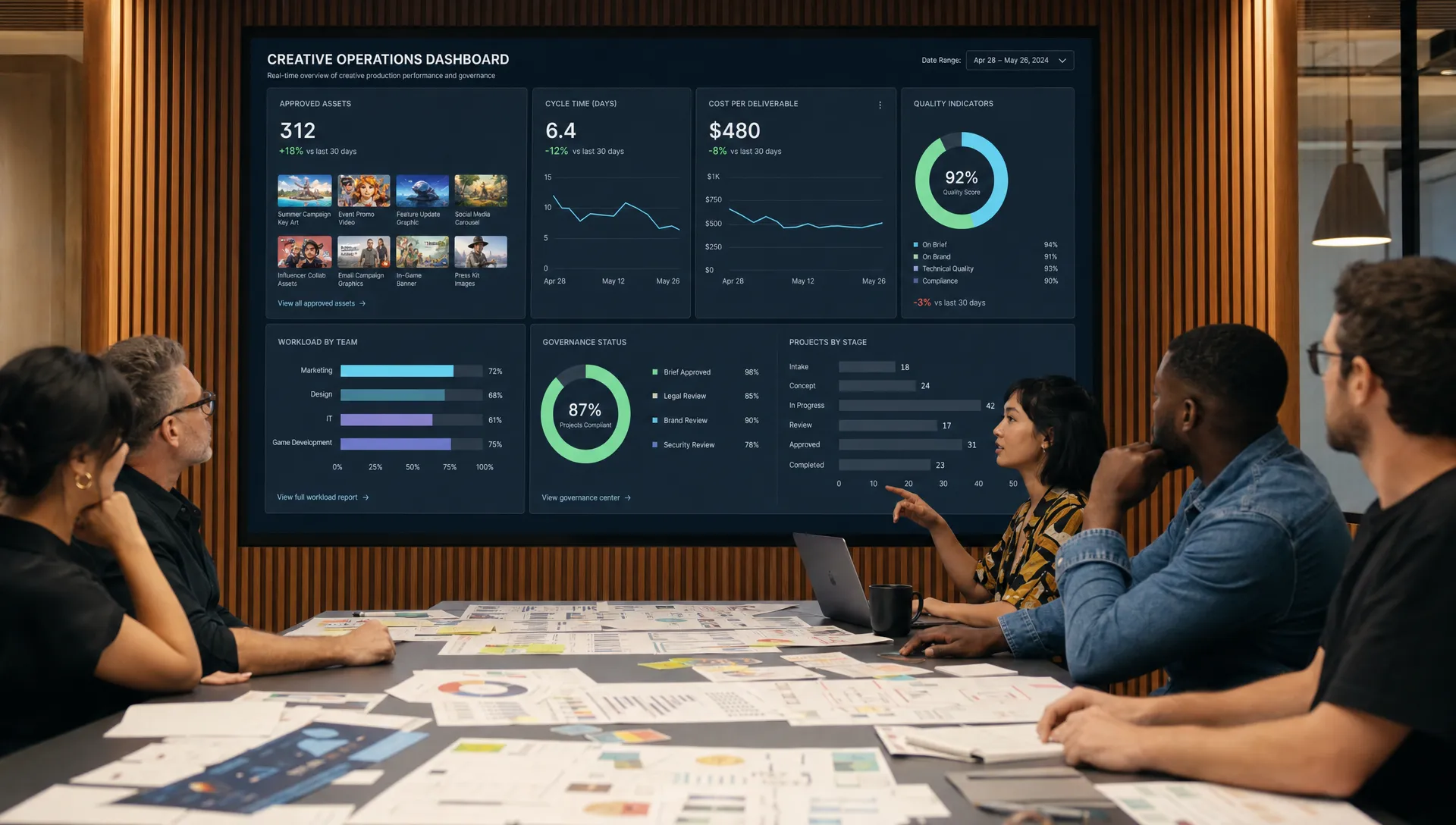
What to include in a Creative AI ROI dashboard
An enterprise dashboard should combine leading indicators, which show whether the system is improving, and lagging indicators, which show business impact. It should also make ownership visible across teams.
| Dimension | Core KPI | Leading signal | Owner |
|---|---|---|---|
| Adoption | Percentage of eligible projects using approved AI workflows | Active users by role and workflow | Creative operations, application manager |
| Production | Approved deliverables per week | Work in progress aging, time to first review | Studio lead, project manager |
| Cost | Cost per approved deliverable | Model spend by use case, rework cost | Finance, application manager |
| Quality | First-pass approval rate | Review comments per asset, rubric scores | Art director, brand lead |
| Governance | Percentage of audit-complete assets | Policy exceptions, unapproved model usage | IT, legal, compliance |
| Business impact | Launch speed, campaign contribution, content coverage | Assets deployed by channel and market | CMO, product or game lead |
This dashboard should not live in isolation. Creative AI ROI becomes more reliable when the measurement system connects to the actual production workflow, including briefs, approvals, assets, model usage, and downstream systems such as DAM, PIM, DCC, or project management tools.
Common mistakes to avoid
Counting generations as value
Raw output volume is easy to measure, but it can create false confidence. A team that generates 10,000 images and approves 100 may be less efficient than a team that generates 1,000 images and approves 300. Always connect generation volume to approval, usage, and business outcome.
Ignoring human review time
Creative AI does not remove human judgment. It changes where judgment happens. Art direction, brand review, legal review, and production QA should be included in the cost model. If AI saves production time but doubles review time, the workflow needs redesign.
Measuring one team in isolation
A marketing team may see faster ideation, but application managers may carry higher support and governance costs. A game team may prototype faster, but pipeline teams may need more validation work. Cross-team ROI should include the full operating model.
Treating governance as a blocker instead of a metric
Governance can feel like friction when teams are experimenting. At scale, it becomes a way to reduce risk, improve consistency, and make AI work repeatable. The ROI model should include governance indicators such as approved model usage, audit completeness, and policy exception reduction.
Mixing experimental and production workflows
Exploration is valuable, but it should not be measured the same way as production. Experimental workflows can be judged by learning velocity and creative range. Production workflows should be judged by approved deliverables, quality, cost, compliance, and business contribution.
How Virtuall helps teams measure and scale creative AI
Measuring creative AI ROI is easier when AI work is not scattered across disconnected tools, private accounts, and undocumented prompt histories. Enterprise teams need a controlled operating layer where workflows, models, approvals, context, and assets can be governed together.
Virtuall is a Creative AI OS designed to help teams operate AI-powered content creation across image, video, 3D, and other creative formats. Its role is to give studios and enterprises the structure needed to orchestrate workflows, apply governance controls, manage context, collaborate on reviews, and connect creative AI production with existing tools and pipelines.
For teams moving beyond isolated experiments, this operating layer is what turns AI activity into measurable production performance.
Frequently Asked Questions
What is the best metric for Creative AI ROI? The best core metric is cost per approved deliverable, supported by cycle time, first-pass approval rate, governance completeness, and business impact. Raw generations are not enough because they do not show whether the work was usable.
How long should a creative AI pilot run before measuring ROI? Most teams need at least 4 to 8 weeks of baseline data and a similar pilot period to compare results. Shorter pilots can show directional value, but they may not capture rework, approval, compliance, or downstream production effects.
How do you measure creative quality in an AI workflow? Use a structured rubric agreed by creative leadership. Criteria can include brand fit, composition, product accuracy, channel suitability, originality, and readiness for approval. Combine rubric scores with first-pass approval rate and review comments.
Should AI model costs be tracked separately? Yes, but model cost should not be the only cost metric. Track model usage by workflow and team, then connect it to total workflow cost and approved deliverables. This prevents teams from optimizing cheap generations that create expensive rework.
How can enterprises measure governance ROI? Governance ROI can be measured through fewer policy exceptions, higher audit completeness, reduced use of unapproved models, faster rights review, and less time spent reconstructing how an asset was created. These metrics become especially important as AI usage scales across teams.
Turn creative AI into measurable production performance
Creative AI ROI is not a single number hidden in a model invoice. It is the combined effect of faster workflows, lower waste, better creative consistency, stronger governance, and more approved assets reaching the market.
If your organization is ready to move from scattered AI experimentation to governed creative production, explore how Virtuall’s Creative AI OS helps teams orchestrate workflows, manage compliance, and scale production-ready content across images, video, and 3D.