NVIDIA AI Enterprise for Creative Teams: What Matters
NVIDIA AI Enterprise for creative teams: learn what matters for governance, workflows, compliance, and production-ready AI at scale.
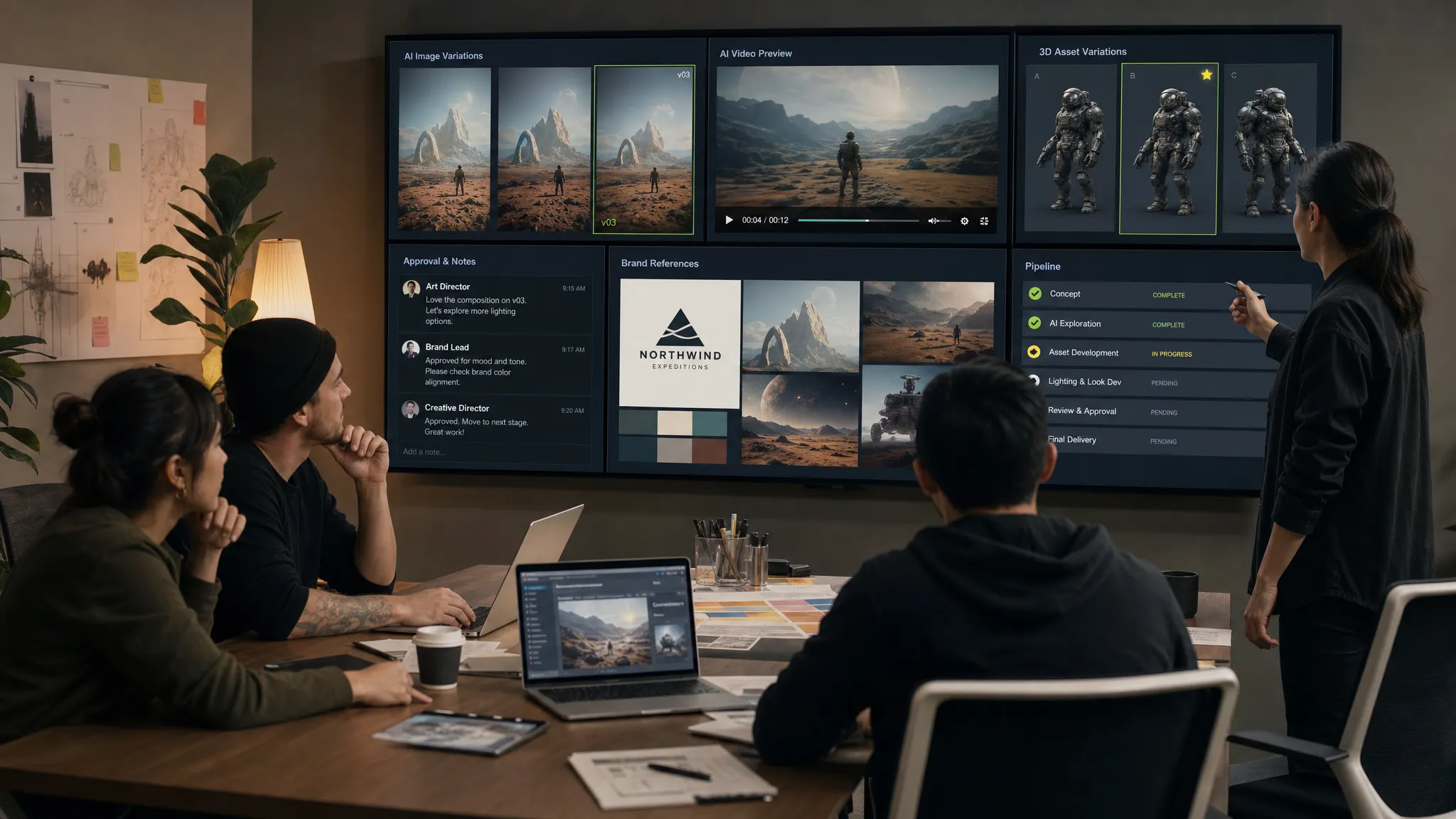
For creative organizations, the hard part of generative AI is no longer proving that a model can make an impressive image, video clip, or 3D concept. The hard part is operating AI reliably across campaigns, studios, tools, approvals, data policies, and production deadlines.
That is why enterprise teams increasingly evaluate NVIDIA AI Enterprise as part of their creative AI strategy. It can be an important foundation for running AI workloads in a governed, supported environment. But it is only one part of the stack. Creative teams also need orchestration, brand context, approval workflows, asset management, and compliance controls that match how production actually happens.
If you are a CMO, art director, application manager, or game developer assessing AI at scale, the question is not simply “Should we use NVIDIA AI Enterprise?” The better question is: what role should it play in a complete creative AI operating model?
What NVIDIA AI Enterprise is, and what it is not
NVIDIA AI Enterprise is NVIDIA’s enterprise software platform for developing and deploying AI applications with support, security, and performance considerations for business environments. It is often evaluated by organizations that need a more reliable path from AI experimentation to production infrastructure, especially when GPU acceleration is central to the workload.
For creative teams, this matters because image, video, 3D, and multimodal generation can be compute-intensive. Enterprise AI teams also care about consistency across environments, compatibility with cloud or on-premises infrastructure, and access to a supported AI software ecosystem.
However, NVIDIA AI Enterprise is not, by itself, a creative production workflow. It does not automatically define your brand rules, manage art direction, route assets through approvals, preserve campaign context, or decide which model should be used for a specific creative task. It is better understood as a powerful infrastructure and software foundation, not the full operating system for creative AI.
A helpful way to frame it is this: NVIDIA AI Enterprise can help you run AI workloads with enterprise-grade expectations. A creative AI operating system helps your teams decide how AI should behave inside creative production.
Why creative teams are evaluating enterprise AI infrastructure now
Generative AI has moved from isolated experimentation into production pressure. Marketing teams want campaign variations faster. Art teams want consistent visual systems across hundreds of assets. Game studios want to accelerate ideation, prototyping, and asset pipelines. Application managers need to connect AI capabilities to existing DAM, PIM, DCC, and workflow tools without creating uncontrolled shadow systems.
That shift changes the evaluation criteria. A single model demo might impress leadership, but enterprise rollout requires answers to more practical questions.
- CMOs need brand control, cost visibility, legal confidence, and repeatable campaign output.
- Art directors need consistent style, reusable visual context, and high-quality review loops.
- Application managers need governance, integrations, access controls, and operational stability.
- Game developers need pipeline fit, asset iteration speed, and reliable handoff into production tools.
This is where many organizations discover a gap. Infrastructure alone is not enough, but creative workflow tools without a serious AI foundation can also struggle at scale. The strongest strategy usually combines both layers.
The evaluation criteria that matter most
When evaluating NVIDIA AI Enterprise for creative teams, avoid treating it as a generic IT procurement decision. Creative AI has unique demands because outputs are subjective, iterative, brand-sensitive, and often tied to intellectual property.
The table below summarizes the main areas to assess.
| Evaluation area | Why it matters for creative teams | Key question to ask |
|---|---|---|
| AI infrastructure | Image, video, and 3D generation can be compute-heavy and latency-sensitive. | Can our infrastructure support production workloads, not just pilots? |
| Model operations | Creative teams often need multiple models for different asset types and styles. | How will models be selected, updated, and governed? |
| Creative context | Brand, mood, style, and campaign intent must persist across iterations. | How do we keep creative direction consistent across teams? |
| Workflow orchestration | AI output needs briefs, reviews, approvals, revisions, and delivery. | How does AI fit into the production pipeline from request to final asset? |
| Compliance | Enterprise teams need data policies, auditability, and regional considerations. | Can we control where data and inference run, and document the process? |
| Integrations | Creative teams already work in DAM, PIM, DCC, and collaboration tools. | Will AI connect to our existing tools or create another silo? |
| Production readiness | Outputs need to be usable, traceable, and reviewable. | What defines an approved, production-ready AI asset? |
This table is useful because it separates two conversations that are often blended together: the infrastructure needed to run AI, and the operating model needed to use AI responsibly in creative work.
Infrastructure is the foundation, not the creative process
NVIDIA’s ecosystem is highly relevant when teams need accelerated AI deployment. Resources such as the NVIDIA NGC catalog and technologies like NVIDIA Triton Inference Server are part of the broader environment that technical teams may consider when building or deploying AI workloads.
For creative production, this foundation can help answer questions such as where AI runs, how workloads are deployed, and how teams can standardize parts of the AI stack. Those are important questions, especially for enterprises that cannot rely on ad hoc tools or uncontrolled public model usage.
But the creative process introduces another layer of complexity. A model may be technically available, but should it be used for a licensed character style? A prompt may produce strong visuals, but does it follow campaign guidelines? A generated 3D concept may look promising, but is it attached to the right project, revision, approval status, and downstream asset workflow?
These are not purely infrastructure questions. They are governance and orchestration questions.
Governance is more than security
Enterprise AI governance is often discussed in terms of data protection, access, and infrastructure security. Those are essential. But creative AI governance must go further because the risks are tied to brand, intellectual property, production consistency, and review accountability.
For example, a creative governance model should define which teams can generate which asset types, what source material can be used as reference, which models are approved for specific use cases, and what approval gates are required before an asset enters production. It should also clarify how prompts, outputs, revisions, and decisions are documented.
This is becoming more important as AI regulation matures. The European Commission’s AI regulatory framework has increased enterprise attention on documentation, accountability, and risk management. Even when a creative use case is not classified as high-risk, large organizations still need internal policies that show responsible AI adoption.
In practice, governance should be designed into the creative workflow. If it sits only in a policy document, teams will work around it. If it is embedded into generation blueprints, permissions, approvals, and pipeline tracking, it becomes part of how production runs.
Multi-model orchestration is a creative requirement
Creative teams rarely need one model for everything. A campaign may require product imagery, lifestyle variations, motion concepts, localized versions, 3D references, and audio or video components. A game studio may use different AI capabilities for ideation, concept art, environment references, character exploration, texture directions, or marketing assets.
That reality makes model orchestration critical. The question is not only “Can we run a model?” It is “Can we route the right creative request to the right model, under the right rules, with the right context, and produce an output the team can actually use?”
This is where a creative AI operating system becomes valuable. Virtuall’s Creative AI OS is designed to help teams control, orchestrate, and scale AI-powered content creation across image, video, 3D, and audio formats. Its intelligence layer, Nyx, orchestrates multiple industry-leading AI models while preserving intent and context across studios and teams.
That distinction matters. Infrastructure can support model execution, but creative orchestration determines whether AI becomes a repeatable production capability.
Workflow orchestration decides whether AI scales
AI pilots often happen outside the normal production pipeline. Someone generates options, downloads files, shares them manually, and asks for feedback in a separate channel. That can work for experimentation, but it breaks down quickly when teams need repeatable, compliant, high-volume production.
A scalable creative AI workflow needs structure. It should connect the brief, context, generation settings, review comments, approvals, asset storage, and delivery path. It should also make it clear who is responsible for each decision.
| Creative production stage | What AI needs to support | What can go wrong without orchestration |
|---|---|---|
| Brief intake | Capture goals, formats, references, and constraints. | Teams generate assets from incomplete or inconsistent instructions. |
| Context setup | Use mood boards, brand direction, and campaign references. | Outputs drift away from the intended visual system. |
| Generation | Apply approved models, templates, and rules. | Teams use unapproved tools or inconsistent prompts. |
| Review | Annotate, compare, and refine outputs collaboratively. | Feedback gets lost across chats, slides, and file versions. |
| Approval | Route assets through brand, legal, or production gates. | Unapproved assets move downstream. |
| Asset management | Store final outputs with project and pipeline context. | Files become hard to find, reuse, or audit. |
| Integration | Connect final assets to DAM, PIM, DCC, or delivery tools. | AI creates another disconnected content silo. |
For application managers, this is often the decisive issue. If AI cannot integrate with existing systems, adoption becomes fragmented. If it does integrate cleanly, AI can become part of the enterprise content supply chain.
Virtuall addresses this operating layer with workflow orchestration, team collaboration tools, review workflows, approvals, content annotation, asset management, pipeline tracking, and integrations with creative tools through plugins and API.
Consistency depends on context memory and generation blueprints
One of the biggest frustrations in creative AI is inconsistency. A team may get one excellent result, then struggle to reproduce the same quality, tone, or style across the next 50 assets. This is especially painful for enterprise brands and studios where consistency is not optional.
The solution is not simply better prompting. Prompts are useful, but they are too fragile to serve as the only operating method for enterprise creative work. Teams need reusable structures that capture intent, references, constraints, and output requirements.
Generation blueprints, or templates, help standardize recurring creative tasks. They can define the type of output needed, the creative direction to follow, the accepted parameters, and the workflow steps required. Studio context memory, such as mood boards, helps preserve visual direction across iterations, teams, and campaigns.
For art directors, this means less time re-explaining the same direction. For CMOs, it means stronger brand consistency. For game developers, it means better continuity across asset families, environments, and production references.
Compliance and regional infrastructure should be discussed early
Compliance should not be left until procurement is almost complete. Creative AI touches sensitive areas, including brand assets, unreleased product visuals, licensed IP, customer-facing content, and sometimes personal data. Enterprises need to know where data is processed, which vendors are involved, and how AI usage is governed.
For organizations operating in Europe or serving European customers, regional infrastructure and inference can be an important part of the risk conversation. Virtuall emphasizes EU-based infrastructure and inference as part of its compliance approach, which can be relevant for teams that need stronger control over where AI operations run.
This does not remove the need for internal legal, procurement, and security review. It does, however, make compliance easier to operationalize when the creative AI system is built around governance controls rather than informal tool usage.
Build, buy, or combine?
Many enterprise teams frame the decision as whether to build an internal AI platform or buy a specialized creative AI solution. In reality, the most practical answer is often a combination.
| Approach | Best fit | Main limitation |
|---|---|---|
| Infrastructure-first with NVIDIA AI Enterprise | Organizations with internal AI platform teams and strong GPU workload requirements. | Does not automatically solve creative workflow, brand context, or approvals. |
| Creative AI OS-first | Teams that need governed creative production across image, video, 3D, and collaboration workflows. | Still needs a clear infrastructure and model operations strategy. |
| Combined stack | Enterprises that want both production-grade AI foundations and creative operating controls. | Requires alignment between IT, creative operations, legal, and business owners. |
For creative teams, the combined model is often the most realistic. NVIDIA AI Enterprise can be part of the technical foundation. A platform like Virtuall can provide the creative operating layer that controls how AI is used across studios, workflows, and tools.
A practical checklist before you scale
Before committing to a broader rollout, enterprise teams should align on the operational basics. This avoids the common trap of buying AI capacity before defining how it will be used.
- Identify the top creative use cases that need AI support, such as product imagery, concept development, campaign variation, 3D ideation, or video production.
- Define which teams can use AI, which models are approved, and which asset types require review or approval.
- Map how AI outputs will move from brief to generation, review, approval, asset management, and downstream tools.
- Decide what creative context must be preserved, including mood boards, brand references, campaign direction, and format requirements.
- Confirm data, compliance, and regional infrastructure requirements with legal, security, and procurement teams.
- Test production readiness with real workflows, not isolated demos.
- Measure adoption by approved output quality, cycle time, governance adherence, and reuse of production-ready assets.
This checklist keeps the conversation grounded. The goal is not to adopt AI for its own sake. The goal is to create a controlled, repeatable, and compliant way for creative teams to produce better work at scale.
Where Virtuall fits
The Creative AI OS is built for the layer that creative teams feel every day: the operating system for AI-powered content creation. It helps studios and enterprises control how AI runs across workflows, tools, and teams while supporting production-ready outputs across image, video, 3D, and audio.
That includes AI governance controls, workflow orchestration, multi-model content generation, generation blueprints, studio context memory through mood boards, collaboration and approval workflows, content annotation, asset management, pipeline tracking, EU-based infrastructure and inference, and integrations with creative tools such as DCC, PIM, and DAM systems through plugins and API.
If your organization is evaluating NVIDIA AI Enterprise, Virtuall does not need to be seen as a replacement for that foundation. Instead, it can be the creative AI OS that helps your teams operate AI safely, consistently, and effectively on top of the infrastructure and model strategy you choose.
Frequently Asked Questions
Is NVIDIA AI Enterprise necessary for every creative team? Not necessarily. It is most relevant for organizations with enterprise AI infrastructure requirements, GPU-intensive workloads, and a need for supported production deployment. Smaller teams may start with managed creative AI tools, while larger enterprises often need a more governed stack.
Does NVIDIA AI Enterprise replace a creative AI operating system? No. NVIDIA AI Enterprise supports enterprise AI workloads, but creative teams still need workflow orchestration, brand context, approvals, asset management, and governance rules specific to production content.
Why do creative teams need multi-model orchestration? Different creative tasks require different AI capabilities. Image generation, video, 3D assets, audio, and campaign variations may each benefit from different models or workflows. Orchestration helps route work to the right model while preserving rules and context.
What should CMOs care about most when scaling creative AI? CMOs should focus on brand consistency, compliance, campaign speed, cost control, and whether AI outputs can move through approved production workflows without increasing risk.
How does Virtuall relate to NVIDIA AI Enterprise? Virtuall operates at the creative workflow and governance layer. It helps teams control, orchestrate, and scale AI-powered content creation across formats and tools, while NVIDIA AI Enterprise can be part of the underlying enterprise AI infrastructure strategy.
Move from AI experiments to governed creative production
Creative AI at enterprise scale requires more than powerful models. It requires rules, context, workflows, approvals, integrations, and production discipline.
If your team is evaluating NVIDIA AI Enterprise or building a broader AI content strategy, Virtuall can help you operate creative AI across your studio, workflows, and tools with the governance and orchestration needed for production.