AI and Creativity: How to Protect Taste While Scaling Output
AI and creativity can scale without losing taste. Learn a practical system for governance, templates, review loops, and consistent production-ready output.

Scaling creative output with AI can feel like a trade: more volume, less “taste.” In practice, the trade is optional. The teams getting real value from AI and creativity are the ones who treat taste as a system they can protect, not a vibe they hope survives.
Taste is what makes a brand recognizable, a game world coherent, and a studio’s work unmistakably theirs. It lives in art direction, narrative tone, compositional habits, lighting, pacing, and the thousands of small decisions that separate “content” from craft. When you introduce multiple models, many users, and high-throughput workflows, taste becomes fragile unless you design for it.
This guide explains how to protect taste while scaling output, with practical steps for CMOs, Art Directors, Application Managers, and Game Developers.
What “taste” actually means in an AI production context
In enterprise creative operations, taste is not just aesthetics. It is a set of decisions that are consistent across time, channels, and teams.
You can think of taste as four layers:
- Brand and narrative intent: What you stand for, what you never say, the emotional contour of the work.
- Design language: Layout patterns, typography rules, composition, color logic, pacing.
- World rules (especially for games and 3D): Materials, scale, physics cues, silhouette language, lore consistency.
- Quality threshold: The line between acceptable and production-ready.
AI can support each layer, but it can also flatten them if the system is unmanaged. The core risk is not that AI is “bad at creativity.” The risk is creative drift: small inconsistencies that compound when output scales.
Why taste gets diluted when you scale AI output
Taste dilution is usually caused by process, not prompts. Common failure modes include:
Too many sources of truth
If teams rely on scattered docs, Slack messages, and personal prompt files, you get inconsistent intent. Different people are effectively “training” the brand differently every day.
Model variability and silent updates
Different models interpret the same direction differently. Even the same model can change behavior over time due to vendor updates. Without governance, your aesthetic shifts without anyone deciding to shift it.
No structured review loop
When output volume spikes, review becomes triage. Teams approve what is “good enough,” which gradually resets the baseline.
Weak provenance and compliance anxiety
If no one can answer “Which model made this, with what inputs, under what policy,” legal and brand teams will either block adoption or accept unmanaged risk. Either outcome hurts consistency.
For a useful overview of organizational risks and controls around generative AI, see the NIST AI Risk Management Framework.
The “Taste System” approach: protect taste by design
To scale AI and creativity without losing your signature, build a Taste System with three pillars:
- Codify taste (so the system has something stable to follow).
- Constrain generation (so output stays inside approved boundaries).
- Close the loop (so humans continuously steer the system).
Done well, this lets you increase throughput while making results more consistent than manual-only production.
1) Codify taste into reusable creative context
Most teams start with prompt tips. High-performing teams start with context.
Create a “taste pack” (usable, not aspirational)
A taste pack is a practical bundle of references and rules that a team can apply repeatedly.
Include:
- Do / don’t examples: Approved vs rejected outputs with short annotations about why.
- Visual references: Mood boards, lighting references, material callouts, silhouette rules.
- Language rules (for copy and narrative): Voice, banned phrases, reading level, disclaimers.
- Format constraints: Aspect ratios, safe areas, frame pacing, camera language, polycount or texture guidelines for 3D.
If you only publish brand guidelines, you will still get drift. If you publish examples with reasons, reviewers align faster and creators iterate less.
Use context memory for continuity
When multiple projects run in parallel, people forget what “on brand” meant in February. A shared, living memory of creative context helps keep intent stable.
This is where systems like Virtuall’s studio context memory (mood boards) are designed to help: not by replacing art direction, but by making it consistently available inside production workflows.

2) Constrain generation with governance, not guesswork
To protect taste at scale, constraints must be enforceable. That means governance.
Define who can generate what, and where
Enterprise creative teams need controls like:
- Which models are approved for which tasks (image, video, 3D, audio).
- Which data sources can be used as inputs.
- Which projects require approvals before publication.
- What logging and audit trail is required.
This is one reason “creative AI OS” platforms are emerging: they add operational control around multi-model generation. Virtuall, for example, positions governance as a core layer, alongside orchestration and compliance.
Standardize workflows with generation blueprints
Taste is easier to protect when teams stop reinventing the process for every request.
Instead of “prompting,” think blueprints:
- Inputs: brand pack, product attributes, world rules, campaign brief.
- Steps: concept set generation, variation, upscale, retouch, localization, exports.
- Controls: permitted models, quality gates, human review checkpoints.
- Outputs: formats, naming conventions, metadata.
Blueprints reduce variability between teams and vendors. They also make it easier to measure what works.
Keep enterprise compliance aligned with creative velocity
If your organization operates in Europe or serves EU customers, compliance posture matters. The EU AI Act is shaping governance expectations across procurement, risk management, and transparency.
The practical takeaway for creative teams is simple: make compliance part of the workflow, not a separate “legal review” after content is done.
Virtuall highlights EU-based infrastructure and inference as part of its compliance story. If your risk profile requires regional constraints, make that a non-negotiable system rule, not a best-effort guideline.
3) Close the loop: review workflows that train the system and the team
Scaling output without scaling review is how taste erodes.
Treat review as structured feedback, not a subjective thumbs up
A fast, consistent review loop is typically:
- Annotated: “Lighting is off-brand,” “material read is too plastic,” “copy violates voice rule #3.”
- Categorized: brand, composition, rendering, anatomy, typography, lore consistency, safety.
- Actionable: points to the rule or reference that resolves the issue.
This creates two benefits:
- Creators learn faster.
- Your organization builds a dataset of “what good means,” which can be translated into better blueprints.
Virtuall’s collaboration features (review workflows, approvals, content annotation) map directly to this need. The key is not the UI, it is the discipline: every approval teaches the system what taste is.
Define “production-ready” with checklists and measurable gates
Taste includes a quality threshold. Make that threshold explicit.
A quality gate can cover:
- Technical specs (resolution, compression, bit depth, topology requirements).
- Brand constraints (logo usage, safe area, color usage rules).
- Content safety and claims (industry and legal requirements).
When the gate is clear, reviewers become consistent and cycle time drops.
A practical operating model for scaling AI output without losing taste
Below is a simple operating model you can adapt. The goal is repeatability.
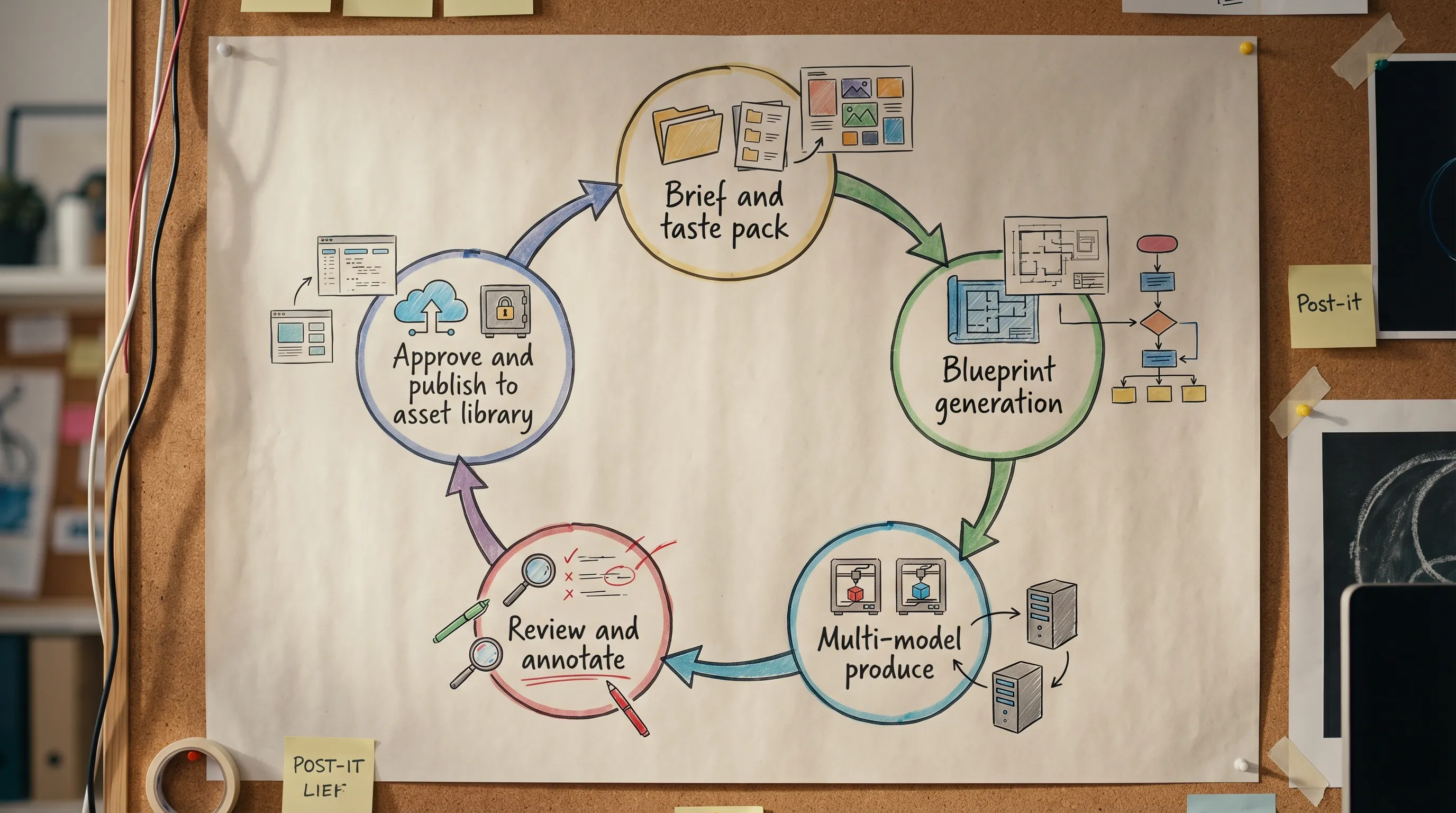
How the operating model maps to real teams
CMO perspective: You want more campaign variations and faster localization without brand fragmentation.
Art Director perspective: You want creative control to remain central, even if more people are generating.
Application Manager perspective: You want secure integration, clear permissions, and audit trails.
Game Developer perspective: You want consistency across concept art, 3D assets, cinematics, and marketing materials, with stable world rules.
Taste protection techniques that work in real production
Use “variation with constraints,” not open-ended ideation
AI is great at breadth. Taste comes from boundaries.
Instead of prompting for “10 cool options,” prompt for “10 options that adhere to these 5 constraints.” Then reject aggressively.
Separate exploration from production
Exploration can be looser, production should be governed.
- Exploration: fast ideation, multiple models allowed, low approval overhead.
- Production: approved models only, blueprint required, review gates enforced.
This protects taste while still capturing AI’s speed.
Prefer model orchestration over model loyalty
Different models excel at different jobs. A mature workflow uses the right tool for each step, while keeping the creative intent stable.
Nyx, Virtuall’s intelligence layer, is described as orchestrating multiple models while preserving intent and context across teams. That is the right direction: the system should carry intent forward, even if models change.
Store outputs like assets, not like files
If you want consistency, treat AI outputs as first-class assets with metadata and lifecycle:
- What project they belong to
- What version is approved
- What variations were rejected and why
- What usage rights and compliance tags apply
This supports reuse without repeating mistakes.
Table: Ad hoc AI use vs governed creative AI at scale
| Dimension | Ad hoc prompting | Governed, taste-protecting system |
|---|---|---|
| Consistency | Depends on individual skill | Enforced by shared context and blueprints |
| Speed over time | Fast at first, slows with rework | Faster sustained throughput |
| Brand risk | High, hard to audit | Lower, policy-based controls and approvals |
| Cross-team alignment | Fragmented | Shared references and review standards |
| Model changes | Silent drift | Managed selection and orchestration |
| Production readiness | Manual cleanup often required | Designed for production-ready outputs |
What to measure so you know taste is protected
If you cannot measure it, you cannot defend it when leadership asks for more volume.
Consider tracking:
- Revision rate: How many cycles before approval.
- Reject reasons: Top 5 reasons content is rejected (brand, lighting, anatomy, voice, lore).
- Time to approved asset: From brief to approved delivery.
- On-brand scorecards: Lightweight reviewer rubric, consistent across teams.
- Reuse rate: How often approved assets are repurposed without rework.
These metrics shift the conversation from “AI quality is subjective” to “our system is getting tighter.”
For broader context on how organizations are approaching generative AI at work, McKinsey’s ongoing reporting is a useful reference point, for example their generative AI insights.
Frequently Asked Questions
Does using AI automatically reduce creativity? No. AI can increase creative range and speed, but only if you preserve human judgment and constrain generation to your creative intent. Without constraints, you get generic output.
What’s the fastest way to keep a consistent brand style across teams? Build a shared taste pack (examples plus reasons), then enforce it through templates or blueprints and a structured review workflow. Consistency is a process outcome.
How do we prevent style drift when models update? Use governed model selection, keep a record of which model and settings produced approved work, and route production through standardized blueprints. Treat model changes like any other production change.
Can this work for game studios using 3D pipelines? Yes. The same principles apply: world rules, asset standards, and review gates. The difference is you also need constraints for topology, materials, scale, and pipeline compatibility.
Is governance just a legal requirement? Governance protects more than compliance. It protects creative taste by making boundaries enforceable, ensuring the brand is consistent even when output scales.
Scale AI and creativity without losing your studio’s signature
If you are trying to scale content across image, video, and 3D while keeping taste consistent, you need more than a model and a prompt library. You need an operating layer that carries creative intent, enforces governance, and supports production workflows.
Virtuall's Creative AI OS is built to help studios and enterprise teams orchestrate multi-model creation with governance, collaboration, context memory, and compliance in mind. Explore how it works at Virtuall.