AI Modelling for Creative Teams: What Changes in Production
Discover how AI modelling changes creative production, from governance and workflows to 3D, video, brand consistency, and scalable AI operations.
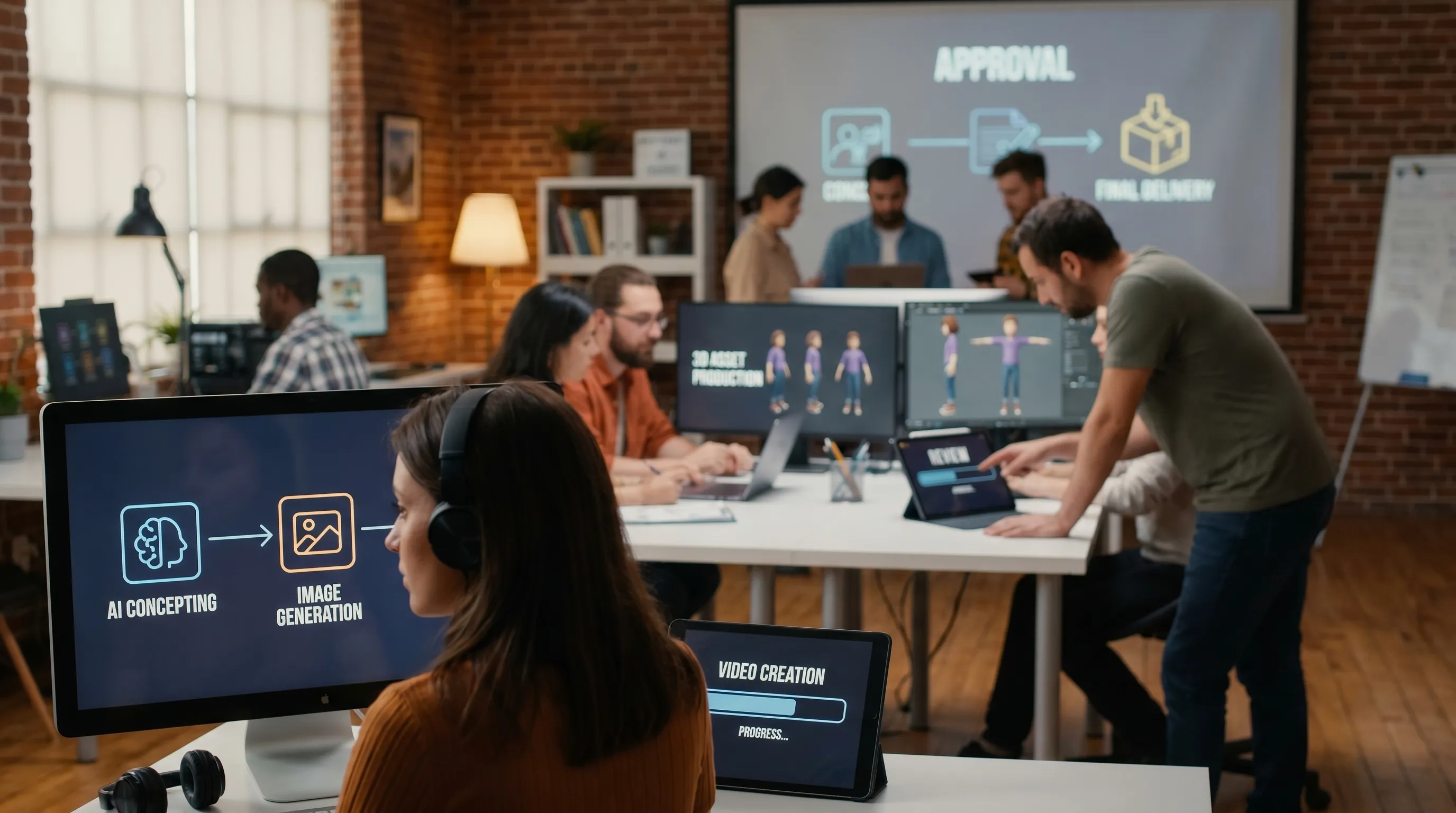
AI modelling is no longer a side experiment for creative teams. It is becoming part of the production system itself, shaping how briefs become concepts, how concepts become assets, and how those assets move through review, localization, approval, and delivery.
For enterprise creative organizations, the shift is bigger than “generate more images faster.” AI changes the operating model of production. It affects roles, governance, tooling, asset quality, brand control, and the relationship between creative ambition and production capacity.
The opportunity is clear: teams can explore more directions, compress repetitive work, and adapt content across channels at a speed traditional pipelines were not built for. The risk is also clear: without control, AI can create inconsistency, compliance exposure, duplicate work, and assets that look impressive but fail production requirements.
This article breaks down what changes when creative teams bring AI modelling into real production, especially across image, video, 3D, and brand content workflows.
What “AI modelling” means in creative production
In creative environments, AI modelling can mean several related things. It may refer to AI-assisted creation of 3D models, characters, product visuals, environments, image variants, video shots, or style explorations. It can also describe the broader use of AI models to generate, transform, or refine creative assets.
For production teams, the important point is not the model itself. It is how the model fits into the workflow.
A model that creates a beautiful concept image is useful. A controlled production system that can turn a brief, mood board, brand guide, prompt, approval history, and technical format requirement into repeatable outputs is far more valuable.
That is where creative teams are seeing the biggest change. AI is moving from isolated prompting to orchestrated production.
The biggest production shift: from manual execution to guided orchestration
Traditional creative production is usually organized around handoffs. Strategy hands off to creative. Creative hands off to production. Production hands off to localization, channel teams, legal, or external partners. Each handoff introduces interpretation, delay, and rework.
AI modelling changes this by making more of the production process configurable and repeatable. Instead of asking every contributor to recreate context manually, teams can encode parts of that context into templates, rules, reference assets, approval flows, and model instructions.
The result is not a fully automated studio. Creative judgment still matters. In fact, it becomes more important. The change is that creative teams can spend less time rebuilding the same foundations and more time directing outcomes.
| Production area | Traditional workflow | AI-enabled workflow |
|---|---|---|
| Concept exploration | Limited by available design time | More directions explored from the same brief |
| Brand consistency | Controlled through manual review | Supported by reusable rules, references, and templates |
| Asset variation | Time-consuming resizing and adaptation | Faster generation of channel, market, or style variants |
| Review cycles | Comments scattered across tools | Centralized annotation, approval, and version tracking |
| Governance | Often checked late in the process | Built into generation and workflow controls |
| Technical delivery | Manual export and cleanup | Outputs guided by format, pipeline, and tool requirements |
This is why enterprises are not only asking, “Which AI model should we use?” They are asking, “How do we operate AI safely and consistently across the creative organization?”
What changes for art directors
For art directors, AI modelling expands the range of visual exploration. A single brief can produce multiple visual territories, lighting directions, compositions, materials, and campaign moods in a shorter timeframe.
But the art director’s role does not become smaller. It becomes more editorial and systemic.
Instead of producing or supervising every early variation manually, art directors increasingly define the creative boundaries that AI should work within. Those boundaries may include visual references, mood boards, product rules, framing conventions, color systems, casting principles, environment constraints, or brand exclusions.
This changes the daily work in three important ways.
First, art direction becomes more continuous. The creative intent must be preserved from the first prompt through the final production asset. If the system loses context between concepting, refinement, and delivery, the team still ends up with rework.
Second, critique becomes more important. AI can generate volume, but volume is not the same as quality. Art directors need fast ways to compare outputs, annotate decisions, reject weak directions, and promote strong ones.
Third, consistency becomes a creative asset. When teams use shared context, approved references, and repeatable generation blueprints, they can scale production without making every asset feel disconnected.
What changes for CMOs and brand leaders
For CMOs, AI modelling affects speed, cost, and brand governance. It can help teams produce more campaign variants, adapt assets for more channels, personalize creative concepts for different markets, and respond faster to seasonal or cultural moments.
The strategic question is not whether AI can make content. It can. The question is whether the organization can scale AI-generated content without weakening the brand.
That requires more than experimentation. It requires operating rules.
Brand leaders need visibility into questions such as:
- Which AI models are being used, and for what purpose?
- Which brand references are approved for generation?
- Who can create, edit, approve, and publish AI-assisted assets?
- How are rights, provenance, and compliance checks handled?
- How are final assets stored, versioned, and reused?
The organizations that benefit most from AI modelling will likely be those that connect creative acceleration with governance. According to McKinsey’s 2025 State of AI report, more organizations are using generative AI, but value depends heavily on workflow redesign, risk management, and adoption at scale. That pattern is especially relevant in creative operations, where brand risk and production complexity are tightly connected.
For the CMO, AI should not be treated as a novelty tool. It should be treated as a production capability that needs ownership, measurement, and alignment with brand strategy.
What changes for application managers and IT teams
Application managers face a different challenge: AI modelling introduces new tools, data flows, integrations, permissions, and compliance requirements.
A creative team may want access to the latest image, video, or 3D model. Procurement may want cost control. Legal may want traceability. Security may want data residency and access rules. Production may need integration with existing DAM, PIM, DCC, and review tools.
This is where many AI initiatives slow down. Individual tools are easy to test. Enterprise production is harder.
IT and application leaders need to evaluate AI creative systems through a practical lens:
- Can the organization control which models are available to which teams?
- Can prompts, references, and outputs be governed?
- Can workflows connect to existing creative and asset systems?
- Can teams track approvals and production status?
- Can the system support compliance requirements, including regional infrastructure needs?
The regulatory environment is also maturing. The EU AI Act introduced a risk-based framework for AI systems, with phased obligations for different categories of AI. Even when creative AI use cases are not classified as high-risk, enterprise teams still need clear policies for transparency, data handling, and responsible deployment.
For application managers, the production shift is clear: AI cannot remain an unmanaged layer of tools. It needs to become part of the enterprise creative stack.
What changes for game developers and 3D teams
Game studios and 3D production teams often feel AI modelling changes most directly. Environments, props, textures, concept art, character exploration, cinematic references, and marketing assets can all be accelerated with AI-assisted workflows.
However, 3D production has stricter requirements than many image workflows. A generated asset is not production-ready just because it looks good in a preview. It may need clean topology, usable UVs, correct scale, optimized geometry, consistent materials, naming conventions, and compatibility with the engine or DCC pipeline.
This means AI has to be evaluated at multiple levels:
| Requirement | Why it matters in 3D production |
|---|---|
| Geometry quality | Poor topology can slow rigging, animation, and optimization |
| Material consistency | Assets must work under real lighting and rendering conditions |
| Scale and orientation | Incorrect units or axes create pipeline friction |
| Level of detail | Real-time applications require performance-aware assets |
| Export compatibility | Teams need formats that fit engines, DCC tools, and asset systems |
| Review traceability | Leads need to know what changed, who approved it, and why |
For game teams, AI modelling is most useful when it supports the pipeline rather than bypassing it. It can speed ideation and asset creation, but the output still has to survive production constraints.
The best approach is often hybrid. Artists use AI to explore, block out, generate variations, or accelerate specific tasks, while senior artists and technical artists define the standards that make assets usable in production.
The new role of context in creative AI
One of the biggest limitations of early generative AI workflows was context loss. A team would create a prompt, generate outputs, refine them, move to another tool, brief another teammate, and lose part of the original intent along the way.
In professional production, context is everything.
A product image is not just a product image. It carries campaign strategy, brand rules, lighting preferences, market requirements, legal restrictions, channel dimensions, and past decisions. A game asset is not just a 3D object. It belongs to a world, a performance budget, an art style, a technical pipeline, and a gameplay context.
AI modelling becomes much more powerful when context is persistent. Mood boards, approved references, generation templates, review notes, and team memory help ensure that AI outputs align with the project instead of drifting with every new prompt.
This is also where the distinction between a tool and an operating system matters. A single AI generator can create an output. A Creative AI OS can help teams define how generation should happen, who controls it, how it connects to workflows, and how context is preserved across production.
Governance becomes part of the creative workflow
In many studios, governance used to happen at the end. Legal, brand, or compliance teams reviewed assets after most of the creative work had already been done. That model becomes risky when AI increases output volume.
If a team can generate hundreds of assets quickly, manual late-stage review becomes a bottleneck. Worse, problems may be discovered after time and budget have already been spent.
AI modelling pushes governance earlier in the workflow. Teams need controls before and during generation, not only after it.
This can include approved model access, prompt rules, reference libraries, permissions, review workflows, content annotations, and approval checkpoints. It can also include decisions about where inference runs, how data is stored, and how outputs are tracked.
The NIST AI Risk Management Framework emphasizes governance, mapping, measurement, and management as core functions for trustworthy AI. Creative teams can apply the same principle in practical terms: define how AI should be used, monitor what it produces, and make accountability visible.
Good governance should not feel like a brake on creativity. Done well, it gives teams the confidence to scale.
Creative quality shifts from single outputs to repeatable systems
Before AI, quality was often evaluated asset by asset. Is this image good? Is this video approved? Is this 3D model usable?
Those questions still matter. But with AI modelling, teams also need to evaluate system quality.
A strong AI production system should produce consistently useful outputs across different briefs, teams, markets, and formats. It should reduce avoidable rework. It should make creative intent easier to preserve. It should allow teams to learn from previous decisions.
This changes how teams measure success. Instead of focusing only on how fast one asset was generated, enterprise teams should track broader production indicators.
Useful metrics can include:
- Time from brief to approved concept
- Number of usable variants per brief
- Rework caused by brand or compliance issues
- Approval cycle length
- Asset reuse across campaigns or products
- Percentage of AI outputs that meet technical delivery standards
- Production cost per approved asset
These metrics help leaders separate novelty from operational value. A model that creates impressive demos may not be the best fit if it produces inconsistent assets, creates review overhead, or fails to integrate with the existing stack.
What creative teams need before scaling AI modelling
Many teams start with pilots, and that is sensible. But moving from pilot to production requires a different level of structure.
Before scaling, creative leaders should align on a few foundations.
First, define the use cases. AI modelling for concept exploration, campaign localization, product visualization, video adaptation, 3D asset generation, and game prototyping all have different requirements.
Second, define the rules. Teams need clarity on approved models, data usage, brand references, rights, review responsibilities, and publication standards.
Third, define the workflow. AI should not create another disconnected production lane. It should connect to the tools and processes teams already use where possible.
Fourth, define what “production-ready” means. For an image team, that may include resolution, composition, retouching standards, and channel specs. For 3D teams, it may include topology, materials, scale, naming, and export formats. For video teams, it may include frame consistency, duration, aspect ratio, soundtrack rules, and legal review.
Finally, define ownership. AI production needs creative owners, technical owners, and governance owners. Without ownership, standards become optional and adoption becomes fragmented.
How The Creative AI OS supports AI modelling at production scale
The Creative AI OS is built for teams that need to operate creative AI across real production workflows, not just run isolated experiments.
As a Creative AI operating system, Virtuall helps studios and enterprise teams control, orchestrate, and scale AI-powered content creation across images, video, audio, and 3D. Teams can define governance controls, use generation blueprints, preserve studio context through mood boards, manage collaboration and approvals, track pipelines, and connect AI workflows with existing creative tools through plugins and API.
Virtuall also includes Nyx, the intelligence layer of the Creative AI OS. Nyx orchestrates multiple industry-leading AI models and helps keep intent and context across studios and teams.
For organizations working in regulated or brand-sensitive environments, Virtuall’s EU-based infrastructure and inference support a more controlled approach to compliance. This matters because enterprise creative AI is not only about output quality. It is also about where work happens, how it is governed, and whether the organization can trust the process.
Common mistakes when introducing AI modelling
AI modelling can create value quickly, but many teams run into predictable issues when they scale too fast without structure.
One common mistake is treating prompting as the whole workflow. Prompts matter, but production also needs references, approvals, asset management, technical standards, and governance.
Another mistake is letting every team choose its own AI stack independently. This may create short-term momentum, but it can lead to inconsistent outputs, duplicated subscriptions, unclear rights, and integration problems.
A third mistake is measuring only speed. Faster production is valuable only if the assets are usable, compliant, and aligned with the brand or game world.
A fourth mistake is ignoring change management. Artists, producers, marketers, technical directors, and legal teams all interact with AI differently. Successful adoption requires training, shared language, and clear expectations.
The strongest AI creative programs usually start with focused use cases, then build the operating model around them.
The future of production is controlled creativity
AI modelling does not remove the need for creative teams. It changes where their effort creates the most value.
Routine production tasks can become more automated. Early exploration can become broader. Variants can become easier to produce. Review can become more structured. Governance can move closer to the point of creation. Technical teams can integrate AI into pipelines instead of managing it as an exception.
But the teams that win will not be the ones that generate the most assets. They will be the ones that generate the right assets, with the right context, under the right controls, at the right level of quality.
That is the real production change. AI modelling moves creative work from isolated creation toward orchestrated, governed, and scalable content operations.
Frequently Asked Questions
What is AI modelling for creative teams? AI modelling for creative teams refers to using AI models to generate, refine, or transform creative assets such as images, videos, 3D models, audio, concepts, and variations. In production, it also includes the workflows, rules, and context needed to make those outputs usable at scale.
Does AI modelling replace artists and designers? No. In professional creative production, AI is best understood as a production accelerator and orchestration layer. Artists, designers, art directors, and technical leads still define taste, intent, quality standards, and final approval.
Why is governance important in AI creative production? Governance helps teams control model usage, brand consistency, permissions, review workflows, data handling, and compliance. Without governance, AI-generated assets can create legal, operational, and brand risks.
How does AI modelling affect 3D production? AI can accelerate concepting, asset generation, texture exploration, and prototyping. However, 3D outputs still need to meet production requirements such as clean geometry, materials, scale, optimization, and compatibility with game engines or DCC tools.
What should enterprises look for in an AI creative platform? Enterprises should look for workflow orchestration, governance controls, multi-model support, collaboration tools, asset management, integration capabilities, compliance support, and the ability to preserve creative context across teams and projects.
Bring AI modelling into production with control
Creative AI is moving fast. The challenge is making it work inside real studios, real approval chains, real brand systems, and real production pipelines.
Virtuall helps creative teams operate AI at scale with governance, orchestration, context memory, collaboration workflows, asset management, and multi-model generation across image, video, audio, and 3D.
If your team is ready to move from AI experiments to controlled creative production, explore how Virtuall can support your workflow at virtuall.pro.