What Professional AI Image Generation Requires at Scale
Learn what professional AI image generation needs at scale: governance, context, orchestration, QA, compliance, and production-ready workflows.
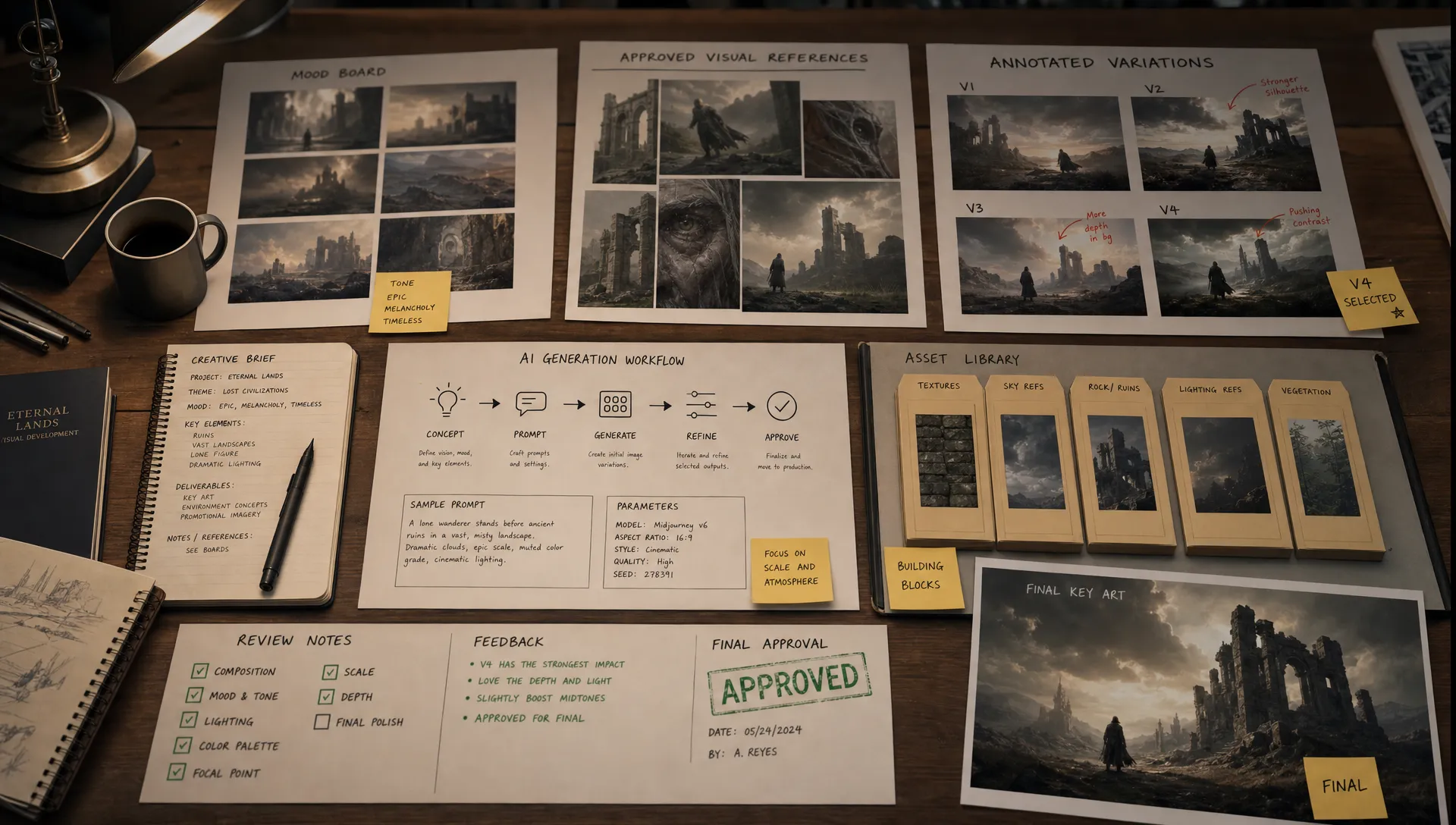
Professional AI image generation becomes strategic when output moves from experiment to production. For an individual creator, success might be one compelling image. For an enterprise studio, success is a reliable system: the right visual, in the right style, approved by the right people, traceable to the right inputs, and ready for downstream use.
That difference matters because creative AI now touches brand identity, product visualization, campaign localization, game concepting, retail content, social assets, and internal prototyping. The risk is not only bad images. The deeper risk is unmanaged variation: inconsistent brand expression, unclear rights, duplicated work, insecure inputs, and outputs that look impressive but cannot survive production review.
Professional AI image generation at scale is therefore less about prompt tricks and more about operating design. It requires governance, shared creative context, model orchestration, review workflows, asset management, compliance, and integration with the systems your teams already use.
If your team is still defining the production difference, Virtuall’s guide to professional AI image generation for production teams explains why consumer-grade generation is rarely enough once multiple stakeholders, markets, brands, and asset types are involved.
Why scale changes the requirements
A single AI-generated image can be judged on taste. A scaled production system must be judged on reliability.
For a CMO, the question is whether every output protects brand equity and accelerates campaign execution. For an art director, it is whether the image aligns with the creative vision and can be refined without starting from zero. For an application manager, it is whether AI can be governed, integrated, and supported like any other enterprise system. For a game developer, it is whether concept outputs can fit a wider pipeline that may include 3D, animation, and asset reuse.
The pressure points usually appear in four places:
- Volume: More teams generate more images across more briefs, variants, markets, and channels.
- Consistency: Visual direction must remain coherent even when many people and models are involved.
- Risk: Teams need clarity on permissions, data use, model selection, approvals, and auditability.
- Integration: Generated assets must move into DAM, PIM, DCC, review, campaign, or production systems without manual chaos.
When these requirements are not designed upfront, AI becomes a collection of disconnected experiments. When they are designed well, professional AI image generation becomes a controllable production capability.
1. Governance that protects speed, not just compliance
At scale, governance is not a blocker. It is what allows creative teams to move faster without creating uncontrolled risk.
A professional AI image generation environment should define who can generate, which models can be used, what inputs are allowed, how outputs are reviewed, and where assets are stored. This is especially important when prompts may include confidential product information, unreleased campaign ideas, licensed references, celebrity likeness concerns, or brand-specific visual codes.
Governance should cover practical production questions such as:
- Which teams can access which projects, models, and assets?
- Are prompts, references, and outputs logged for traceability?
- Can the organization restrict certain model providers or inference locations?
- Who approves visuals before they enter a campaign, game build, product page, or DAM?
- How are rejected generations, approved variants, and final assets retained?
Enterprise leaders do not need governance for its own sake. They need it because unmanaged AI introduces hidden operational debt. The NIST AI Risk Management Framework is useful here because it frames AI risk around governance, mapping, measurement, and management. For European organizations or global companies operating in Europe, the EU AI Act also reinforces the need to treat AI systems with clear accountability, transparency, and risk controls.
The goal is not to make every image generation process slow. The goal is to make safe workflows repeatable.
2. Shared creative context and memory
AI image tools can produce endless visual options, but they do not automatically understand your brand, campaign, product line, game world, or art direction. At scale, context is the difference between random variety and useful variation.
A professional system needs a way to preserve and apply studio context across teams. That context may include mood boards, approved references, product photography rules, color palettes, camera language, lighting direction, negative examples, style constraints, audience segments, and prior creative decisions.
Without shared context, every generator recreates the brief from scratch. That leads to drift: the visuals may look good individually, but the campaign, collection, or game environment lacks cohesion.
| Context input | Why it matters at scale |
|---|---|
| Brand guidelines | Keeps campaign and channel outputs aligned with brand identity |
| Mood boards | Gives teams a shared visual language before generation begins |
| Product data | Reduces inaccurate depictions of materials, proportions, colors, and details |
| Negative examples | Helps avoid styles, compositions, claims, or visual elements that are off-brand |
| Prior approvals | Allows future work to build from accepted decisions instead of repeating debate |
| Market requirements | Supports localization without losing global consistency |
This is where professional AI image generation begins to resemble a production system rather than a blank prompt box. The more the system understands the studio’s intent, the less time teams spend correcting preventable mistakes.
3. Multi-model orchestration instead of one-model dependency
No single AI image model is ideal for every professional use case. Some models are better for photorealistic product visualization. Others may be stronger for illustration, character exploration, layout ideation, brand-safe commercial outputs, or style consistency. As image generation expands into video, 3D, and audio-adjacent workflows, model choice becomes even more complex.
At scale, professional teams need orchestration: the ability to route work through the right model or combination of models while maintaining consistent intent, permissions, and output standards.
Model orchestration should account for:
- Creative fit for the task and visual style
- Output quality, resolution, editability, and consistency
- Commercial usage terms and IP considerations
- Data handling and infrastructure requirements
- Latency and cost per approved output
- Ability to connect with downstream image, video, or 3D workflows
This is why tool selection should not only be based on which model produces the most impressive demo image. It should be based on how the model behaves inside your production environment. If you are comparing options, Virtuall’s article on finding the best AI for image creation is a useful companion to this operating perspective.
A mature setup abstracts complexity from the user. The art director should not need to manually evaluate every underlying model for every brief. The system should help apply the right model, context, blueprint, and workflow based on the production need.
4. Repeatable workflows and generation blueprints
Creative AI does not scale when every request starts with a blank page. It scales when teams can turn successful patterns into reusable workflows.
In professional image generation, this often means creating generation blueprints: structured templates for common production tasks. A blueprint might define the input fields, reference assets, style constraints, model routing, output formats, review steps, and naming conventions for a specific use case.
Examples include campaign key visual exploration, product lifestyle scenes, ecommerce image variations, game environment concepts, character mood studies, packaging visualization, social media adaptations, or localized campaign imagery.
A strong production workflow should define:
- The required brief information before generation begins
- The approved references, mood boards, and constraints to use
- The model or model sequence appropriate for the task
- The number and type of variants expected
- The review, annotation, and approval process
- The final output format, metadata, and storage destination
This is the shift covered in Virtuall’s enterprise playbook for operating creative AI at scale: teams need an operating model, not just a collection of tools.
Blueprints also help teams learn. When one workflow produces excellent results, it can be reused, refined, and governed rather than lost in an individual’s prompt history.
5. Review and quality control for production-ready outputs
Professional AI image generation must account for the gap between impressive and usable. Many AI images look compelling at first glance but fail under production scrutiny. Hands may be wrong, product proportions may shift, logos may distort, materials may be inaccurate, lighting may conflict with the scene, or the image may not match campaign rules.
Quality control needs to be designed as part of the workflow, not added at the end as a manual cleanup panic.
A practical production QA process should check:
- Brand fit and visual direction
- Product accuracy and factual consistency
- Resolution, aspect ratio, and technical specifications
- Artifacts, distortions, and visual defects
- Legal, licensing, likeness, and usage concerns
- Prompt, input, model, and approval traceability
- Readiness for retouching, compositing, 3D handoff, DAM storage, or campaign use
For enterprise teams, the most important question is not whether AI can generate attractive images. It is whether the organization can reliably identify which generated images are safe, approved, and production-ready.
6. Compliance and infrastructure that match enterprise expectations
Professional AI image generation often involves sensitive inputs: unreleased products, confidential campaigns, proprietary style guides, licensed assets, internal strategy, or game concepts. Application managers and security teams need confidence that AI production can meet the same standards expected from other enterprise platforms.
Key infrastructure questions include where inference happens, how data is stored, whether prompts and outputs are retained, how access is controlled, and how the organization can audit activity. For global organizations, regional data requirements can also influence which AI systems are acceptable.
Compliance is not only a legal concern. It directly affects adoption. If creative teams are unsure whether a tool is approved, they may avoid it, or worse, use unapproved workarounds. A governed environment makes the approved path the easiest path.
This is especially important for organizations operating in regulated sectors, publicly visible consumer brands, or industries with strict IP management. The more valuable the creative assets, the more important it becomes to control the full lifecycle of AI-assisted production.
7. Integration with the creative and business stack
AI image generation cannot stay isolated from the systems where work actually happens. If teams must manually download, rename, upload, brief, track, and re-approve every asset, the productivity gain quickly erodes.
At scale, generated images need to connect with creative tools, DAM platforms, PIM systems, DCC workflows, review systems, and internal production pipelines. For game teams, AI-generated concepts may need to inform 3D modeling, environment art, character development, or level design. For marketing teams, outputs may need to move into campaign management, localization, ecommerce, or social production workflows.
The technical requirement is not simply an export button. It is pipeline continuity. Assets should carry context, metadata, status, version history, and approval information as they move from generation to production.
This reduces duplicated effort and helps teams answer basic but critical questions: Which image is approved? Which prompt and reference set created it? Which campaign or product is it connected to? Has legal or brand reviewed it? Where is the final version stored?
8. Measurement that reflects production value
Early AI pilots often measure excitement. Scaled programs need operational metrics.
The right metrics depend on the team, but they should connect AI image generation to production outcomes rather than vanity activity. Generating thousands of unused images is not success. Producing more approved, usable, on-brand assets with less rework is.
| Metric | What it reveals |
|---|---|
| Time from brief to approved visual | Whether AI is accelerating the actual production path |
| Approval rate by workflow | Whether briefs, context, and model routing are effective |
| Rework cycles | Whether outputs are close enough to the intended direction |
| Cost per approved asset | Whether the system is economically sustainable |
| Reuse of blueprints | Whether best practices are becoming repeatable |
| Compliance exceptions | Whether governance controls are working |
| Asset adoption rate | Whether generated outputs are actually used downstream |
Measurement also helps teams improve the system. If a certain blueprint has a low approval rate, the issue may be unclear input fields, weak references, the wrong model, or missing review criteria. If one team produces consistently better results, their workflow can be turned into a shared standard.
What each stakeholder needs from the system
Professional AI image generation at scale succeeds when every stakeholder gets what they need without forcing everyone into the same interface or priority set.
| Stakeholder | Primary need | What the AI image system must provide |
|---|---|---|
| CMO | Brand-safe speed and market coverage | Governance, consistency, approval visibility, and measurable production impact |
| Art Director | Creative control and quality | Shared context, mood boards, refinement paths, annotations, and style consistency |
| Application Manager | Secure and manageable adoption | Access controls, integrations, auditability, compliance, and supportable workflows |
| Game Developer | Pipeline-ready visual exploration | Concept consistency, asset traceability, 3D-aware workflows, and integration with production tools |
This alignment matters because AI image generation creates value across functions. If the system only serves experimentation, it will struggle to become part of daily production. If it serves governance without creative usability, teams will bypass it. The operating layer has to satisfy both.
What this looks like in Virtuall
Virtuall's Creative AI OS is built for teams that need to operate AI-powered content creation across image, video, 3D, and audio formats. Rather than treating generation as a standalone activity, it focuses on control, orchestration, collaboration, and production readiness.
Within that operating model, teams can work with governance controls, workflow orchestration, multi-model generation, generation blueprints, studio context memory through mood boards, review and approval workflows, content annotation, asset management, pipeline tracking, and integrations with creative tools through plugins and API.
Virtuall also includes Nyx, the intelligence layer of the Creative AI OS. Nyx orchestrates multiple industry-leading AI models and helps maintain intent and context across studios and teams. For enterprises that require stronger control over infrastructure and compliance, The Creative AI OS supports EU-based infrastructure and inference.
The practical value is simple: creative teams get room to explore, while the organization keeps control over how AI runs across people, tools, workflows, and outputs.
Frequently Asked Questions
What is professional AI image generation? Professional AI image generation is the use of AI image models inside controlled creative workflows that support brand consistency, review, collaboration, compliance, and production-ready outputs. It is different from casual generation because it must fit real business and creative pipelines.
Why do consumer AI image tools struggle at enterprise scale? Consumer tools can be useful for experimentation, but they often lack the governance, traceability, shared context, workflow control, integrations, and compliance features that enterprise teams need for repeated production use.
Does scaling AI image generation mean replacing creative teams? No. In professional environments, AI is most useful when it expands creative capacity and accelerates exploration while humans remain responsible for direction, judgment, approval, and final production decisions.
How should teams choose which AI image model to use? Teams should evaluate models based on creative fit, commercial terms, data handling, output quality, consistency, cost, latency, and integration with the wider workflow. The best choice depends on the production task, not only on visual impressiveness.
What is the biggest risk when scaling AI image generation? The biggest risk is unmanaged production drift. This includes inconsistent style, unclear approvals, insecure inputs, poor asset tracking, weak compliance controls, and outputs that cannot be confidently used in commercial work.
Build professional AI image generation into your production system
Scaling AI image generation is not about giving everyone access to more prompts. It is about giving teams a governed, repeatable, and integrated way to create better visual work faster.
If your studio or enterprise team is ready to move from experimentation to controlled creative AI operations, Virtuall helps orchestrate image, video, 3D, and audio generation across teams, workflows, models, and tools while keeping governance and production readiness at the center.