Draw a Cup of Coffee From Concept to Final Asset
Learn how to draw a cup of coffee that looks truly authentic. Our guide covers everything from initial concept sketches to final 3D renders for your projects.
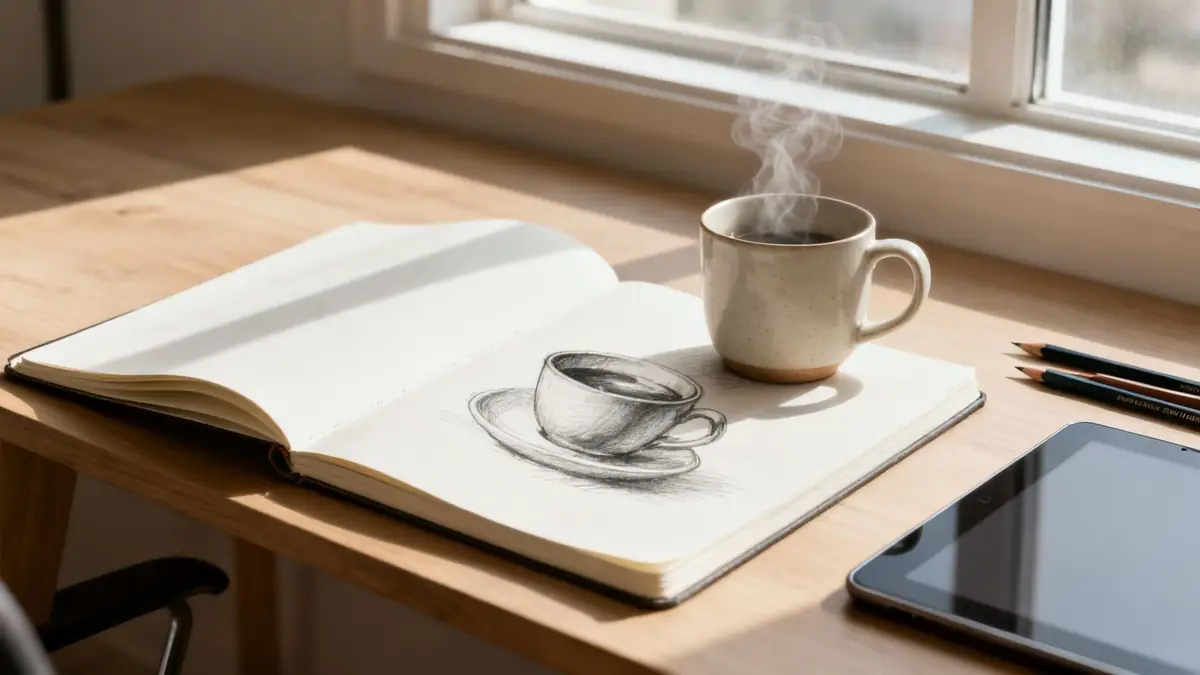
Turning a simple idea like "draw a cup of coffee" into a memorable visual asset for your enterprise isn't just about drawing skills. It's about taking that generic sketch and giving it personality, context, and a story. The first step is to define the narrative before your pen ever hits the tablet. For professionals looking to streamline this creative process, our Creative AI OS, VirtuallPRO, offers a powerful and secure platform to kickstart your project. If you haven't generated anything already, you can try it for free.
From Initial Idea to a Believable Coffee Cup
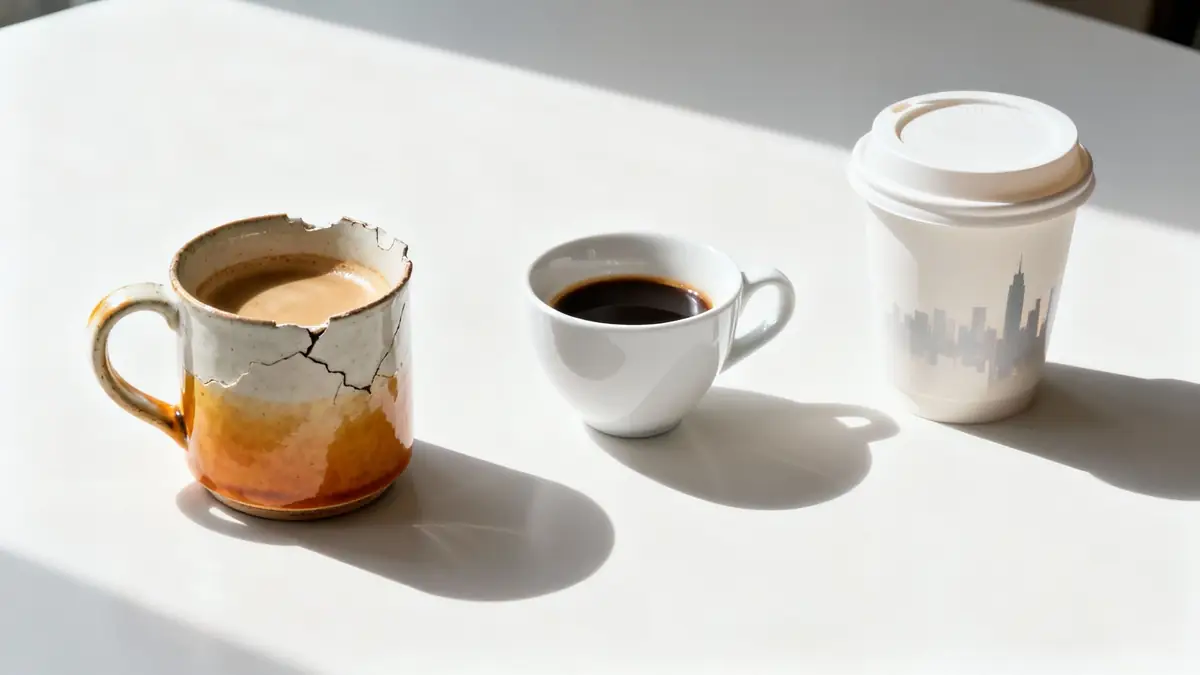
Every great visual starts with a question, not a line. Who is this coffee for? Where is it? Is it a chipped ceramic mug sitting in a cluttered game studio? A sleek espresso cup in a minimalist café? Or a steaming takeaway cup on a rainy city street?
Answering these questions builds a world around the object, making it instantly more real and engaging for your audience.
This is where brainstorming and rapid prototyping are your best friends. You can kickstart this process using VirtuallPRO's Creative AI OS to generate initial concepts and pull together visual references. It’s how creative teams at responsible companies like Virtuall go from an abstract thought to a solid visual direction in no time, all within a compliant and secure environment.
Defining Your Artistic Direction
Once you have that core story, the next step is translating it into visual elements. This is where you define the artistic style.
- Storytelling Through Detail: A coffee cup for a character in a gritty sci-fi game will look completely different from one in a bright, cheerful animated short. Think about adding details like scratches, company logos, or unique shapes that reinforce the world-building.
- Setting the Mood: Lighting, colour palette, and composition all work together to set a specific tone. A warm, softly lit scene feels cosy and inviting. Harsh, cool lighting can create a feeling of unease or stark modernity.
A prop is never just a prop; it’s an opportunity to reinforce the narrative. The details you choose for a simple coffee cup can inform the audience about the character, the environment, and the overall story without saying a single word.
This conceptual phase is absolutely crucial, especially if you're creating assets for interactive media. Getting this foundational visual narrative right is key. We actually dive much deeper into this in our guide on concept art for games, which breaks down how to turn ideas into truly impactful designs.
By locking in a clear artistic direction upfront, you ensure every single creative decision supports the final vision.
Mastering the Fundamentals of a Coffee Drawing

Once you have a solid idea in your head, it’s time to get it down on paper. To really draw a cup of coffee that feels real, you need to go beyond just tracing the outlines. It’s the small details and foundational techniques that give a drawing weight and presence.
The first hurdle is getting the perspective and proportions right. This is what keeps your cup from looking like it’s floating in space. A key detail here is the elliptical shapes of the cup’s rim and its base—getting those curves just right instantly tells the viewer the angle they’re seeing it from.
Capturing Believable Textures and Surfaces
A coffee scene is a fantastic study in contrasting textures. Honestly, the success of your drawing often comes down to how well you can sell the illusion of different materials.
Think about the surfaces you’re dealing with:
- Ceramic or Porcelain: Most mugs have a glossy finish. The trick is to capture those sharp, bright highlights where the light hits directly. That’s what sells the “shiny” effect.
- The Coffee Itself: The liquid is dark and rich. Its surface will often have subtle, warped reflections of whatever is around it, like a window or a lamp.
- Latte Foam or Crema: This is the complete opposite of the mug. It’s soft, matte, and full of tiny air bubbles. Light doesn’t reflect sharply here; it diffuses, creating gentle, soft gradients.
The real magic happens when you nail how light behaves on each surface. A shiny ceramic mug reflects light with crisp edges, while the delicate foam on a latte absorbs it, creating soft shadows and a much gentler appearance.
Creating Depth with Light and Shadow
Shading is what turns a flat sketch into a convincing 3D object. To pull this off, you have to think like a photographer for a moment: where is your light source? Is it a soft, diffused light from a window, or a harsh, direct light from a desk lamp?
Your answer dictates where every shadow and highlight will fall, carving out the cup’s form and giving it volume.
If you’re looking to sharpen these core skills, it really helps to go back to basics. Our guide can help you learn how to sketch with exercises built specifically for these fundamental techniques. Once you master light, shadow, and texture, you won't just draw a coffee cup—you'll create one that feels like you could pick it up.
Adding Cultural Context to Your Creation
A coffee cup is never just a prop. It's a tiny piece of a much larger cultural story. If you want to draw a cup of coffee that feels truly alive—especially for a specific audience like in Denmark—you have to understand the world it lives in.
In Denmark, coffee is practically a national pastime. It’s woven into the very fabric of social life through concepts like 'kaffeslabberas'—a get-together over coffee and cake. This isn't about grabbing a quick caffeine fix; it’s a dedicated moment to slow down, connect, and talk. That entire ritual shapes how and where coffee is enjoyed.

Capturing the Danish Coffee Scene
So, when you're creating a game environment, an architectural visualisation, or a marketing asset aimed at a Danish audience, tapping into this obsession makes your work instantly more believable. It's about looking beyond the cup itself.
- The Setting: Think cosy, minimalist interiors. Warm lighting, natural wood, and comfortable chairs are all hallmarks of Danish hygge.
- The Accompaniments: A lonely coffee cup is rare. More often, it’s paired with a pastry, like a classic wienerbrød (Danish pastry), which grounds the scene in that cherished coffee break tradition.
- The Cup Style: Notice the kind of cups people actually use. You’ll often see simple, beautifully designed ceramics from brands like Royal Copenhagen or other iconic Scandinavian designers. Form and function, perfectly balanced.
Getting these details right transforms a generic 3D model into an asset that tells a story and feels authentic.
In Denmark, to “draw a cup of coffee” is to tap into a social ritual that's been around for over a century. It's no surprise that Denmark consistently ranks among the top coffee-consuming nations. One 2025 projection puts their consumption at a massive 8.7 kg per person per year.
To push the realism even further, it helps to understand how coffee is actually presented. Digging into real-world coffee art courses can give you fantastic visual cues—the delicate foam on a cappuccino, the sharp lines of latte art.
By layering these cultural and visual details, your coffee cup stops being a simple object and becomes a genuine piece of storytelling.
Choosing Your Creative Tools and Techniques
The tools you pick will completely define how you draw a cup of coffee. It all comes down to your end goal. Are you making a quick concept sketch, a polished marketing image, or a game-ready 3D asset? Each path requires a different approach.
A simple 2D digital painting, for example, is perfect when speed is the priority. Firing up an app like Procreate or Photoshop, an artist can blast through different styles, colours, and compositions in no time. This method is all about speed and artistic expression, making it a go-to for concept art or stylised illustrations where the mood is more important than perfect realism.
Selecting the Right Approach
But what if your project needs to feel real? Or be interactive? That’s where a 3D workflow takes over.
Using tools like Blender or Maya, you can build a complete 3D model of the coffee cup. This gives you total control over lighting, textures, and camera angles, letting you create photorealistic renders that look great from any perspective. It's the standard for product shots, architectural scenes, and video game assets.
For teams that need to move fast, this is where VirtuallPRO ties it all together. You can generate 2D concepts with integrated AI engines and then flip those ideas into 3D models, all inside one collaborative, enterprise-grade workspace. It gets rid of the headache of switching between different programs and keeps the whole creative process in one place.
The choice between 2D and 3D isn't just about software; it's a strategic decision. 2D is for capturing an impression fast. 3D is for building a tangible object that can exist in a virtual space.
Ultimately, the right technique is the one that fits your team's skills and what the project actually needs.
Here's a quick breakdown of how these different methods stack up when you're tasked with creating a coffee cup. Each has its place, depending on whether you're brainstorming or building a final, polished asset.
Creative Approaches to Drawing a Coffee Cup
As you can see, the path from idea to final image is rarely a straight line. The best modern workflows blend the speed of 2D ideation with the power of 3D execution, which is exactly what integrated platforms are designed to streamline.
Enhancing Your Workflow With AI
Today’s creative pipelines are getting a serious boost from AI, which is a massive help when you need to draw a cup of coffee for a project. Instead of starting from a blank canvas, you can use text-to-image models—like those inside VirtuallPRO’s Creative OS—to instantly generate a whole range of concepts.
You can explore different angles, lighting, and artistic styles in minutes, not hours.
Of course, the magic is all in the prompt. Getting the most out of these tools comes down to how you ask for what you want. If you're new to this, spending some time on mastering AI prompt crafting is well worth it. This is how you accelerate iteration and explore more ideas, faster.
From 2D Concept to 3D Asset
Here’s a powerful technique we use all the time: take a compelling 2D AI-generated image and use it as a direct reference for a 3D model. This completely streamlines the path from a rough idea to a production-ready asset. For a platform like ours, it's a game-changer for prototyping environments and props.
Think about embedding a realistically rendered cup of coffee into visuals for a Danish workplace. It’s not just a stylistic choice; it's grounded in reality. Danes drink between 11–20 million cups of coffee every single day.
This simple decision tree can help you choose the best workflow for your coffee cup, whether it's a quick sketch, a full 3D asset, or an AI-powered concept.
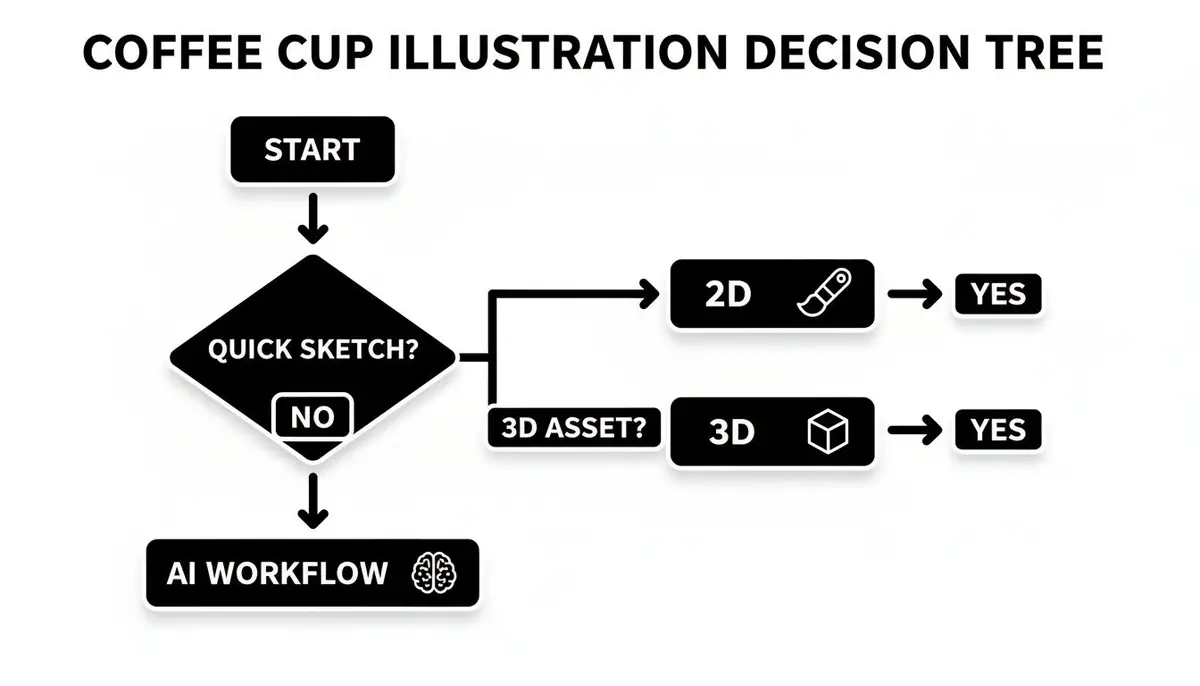
As you can see, an AI workflow isn't just a replacement for other methods. It's a powerful middle-ground for ideation when a quick 2D sketch isn't enough and a full 3D model is overkill.
To dive deeper into this, check out our guide on artificial intelligence drawing.
A Few Common Questions
How Can I Make My Coffee Asset Look Truly Realistic?
It really comes down to three things: reflections, steam, and texture.
For the liquid itself, think subtle. You want soft, distorted reflections of the world around the cup on the surface. For steam, a gentle touch with a low-opacity brush to paint some delicate wisps is far more convincing than a solid plume. And if it's a latte, the foam is everything. Get that mix of tiny bubbles and creamy smoothness right, and you're golden.
What's the Best Way to Choose the Right Art Style?
Let the project's overall art direction be your guide. There's no single "best" style.
If you're building assets for a hyper-realistic game, you'll be aiming for photorealism with incredibly detailed textures. But for a stylised mobile game, something with bold lines and flat colours might fit perfectly.
Context is also key, especially when you're creating for a specific market. Take Denmark, for instance. Price analyses show it has one of the highest coffee prices in the world, around US$5.40 a cup. This points to a design-savvy market where people expect a premium experience. So, if you're modelling assets for that audience, creating high-end, premium-looking coffee items is crucial for authenticity. Diving into global coffee trends can give you tons of great insights to inform your designs.
AI is an incredible partner for rapid ideation. Take a simple sketch of your coffee cup and feed it to an AI. You can prompt it to generate variations in different materials, settings, or styles, letting you explore dozens of creative avenues in just a few minutes.
Ready to get from an idea to a final asset faster than ever before? Check out VirtuallPRO, the Creative AI OS that brings your entire workflow together in one collaborative space. Give it a try today.