Enterprise AI Governance Frameworks for Creative Teams
Compare enterprise AI governance frameworks for creative teams, with controls for risk, policy, audits and multi-model production workflows.
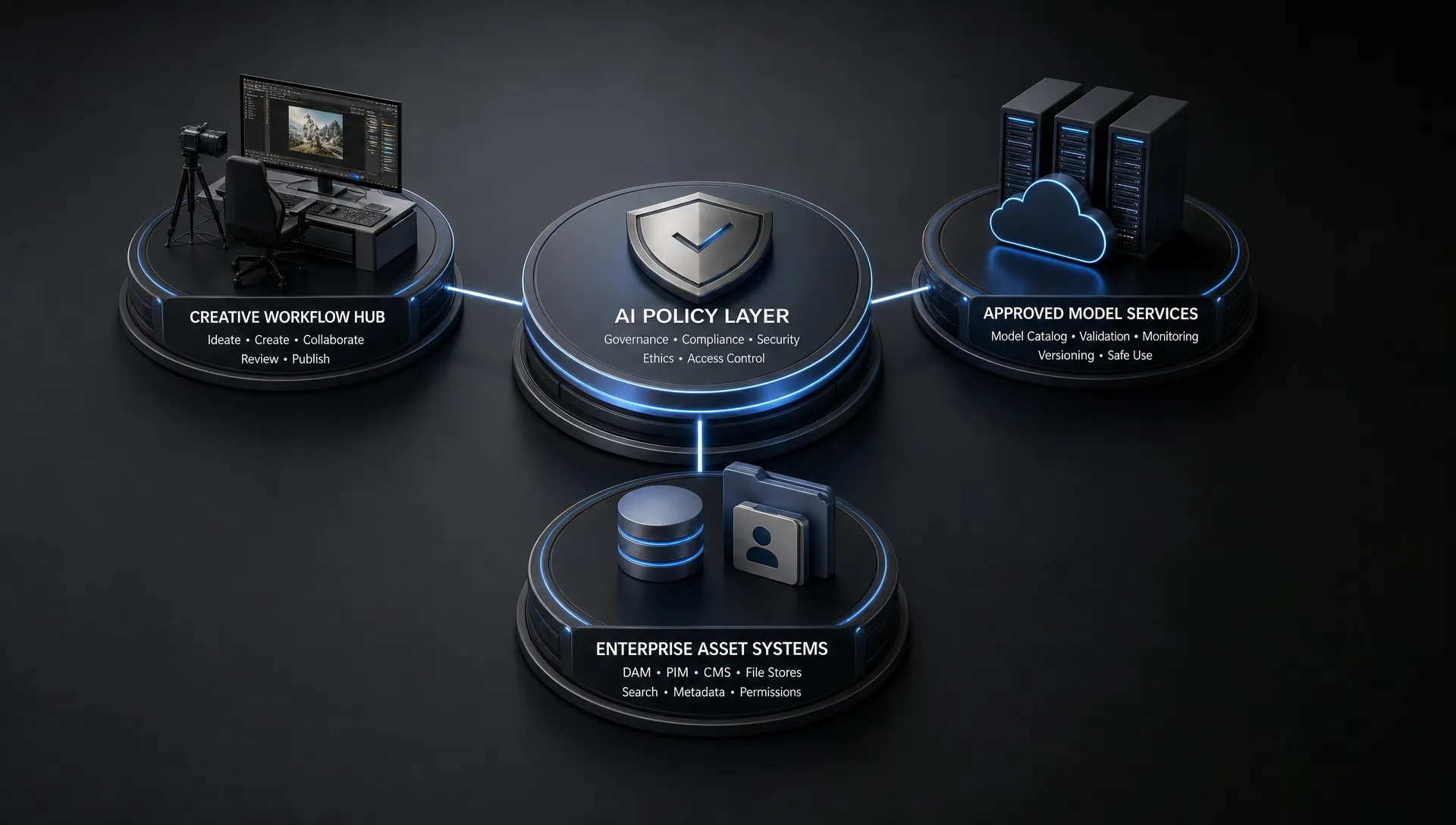
For creative teams, AI governance is no longer a legal appendix. It determines which models can be used, what data can enter a prompt, who approves outputs, how rights are documented and whether the organization can prove what happened after the campaign ships.
That is why enterprise AI governance frameworks need to be evaluated differently for creative operations than for generic AI programs. A CMO cares about brand consistency and market speed. An art director cares about quality, authorship and intent. An application manager cares about integrations, identity, data flows and supportability. A game developer cares about asset provenance, model fit, iteration speed and pipeline compatibility.
A flat list of governance tools does not help much because the market groups very different capabilities under the same label. Some platforms are built for compliance evidence. Some are built for content moderation. Others are built for operational governance inside the creative workflow. The right architecture often combines more than one category.
The useful question is not, which AI governance platform is best? The better question is, which governance job are you trying to perform, and where must the control happen in your creative supply chain?
Why creative AI governance needs its own framework
Most enterprise AI governance guidance starts at the level of corporate risk. That is necessary, but creative AI adds several production-specific risks that do not fit neatly into traditional model governance.
A single campaign may involve mood boards, licensed references, confidential product data, model prompts, image generations, video edits, 3D assets, human retouching, regional adaptations and final publication through a CMS or commerce platform. If governance lives only in a PDF policy, the real decisions still happen in Slack, local drives, browser tools and disconnected model interfaces.
The NIST AI Risk Management Framework is a strong starting point because it organizes AI risk work around govern, map, measure and manage. For creative teams, those functions must become concrete production controls. Mapping is not just documenting a model. It means knowing which teams use which models for which asset types, under which rights restrictions and with which human approvals.
The EU AI Act also pushes organizations toward risk-based governance, documentation and accountability. Even when a creative use case is not high risk under the Act, enterprises still need to manage confidentiality, copyright, brand safety, consumer trust, contractual licensing and auditability.
For a deeper policy-level foundation, Virtuall has outlined the core pillars of an AI governance framework for enterprise creative teams. This article takes the next step and compares the governance platform categories that turn those rules into operating architecture.
The three governance platform categories that matter
Enterprise buyers often compare AI governance vendors as if they all solve the same problem. They do not. For creative AI, the market breaks into three practical categories: compliance governance, moderation governance and operational governance.
| Governance category | Primary job | Typical owner | Strongest controls | Common limitation |
|---|---|---|---|---|
| Compliance governance | Prove that AI use is inventoried, classified, controlled and auditable | Legal, risk, compliance, IT governance | AI inventory, risk classification, control mapping, evidence retention, audit trails | Often too far from day-to-day creative production |
| Moderation governance | Prevent unsafe, off-brand or prohibited content from being generated or published | Trust and safety, brand, legal, platform teams | Prompt filters, output classifiers, policy checks, escalation workflows | Can miss broader workflow context, licensing logic and approval history |
| Operational governance | Embed policy, approvals and model controls into the creative workflow itself | Creative operations, marketing operations, studio technology, product teams | Policy enforcement, workflow orchestration, asset lineage, review steps, model routing | Requires integration with existing creative systems and process adoption |
Most mature enterprises need all three, but not always from the same system. A bank running AI-generated campaign visuals may need compliance governance for evidence, moderation governance for prohibited claims and operational governance for production approvals. A game studio may prioritize asset lineage, model permissions and pipeline integration first, then synchronize evidence into enterprise GRC.
Compliance governance: evidence, risk and accountability
Compliance governance platforms answer the question, can we prove our AI use is known, classified and controlled?
These systems are usually closest to GRC, vendor risk management, internal audit, privacy, security and legal workflows. Their value is not creative speed. Their value is evidence. They help the organization maintain an AI system inventory, classify risks, map controls to frameworks, assign owners, document exceptions and produce audit-ready records.
A strong compliance governance layer should support AI inventory management at more than the tool level. For creative teams, the inventory should capture the use case, business owner, model or vendor, data categories, asset type, regions, intended audience, rights considerations, review requirements and retention policy. A generic record that says marketing uses image AI is not enough.
Risk classification is the second major capability. The platform should help teams classify creative AI use by confidentiality, rights exposure, brand sensitivity, regulatory impact, audience impact and publication channel. A private concept exploration workflow is not the same risk as a public product claim, a celebrity likeness exploration or a synthetic video localized across 20 markets.
Framework alignment matters because enterprises need a common language across teams. NIST AI RMF can structure risk management practices. ISO/IEC 42001 provides requirements for an AI management system. The EU AI Act creates a legal risk classification model for organizations operating in or serving the European market. A governance platform does not make an organization compliant by itself, but it can make controls visible, assignable and testable.
| Compliance capability | What it means for creative teams | Evidence the platform should retain |
|---|---|---|
| AI inventory management | Records approved tools, models, workflows, owners and asset types | Use case record, owner, vendor, model version, data categories, approval status |
| Risk classification | Scores creative use cases by legal, brand, data and audience risk | Risk tier, rationale, reviewer, date, required controls |
| Policy mapping | Connects internal AI rules to NIST, ISO, EU AI Act or company controls | Control library, mapped obligations, exceptions, remediation tasks |
| Audit trails | Shows who used AI, how outputs were reviewed and what was approved | User, timestamp, model, prompt metadata, asset ID, reviewer, final decision |
| Exception management | Allows controlled deviations from standard policy | Exception owner, expiry date, justification, compensating controls |
The tradeoff is proximity. Compliance platforms are excellent for governance records, but they often do not sit where creative work actually happens. If artists and producers must manually document every AI experiment in a separate system, the inventory will decay. Compliance governance works best when operational systems automatically feed it structured evidence.
Moderation governance: guardrails for prompts, outputs and publication
Moderation governance answers a different question, can we prevent prohibited or unsafe content from entering the creative supply chain?
This category is familiar to organizations managing user-generated content, advertising review, marketplace listings or regulated claims. In creative AI, moderation can happen before generation, during generation, after generation or before publication. The controls may include prompt filters, output classifiers, brand safety checks, logo or character restrictions, claim detection, visual similarity review and human escalation.
Moderation is useful when teams generate high volumes of variants. A global marketing organization may need to prevent prohibited language in local ads. A game studio may need to check that concept art does not include restricted symbols or unintended references. A retail brand may need to ensure AI-generated product imagery does not misrepresent the actual product.
The main architectural decision is where moderation runs. If it runs only at the model endpoint, it can block certain prompts and outputs early, but it may not understand campaign context or licensing rules. If it runs at DAM ingestion, it can inspect assets before they become reusable, but it may be too late to prevent wasted creative effort. If it runs in the CMS, it can protect publication, but not internal reuse.
Moderation governance is strongest when policies are machine-readable and context-aware. A rule that blocks all use of celebrity names may be too blunt for an entertainment studio with licensed talent rights. A better rule can distinguish between unlicensed likeness generation, licensed campaign usage, internal ideation and final publication.
The tradeoff is false confidence. Content moderation can catch visible policy violations, but it cannot replace an AI inventory, rights documentation or workflow approvals. It should be treated as a guardrail layer, not the whole governance framework.
Operational governance: controls embedded in the creative workflow
Operational governance answers the most practical question for creative leaders, can teams use AI at production speed without losing control?
This is where AI governance moves from policy documentation into daily work. As Virtuall argues in Enterprise AI Governance Beyond Policies and PDFs, AI controls need to live inside the production flow, not outside it. For creative teams, that means the governance system must understand briefs, assets, models, approvals, versioning, collaboration and publishing handoffs.
Operational governance includes enforceable model access, approved generation templates, prompt and context handling rules, role-based permissions, review workflows, asset annotation, version history and pipeline tracking. It can also manage which models are approved for image, video, audio or 3D work, and which workflows require legal, brand or art direction approval before export.
This category is especially important in multi-model environments. Creative teams rarely use one model for everything. They may route concept exploration to one model, product rendering to another, video extension to a third and 3D generation to a specialized service. Without orchestration, governance fragments across vendor consoles and browser tools.
Operational governance also improves creative consistency. Reusable generation blueprints, shared context, mood boards and approved references reduce the variance that appears when every team writes prompts from scratch. That connects governance with quality, not just risk reduction. Virtuall covers this production angle in its guide to improving AI output across teams and tools.
The tradeoff is implementation depth. Operational governance requires integration with the way teams actually work. It may need plugins, APIs, DAM integration, identity management, approval routing and metadata mapping. The payoff is that governance becomes part of production instead of an after-the-fact reporting task.
Architectural tradeoffs: where should governance live?
The key architectural decision is not whether governance should be centralized or embedded. It must be both. Central governance defines policy, risk classification and evidence requirements. Embedded governance enforces those rules at the point of work.
| Architecture pattern | How it works | Best fit | Main tradeoff | Required integrations |
|---|---|---|---|---|
| GRC-led AI register | Central system tracks AI use cases, risks, owners and controls | Highly regulated enterprises with mature risk functions | Strong evidence, weak production enforcement unless connected to workflow tools | GRC, IAM, procurement, vendor risk, security, privacy systems |
| Model gateway | A controlled layer routes requests to approved models and logs usage | Enterprises standardizing model access across teams | Good model control, limited understanding of creative workflow unless enriched with context | Model providers, IAM, logging, DLP, SIEM, application APIs |
| DAM or CMS-embedded governance | Assets are checked and controlled at ingestion, reuse or publication | Brands with mature asset and publishing operations | Strong downstream control, weaker early-stage ideation control | DAM, CMS, PIM, rights management, approval workflows |
| Creative AI OS | Governance, orchestration, collaboration and asset lineage sit inside creative production | Studios and marketing teams scaling AI-generated images, video, audio or 3D | Requires process adoption and integration planning | Creative tools, DAM, PIM, CMS, model services, APIs, review systems |
A GRC-led approach gives executives and auditors a clean control view, but it can become a reporting layer if not fed by operational data. A model gateway provides strong control over which models are called, but it may not know whether a prompt is tied to a confidential product launch, a licensed reference or a public campaign.
DAM and CMS governance is valuable because it controls what becomes reusable or publishable. However, many AI risks emerge before an asset reaches the DAM. If teams generate hundreds of concepts in external tools, the organization may never see the prompts, references or discarded outputs that influenced the final work.
A Creative AI OS approach places governance closer to the source of creative activity. It can connect policy enforcement, context, generation, review, asset management and pipeline tracking. For many enterprises, the strongest architecture is a connected model: creative operations enforce rules in workflow, DAM and CMS systems preserve asset governance, and GRC receives structured evidence for oversight.
Integration requirements across enterprise systems
AI governance succeeds or fails at the integration layer. The framework may be elegant, but if it cannot connect with enterprise systems, teams will route around it.
Identity and access management is the first requirement. Role-based permissions should determine who can access specific models, workflows, asset libraries and export actions. For example, an external freelancer may be allowed to generate internal concepts but not upload confidential product data or export final campaign assets.
GRC integration is needed for evidence continuity. Creative systems should be able to send use case status, risk classification, policy exceptions, approval records and audit events into the enterprise risk environment. This avoids duplicate documentation and supports audit readiness.
DAM integration is critical because generated outputs become assets. Governance metadata should travel with those assets, including source workflow, approved usage rights, model information, review status, market restrictions and version history. A generated image without lineage is difficult to approve for reuse months later.
CMS and PIM integration matter when AI outputs affect customer-facing experiences. A product image, claim, description or localized creative variant may need publication controls based on region, audience, channel or product category. Governance should not end when the creative team exports a file.
Multi-model integration is the newest challenge. Enterprises need to orchestrate multiple AI models without hardcoding governance into each provider interface. A practical framework separates policy from model selection. Policies define which model categories are approved for which task, what data can be used, what review is required and what evidence must be logged. The orchestration layer then applies those rules across models.
What to look for in an enterprise AI governance framework
A strong evaluation should test capabilities against real creative workflows, not vendor slides. Ask vendors to demonstrate how governance works from brief to final asset, including the messy middle where teams iterate, reject outputs, reuse references and collaborate across departments.
| Evaluation area | Questions to ask | Why it matters |
|---|---|---|
| Policy enforcement | Can rules be enforced in the workflow, or only documented after the fact? | Prevents policy drift and shadow AI |
| Auditability | Can the system reconstruct who generated, reviewed and approved an asset? | Supports legal, brand and compliance review |
| AI inventory | Does the inventory track workflows, models, use cases and owners? | Creates visibility across distributed teams |
| Risk classification | Can creative use cases be tiered by data, rights, brand and publication risk? | Applies the right level of control without slowing low-risk work |
| Framework alignment | Can controls map to NIST, ISO, EU AI Act and internal policies? | Helps risk, legal and creative teams speak the same language |
| Multi-model orchestration | Can policies apply across different models and formats? | Reduces vendor lock-in and inconsistent controls |
| Asset lineage | Does governance metadata stay connected to images, video, audio and 3D assets? | Enables reuse, review and provenance checks |
| Enterprise integration | Does the platform connect with GRC, DAM, CMS, PIM and creative tools? | Determines whether governance scales beyond pilots |
The strongest signal is not the number of controls listed. It is whether controls are enforceable at the point where the risk occurs. A policy about confidential data must operate before a prompt is sent. A rights rule must operate before a reference is used. A brand review must operate before an asset is approved for publication. An audit trail must be created automatically, not reconstructed from memory.
Building a practical governance roadmap
Creative teams do not need to solve every governance problem in the first phase. A staged roadmap reduces friction and makes adoption more realistic.
- Define a creative AI use case taxonomy: Separate internal ideation, campaign production, product content, 3D asset creation, localization, video generation, audio generation and customer-facing publication.
- Create the AI inventory: Record tools, models, workflows, owners, data categories, regions, asset types and approval requirements.
- Classify risk by workflow: Rate use cases by confidentiality, rights exposure, brand sensitivity, regulatory impact, audience impact and publication risk.
- Translate policies into controls: Convert rules into access permissions, model whitelists, prompt restrictions, review steps, export gates and evidence requirements.
- Integrate with production systems: Connect governance to creative tools, DAM, CMS, PIM, GRC, identity systems and model services where needed.
- Review evidence and refine: Use audit trails, exceptions and incident reviews to update policies as models, teams and regulations evolve.
This roadmap helps avoid a common mistake: starting with a policy document and hoping teams will self-enforce it. The more scalable path is to define policy centrally, then embed it in the workflow systems where creative decisions happen.
Where Virtuall fits in the governance landscape
Virtuall is a Creative AI operating system built for teams that need to operate AI-powered content creation at scale across image, video, audio and 3D workflows. In the governance landscape, it is closest to the operational governance category, with controls designed to sit inside creative production rather than outside it.
The Creative AI OS supports AI governance controls, workflow orchestration, multi-model content generation, generation blueprints, studio context memory through mood boards, team collaboration, review workflows, approvals, content annotation, asset management, pipeline tracking and integrations with creative tools, DCC systems, PIM, DAM and other enterprise environments through plugins and APIs.
Nyx, Virtuall's intelligence layer, orchestrates multiple industry-leading AI models while preserving intent and context across studios and teams. For enterprises, that matters because governance cannot depend on one model interface. Policy, context and evidence need to travel across a multi-model production environment.
Virtuall also emphasizes compliance through EU-based infrastructure and inference, which can be relevant for organizations with European data, vendor governance or regional compliance requirements. As with any enterprise platform, buyers should validate requirements against their own legal, security, procurement and architecture standards.
Frequently Asked Questions
What is an enterprise AI governance framework for creative teams? An enterprise AI governance framework for creative teams defines how AI tools, models, prompts, references, outputs, approvals and asset metadata are controlled across creative production. It typically covers AI inventory, risk classification, policy enforcement, audit trails, framework alignment and workflow integration.
How is creative AI governance different from general AI governance? General AI governance often focuses on model risk, data science systems and corporate compliance. Creative AI governance also needs to manage brand consistency, rights, confidential references, generated asset lineage, human review, publication controls and collaboration across creative tools.
Which governance category should an enterprise prioritize first? Start with the highest operational risk. If the organization lacks visibility, prioritize AI inventory and compliance governance. If unsafe or off-brand outputs are the main risk, prioritize moderation controls. If teams are already using AI in production, operational governance is usually the most urgent because it embeds rules where work happens.
What systems should connect to an AI governance framework? Common integrations include GRC, identity and access management, DAM, CMS, PIM, creative tools, model providers, model gateways, review systems, logging systems and sometimes SIEM or DLP platforms. The exact architecture depends on where AI generation, approval and publication occur.
What should an audit trail include for AI-generated creative assets? A useful audit trail should include the user, timestamp, workflow, model or model category, prompt metadata, input references where appropriate, generated output, asset ID, review decisions, approval status, policy exceptions and final publication or export record.
Bring governance into the creative workflow
Enterprise AI governance works when it is close enough to production to guide real decisions. Compliance records, moderation checks and operational controls each have a role, but creative teams need them connected across the full content lifecycle.
If your organization is scaling AI-generated images, video, audio or 3D assets and needs governance built into the way teams work, Virtuall provides a Creative AI OS for orchestrating models, workflows, collaboration and production controls across enterprise creative environments.