Public Sector AI for Creative and Content Operations
Public sector AI can scale content safely. Learn governance, workflows, use cases, and controls for compliant creative operations.
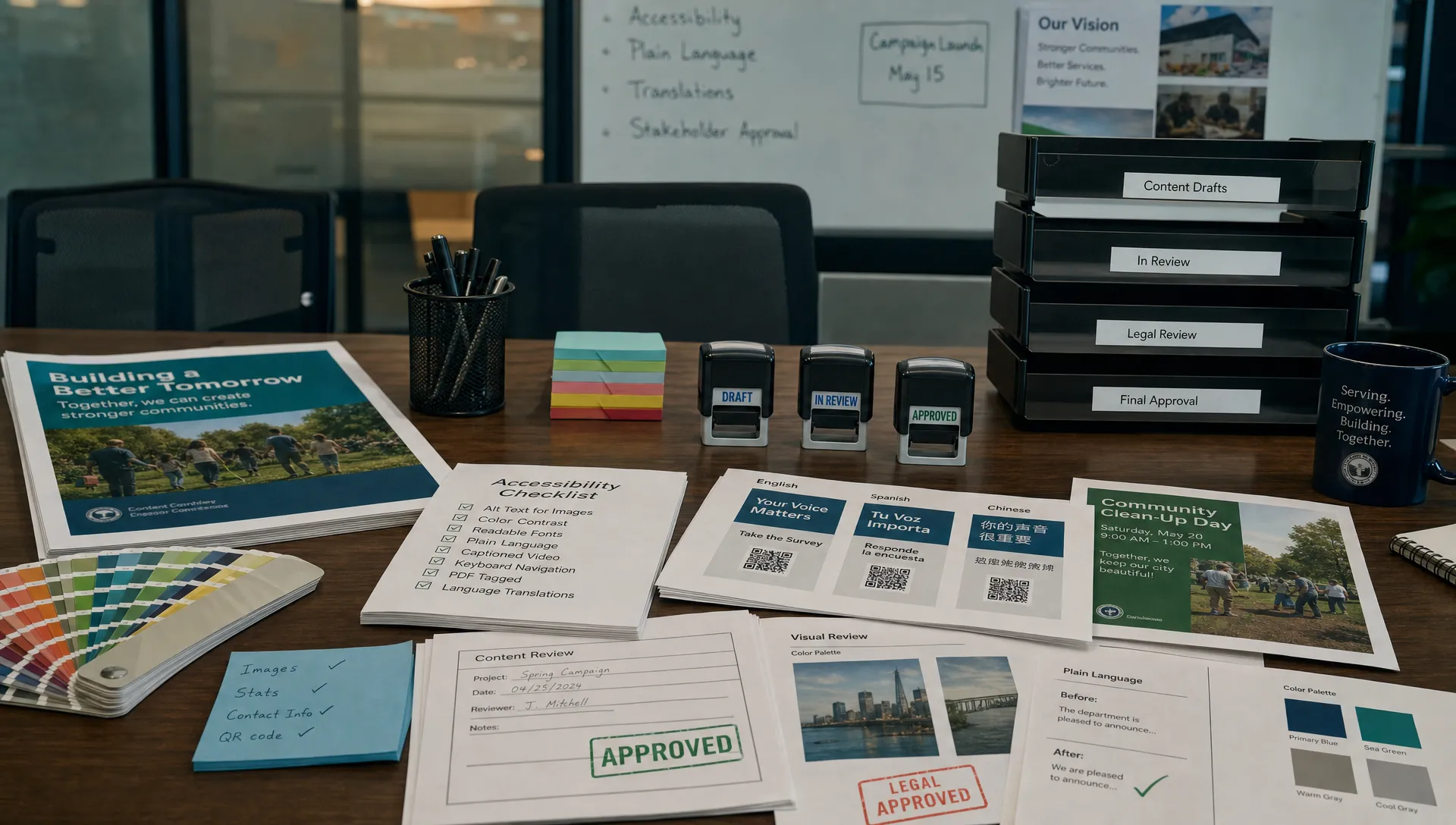
Public sector organizations produce more content than many people realize: service updates, citizen notices, campaign assets, training material, procurement content, tourism visuals, accessibility variants, social media, video, and sometimes 3D or simulation assets. The challenge is not simply making more. It is making content that is accurate, accessible, traceable, policy aligned, and consistent across departments.
That is why public sector AI should not be limited to chatbots or back-office automation. Used carefully, AI can become a practical production layer for creative and content operations, helping communications, digital service, education, cultural, health, and economic development teams move faster without weakening trust.
But the operating model matters. A single prompt tool may help one person draft a caption. It will not give an agency the controls it needs for approvals, records, model governance, accessibility, or brand consistency. Public institutions need AI that behaves like an accountable production system, not a collection of disconnected experiments.
Why creative and content operations are a public sector AI priority
Every policy, program, and public service needs communication. A transport agency may need station posters, route change notices, digital signage, app banners, and multilingual social posts. A public health team may need local campaign variants for different communities. A cultural institution may need exhibition visuals, education packs, video explainers, and 3D previews. A city office may need consultation materials that are clear, inclusive, and accessible.
These workflows are often high volume and time sensitive. They also carry high consequences. A poorly worded message can create confusion. An inaccessible asset can exclude citizens. An unapproved image can damage public trust. A misleading AI-generated draft can create legal or policy risk if it moves too quickly into publication.
Creative AI is useful precisely because much of this work involves controlled variation: resizing, adapting, localizing, versioning, testing different formats, preparing concepts, and transforming approved messages into channel-specific assets. The goal is not to remove expert communicators, designers, or policy reviewers. The goal is to reduce repetitive production work while preserving human accountability.
For public sector leaders, the real question is not whether AI can generate content. It can. The question is whether your organization can govern, review, reuse, archive, and explain how that content was produced.
What makes public sector AI different?
Public sector AI operates under a different trust model than consumer or even private enterprise AI. Citizens cannot always opt out of public services. Agencies are accountable to legal, ethical, democratic, and accessibility obligations. That means AI-assisted content production needs stricter operating controls from the beginning.
| Public sector requirement | What it means for creative and content operations |
|---|---|
| Public trust | Content must be accurate, consistent, and aligned with official policy. |
| Transparency | Teams may need to document when and how AI was used in production. |
| Accessibility | Outputs should support plain language, inclusive design, and accessibility standards. |
| Data stewardship | Prompts, source assets, and generated outputs must respect privacy, security, and records policies. |
| Auditability | Review steps, approvals, and asset lineage should be traceable. |
| Vendor oversight | Procurement teams need clarity on infrastructure, model use, data handling, and contractual responsibilities. |
Accessibility is especially important. Many public institutions already align digital content with the Web Content Accessibility Guidelines. AI can help create variants and drafts, but it should not be treated as a substitute for accessibility review, plain language validation, or inclusive design expertise.
High-value use cases for AI-assisted public content
The best starting points are usually content workflows where the source message is already approved, the audience is clearly defined, and human review can remain in place. This avoids the risk of asking AI to decide policy or interpret sensitive public needs on its own.
| Use case | How AI can help | Human control that should remain |
|---|---|---|
| Citizen information campaigns | Generate channel variants, visual concepts, localized drafts, and format adaptations. | Policy accuracy, tone, accessibility, and final approval. |
| Public health and safety messaging | Convert approved guidance into posters, social content, explainer scripts, and reminders. | Medical, legal, and crisis communication review. |
| Tourism and cultural promotion | Create campaign concepts, exhibition previews, 3D visual ideas, and multilingual assets. | Rights clearance, cultural sensitivity, and brand approval. |
| Education and training | Produce learning visuals, scenario drafts, video outlines, and role-based training content. | Subject matter expertise and learner safety. |
| Internal communications | Adapt leadership messages into newsletters, intranet posts, slide visuals, and FAQs. | Confidentiality, HR policy alignment, and leadership review. |
| Public consultation materials | Prepare explainers, simplified summaries, visual aids, and feedback prompts. | Neutrality, factual accuracy, and democratic process integrity. |
This is where creative operations discipline becomes essential. AI is not just producing one output. It is producing multiple content variants across many formats, audiences, and approval paths. Without structure, the work becomes hard to track. With structure, AI can support a faster and more consistent public communication engine.
From prompts to governed production
Many public sector AI pilots begin with individual productivity tools. Someone drafts copy. Someone else tests an image generator. A digital team experiments with video. These pilots can be useful for learning, but they rarely create an organization-wide operating model.
Creative and content operations need more than isolated generation. They need shared context, policy boundaries, reusable templates, role-based approvals, asset management, and integration with the systems teams already use. Traditional repositories and CMS workflows were not designed for AI-generated variations at scale, which is why many teams are now rethinking content management for the AI era.
A governed production model usually includes three layers.
First, there is the governance layer: which models are approved, which data can be used, which teams can generate which types of assets, and what review is required before publication.
Second, there is the workflow layer: intake, briefing, generation, annotation, review, approval, export, archive, and reporting. This is where AI becomes operational rather than experimental.
Third, there is the context layer: brand rules, campaign goals, audience profiles, mood boards, previous approved assets, tone of voice, accessibility guidance, and public service constraints. Without shared context, AI outputs drift. With shared context, teams can generate content that is more aligned from the first draft.
If your organization is moving from experimentation to repeatable production, the broader discipline of operating creative AI at scale offers a useful framework: treat AI as a production capability with governance, measurement, and accountability, not as a set of disconnected tools.
Governance and compliance controls to define early
By 2026, AI governance is no longer a side discussion. The NIST AI Risk Management Framework gives organizations a practical structure around governing, mapping, measuring, and managing AI risk. In Europe, the European Commission's AI Act overview describes a risk-based approach that is shaping procurement, transparency, and governance expectations across many sectors.
Not every creative AI use case in the public sector will be high risk. Creating campaign size variants is very different from making eligibility decisions or policing recommendations. Still, public agencies should build controls that match the sensitivity of the content and the audience.
A practical governance checklist should include:
- Approved use cases: Define which creative and content workflows are allowed, restricted, or prohibited.
- Data classification: Separate public, internal, confidential, personal, and sensitive data before teams use AI tools.
- Model and vendor rules: Decide which models, environments, and providers are approved for different content types.
- Human review: Require expert approval for public-facing, policy-sensitive, health, legal, or crisis-related content.
- Traceability: Keep records of prompts, source materials, generated assets, edits, approvals, and final publication versions.
- Accessibility checks: Validate readability, alt text, captions, contrast, localization, and inclusive language before release.
- Asset status labels: Clearly separate draft, AI-assisted, reviewed, approved, published, and archived assets.
- Procurement review: Assess data handling, infrastructure location, security controls, audit support, and contractual terms.
Good governance should not feel like bureaucracy added after the fact. It should be built into the workflow so teams can move quickly inside clear boundaries.
What a Creative AI OS should provide for public institutions
A Creative AI OS is an operating layer for AI-powered production. Instead of asking every team to manage prompts, models, assets, and approvals manually, it gives the organization a controlled environment for generating and managing creative work across formats.
For public sector organizations, the value is not just speed. It is controlled speed. The system should help teams scale output while keeping context, review, compliance, and asset lineage visible.
| Capability | Why it matters in public sector content operations |
|---|---|
| AI governance controls | Helps enforce approved use cases, model access, permissions, and review requirements. |
| Workflow orchestration | Coordinates briefs, generation, annotation, approvals, and handoffs across teams. |
| Generation blueprints | Turns repeatable content patterns into templates for campaigns, notices, variants, and asset families. |
| Studio context memory | Keeps mood boards, brand guidance, campaign context, and approved references available to teams. |
| Multi-model generation | Supports different output needs across image, video, audio, and 3D rather than relying on one model. |
| Collaboration tools | Enables reviewers to comment, annotate, approve, and align on assets before publication. |
| Asset and pipeline tracking | Helps teams know what was generated, where it is in review, and what is approved for use. |
| Integrations and APIs | Allows AI workflows to connect with creative tools, DAM, PIM, and other enterprise systems. |
| EU-based infrastructure and inference | Supports organizations that need stronger control over data residency and operational compliance. |
The Creative AI OS is built for this category of work. As a Creative AI operating system, it helps teams control, orchestrate, and scale AI-powered content creation across image, video, audio, and 3D workflows. Its governance controls, workflow orchestration, review processes, asset management, and integrations are designed for production environments where consistency and compliance matter.
Virtuall also includes Nyx, the intelligence layer of the Creative AI OS. Nyx orchestrates multiple industry-leading AI models and helps preserve intent and context across studios and teams, which is especially valuable when many departments contribute to the same public campaign or content program.
For organizations still defining the operating layer, this guide to a Creative AI OS explains why AI production needs a system of record and coordination, not just generation tools.
A sensible implementation roadmap
Public agencies do not need to transform every content workflow at once. In fact, the safest path is usually a focused pilot with clear success criteria and strong governance.
- Choose a low-risk, high-volume workflow: Start with content adaptation, format resizing, internal communications, or campaign variants based on already approved source material.
- Define the policy boundary: Clarify what data can be used, what outputs are allowed, who reviews them, and what must never be automated.
- Create reusable templates: Turn recurring briefs, campaign structures, and asset specifications into generation blueprints so teams are not reinventing prompts.
- Connect context and approved assets: Give the AI system access to the right brand references, mood boards, product or service information, and previously approved content.
- Run human review in the workflow: Keep creative, policy, legal, accessibility, and communications review visible inside the production process.
- Measure before scaling: Compare cycle time, revision rates, quality consistency, accessibility findings, and reviewer workload before expanding to more departments.
This approach gives application managers, communications leaders, art directors, and procurement teams a shared evidence base. It also makes it easier to explain the value of AI in practical operational terms rather than abstract innovation language.
Metrics that matter for public sector content teams
AI success should not be measured only by how many assets were generated. In public sector content operations, volume without quality can create more risk. The better question is whether AI improves speed, consistency, accessibility, and control at the same time.
| Metric | What to measure | Why it matters |
|---|---|---|
| Production cycle time | Time from brief to approved asset. | Shows whether AI reduces delays without bypassing review. |
| Revision rate | Number of review rounds before approval. | Indicates whether outputs match context and standards earlier. |
| Content consistency | Alignment with brand, tone, policy, and campaign rules. | Protects trust across departments and channels. |
| Accessibility findings | Issues found in captions, contrast, alt text, readability, or localization. | Ensures AI-supported content remains inclusive. |
| Asset reuse | Percentage of approved assets reused or adapted safely. | Reduces duplicate work and supports efficient public spending. |
| Governance coverage | Share of AI outputs with traceable prompts, sources, reviews, and approvals. | Supports auditability and accountability. |
These metrics help teams avoid the common trap of proving AI value through novelty alone. A public institution needs durable operational improvement, not just impressive demos.
Common pitfalls to avoid
The first pitfall is starting with the flashiest use case. Public-facing video generation, synthetic spokespeople, or sensitive citizen communication may attract attention, but they can also create avoidable risk. Many organizations get better results by starting with controlled adaptation workflows where the source content is already approved.
The second pitfall is letting every department choose its own AI tools. This often creates inconsistent outputs, unclear data exposure, fragmented contracts, and no shared audit trail. Public sector AI works better when experimentation is guided by approved infrastructure and common operating rules.
The third pitfall is treating AI-generated content as temporary drafts that do not need records discipline. Drafts can still contain sensitive information, influence decisions, or become part of a publication chain. If an asset contributes to a public output, teams should understand how it was created, reviewed, and approved.
The fourth pitfall is underestimating creative judgment. AI can accelerate production, but it does not understand public trust in the way an experienced communicator, designer, curator, planner, or policy expert does. Human oversight is not a compliance checkbox. It is the mechanism that keeps AI useful, appropriate, and aligned with the public interest.
Frequently Asked Questions
What is public sector AI in creative and content operations? It is the use of AI to support the planning, generation, adaptation, review, and management of public sector content, such as campaigns, notices, training materials, visuals, video, audio, and 3D assets. The focus is on governed production, not uncontrolled automation.
Can public agencies use generative AI for public-facing content? Yes, but it should be used with clear controls. Public-facing outputs should be reviewed for factual accuracy, policy alignment, accessibility, privacy, cultural sensitivity, and approval status before publication.
What controls matter most for public sector AI content workflows? The most important controls are approved use cases, data classification, model governance, human review, audit trails, accessibility validation, and clear separation between draft and approved assets.
How is a Creative AI OS different from a chatbot or image generator? A chatbot or generator helps with individual outputs. A Creative AI OS manages the broader production system: governance, workflows, context, models, collaboration, asset tracking, and integrations across teams.
Is public sector AI only relevant for large government departments? No. Local authorities, agencies, public universities, cultural institutions, public media teams, and publicly funded programs can all benefit from AI-assisted content operations if they need to produce consistent, accessible, and compliant content at scale.
Bringing public sector AI into production safely
Public sector AI can help agencies and public institutions communicate more clearly, produce content faster, and make better use of creative resources. But the organizations that succeed will be the ones that operationalize AI with governance, context, review, and accountability from the start.
If your team is ready to move beyond scattered AI experiments, Virtuall provides a Creative AI operating system for controlled, scalable content production across image, video, audio, and 3D. It is designed for teams that need production-ready outputs, governed workflows, and enterprise-grade control over how creative AI runs across the organization.