How to Benchmark Comparative Generators for Creative Production
Learn comparative generator benchmarking for Sea Dance 2.5, Google Omni, and MiniMax H3 across realism, safety, control, and workflow fit.
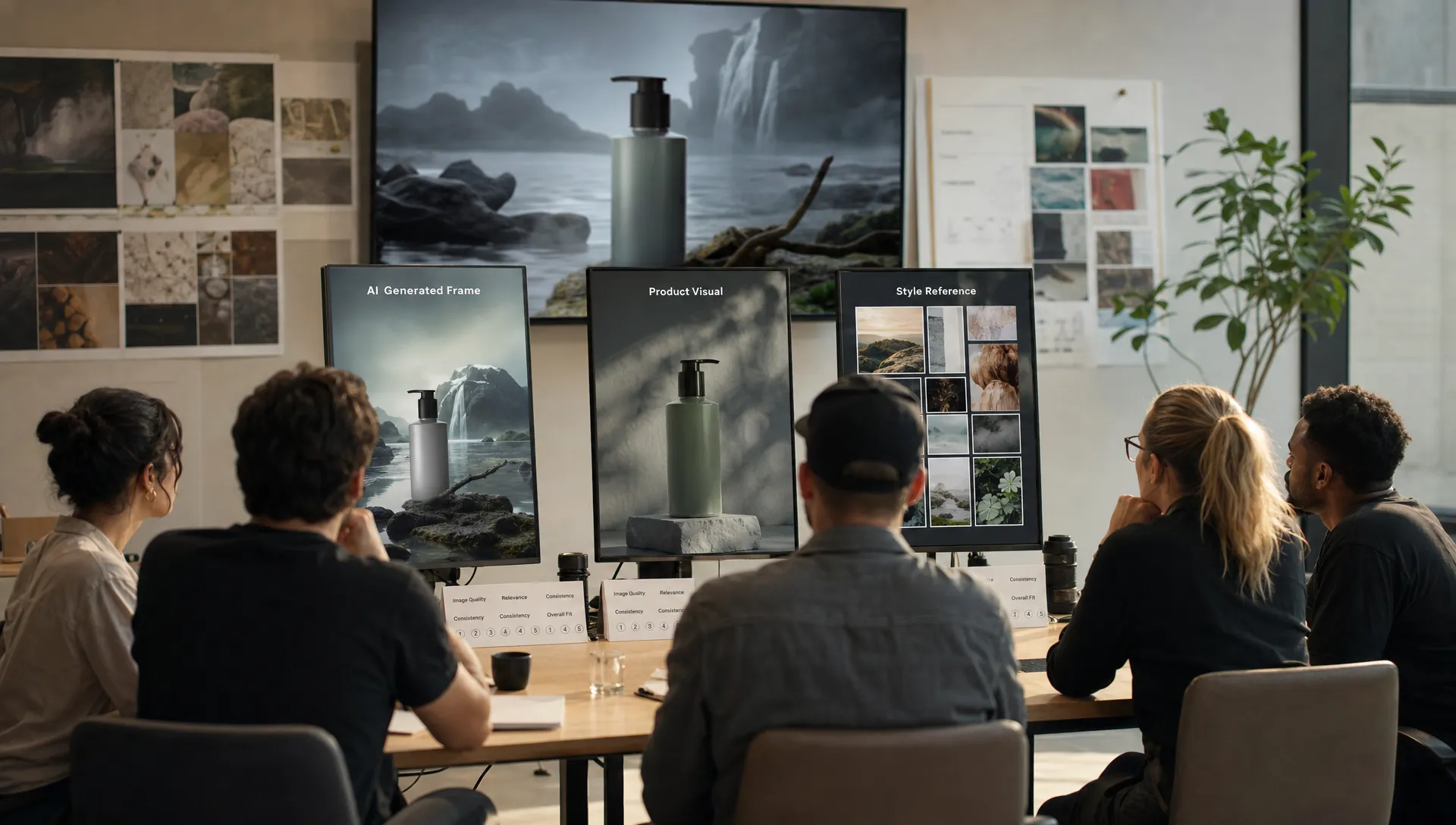
Comparative generator benchmarking has become a production discipline, not a side-by-side curiosity. For enterprise creative teams, the goal is not to find one universal best model. The goal is to understand which generator performs best for a specific production job, under your brand rules, compliance requirements, review process, asset formats, and creative standards.
That distinction matters when evaluating tools like Sea Dance 2.5, Google Omni, and MiniMax H3. Each can be valuable, but each should be routed differently. One may be stronger for cinematic realism, another for prompt adherence and text rendering, and another for flexible concept exploration. A serious benchmark should expose those strengths clearly enough that CMOs, art directors, application managers, and game developers can make different decisions from the same evidence.
If your team is already comparing tools at a broader level, use this article as the production-specific layer that follows a general AI comparison guide for creative teams. Here, the focus is comparative generator benchmarking for real creative output.
What a comparative generator benchmark should prove
A useful benchmark answers one core question: can this generator reliably produce usable work in our pipeline?
That is different from asking which sample looks most impressive on social media. Creative production requires repeatability, reviewability, compliance, and fit with the way your team actually works. A model that creates a stunning one-off frame may still be a poor production choice if it fails brand constraints, struggles with revisions, cannot preserve context, or produces assets that need too much manual repair.
For enterprise teams, a benchmark should test:
- Whether the model follows structured creative briefs, not just short prompts.
- Whether outputs remain consistent across repeated generations and revisions.
- Whether generated people, products, environments, and typography survive review.
- Whether the model can plug into approval, asset management, and governance workflows.
- Whether legal, brand, and safety risks can be identified before assets move downstream.
The benchmark should produce a routing decision, not a trophy. For example, Sea Dance 2.5 might become your preferred generator for cinematic motion tests, Google Omni might handle brand-constrained visuals with text, and MiniMax H3 might support fast concept exploration for game worlds or campaign variants.
The criteria that matter in creative production
Before ranking generators, define the criteria your team will repeat across every test. The same prompt suite, scoring rubric, reviewer group, and export requirements should be used for each model. Otherwise, the benchmark becomes subjective preference rather than operational evidence.
| Criterion | What to evaluate | Why it matters in production |
|---|---|---|
| Cinematic quality | Shot composition, lighting, motion, camera feel, atmosphere, and polish | Determines whether outputs are suitable for hero content, trailers, pitch films, and premium campaign work |
| Prompt adherence | Ability to follow brief details, constraints, exclusions, and sequencing | Reduces revision cycles and improves creative reliability |
| Realism and anatomy accuracy | Faces, hands, body mechanics, product geometry, spatial consistency, and physical plausibility | Protects quality when humans, products, vehicles, or characters are central to the asset |
| Text rendering | Legibility, spelling, placement, brand lockup behavior, and consistency across variants | Critical for ads, packaging mockups, retail visuals, UI concepts, and branded content |
| Creative control | Responsiveness to style, camera, mood, art direction, pacing, and negative constraints | Gives art directors the ability to steer instead of regenerate endlessly |
| Workflow integration | API access, export formats, metadata, review states, and compatibility with DAM, PIM, DCC, or pipeline tools | Determines whether the model can be used beyond isolated experimentation |
| Enterprise safety | Policy controls, auditability, regional requirements, data handling, usage rights, and approval gates | Reduces operational, legal, and reputational risk |
| Customization flexibility | Ability to work with references, mood boards, templates, brand systems, and recurring production patterns | Supports consistency across teams, campaigns, and franchises |
For risk and governance, model quality should be considered alongside frameworks such as the NIST AI Risk Management Framework. In creative environments, risk is not only about harmful content. It also includes off-brand output, rights uncertainty, unapproved likenesses, product inaccuracies, and assets moving into production without the right approvals.
Run the benchmark like a production simulation
The most common benchmarking mistake is testing a few attractive prompts and calling the result a ranking. That approach rewards surprise, not reliability. A better method is to simulate the actual lifecycle of an asset.
Start with a locked benchmark pack. Include realistic briefs from your own production needs, such as a product hero shot, a human lifestyle scene, a short cinematic motion sequence, a branded social variant, a typography-heavy asset, and a game environment or character concept. Then run the same pack through Sea Dance 2.5, Google Omni, and MiniMax H3.
Generate multiple samples per prompt, ideally three to five at minimum, because one lucky output does not prove production readiness. Score both best-case and average-case results. The average-case score is especially important for teams producing at scale, because review teams experience the full batch, not only the cherry-picked winner.
Add a revision pass. Ask each generator to correct a specific issue, such as changing a camera angle, preserving a product silhouette, fixing a hand pose, keeping a logo area empty, or maintaining a character identity. This reveals whether the model can participate in an iterative creative workflow.
Finally, review outputs by role. The CMO may score brand safety and campaign usability. The art director may score visual language and control. The application manager may score integration and governance. The game developer may score asset usefulness, continuity, and adaptability. A single creative lead should not be the only judge if the tool will affect the whole production system.
Side-by-side category ranking: Sea Dance 2.5, Google Omni, and MiniMax H3
The ranking below is a practical starting hypothesis for comparative generator benchmarking. Model behavior, availability, safety terms, and API performance can change quickly, so your team should validate these rankings against the exact versions, deployment regions, and commercial terms available to you.
The key point is not that one tool wins everything. The key point is that each generator has a distinct production role.
| Strength category | Rank 1 | Rank 2 | Rank 3 | Production interpretation |
|---|---|---|---|---|
| Cinematic quality | Sea Dance 2.5 | MiniMax H3 | Google Omni | Sea Dance 2.5 is the strongest starting point for polished motion, atmosphere, and high-impact visual sequences |
| Prompt adherence | Google Omni | Sea Dance 2.5 | MiniMax H3 | Google Omni is best suited when detailed instructions, constraints, and structured briefs matter most |
| Text rendering | Google Omni | MiniMax H3 | Sea Dance 2.5 | Google Omni should be prioritized when readable copy, signage, packaging text, or campaign typography is part of the asset |
| Realism and anatomy accuracy | Sea Dance 2.5 | Google Omni | MiniMax H3 | Sea Dance 2.5 is the preferred first test for realistic human motion, physical presence, and cinematic plausibility |
| Creative control | MiniMax H3 | Sea Dance 2.5 | Google Omni | MiniMax H3 is strong for art direction exploration, stylized variation, and flexible visual ideation |
| Enterprise safety | Google Omni | MiniMax H3 | Sea Dance 2.5 | Google Omni usually belongs first in tests where default safety posture, structured controls, and enterprise review requirements are central |
| Workflow integration | Google Omni | Sea Dance 2.5 | MiniMax H3 | Google Omni is often the easiest first candidate for enterprise teams that prioritize integration readiness, though the operating layer matters more than the model alone |
| Customization flexibility | MiniMax H3 | Sea Dance 2.5 | Google Omni | MiniMax H3 is a strong candidate when teams need fast style exploration, references, and creative range |
This table should be treated as a routing map. If the brief is a cinematic product launch film, start with Sea Dance 2.5. If the brief includes exact messaging or regulated brand rules, start with Google Omni. If the brief is exploratory, stylistic, or worldbuilding-heavy, start with MiniMax H3.
Sea Dance 2.5: strongest for cinematic production tests
Sea Dance 2.5 should be benchmarked first when the creative goal is cinematic impact. That includes mood films, product hero motion, premium social cuts, trailer-style shots, and visually rich concept sequences. In a benchmark, pay close attention to lighting depth, camera movement, environment coherence, motion smoothness, and how well subjects hold together across frames.
Its most important strength is not only realism. It is the feeling of production value. For art directors and campaign teams, this matters because a visually persuasive sequence can help sell a concept, align stakeholders, or accelerate previsualization.
The watch-outs are typical of high-impact visual generators. Test hard constraints carefully. Can it preserve a specific product shape? Can it avoid unwanted text? Can it follow brand exclusions? Can it revise a single issue without changing the entire shot? If the answer is inconsistent, Sea Dance 2.5 may still be your cinematic generator, but it should sit behind review gates and be paired with models that handle precision better.
Best fit: cinematic hero content, motion exploration, product atmosphere, previsualization, campaign mood development, and high-end concept sequences.
Google Omni: strongest for structured briefs, text, and enterprise control
Google Omni should lead when the asset must follow detailed instructions. In practical terms, that means brand campaigns with specific rules, visuals with copy, product concepts with layout constraints, or enterprise workflows where safety, review, and auditability are as important as visual appeal.
In benchmarking, Google Omni should be tested with long prompts, structured creative briefs, mandatory inclusions, negative constraints, and text rendering tasks. Ask it to place copy in a defined area, preserve a clean product surface, keep a background compliant with brand guidelines, and avoid disallowed subject matter. These tests reveal whether it can reduce review friction.
Its likely tradeoff is creative surprise. A model that follows constraints well can sometimes feel more conservative than tools optimized for expressive or cinematic output. That is not a weakness if the production context values reliability. For a CMO or application manager, fewer risky outputs may be more valuable than the most adventurous first generation.
Best fit: brand-safe campaign assets, copy-sensitive visuals, controlled concepting, regulated review workflows, and enterprise production environments.
MiniMax H3: strongest for flexible ideation and art direction range
MiniMax H3 is a strong candidate when creative breadth matters. It should be benchmarked for style exploration, mood variation, character concepts, game environments, expressive scenes, and rapid creative iteration. For teams that need many visual directions before committing to one, flexibility can be more valuable than strict first-pass precision.
In the benchmark, test how well MiniMax H3 responds to art direction language. Try references to lighting mood, material feel, camera style, genre, character tone, environment density, and visual rhythm. Then test revision behavior. Can it push a concept darker, more premium, more playful, more realistic, or more stylized without losing the core idea?
The watch-out is consistency. Exploratory tools can produce exciting alternatives, but they may need stronger curation before assets enter production. For game developers, MiniMax H3 can be useful in early concept phases, but character continuity, anatomy, and asset handoff should be scored separately.
Best fit: game concepting, campaign route exploration, stylized variants, early art direction, worldbuilding, and rapid creative development.
Match each generator to the right production use case
Once category rankings are clear, the next step is model routing. This is where comparative generator benchmarking becomes operational. Instead of asking every team member to choose a favorite tool, define which generator should be tried first for each kind of work.
| Production use case | Primary generator to test first | Secondary generator | Why this routing makes sense |
|---|---|---|---|
| Cinematic product launch film | Sea Dance 2.5 | Google Omni | Start with cinematic quality, then use a more constrained model for copy, compliance, or structured variants |
| Brand campaign with required copy | Google Omni | Sea Dance 2.5 | Text rendering, prompt adherence, and brand control should lead the decision |
| Game world or character exploration | MiniMax H3 | Sea Dance 2.5 | Flexible style generation supports early exploration, while cinematic tests help validate mood and motion |
| Regulated enterprise content | Google Omni | Approved model through governance layer | Safety, reviewability, and workflow control should determine the production path |
| Social creative variant testing | MiniMax H3 | Google Omni | MiniMax H3 can explore many directions, while Google Omni can refine assets against campaign rules |
| Premium pitch visuals | Sea Dance 2.5 | MiniMax H3 | Sea Dance 2.5 can create polished presentation assets, while MiniMax H3 can broaden creative options |
This approach aligns with a portfolio mindset. As discussed in Virtuall's guide to model selection for studios, production teams usually need model orchestration rather than a single model mandate.
Weight the benchmark differently by role
A fair benchmark does not mean every criterion has equal weight for every team. The best scoring model for a CMO may not be the best scoring model for a game developer. Weighting helps avoid generic conclusions.
| Role | Highest-weight criteria | Practical recommendation |
|---|---|---|
| CMO | Brand safety, prompt adherence, text rendering, campaign usability | Put Google Omni first for controlled campaign work, with Sea Dance 2.5 for cinematic storytelling |
| Art Director | Cinematic quality, creative control, customization flexibility, realism | Use Sea Dance 2.5 for polished visual direction and MiniMax H3 for exploration |
| Application Manager | Workflow integration, governance, auditability, API behavior, policy controls | Prioritize Google Omni and test all models through a governed operating layer |
| Game Developer | Concept range, anatomy, consistency, style control, iteration speed | Start with MiniMax H3 for exploration, then validate motion or realism with Sea Dance 2.5 |
This weighting step is where many benchmarks become more useful. A model does not need to be best overall. It needs to be best for a role, a workflow, and a production outcome.
Benchmark the operating layer, not only the model
A generator can score highly on output quality and still fail inside an enterprise studio. The missing layer is often governance and orchestration. Who can use the model? Which prompts are allowed? Which assets require approval? Where are outputs stored? Can reviewers annotate and reject generations? Can the team preserve style context across campaigns? Can the organization prove where and how AI was used?
That is why mature teams increasingly benchmark platforms, not only models. A governed creative AI environment should support model routing, approval workflows, context memory, asset management, pipeline tracking, integrations, and compliance controls. If your team is evaluating this layer, Virtuall's article on generative AI platforms enterprise teams can actually govern is a helpful companion.
Virtuall approaches this problem as a Creative AI OS. It is designed to help teams orchestrate multiple AI models across image, video, audio, and 3D production while preserving studio context through mood boards, generation blueprints, review workflows, approvals, content annotation, asset management, pipeline tracking, and integrations with creative tools through plugins and API. Its intelligence layer, Nyx, is built to orchestrate multiple industry-leading AI models while keeping intent and context across studios and teams.
For benchmarking, that means your team can evaluate Sea Dance 2.5, Google Omni, and MiniMax H3 as part of a controlled production system rather than as isolated tools. This is especially important for enterprises that need EU-based infrastructure and inference, consistent outputs, and auditable review processes.
A practical scoring template
A simple scoring template is often enough if teams apply it consistently. Use a 1 to 5 score for each criterion, then add written reviewer notes. Do not rely on numbers alone, because a low score caused by a minor fixable issue is different from a low score caused by a structural model limitation.
| Score | Meaning | Production implication |
|---|---|---|
| 1 | Fails the requirement | Do not use for this task without major manual intervention |
| 2 | Partially works but requires heavy correction | Use only for exploration or internal ideation |
| 3 | Usable with review and cleanup | Acceptable for controlled workflows, not autonomous production |
| 4 | Strong and repeatable | Good candidate for team routing and production templates |
| 5 | Excellent and reliable across repeated tests | Preferred generator for this use case |
Add pass or fail gates for non-negotiables. For example, a regulated brand may require a compliance pass before visual quality is considered. A game studio may require character anatomy and style continuity before an output is moved into production. A retail team may require readable product text and correct geometry before a visual can reach a campaign review.
Final recommendation: build a ranked model portfolio
The strongest enterprise benchmark does not end with a single winner. It ends with a ranked model portfolio.
Sea Dance 2.5 should be treated as the leading candidate for cinematic quality, realistic motion, and premium visual sequences. Google Omni should be treated as the leading candidate for prompt adherence, text rendering, and enterprise-controlled workflows. MiniMax H3 should be treated as the leading candidate for creative control, style exploration, and flexible ideation.
From there, the right production question becomes simple: which generator should handle this brief first, which should support it second, and what governance layer ensures the final asset is safe, consistent, and production-ready?
Frequently Asked Questions
What is comparative generator benchmarking? Comparative generator benchmarking is the process of testing multiple AI generators against the same production criteria, prompts, review workflows, and output requirements so teams can choose the right model for each use case.
Should creative teams choose one generator as the standard? Usually, no. Enterprise teams typically get better results from a governed portfolio of generators, with different models routed to different tasks such as cinematic work, text-heavy assets, or concept exploration.
How many prompts should be included in a benchmark? A small but useful benchmark can start with 10 to 20 production-relevant prompts, each tested across multiple generations and at least one revision pass. Larger teams should expand the pack by brand, format, market, and asset type.
Which generator is best for enterprise safety? Google Omni is often the strongest first candidate when safety posture, prompt adherence, and structured controls matter. However, enterprise safety depends on the full operating layer, including permissions, approvals, audit logs, data handling, and compliance controls.
Where does human review fit into generator benchmarking? Human review should be built into the benchmark from the start. AI outputs should be scored by the people responsible for brand, creative quality, technical integration, and production approval.
Operationalize comparative benchmarking with Virtuall
If your team is comparing Sea Dance 2.5, Google Omni, MiniMax H3, or other creative AI models, the benchmark should not live in a spreadsheet forever. It should become part of how your studio routes work, preserves context, applies governance, and produces approved assets.
Virtuall helps creative teams operate AI at scale through governance controls, workflow orchestration, multi-model generation, studio context memory, review workflows, asset management, and integrations with professional creative pipelines. Instead of forcing one generator to do everything, Virtuall helps teams control how multiple models are used across production.