A Guide to Lave Billeder Om Til Tegninger With AI
Learn how to expertly lave billeder om til tegninger using AI. This guide covers everything from preparation to final export for creative teams. Try it now!
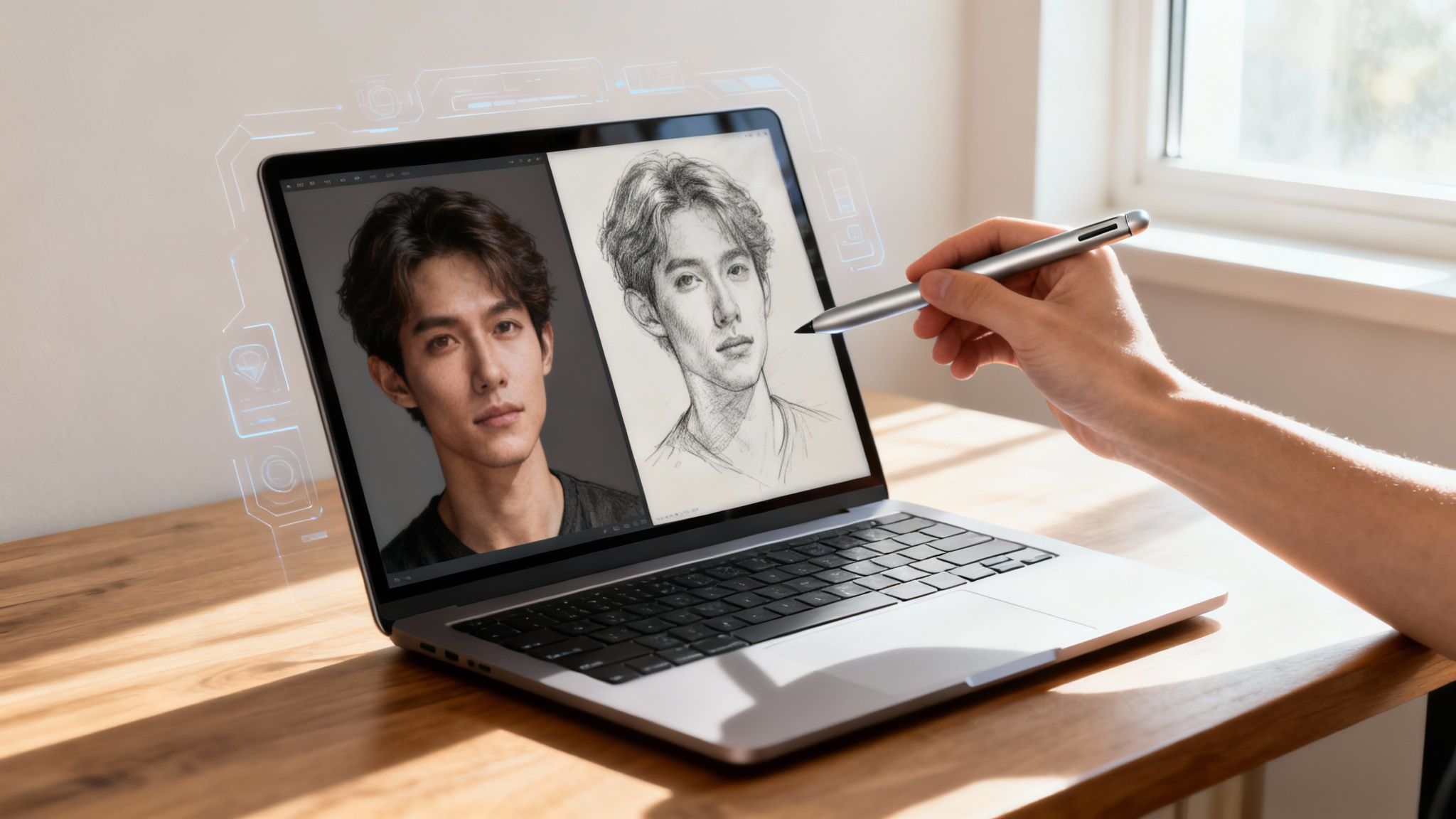
The quickest way to lave billeder om til tegninger these days is with a purpose-built AI tool. Modern platforms, like the VirtuallPRO Creative AI OS, can turn a photo into a detailed drawing in mere seconds. If you have not generated anything with our responsible, compliant, and safe enterprise platform yet, you can try it for free. We're talking about something far more sophisticated than a simple filter—this is about giving you full artistic control over the final look and feel.
Transforming Photos into Art: The Modern Creative Workflow
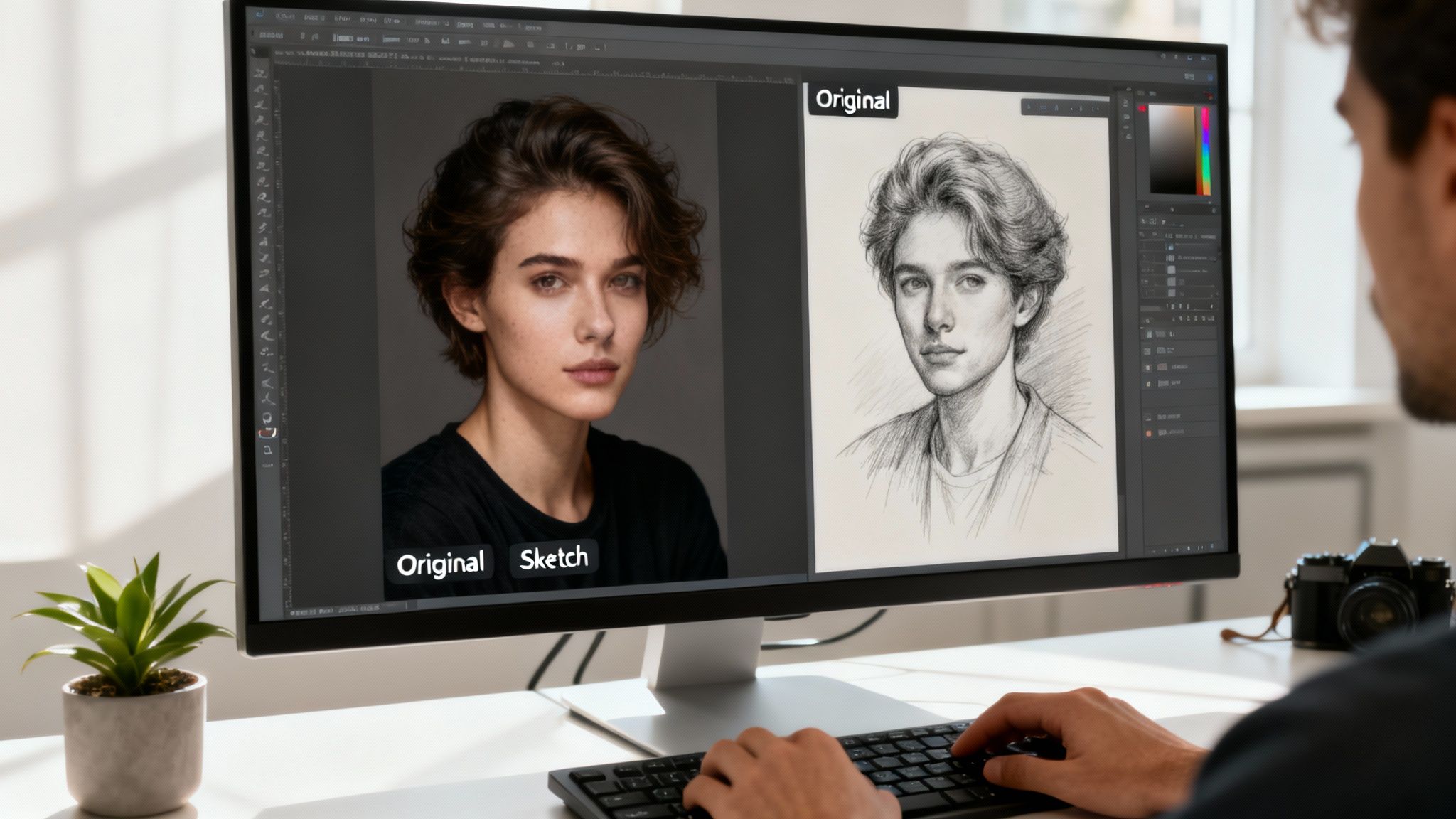
Ready to see how your team can start converting images into one-of-a-kind drawings? Our Creative AI OS, VirtuallPRO, makes the whole process intuitive and fast. If you’re new to generating with us, you can give it a try for free and see firsthand how to bring image generation and asset management together in a single, unified workspace.
Turning a photo into a drawing isn’t about just slapping on a "sketch" filter anymore. Today, it’s a process of guiding an AI to produce professional-grade artwork that fits a specific creative brief. This is a massive leap forward for professionals who need to iterate on visual concepts quickly without sacrificing artistic quality.
Who Benefits from AI Photo-to-Drawing Conversion?
This technology is already making a huge difference across several creative fields. We see it every day.
- Game Developers: They can now generate concept art, character sketches, or environmental textures from reference photos in a fraction of the time, seriously speeding up pre-production.
- Marketers: Creative teams are producing unique, stylised illustrations for campaigns and social media, helping their brand visuals cut through the noise of generic stock imagery.
- Designers: It's become a go-to for exploring different artistic directions. They can convert product mock-ups into hand-drawn styles for storyboarding and client pitches, making ideas feel more tangible.
This approach empowers teams to churn out a high volume of visual assets while keeping the aesthetic perfectly consistent.
For enterprise teams, a compliant and responsible AI platform is non-negotiable. The Creative AI OS provides a secure environment where your creative assets and workflows are protected and scalable, ensuring your intellectual property remains safe throughout the generation process.
The ability to lave billeder om til tegninger with AI gives you the power to translate photographic reality into pure artistic interpretation. It’s about using technology not just as a tool, but as a creative partner that understands nuance and style. For a wider look at different techniques, you can explore guides on how to turn photos into art. Here, we’ll focus on how our platform, VirtuallPRO, is built to meet the specific demands of professional teams.
Getting Your Images Ready for AI Conversion
The old saying "garbage in, garbage out" has never been more true than with AI. The quality of the drawing you get out of the system is directly tied to the quality of the photo you put in. To successfully lave billeder om til tegninger that look professional, you need to give the AI the best possible ingredients to work with.
It all starts with a high-resolution image. Think about it – a sharp, clean photo has tons of data for the AI to analyse. This translates into more precise linework and richer details in the final piece. If you feed it a blurry, low-res photo, the AI will struggle to find clear edges and features, leaving you with a muddled, undefined mess.
But it’s not just about pixels. The subject of your photo really changes how you should prep it.
Tweaking for Different Kinds of Photos
You wouldn't treat a close-up portrait the same way you'd handle a wide-open landscape or a detailed building. Each one has its own quirks that you can play up to help guide the AI.
- Portraits: When you're working with faces, a slight bump in contrast can make a world of difference. It helps define the jawline, eyes, and nose, giving the AI really clear lines to trace for a sketch.
- Landscapes: For big scenes, try adjusting the brightness to create more separation between the foreground and background. Making the foreground a touch brighter can trick the AI into creating a much better sense of depth.
- Architecture: Architectural photos love a good sharpening filter. It accentuates all those hard edges and geometric lines on buildings, which leads to a much cleaner, more precise drawing.
A well-prepped image can save your team an incredible amount of time iterating in VirtuallPRO. Spending a few minutes on these adjustments upfront can prevent hours of headaches later, simply because the first AI output will be much closer to what you actually want.
Cropping and Composition
Cropping is your secret weapon for telling the AI what to focus on. By chopping out distracting background noise, you're pointing a big, flashing arrow at the subject. This works wonders for product shots or character concepts where the central figure is all that matters.
If the background is just too busy, sometimes it's best to get rid of it completely. We actually have a whole guide on how to remove the background from an image for free if you want to dive deeper.
These little adjustments aren't just technical busywork; they’re the first real creative step. By thoughtfully preparing your images, you're steering the AI to produce something that’s not just technically sound, but genuinely compelling. It’s how you ensure the final drawing has a strong composition, clear shading, and beautifully defined lines.
Alright, with your source images prepped and ready, it's time to get into the fun part: telling the AI what you actually want it to create. This is where your role as a creative director really comes to life, translating a vision into instructions the machine can understand. It all boils down to picking the right model and writing a prompt that leaves no room for misinterpretation.
Inside Virtuall, you’ll find a library of different models, and it helps to think of them as artists with unique specialities. One might be a master of clean, minimalist line art—perfect for icons or technical diagrams. Another might excel at creating rich, textured pencil sketches that are ideal for emotive character concepts. Then you have models trained specifically on comic book art, ready to produce those bold outlines and punchy, saturated colours.
Choosing the right model from the get-go saves a massive amount of time and avoids frustrating trial-and-error. If you're unsure where to start, our guide on finding the best AI for image generation is a great resource for comparing what different models bring to the table.
Turning Vague Ideas into Concrete Instructions
The prompt is your direct line to the AI, and specificity is everything. A lazy, vague prompt will almost always give you a generic, uninspired result. A detailed prompt, on the other hand, acts like a comprehensive creative brief, guiding the AI toward a very specific outcome.
Think about the difference between just asking for "a drawing" versus providing clear direction. For instance:
- Prompt 1:
detailed charcoal drawing of a cityscape, high contrast, dramatic shadows, gritty texture - Prompt 2:
delicate watercolour sketch of a flower, soft edges, pastel palette, translucent petals
The first prompt is clearly going for something moody and atmospheric, while the second aims for a light, ethereal feel. The words you choose—like "gritty," "dramatic," "delicate," and "translucent"—directly influence the AI's approach to line weight, shading, and even colour theory. This is how you lave billeder om til tegninger that perfectly match a project's style guide.
This whole creative process, however, is built on a solid foundation of good source material.
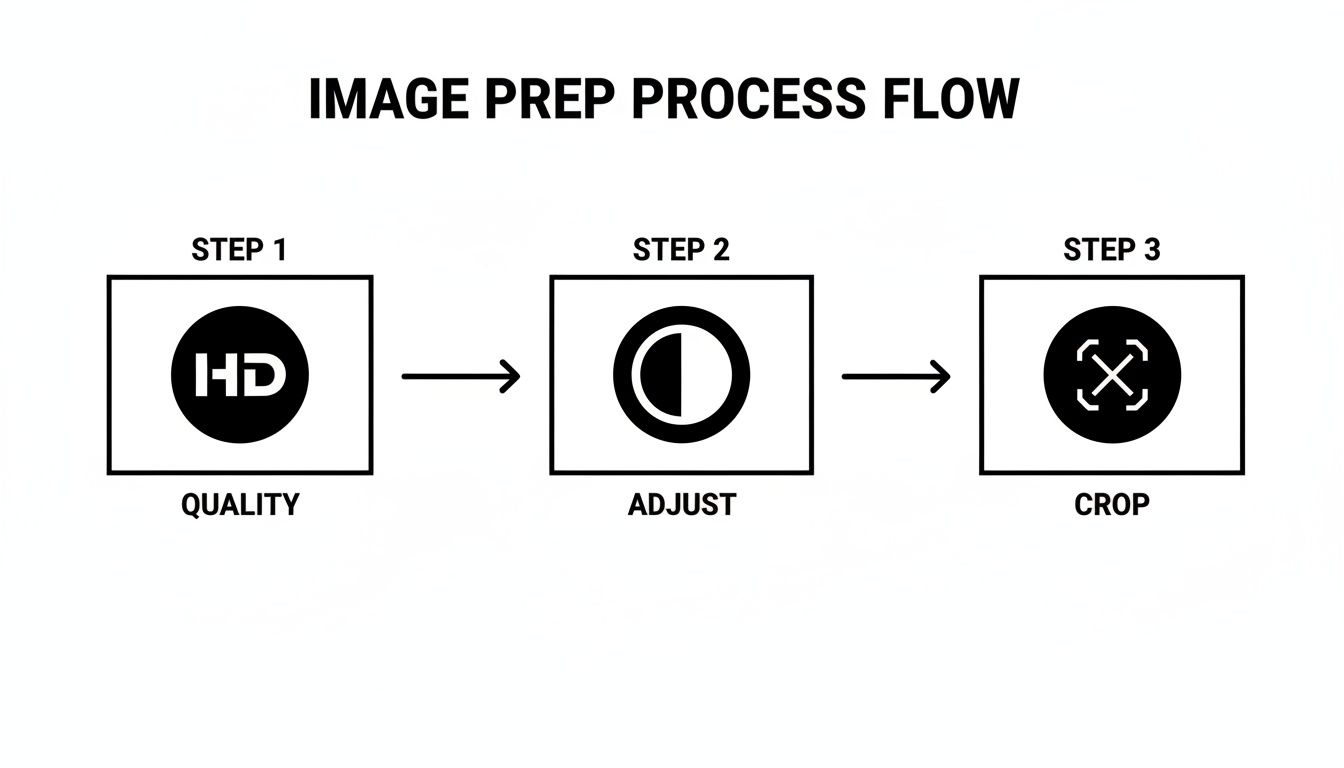
As you can see, getting the quality checks, adjustments, and cropping right before you start prompting is what sets you up for a fantastic final drawing.
Prompt Comparison for Different Drawing Styles
To give you a more practical idea of how this works, here’s a look at how you can tweak prompts to get completely different styles from the same base image of a person's face.
| Desired Style | Example Positive Prompt | Example Negative Prompt | Best For |
|---|---|---|---|
| Pencil Sketch | detailed pencil sketch of a face, realistic, fine lines, subtle shading, graphite, hyperrealistic |
--no colour, paint, cartoon, abstract, disfigured |
Portraits, concept art, classic illustrations. |
| Line Art | minimalist line art portrait, clean single line, black and white, simple, elegant, vector style |
--no shading, colour, texture, busy background, realistic |
Icons, logos, branding materials, minimalist designs. |
| Cartoon/Comic | comic book style illustration of a face, bold outlines, vibrant colours, halftone dots, dynamic |
--no realistic, photorealistic, muted colours, blurry |
Character design, storyboarding, marketing visuals. |
| Watercolour | soft watercolour painting of a face, pastel colours, wet-on-wet technique, delicate brush strokes |
--no harsh lines, black outlines, dark colours, digital art |
Editorial illustrations, book covers, artistic prints. |
As you can see, the combination of positive and negative prompts is what really refines the output and pushes the AI toward a specific aesthetic.
Don't Underestimate Negative Prompts
Telling the AI what not to do is often just as crucial as telling it what you want. Negative prompts are your secret weapon for fine-tuning results and steering the AI away from common pitfalls or unwanted styles.
Say you're aiming for a classic black-and-white sketch. If the AI keeps trying to add a splash of colour or a cartoony feel, you can shut that down immediately. Adding
--no colour, vibrant, cartoonto your negative prompt acts as a firm creative boundary, keeping the output focused and precise.
The awareness of AI's role in creative fields is growing fast. In Denmark, the media has been buzzing about how these tools are changing artistic workflows. By 2024, an incredible 61% of Danes were already familiar with tools like ChatGPT, which points to a wider acceptance and integration of AI in creative tasks, including turning images into drawings. We're even seeing projects where models are trained on the entire works of artists like Munch to generate new art. It’s this combination of human direction and AI execution that’s defining the next wave of creative production.
Handling Projects at Scale with Batch Processing and Versioning
For any creative studio, efficiency is everything. It’s one thing to convert a single image, but moving from a one-off task to processing entire project folders is where professional tools really start to shine. When you have to lave billeder om til tegninger for a whole production, doing each one by hand is a massive bottleneck that eats up artist time and blows up budgets.
This is exactly where batch processing inside VirtuallPRO changes the game for project managers and producers. Instead of tying up a workstation for hours on end, you can queue up a job to convert hundreds of reference photos overnight. Just imagine dropping in a folder full of location-scouting shots or character references and coming back the next morning to a full set of stylised drawings, all prepped and ready for review.
Keeping It All Organised with a Solid Versioning System
Of course, generating assets that quickly brings a new problem to the table: how do you manage all the variations? A creative director might ask to see the same photo rendered as a pencil sketch, then a comic book illustration, and maybe a charcoal drawing for good measure. Without a system, your project folders can turn into a nightmare of files like concept_v3_final_final_2.jpg in no time.
VirtuallPRO’s built-in versioning system is designed to prevent that chaos. Every new iteration is automatically tracked, which lets your team:
- Compare Styles Side-by-Side: You can instantly pull up different artistic interpretations of the same source image to see what’s working and what isn’t.
- Go Back in Time: If a new direction just isn't hitting the mark, reverting to a previous version is just a click away. No lost work, no drama.
- Keep a Clear History: Every generation is logged, creating an organised trail that shows how the project's look has evolved.
This kind of structured approach is quickly becoming the norm. A landmark 2024 survey of Danish executives revealed that 45% of design and media firms are now using Generative AI to convert 2D images into editable drawings. For creators in demanding fields like game development and AR/VR, these tools are reportedly speeding up the process of turning reference images into stylised assets by as much as 60%. You can dig deeper into how Danish companies are leveraging these tools for asset creation.
A centralised system with proper version control means the end of hunting for files on a shared drive. Everything is in one place, accessible to everyone from the Prop Artist to the Art Director, making sure the entire team stays on the same page.
Making Feedback and Collaboration Painless
The last piece of the puzzle is collaboration. Forget the old routine of exporting images, sending them over email, and then trying to make sense of vague feedback. VirtuallPRO lets your team leave comments directly on the asset. Team members can draw right on a generated image, circle areas that need a tweak, and leave precise notes—all inside the same workspace.
It creates a really clear, actionable feedback loop that cuts down on revision time and gets everyone aligned much, much faster.
Refining and Exporting Your AI-Generated Drawings
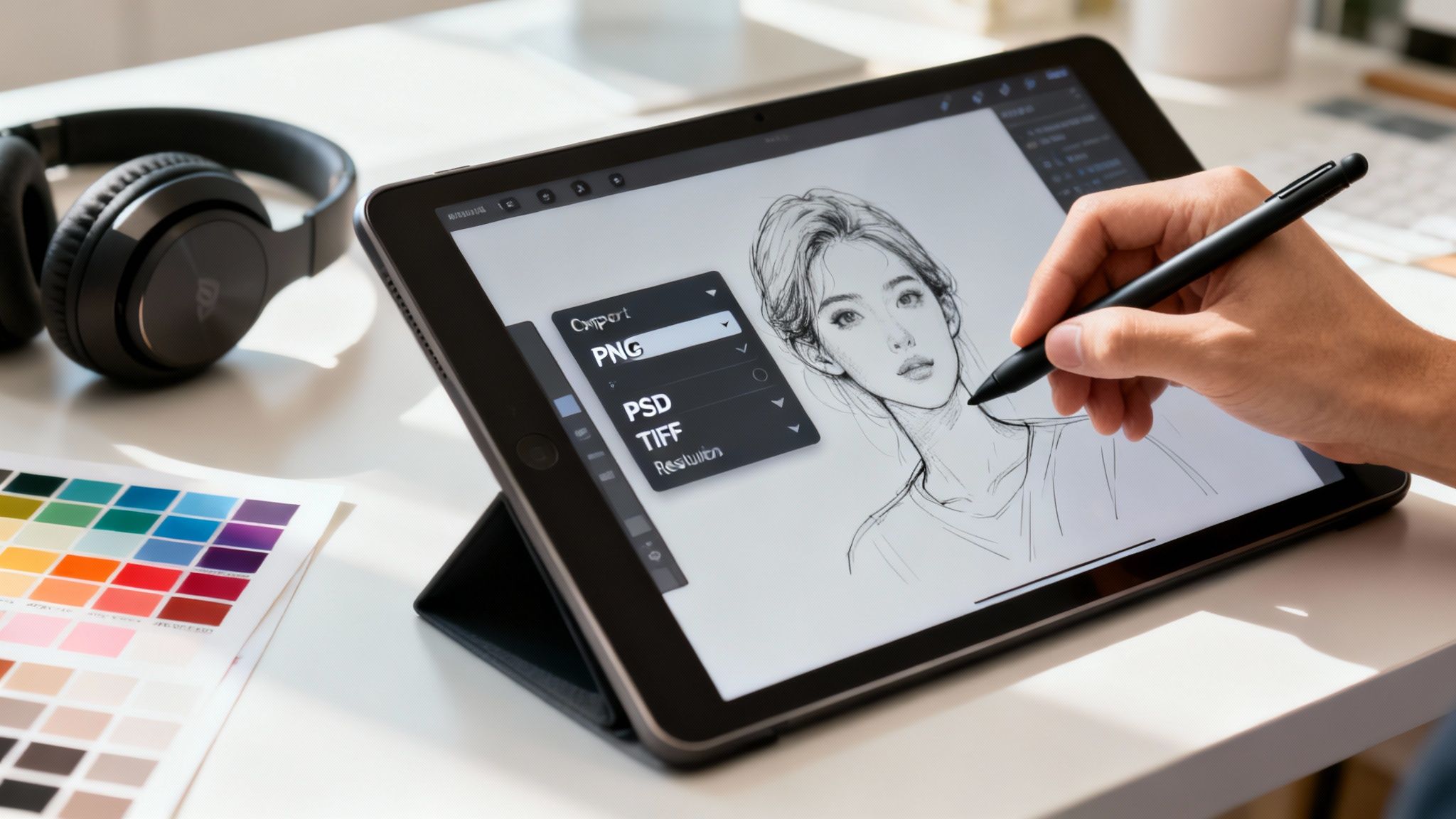
The AI gets you surprisingly close to a finished piece, but that last 10% of polish is where the real artistry happens. This is the stage where you take a great AI output and turn it into a production-ready asset, infusing it with your own intent and precision.
One of the first things I usually tackle is the line work. AI can sometimes generate lines that are a little jittery or inconsistent. Using the built-in editing tools in VirtuallPRO, you can quickly smooth out those little wobbles or even redraw small parts to better fit the aesthetic you're aiming for. It’s not about starting over; think of it as targeted, surgical enhancement.
Adding Depth and Professional Polish
With the lines cleaned up, it's time to look at shading and colour. The AI's shading gives you a solid foundation, but you can add so much more depth by manually punching up key shadows or adding a few strategic highlights. This is how you guide the viewer's eye and make the whole composition feel more dynamic.
Colour is another area where your artistic direction is absolutely vital. The AI’s palette is a great starting point, but it's just a suggestion. You might need to:
- Tweak hues to match a client's specific brand guidelines.
- Boost saturation in certain spots to make the drawing pop.
- Introduce subtle colour gradients for a more sophisticated, polished look.
For quick touch-ups like these, you can stay right inside the VirtuallPRO workspace, which is incredibly efficient. But if you're planning on more intensive edits, exporting the asset to your favourite specialised software is the way to go.
The real magic happens when you merge the raw speed of AI generation with the nuanced control of a skilled artist. The AI is your assistant—it does the heavy lifting, so you can focus on the final, creative details that make all the difference.
Choosing the Right Export Settings
How you export your drawing is just as crucial as how you refine it. The file format and settings you choose will depend entirely on what you're using it for. A drawing for a website has very different needs from an asset going into a game engine.
This is especially true in fields where 2D assets are the foundation for 3D modelling. Just look at Denmark's construction sector, where an incredible 90% of building planning now starts with 3D models derived from 2D plans. One firm in Copenhagen even managed to cut its planning phases by 40% by using AI for the conversion. It’s a powerful example of the efficiency gains you can unlock when your digital assets are correctly formatted for the pipeline.
Here are a few common scenarios I run into:
- For Web and Marketing: Exporting as a PNG is usually my first choice, especially if I need a transparent background. If transparency isn't a concern, a high-quality JPEG strikes a great balance between visual quality and file size.
- For Game Asset Pipelines: Every game engine has its quirks. A PNG is often a safe bet for textures, but it always pays to double-check the engine’s documentation to ensure you’re using the most performant format.
- For Print: When you're preparing something for print, you can't afford to lose detail. A lossless format like TIFF is essential to avoid compression artefacts and keep everything looking crisp.
Getting these small details right ensures your asset performs exactly as it should in its final environment. If you're weighing your options, we've put together a handy comparison that breaks down the key differences between the PNG and JPEG formats.
Got Questions? We’ve Got Answers
When your team starts to lave billeder om til tegninger with AI for the first time, a few common questions always pop up. Let's walk through the ones we hear most from creative teams trying to fold this into their day-to-day work.
How Can I Make Sure the AI Drawing Fits Our Brand Style?
This is usually the first hurdle. Getting that consistent brand look is non-negotiable. Inside VirtuallPRO, we built a feature for this exact problem: 'blueprinting'.
Once you nail that perfect mix—the right model, the perfect style keywords, and those specific parameters that just scream your brand—you can save that whole setup as a blueprint. Your entire team can then pull from that blueprint for any new project, keeping everything from marketing graphics to game assets perfectly on-brand.
What’s the Deal with Intellectual Property?
A big one, and rightly so. You can't afford to get this wrong. We designed VirtuallPRO from the ground up to be a safe, compliant tool for professional studios, with transparent data policies and governance features baked right in.
The golden rule for any commercial project is simple: only use source photos you own or have the rights to. While the drawings you generate on our platform are cleared for commercial use, it all starts with clean inputs. Virtuall helps you manage and track where your assets come from, so compliance is never an afterthought.
This isn’t just about ticking a box; it’s about protecting your work and upholding professional standards.
Can I Get Decent Drawings from Low-Resolution Photos?
AI is powerful, but it's not a miracle worker. Garbage in, garbage out still applies. A high-quality source photo gives the AI more information to work with, resulting in a much better final drawing. Low-res photos just don't have the detail needed for crisp lines and clear shapes.
But, you're not out of luck. VirtuallPRO has upscaling tools built in to help salvage those less-than-perfect source images. We’ve found a two-step process works best:
- First, run the source photo through an upscaler to boost its clarity and resolution.
- Then, use that newly upscaled image for the photo-to-drawing conversion.
This simple workflow gives the AI so much more to work with, leading to a far cleaner and more professional-looking drawing. It’s a great way to rescue older assets and still get fantastic results.
Ready to unify your creative workflows and accelerate your production pipeline? See how Virtuall can transform your team’s process from concept to final asset. Try our Creative AI OS today.