What Is a Dynamic Web Page and Why Does It Matter
Discover what a dynamic web page is and how it fuels modern creative workflows. Learn how real-time, interactive content transforms digital experiences.

Ever wondered what makes your favourite design tools, social media feeds, or project dashboards feel so alive and responsive? The secret sauce is the dynamic web page—an interactive digital space that changes based on what you do. Unlike a static page, which is the same for everyone, a dynamic page is the engine powering the personalised experiences creative professionals rely on every single day. If you've never generated visual assets in a dynamic, AI-powered environment, you can try our Creative AI OS for free and see how it transforms your workflow.
The Engine Behind Modern Creative Workflows
This is the technology that allows collaborative platforms like the one developed by Virtuall to unify 3D, image, and video generation into a single, seamless workspace. It’s how your entire team can see updates in real time.
A dynamic web page is really more of an application that runs in your browser than just a simple website. Think of a static page as a printed brochure—it’s fixed and unchanging. A dynamic page, on the other hand, is like a living document, constantly refreshing with new information tailored specifically to you. This kind of functionality is absolutely essential for creative workflows where collaboration and instant feedback are everything.
How Dynamic Pages Power Collaboration
The real magic of a dynamic web page is its ability to process your input and fetch fresh data from a server without having to reload the entire thing. This is what makes all those features we now take for granted in professional creative tools possible.
- Real-Time Updates: Team members can see comments, annotations on a 3D model, or tweaks to a design the moment they happen.
- Personalised Dashboards: A project manager gets a bird's-eye view of all team tasks, while a designer sees only their assigned assets.
- Interactive Asset Libraries: You can instantly filter, search, and preview huge libraries of images, videos, or 3D models.
This responsive environment doesn't just happen; it's built on complex systems working tirelessly behind the scenes. To really get a feel for the "engine" driving a dynamic page, it helps to understand the underlying modern web application architecture. This structure is what lets platforms handle data securely and efficiently, delivering the fluid experience we all expect. These systems also lean heavily on powerful backend services, a topic you can explore in our guide to cloud-as-a-service models.
2. Static vs Dynamic Pages: A Simple Analogy
Let's break down the difference with a real-world creative scenario.
Think of a static web page as a printed poster for an art exhibition. The design, the text, the images—it’s all fixed. Every person who sees that poster gets the exact same information. It’s effective for what it is, but it’s a one-way street. It can't adapt to who's looking at it.
Now, imagine a dynamic web page as a smart, interactive mood board in your studio. When you approach it, the board recognises you. It pulls up your current project, shows you the latest feedback from your art director, and even suggests new visual assets from the team’s library based on the style you're developing. If a colleague uploads a new 3D model, it appears on your board instantly. The display is assembled on the spot, just for you.
This is the fundamental difference. A static page is sent from a server to your browser as a finished product, ready to go. A dynamic page, on the other hand, is built in real-time. The server acts like a master builder, grabbing all the necessary components—your user profile, the project data, recent comments—and constructing a custom page just for that moment.
The Power of On-the-Fly Generation
This "on-the-fly" assembly is the secret sauce behind the interactive tools we use every day. It’s what makes a web application feel responsive and alive, rather than just a folder of digital documents. It's the engine that drives real-time collaboration.
The crucial shift is from a one-to-many broadcast (static) to a one-to-one conversation (dynamic). This ability to tailor content instantly is the engine behind any effective digital workspace, where personalisation and speed are not luxuries, but necessities.
This dynamic capability is precisely what platforms like VirtuallPRO run on. When you log into your account, the system doesn’t just hand you a generic homepage. It builds your dashboard, showing projects you’re assigned to, surfacing notifications meant specifically for you, and rendering live previews of complex 3D assets.
This immediate, personalised delivery of information is what defines a modern dynamic web page. Without it, collaborative creative work would be a frustrating cycle of hitting refresh and waiting for manual updates.
How Dynamic Content Comes to Life
To get your head around how a dynamic web page works, let's use an analogy: a high-end restaurant. The magic isn't just what happens at your table; it starts in a busy kitchen you never see. This whole behind-the-scenes operation is where the experience is crafted just for you, and it involves two very distinct but equally important roles.
This diagram helps visualise the core differences between the digital equivalent of a printed brochure (a static page) and an interactive kiosk (a dynamic one).
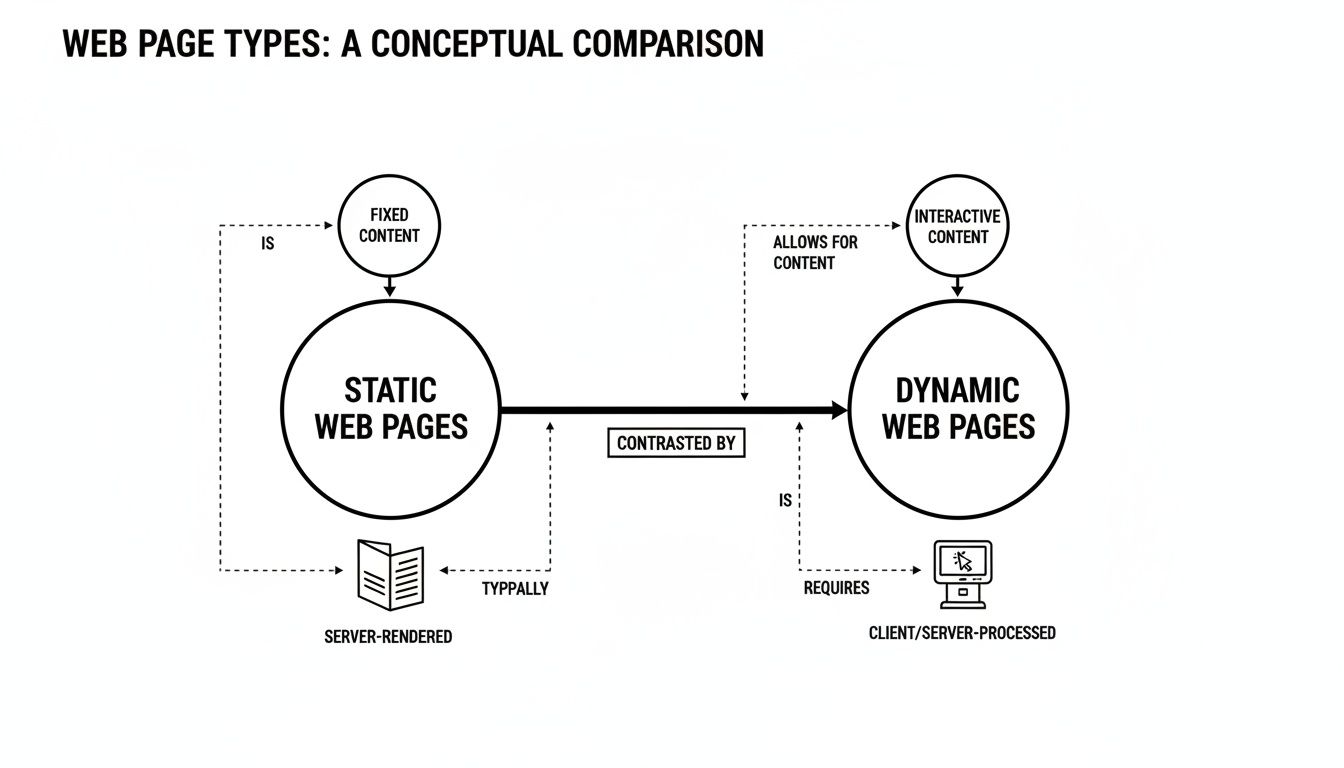
It’s pretty clear from this that while static pages deliver a fixed, one-size-fits-all experience, dynamic pages are built from the ground up for interaction and personalisation.
The Server-Side Chef
First up, we have server-side scripting. Think of this as the master chef working away in the kitchen (the server). When you request a page—let’s say, opening your project dashboard—the server-side code, often written in languages like PHP or Python, gets to work. It pulls together all the necessary ingredients: your user ID, your specific project files, recent comments from teammates, and your security permissions.
The chef then "cooks" a personalised dish—a unique HTML page—and sends it straight out to your table. This is exactly why your dashboard looks different from your colleague's; the server assembled a custom view just for you, based on live data from a database.
The Client-Side Butler
Once the plate arrives, client-side scripting takes over. This is like having a smart, attentive butler right at your table (your web browser). Powered almost entirely by JavaScript, this code runs directly on your device. It’s what lets you interact with your "meal" without having to send the plate back to the kitchen for every tiny change.
When you drag and drop a 3D asset into a new folder, filter an image gallery by file type, or "like" a new design concept, that’s client-side scripting in action. It modifies the page you're already looking at, giving you instant feedback and that fluid, responsive feel we all expect. These scripts are what make modern real-time collaboration tools feel so seamless.
This double act is what makes a dynamic web page feel so alive and interactive. If you really want to get into the nuts and bolts, it's worth exploring the world of custom web application development, a field dedicated to building these sophisticated, two-part systems.
In essence, server-side scripting builds the personalised foundation of the page, while client-side scripting handles the immediate interactions that make the experience feel alive and responsive. Both are essential for creating the powerful tools creative teams rely on.
Here in Denmark, the evolution of dynamic web pages has been hugely influenced by the country's incredible internet penetration, which sits at 99.0% of the population. This creates the perfect environment for the rich, interactive digital experiences that power modern creative workflows.
The Role of Dynamic Pages in Creative Industries
When we move past the technical definitions, we can see where dynamic web pages truly shine: in the hands of modern creative teams. For designers, marketers, and game developers, these aren't just websites; they're living, breathing workspaces. This technology is the invisible backbone that makes demanding creative collaboration not just possible, but efficient.
Think about a real-time collaborative review. Your entire team, scattered across the globe, can see annotations on a 3D model appear instantly. No refreshing, no lag. Or picture a project dashboard where asset statuses and team progress update automatically, giving everyone a live view of the project's health. This is the reality that dynamic pages power.

This shift towards interactive, data-driven platforms has a real-world impact. In Denmark, for example, the creative industry's embrace of dynamic content has helped fuel incredible growth on social platforms. Snapchat's ad reach in the region jumped by 205,000 (+7.7%) between early 2024 and 2025, with a quarterly spike of 161,000 (+15.1%), as detailed in the latest Denmark digital report. It’s a clear sign of how powerful real-time, interactive content can be.
Powering the Next Generation of Creative Tools
The applications for a dynamic web page in creative industries are vast, tackling the core challenges of production and teamwork head-on. In essence, these pages provide the foundation for any modern creative production system.
- Personalised Asset Libraries: An AI-powered library can analyse your project history and dynamically suggest relevant content, textures, or 3D models. This saves hours of manual searching.
- Interactive Prototyping: Designers can build and share interactive product mock-ups or game levels that clients and stakeholders can experience directly in their browser.
- Automated Status Updates: A central dashboard can automatically reflect when an asset is modified, moving it from "In Progress" to "Awaiting Review" without anyone having to do it manually.
At their core, dynamic pages transform a one-way presentation into a two-way collaborative environment. They are the essential ingredient for tools that aim to shorten the distance between an idea and its final execution.
The VirtuallPRO Creative AI OS is built entirely on these principles. It gives designers, marketers, and game developers a centralised, browser-based environment to generate, manage, and iterate on visual assets. By making the interface dynamic, VirtuallPRO dramatically cuts down the time from the first spark of an idea to the final render. This approach is central to effective creative workflow management software, where speed and collaboration are non-negotiable. The result is a unified workspace where every action—from generating an image to leaving feedback on a video—is reflected instantly for the entire team.
Optimising Dynamic Pages for Performance and SEO
While dynamic pages offer incredible power, they also come with their own set of challenges, especially when it comes to performance and search engine optimisation (SEO). For creative teams, getting a handle on these issues is the difference between work that looks brilliant and work that actually gets seen by the right audience.
One of the most common tripwires is that search engine crawlers can struggle to interpret certain dynamic rendering methods. If Google can't "see" the content on your public-facing portfolio because it takes too long to load or depends on complex client-side scripts, your incredible work might never be discovered. Thankfully, modern solutions like pre-rendering or hybrid architectures tackle this head-on, making sure content is ready and waiting for both users and search bots.
Ensuring a Flawless User Experience
When your page is designed to showcase massive 3D models or high-resolution video, performance simply isn't negotiable. A slow-loading dynamic web page creates a frustrating experience, often causing visitors to click away before your best work even gets a chance to appear. The fix lies in writing efficient code and using smart caching strategies, which store temporary copies of data to serve them up much faster on subsequent visits.
Security is another critical layer. A dynamic web page must have robust measures in place to protect sensitive user data and, just as importantly, your valuable creative intellectual property. This means everything from secure login protocols to encrypted data transmission, all working to prevent unauthorised access.
The creative industry in Denmark is already leaning into this, reflecting the nation's reputation for digital innovation. In fact, 28% of Danish companies are using AI technologies—nearly double the EU average—to drive interactive tools for 3D, image, and video generation. You can explore more insights into Denmark's AI adoption to see how the country is pushing boundaries.
This is where enterprise-grade platforms come into play. A solution like VirtuallPRO is engineered from the ground up to manage these complexities. It provides a secure, compliant, and high-performance environment, letting your team stay focused on creative production without getting bogged down by the technical overhead.
Common Questions About Dynamic Web Pages
As creative professionals start working with tools built on dynamic technology, a few key questions always seem to pop up. Getting these cleared up makes it much easier to see how these powerful systems can fit into a modern workflow.
Is a Dynamic Page Always Better?
Not at all. It really boils down to what you need the page to do. If the content hardly ever changes—think of a simple portfolio landing page or a blog post—a static page is usually the faster and more secure option.
But for interactive experiences where content needs to be personalised or updated on the fly, dynamic pages are king. We're talking about things like project management dashboards, e-commerce stores, and collaborative design tools. Those platforms absolutely rely on dynamic functionality to work.
Do I Need to Be a Developer to Use Them?
Nope. While developers are the ones building the engine under the bonnet, platforms like VirtuallPRO are designed from the ground up for creatives. You get all the perks of a dynamic, interactive experience—like real-time collaboration and AI-powered suggestions—through a clean, intuitive interface. You don't need to write a single line of code to get the full benefit.
Are Dynamic Websites Secure for Creative Projects?
Yes, provided they're built properly. Any reputable platform invests heavily in security to protect user data and intellectual property. This means putting essential measures in place, such as secure logins, solid data encryption, and fine-grained access controls to manage who can view or edit sensitive files.
For any serious enterprise tool, security and compliance have to be top priorities. This is how you ensure your valuable creative assets are always protected from unauthorised access, giving your team peace of mind.
These security layers are fundamental. They create a trustworthy environment where teams feel confident managing their most important work, making robust security non-negotiable for professional-grade tools.
Ready to see how a secure, dynamic environment can speed up your creative production? With VirtuallPRO, you can bring your 3D, image, and video generation into a single collaborative workspace. Try our Creative AI OS for free.