Mood Boards With Memory: Building Reusable Studio Context
Learn how mood boards with memory turn studio context into reusable AI direction for consistent image, video, and 3D production.
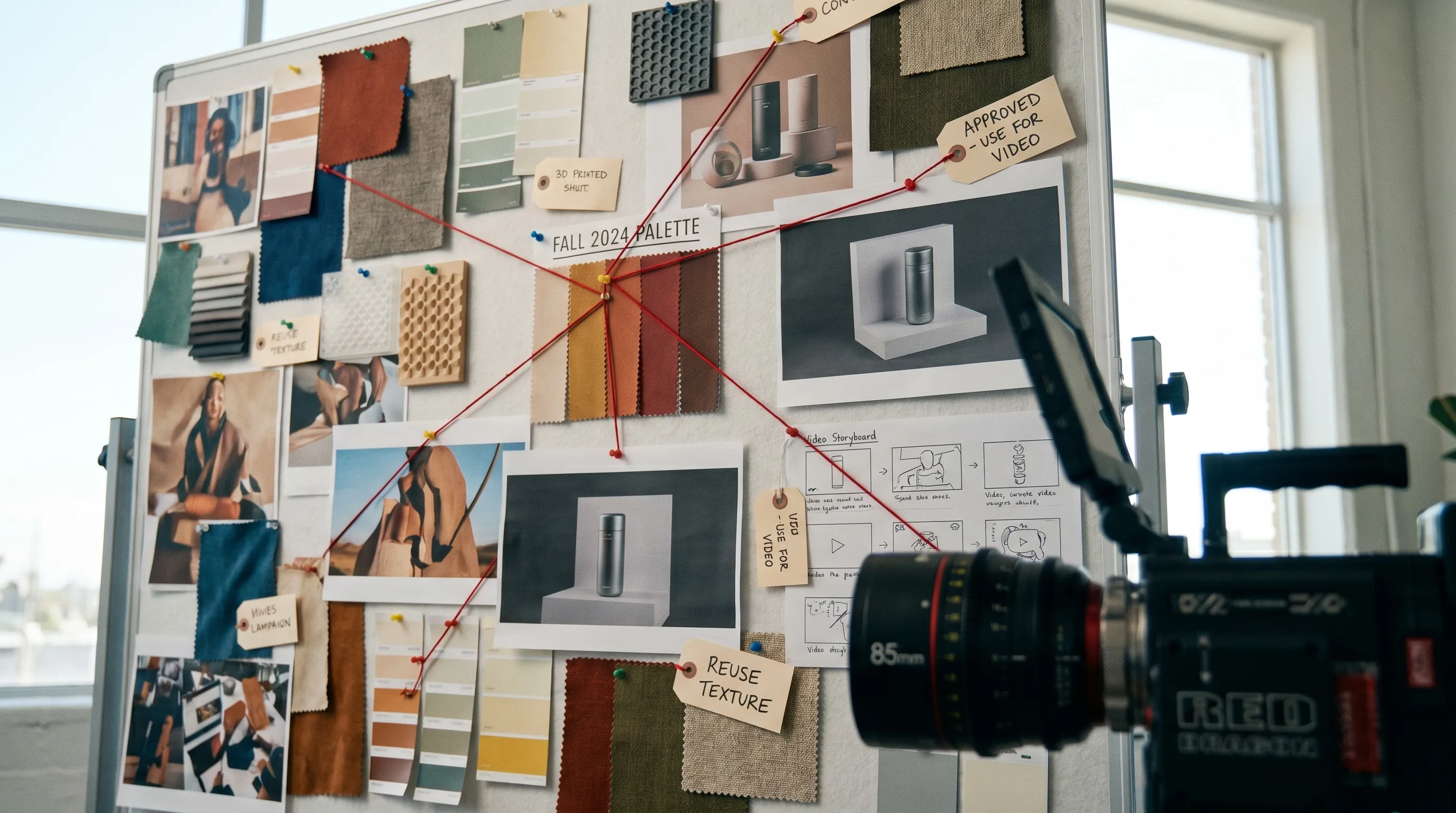
A mood board used to be a wall of references: color palettes, lighting cues, materials, typography, product shots, competitor examples, and a few notes about the desired feeling. It helped align people before production started.
In AI-assisted production, that is no longer enough.
When a creative team uses AI for image generation, video generation, 3D concepting, localization, campaign variants, or game asset exploration, the mood board cannot remain a static presentation artifact. It needs to travel with the workflow. It needs to tell models what matters, help teams understand why decisions were made, and preserve the studio context that keeps outputs consistent over time.
That is the idea behind mood boards with memory: reusable studio context that captures not only what a creative direction looks like, but also how it should be applied, governed, reviewed, and scaled.
For CMOs, this protects brand consistency. For art directors, it preserves creative intent. For application managers, it turns AI experimentation into a controlled workflow. For game developers and production teams, it helps maintain a coherent visual universe across hundreds or thousands of assets.
Why static mood boards break in AI workflows
Traditional mood boards are excellent for human inspiration. They are less effective as operational context.
A human can look at a set of references and infer taste, cultural cues, composition preferences, and emotional tone. AI systems need more structured direction. If that direction is reduced to a single prompt, the studio quickly runs into prompt drift, inconsistent outputs, repeated feedback loops, and fragmented versions of the same concept.
The issue becomes more visible at enterprise scale. One team may generate hero campaign images, another adapts them into video, a localization team creates market variants, and a 3D team builds product visuals or game assets. If each team interprets the mood board manually, consistency depends on memory, taste, and luck.
A mood board with memory solves a different problem: it makes creative context reusable.
| Creative need | Static mood board | Mood board with memory |
|---|---|---|
| Visual alignment | Shows references and inspiration | Stores approved visual direction as reusable context |
| AI generation | Requires manual prompt interpretation | Connects context to generation blueprints and workflows |
| Review cycles | Feedback is often scattered in comments or meetings | Captures decisions, approvals, and rejected directions |
| Brand governance | Relies on team discipline | Applies rules, constraints, and usage guidance |
| Cross-format production | Needs reinterpretation for image, video, and 3D | Carries intent across formats and tools |
| Scaling | Works best for one project or small team | Supports repeatable production across teams and markets |
The goal is not to replace creative judgment. The goal is to stop forcing every team to rediscover the same direction from scratch.
What reusable studio context actually includes
A mood board with memory is not just a richer folder of references. It is a structured creative knowledge layer that can be reused by people, AI models, workflows, and approval systems.
At a minimum, reusable studio context should capture the visual DNA of a project or brand world. That includes color, lighting, composition, materials, camera language, textures, proportions, and any recurring motifs. But visual DNA is only the surface.
The deeper value comes from capturing intent. Why should this campaign feel cinematic rather than editorial? Why is the material finish matte instead of glossy? Why should a character silhouette feel agile rather than heavy? These decisions are often obvious to the creative lead, but invisible to downstream teams and AI systems unless they are recorded.
| Context layer | Examples | Why it matters |
|---|---|---|
| Visual DNA | Color palette, lighting, framing, materials, composition | Keeps generated outputs visually coherent |
| Creative intent | Mood, emotion, audience, campaign goal, narrative role | Helps teams apply style with purpose, not imitation |
| Production constraints | Aspect ratios, channels, file requirements, forbidden elements | Reduces rework and unusable outputs |
| AI generation context | Prompts, negative prompts, model settings, approved examples | Makes successful generation patterns repeatable |
| Governance rules | Brand rules, legal restrictions, rights information, compliance notes | Supports responsible and compliant AI use |
| Review memory | Approved outputs, rejected directions, annotations, decision history | Prevents teams from repeating known mistakes |
This is where mood boards become more than inspiration. They become a reusable operating layer for creative production.
From inspiration board to operational context
The practical shift is simple: instead of treating a mood board as a file, treat it as a living context object.
A context object can be invoked inside a generation workflow. It can inform a prompt, constrain a model, guide a reviewer, or attach to an asset inside a DAM, PIM, DCC tool, or production pipeline. It can also be versioned, so teams know whether they are working from an approved brand context, a campaign-specific variation, or an experimental exploration.
This matters because AI content automation without context often creates volume without control. Teams can produce more assets, but they may also produce more inconsistency. A reusable studio context helps creative AI systems generate closer to the intended result from the first pass.
For example, an art director might define a seasonal product world with a cool color temperature, soft shadows, natural fabric textures, and restrained camera angles. A CMO may add campaign positioning, audience tone, and market sensitivity rules. A production team may attach aspect ratios, background restrictions, and usage rights. An application manager may connect that context to approved models, review workflows, and asset management systems.
Together, these inputs become a memory layer that can guide production instead of sitting in a slide deck.
How mood boards with memory improve image, video, and 3D generation
Creative AI is no longer limited to one output type. Teams increasingly move between image, video, audio, and 3D generation. The challenge is maintaining continuity as the format changes.
Image generation
For image generation, reusable context helps maintain brand style, product accuracy, lighting preferences, and composition rules across large sets of variations. This is especially useful for campaign adaptation, e-commerce imagery, social content, and concept exploration.
Instead of rewriting prompts for every scene, teams can work from a shared context that already contains approved visual direction. The prompt becomes more focused on the specific asset request, while the mood board memory carries the underlying studio rules.
Video generation
Video adds time, pacing, movement, transitions, and narrative rhythm. A static mood board can suggest a look, but it rarely captures motion language well enough for repeatable production.
A mood board with memory can store camera movement preferences, editing rhythm, shot types, lighting continuity, and narrative tone. This makes it easier to produce video outputs that feel connected to campaign imagery rather than like a separate experiment.
3D generation and game production
For 3D teams and game developers, context memory can preserve shape language, material direction, world-building rules, character proportions, prop families, and environment references. This is especially valuable when multiple artists, vendors, or AI models contribute to the same visual universe.
A fantasy marketplace, a sci-fi vehicle family, or a stylized mobile game environment needs consistency across many assets. Mood boards with memory help define what belongs in the world and what breaks it.
Governance is part of the mood board now
Enterprise creative AI cannot separate creativity from governance. If a team is using AI-generated assets in commercial production, context should include rules about what is allowed, what must be reviewed, and what cannot be used.
This includes rights and provenance, brand restrictions, market-specific compliance requirements, model usage policies, and approval chains. It also includes the ability to document why a certain direction was approved or rejected.
Governance is becoming a broader expectation across AI programs. Frameworks such as ISO/IEC 42001 describe management systems for responsible AI use, while the European Commission's AI Act overview highlights the growing importance of risk management, transparency, and accountability. For creative production, standards and initiatives such as C2PA also point toward a future where provenance and content authenticity matter more, not less.
A mood board with memory does not replace legal, compliance, or brand review. It makes those requirements easier to operationalize inside the creative workflow.
How to build reusable studio context
The best mood boards with memory are built around real production needs, not abstract documentation. Start with the creative worlds your team repeats often: brand campaigns, product categories, seasonal launches, game environments, character families, retail formats, or recurring social templates.
Then capture the context that helps those worlds stay consistent. This should be practical, searchable, and usable by both humans and AI systems.
- Start with an approved creative direction: Use a real campaign, product world, or asset family that already has stakeholder alignment. Memory is most useful when it captures decisions that the studio trusts.
- Separate inspiration from approved reference: Inspiration can be broad, but approved reference should be clear, rights-aware, and tied to production intent. This distinction matters for compliance and quality control.
- Translate visuals into usable attributes: Define color behavior, camera language, lighting, materials, composition, mood, forbidden elements, and quality standards in language that can guide generation.
- Capture prompts and generation settings that worked: Successful AI outputs often depend on prompt structure, model choice, parameters, and negative guidance. Store these as reusable patterns rather than personal notes.
- Connect context to workflow orchestration: The context should be available where work happens, including generation templates, review workflows, asset libraries, and production pipelines.
- Record feedback and approvals: A rejected output is valuable if the reason is captured. Over time, this creates a studio memory that reduces repeated mistakes.
- Version context deliberately: A global brand context, a campaign context, and a market-specific context may all be valid, but teams need to know which one governs their work.
The point is not to document everything. The point is to preserve the decisions that improve consistency, speed, and production readiness.
Common mistakes to avoid
The first mistake is treating memory as a dumping ground. If every reference, prompt, and comment is stored without structure, the mood board becomes noisy. Teams need curated context, not infinite context.
The second mistake is confusing style imitation with creative direction. A good reusable context describes the qualities a team wants to preserve, not just the examples it wants to copy. This matters for originality, rights, and long-term brand value.
The third mistake is ignoring review memory. Many teams save final assets but lose the reasoning behind them. If the only thing preserved is the output, future teams still have to guess why it worked.
The fourth mistake is making context too rigid. Studio context should guide production, not freeze creativity. The best systems allow controlled variation, experimentation, and versioning while keeping the core direction intact.
Measuring the value of mood boards with memory
Reusable studio context should improve both creative quality and operational performance. The metrics do not need to be complicated. What matters is whether teams can produce consistent, approved assets with less friction.
| Metric | What to look for |
|---|---|
| First-pass quality | More outputs that match the intended direction before heavy revision |
| Review efficiency | Fewer repeated comments and shorter approval cycles |
| Brand consistency | Stronger alignment across teams, markets, and formats |
| Asset reuse | More approved context, prompts, and outputs reused across campaigns |
| Production readiness | Fewer assets rejected for format, compliance, or quality issues |
| Governance visibility | Clearer records of approvals, restrictions, and context versions |
For enterprise teams, the business case is not simply faster generation. It is more controlled creative throughput. AI can produce volume, but memory helps produce continuity.
Why a Creative AI OS is the natural home for studio context
A mood board with memory cannot reach its full value if it lives outside the production system. To be useful, it needs to connect with generation, review, asset management, governance, and the creative tools teams already use.
This is where a Creative AI OS becomes important. Rather than treating AI as a collection of disconnected tools, a Creative AI OS provides an operating layer for creative AI at scale. It can help teams define rules, orchestrate workflows, manage assets, support approvals, and keep context available across image, video, audio, and 3D production.
Virtuall is built around this operating model. Its Creative AI OS enables studios and teams to control, orchestrate, and scale AI-powered content creation with enterprise-grade governance and compliance. Features such as AI governance controls, workflow orchestration, generation blueprints, team review workflows, asset management, and studio context memory are designed for teams that need consistent, production-ready results.
Nyx, the intelligence layer of the Creative AI OS, orchestrates multiple industry-leading AI models and keeps intent and context across studios and teams. For organizations moving from AI experimentation to AI-powered production, that continuity is critical.
Frequently Asked Questions
What is a mood board with memory? A mood board with memory is a reusable creative context layer that stores visual direction, intent, prompts, approved references, review feedback, governance rules, and production constraints. It helps teams and AI systems apply creative direction consistently.
How is it different from a traditional mood board? A traditional mood board mainly inspires and aligns people. A mood board with memory also connects to workflows, AI generation, approvals, asset management, and governance, making the context operational and reusable.
Why does studio context matter for AI-generated content? AI outputs depend heavily on context. Without shared studio context, teams often get inconsistent results, repeated revisions, and fragmented creative direction. Reusable context helps preserve intent across models, tools, and teams.
Can mood boards with memory support 3D and game development? Yes. They can store world-building rules, shape language, materials, character proportions, environment references, and approved asset directions, which helps game and 3D teams maintain consistency across large asset sets.
Does this replace human art direction? No. It supports human art direction by preserving decisions and making them easier to apply at scale. Creative leaders still define the vision, approve outputs, and decide when to evolve the direction.
Build creative memory into your AI workflows
AI can generate more content. The next challenge is generating the right content consistently, across teams, tools, formats, and markets.
Mood boards with memory give studios a practical way to preserve creative intent and turn it into reusable production context. For enterprise teams, this is how AI moves from isolated experiments to governed creative workflow automation.
If your team is ready to operationalize AI across image, video, audio, and 3D production, explore Virtuall and see how a Creative AI OS can help you scale studio-quality results with control, context, and compliance.