Studio Context Memory: Keep Creative Intent Consistent
Learn how studio context memory helps creative teams preserve intent, reduce AI drift, and scale consistent image, video, and 3D production.
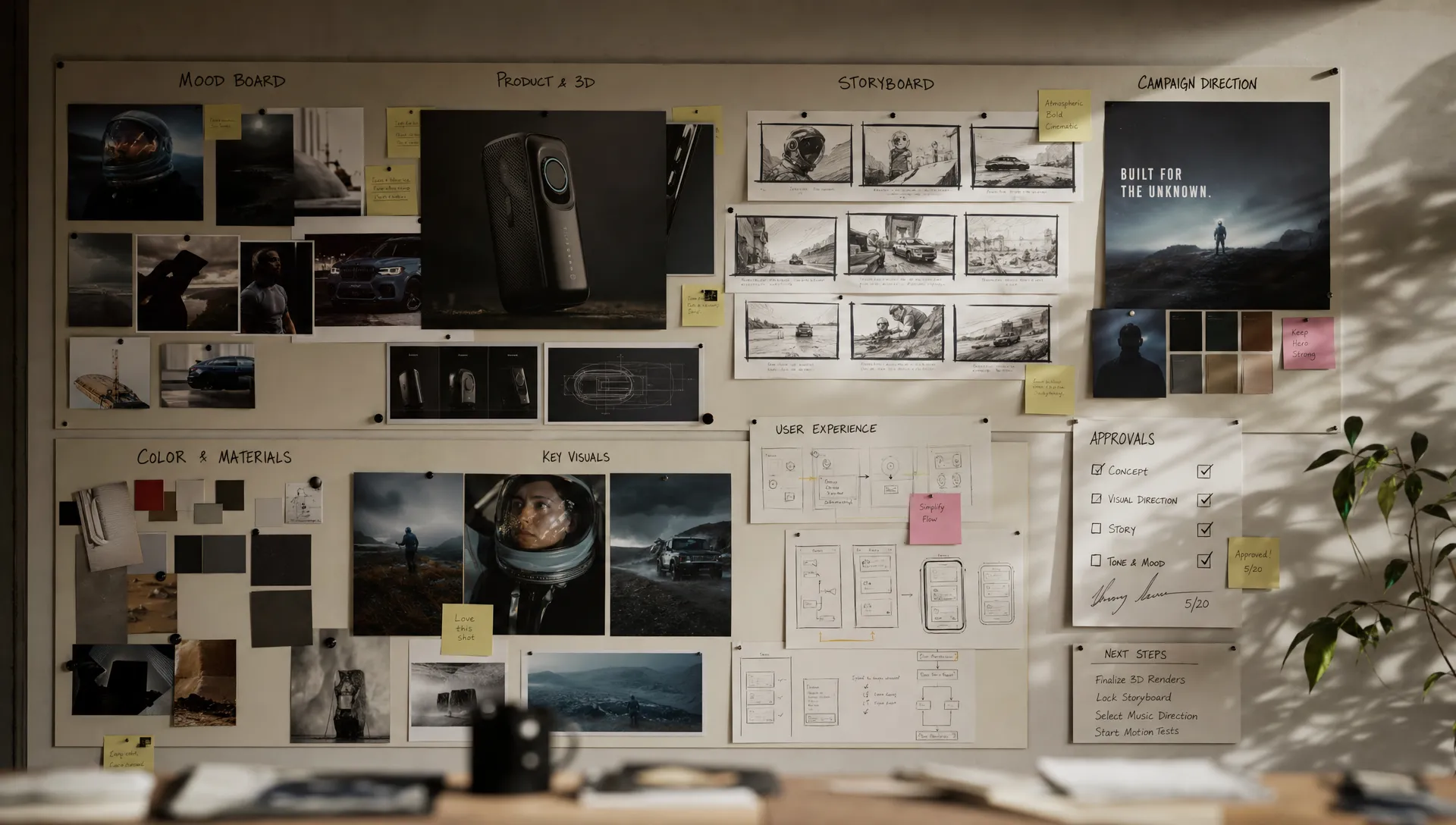
Creative AI can generate more concepts, variations, and production assets than a traditional pipeline could ever handle manually. But speed creates a new operational problem: creative intent can drift.
One team prompts for “premium minimalism” and gets a clean product shot. Another uses the same phrase and gets something colder, flatter, or off-brand. A 3D artist interprets a campaign mood board differently from the video team. A model update changes visual behavior. A freelancer reuses an outdated reference. Suddenly, the studio is producing more content, but spending more time correcting, explaining, and re-aligning.
That is the problem studio context memory is designed to solve. It gives creative teams a shared, reusable layer of intent, references, constraints, approvals, and production knowledge so AI-generated work stays consistent across people, tools, models, and formats.
For enterprise creative teams, game studios, and content operations leaders, this is quickly becoming a foundational capability. AI output quality is no longer just about the prompt. It is about the system that remembers what the studio means.
What Is Studio Context Memory?
Studio context memory is the structured memory of a creative organization. It captures the context behind creative work, then makes that context available across AI workflows.
In practical terms, it can include mood boards, brand guidelines, approved visual references, art direction notes, negative prompts, asset relationships, campaign-specific rules, model preferences, review feedback, and final approval decisions. The goal is not to replace human judgment. The goal is to make sure human judgment travels through the workflow instead of being lost in scattered files, chat threads, and individual prompt habits.
A prompt tells an AI system what to do in a single moment. Studio context memory helps define what the studio consistently means by that instruction.
For example, “cinematic sci-fi corridor” may mean one thing for a realistic AAA game, another for a stylized mobile title, and another for a luxury product launch film. Without memory, every creator has to re-explain the intent. With memory, the system can carry forward the approved visual language, constraints, and production expectations that already exist inside the studio.
Why Creative Intent Breaks in AI Production
Creative teams have always managed interpretation. A creative director sets the vision, artists explore, producers coordinate, and reviewers refine. AI adds another layer of interpretation, because models do not automatically understand a studio’s internal taste, brand history, or production standards.
Intent often breaks for predictable reasons:
- Language is ambiguous: Terms like “premium,” “gritty,” “playful,” or “realistic” depend on context.
- References are fragmented: Mood boards, prior campaigns, 3D assets, and brand decks often live in different systems.
- Models behave differently: The same brief can produce different outcomes across image, video, audio, and 3D models.
- Feedback is not reusable: Review comments improve one asset, but rarely become persistent guidance for the next generation.
- Teams work in parallel: Art directors, marketers, game developers, and external partners may all generate content from slightly different assumptions.
In a small team, these gaps can be solved through conversation. At enterprise scale, conversation alone is not enough. A campaign may involve multiple markets, agencies, tools, approval layers, and asset formats. The studio needs a memory layer that is operational, not informal.
What Studio Context Memory Should Contain
A useful memory layer should not become a dumping ground. If everything is “context,” nothing is actionable. The most valuable studio context memory is organized around the decisions that influence output quality.
| Context type | Why it matters | Example |
|---|---|---|
| Brand and art direction | Keeps generated work aligned with the creative system | Color palettes, lighting rules, composition preferences |
| Mood boards and references | Makes subjective intent more concrete | Approved campaign visuals, character references, product angles |
| Negative constraints | Prevents repeated mistakes | Avoid glossy plastic textures, avoid exaggerated proportions |
| Production requirements | Ensures outputs fit downstream use | Aspect ratios, file expectations, 3D topology considerations |
| Review and approval history | Turns feedback into reusable guidance | “Approved for social,” “needs legal review,” “off-brand expression” |
| Model and workflow preferences | Improves consistency across generation methods | Preferred models for concepting, upscaling, video variation, or 3D exploration |
This is especially important when teams generate content across multiple formats. A campaign may begin with image concepts, move into short-form video, then require 3D product renders, localized social assets, and ecommerce visuals. If each format starts from scratch, consistency suffers. If each format draws from the same memory, the creative system becomes more stable.
Studio Context Memory Is Not Just a Prompt Library
Prompt libraries are useful, but they are only one piece of the puzzle. A prompt library stores instructions. Studio context memory stores intent.
That distinction matters. A prompt can say “use soft natural lighting,” but context memory can connect that instruction to approved examples, rejected examples, brand rules, campaign goals, and prior reviewer decisions. It can also help teams understand when the rule applies and when it should be adapted.
| Capability | Prompt library | Studio context memory |
|---|---|---|
| Stores reusable text prompts | Yes | Yes, when relevant |
| Connects prompts to visual references | Sometimes | Yes |
| Preserves review decisions | Rarely | Yes |
| Carries context across teams | Limited | Yes |
| Supports image, video, 3D, and asset workflows | Often fragmented | Designed to span formats |
| Helps governance and auditability | Limited | Stronger when connected to workflow controls |
A prompt library helps individuals work faster. Studio context memory helps organizations work consistently.
How It Supports Different Creative Stakeholders
Studio context memory is valuable because it does not serve only one role. It creates a shared operating layer for everyone who influences creative output.
| Stakeholder | What they need | How context memory helps |
|---|---|---|
| CMO | Brand consistency, speed, campaign governance | Keeps AI content aligned with brand and market expectations |
| Art Director | Control over visual language | Preserves mood, references, composition rules, and feedback |
| Application Manager | Tool interoperability and governance | Connects AI workflows to systems, permissions, and operational rules |
| Game Developer | Consistent worlds, characters, props, and environments | Carries style, lore, asset constraints, and iteration history across production |
For a CMO, the value is trust. AI can scale content without diluting the brand. For an art director, the value is control. AI becomes a production partner that understands the intended direction more reliably. For an application manager, the value is operational clarity. Creative AI can be governed across tools and workflows. For game developers, the value is continuity across worlds, assets, and iterations.
From Mood Boards to Production Memory
Mood boards are often the natural starting point for studio context memory. They already contain the visual DNA of a project: color, texture, lighting, framing, emotion, and style. But traditional mood boards are mostly static. They inspire humans, but they do not automatically guide AI systems across an entire production pipeline.
The next step is making mood boards operational. That means connecting visual references to generation workflows, review criteria, asset metadata, and approval states. A mood board should not only say “this is the vibe.” It should help define what the system should generate, what it should avoid, and what counts as production-ready.
This is where creative teams can move from one-off experimentation to repeatable AI production. Instead of prompting from memory or copying old instructions, teams can reuse approved creative context through templates, structured workflows, and shared references.
Governance: The Enterprise Difference
At enterprise scale, creative consistency is inseparable from governance. Teams need to know which models are used, what content is approved, where assets are stored, who can generate what, and how outputs move through review.
This becomes more important as AI regulation and internal compliance expectations mature. The European Commission’s AI regulatory framework highlights the broader shift toward accountability, transparency, and risk management in AI systems. Creative AI teams may not all face the same level of regulatory exposure, but enterprise buyers increasingly expect clear controls.
A strong studio context memory strategy should support:
- Permissioning: Not every user should access every brand, market, asset, or campaign context.
- Traceability: Teams should understand how an output was generated and which context influenced it.
- Approval workflows: Creative, legal, brand, and production stakeholders need clear review paths.
- Model governance: Organizations should define where and how models are used in production.
- Regional and data controls: Enterprise teams may need infrastructure and inference choices that match compliance requirements.
Without governance, context memory can become risky. With governance, it becomes a controlled foundation for scaling AI-assisted production.
How to Implement Studio Context Memory
Implementing studio context memory is not just a technical project. It is a creative operations project. The best results come when creative leadership, production teams, IT, and governance stakeholders define the system together.
Start With One High-Value Workflow
Do not try to capture the entire organization’s creative knowledge on day one. Start with a workflow where inconsistency is costly and easy to see. Good candidates include campaign image generation, ecommerce product visuals, game environment concepting, social video variations, or 3D asset exploration.
The goal is to prove that persistent context reduces rework, improves consistency, and accelerates approvals.
Define What “Consistent” Actually Means
Consistency is not sameness. A brand can be flexible while still recognizable. A game world can include diverse regions while maintaining a coherent art direction. A product campaign can localize for different markets without losing its core identity.
Teams should define which elements must remain stable and which can vary. For example, lighting, material realism, product proportions, character silhouettes, typography, or tone may be protected. Backgrounds, camera angles, seasonal elements, or regional details may be adaptable.
Capture Both Positive and Negative Examples
Approved references are important, but rejected examples are just as useful. They teach the system and the team what “wrong” looks like. If a model repeatedly generates overly polished skin, inaccurate product geometry, or off-brand environments, those patterns should become part of the memory layer.
A mature context memory system does not only preserve the final answer. It preserves the reasoning behind the answer.
Connect Memory to Review and Approval
If context memory is disconnected from review, it will become outdated. Feedback should not remain trapped in comments. When reviewers approve, reject, or annotate assets, those decisions should inform future generations where appropriate.
This helps teams build a living memory that improves over time. It also reduces the repetitive burden on art directors and brand reviewers, who should not have to restate the same guidance for every new asset batch.
Make It Accessible Inside the Tools Teams Already Use
Creative teams do not want another isolated system that adds friction. Studio context memory is most valuable when it connects to existing creative tools, asset systems, and production workflows. For enterprise teams, this often means integrations with DCC tools, PIM systems, DAM platforms, or internal production pipelines.
The more naturally context travels through the workflow, the more likely teams are to use it.
How Virtuall Approaches Studio Context Memory
Virtuall is built as a Creative AI OS for operating AI-powered content creation at scale. Within that operating system, studio context memory helps teams keep creative intent consistent across image, video, audio, and 3D workflows.
Rather than treating AI generation as isolated prompts, Virtuall connects creative context to orchestrated workflows, generation blueprints, team collaboration, asset management, review processes, and pipeline tracking. This matters because consistency is rarely solved at the generation step alone. It depends on the full path from brief to output to approval.
Virtuall also includes Nyx, the intelligence layer of the Creative AI OS. Nyx orchestrates multiple industry-leading AI models and keeps intent and context across studios and teams. For creative organizations, that means AI workflows can become more repeatable without forcing teams into a single model or one rigid way of working.
For enterprise teams with compliance requirements, Virtuall’s governance controls and EU-based infrastructure and inference are especially relevant. Creative AI can move faster while staying aligned with internal rules, review expectations, and operational standards.
Metrics That Show Context Memory Is Working
Studio context memory should improve creative quality, but it should also improve measurable production outcomes. The right metrics depend on the workflow, but these indicators are a strong starting point.
| Metric | What it reveals |
|---|---|
| Revision rate | Whether generated outputs are closer to the brief earlier in the process |
| Approval cycle time | Whether reviewers spend less time correcting repeated issues |
| Brand consistency score | Whether outputs meet defined brand or art direction criteria |
| Asset reuse rate | Whether approved context and assets are being leveraged effectively |
| Prompt variation spread | Whether teams are using aligned instructions instead of fragmented language |
| Production handoff quality | Whether outputs meet downstream requirements for video, 3D, DAM, or campaign delivery |
The key is to measure both speed and control. Faster output is not enough if the team creates more review debt. The value of studio context memory is that it helps AI scale without making creative direction fragile.
Common Mistakes to Avoid
The first mistake is treating memory as storage. A folder of brand decks and mood boards is not enough. Context must be structured in a way that can influence workflows.
The second mistake is over-standardizing creativity. If the memory layer becomes too rigid, it can flatten exploration. The goal is to preserve intent, not prevent invention.
The third mistake is ignoring ownership. Someone needs to maintain the quality of the memory. Creative leadership should define artistic standards, operations should manage workflow integration, and governance teams should define controls.
The fourth mistake is failing to update context after approvals. If the memory does not learn from production decisions, it will slowly drift away from the studio’s actual standards.
Frequently Asked Questions
What is studio context memory? Studio context memory is a shared layer of creative knowledge that preserves intent, references, constraints, feedback, and approval decisions so AI-generated work stays consistent across teams, tools, and formats.
How is studio context memory different from a DAM? A DAM stores and manages assets. Studio context memory helps explain how those assets should guide future creative work, including visual direction, constraints, approval history, and generation context.
Does studio context memory replace art directors? No. It supports art directors by carrying their guidance through AI workflows more consistently. Human creative judgment remains essential for setting direction, evaluating quality, and approving final work.
Why does studio context memory matter for 3D and game production? Game and 3D workflows depend on continuity across characters, environments, props, materials, and world rules. Context memory helps teams preserve that continuity while using AI to accelerate exploration and production.
Can studio context memory support compliance? Yes, when it is connected to governance controls such as permissions, traceability, model usage rules, approval workflows, and infrastructure choices that match enterprise requirements.
Keep Creative Intent Consistent as You Scale AI
Creative AI is moving from experimentation to production. The teams that succeed will not be the ones that generate the most outputs. They will be the ones that preserve intent, govern workflows, and deliver production-ready assets consistently.
Studio context memory gives creative organizations a practical way to do that. It turns mood boards, feedback, approvals, and production standards into reusable operating context for AI-powered work.
If your studio is ready to scale AI across image, video, audio, and 3D while keeping creative direction under control, explore how Virtuall helps teams operate creative AI at scale.