The new DAM in the age of creative AI.
Explore the new DAM in creative AI: unify production, governance, and asset management to scale image, video, and 3D content.
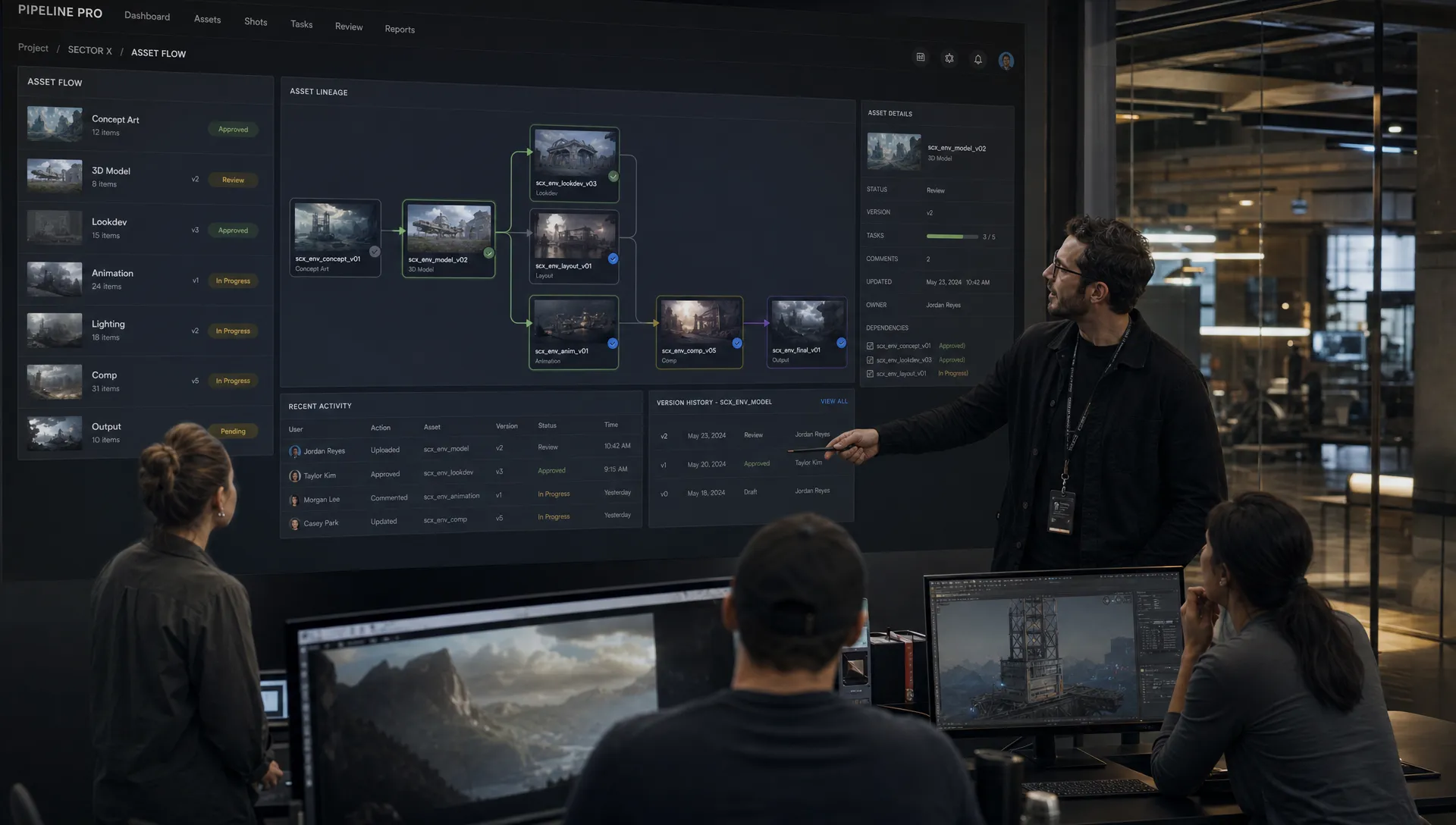
Digital asset management has never been more important. Not because teams need another place to store files, but because creative production is entering a scale that traditional storage models were never designed to handle.
Enterprise studios are no longer managing thousands of approved images and a few campaign videos. They are managing hundreds of thousands, sometimes millions, of visual assets, generated variants, 3D models, audio files, prompts, references, rights records, model outputs, review notes, and localized adaptations. Creative AI accelerates the volume, but it also changes the meaning of an asset.
An asset is no longer just a file. It is a production event with context.
Who generated it? Which reference board shaped it? Which model was used? What prompt, seed, input mesh, texture set, approval state, usage right, region, and brand rule applies? Can the team regenerate it safely? Can it be used in a product configurator, a game build, a social campaign, or a marketplace listing without legal or brand risk?
This is why the new DAM cannot be a passive library. In the age of creative AI, DAM must become part of the production system itself.
Why traditional DAM breaks under creative AI scale
Classic DAM platforms were built around a sensible premise: centralize final assets, enrich them with metadata, and make them searchable for reuse. That is still useful. In fact, it is essential. But it is not sufficient when production becomes AI-assisted, multi-format, and continuous.
The old model assumes a relatively clean separation between creation and storage. Designers create in creative tools, producers review in workflow systems, approved files move into the DAM, and other teams retrieve them later. This worked when the DAM mainly held finished campaign assets, brand libraries, and media archives.
Creative AI disrupts that separation. The production process now creates assets at every stage:
- Early concept directions generated from brand context and mood boards
- Variations created for audience segments, channels, and regions
- 3D models, textures, renders, product views, animation references, and video snippets
- Intermediate generations that may not be final, but still contain useful intent
- Prompt and model settings required to reproduce or audit an output
- Approval data showing what is safe, on-brand, and ready for use
If production and asset management live in two separate systems, teams lose the thread. The DAM receives outputs but not the decisions that created them. Production tools know the work in progress but not the enterprise rules. Review workflows capture feedback but not always the asset lineage. AI tools generate impressive material but often leave context behind.
That gap becomes expensive at scale. Teams duplicate work because they cannot find the right version. Legal teams cannot validate how an asset was made. Art directors cannot enforce a visual direction across hundreds of AI outputs. Application managers struggle to connect creative tools, DAM, PIM, CMS, and commerce systems. Game teams lose time resolving missing dependencies, broken references, or outdated assets in builds.
The question is no longer whether the DAM is useful. The question is whether it is close enough to production to remain trustworthy.
The new DAM is an operating layer, not just a repository
The next generation of DAM needs to manage the full creative asset lifecycle. That includes ideation, generation, editing, review, approval, distribution, reuse, and retirement. It must understand assets as living objects connected to workflows, people, AI models, rules, and downstream systems.
This is why many enterprise creative teams are rethinking the role of DAM entirely. A useful way to frame the shift is that traditional digital asset management is no longer enough when AI becomes part of everyday production. The DAM still matters, but it needs to evolve from a final-file archive into a governed production layer.
| Traditional DAM | New DAM in the age of creative AI |
|---|---|
| Stores finished files | Manages assets across ideation, generation, review, and reuse |
| Relies heavily on manual metadata | Captures production context, prompts, lineage, approvals, and rights |
| Focuses on search and retrieval | Supports orchestration, governance, and regeneration |
| Sits after production | Operates inside the production workflow |
| Treats assets as static files | Treats assets as versioned, connected, multi-format objects |
| Serves marketing libraries | Serves enterprise creative operations across image, video, 3D, audio, product, and game pipelines |
This shift matters because AI increases both creative possibility and operational risk. Without governance, teams can produce more content than they can approve. Without lineage, they cannot explain how outputs were created. Without asset intelligence, they cannot reuse the best material. Without integration, AI becomes another silo.
A new DAM needs to answer practical production questions, not just storage questions:
- Which assets are approved for which markets and channels?
- Which generated outputs were based on licensed, proprietary, or restricted references?
- Which variants belong to the same campaign, product, character, environment, or SKU?
- Which version is currently used in a game build, product page, ad set, or retail activation?
- Which assets can be regenerated with the same intent and constraints?
- Which files are final, which are work in progress, and which should never be reused?
When DAM becomes operational, it stops being a place teams visit at the end. It becomes the connective tissue of creative production.
Game development shows where asset management is going
Game development is one of the clearest examples of why production and asset management cannot remain separate. A modern game is a dense network of interdependent assets: characters, rigs, animations, environment meshes, textures, shaders, materials, VFX, UI, audio, cinematic sequences, localization files, and engine-specific references.
One environment asset can affect multiple teams. A concept artist defines the visual target. A 3D artist creates the mesh. A texture artist builds materials. A technical artist validates performance. A level designer places it in the world. A gameplay engineer may depend on collision or interaction data. A producer tracks status. A QA team verifies it in context. Marketing may later use the same asset for key art or trailers.
If the asset library is disconnected from production, the pipeline slows down quickly.
A missing texture can break a build. An outdated rig can invalidate animation work. A renamed file can break references. A high-poly model can pass visual review but fail performance budgets. A beautiful generated concept can inspire a character, but if the team cannot trace the approved direction, later variants drift away from the art director’s intent.
Game teams have long used specialized systems to control these problems. Version control systems and engine-level asset workflows help teams track dependencies and delivery. For example, Unreal Engine’s Asset Manager is built around identifying and loading assets in structured ways, while Unity Addressables helps teams manage asset references and content delivery. Large binary files also require discipline, which is why many teams rely on tools such as Git LFS or dedicated versioning systems for game production.
The lesson for enterprise creative teams is simple: when assets are connected to production logic, teams move faster with fewer mistakes.
Game development shows that asset management improves pipeline performance in several concrete ways:
- It reduces rework by making the current approved version visible to everyone.
- It protects dependencies so teams know what an asset affects before it changes.
- It improves review by placing feedback directly on the asset and its production state.
- It helps producers see bottlenecks across concept, modeling, rigging, texturing, optimization, and approval.
- It supports collaboration between creative, technical, legal, and publishing teams.
The same logic now applies far beyond games. Retail teams managing 3D product twins, automotive brands producing configurator visuals, entertainment studios generating promotional variants, and consumer brands scaling localized content all face a similar challenge. The asset is not just a deliverable. It is part of a pipeline.
Creative AI makes asset context as important as the asset itself
In AI-assisted production, context is production value. The prompt matters. The model matters. The reference image matters. The negative prompt, control image, brand rule, approval note, and rights constraint all matter.
A generated image without context is difficult to trust. A generated 3D asset without lineage is difficult to reuse. A video variant without approval status is difficult to distribute. A prompt that lives in a private document or chat history is difficult to govern. A mood board that shaped the work but is not connected to the output is difficult to scale.
This is where the new DAM must become context-aware. It should not only store the final file. It should store the production memory around the file.
For AI-generated or AI-assisted assets, useful context may include:
- Source references, mood boards, and brand inputs
- Prompt history and generation parameters when appropriate
- Model or tool used to create the asset
- Human edits, retouching, and post-production steps
- Approval status, reviewer comments, and decision history
- Rights, usage constraints, market restrictions, and expiry dates
- Relationships to campaigns, products, SKUs, characters, environments, or scenes
- Distribution destinations such as DAM, PIM, CMS, DCC tools, game engines, or marketplaces
This does not mean every team needs to expose every technical detail to every user. Enterprise systems should present the right information to the right role. A CMO may need confidence that assets are approved, on-brand, and reusable across regions. An art director may need to see visual lineage and reference consistency. An application manager may need integration, permissions, and auditability. A game developer may need dependency data, engine compatibility, and version history.
The asset is the visible part. The context is what makes it usable at scale.
Search must become visual, semantic, and workflow-aware
Search is one of the most obvious places where traditional DAM struggles. Manual tags, folder structures, and file names cannot keep up with AI-generated volume. Teams may generate hundreds of variations of a product visual, character concept, environment style, or social format in a single project. Naming conventions alone will not make those assets discoverable.
The new DAM needs search that understands meaning, not only metadata. A user should be able to find assets by visual similarity, creative intent, product relationship, approval state, campaign context, or usage constraint. They should be able to ask for “approved winter campaign renders with a premium studio lighting look” or “all character concepts related to this faction that passed art director review.”
This is especially important for reuse. Many enterprises already own valuable creative assets, but teams recreate work because they cannot find what exists. AI can make that problem worse by multiplying near-duplicates. Or it can help solve it, if the DAM uses AI to interpret images, video, 3D metadata, and production context.
For a deeper look at this shift, Virtuall has covered how AI-driven enterprise search can improve creative asset libraries by moving beyond filenames and manual tags. In practice, search becomes most powerful when it is connected to workflow status. Finding an asset is useful. Finding the right asset, approved for the right use, with the right lineage, is what enterprise production needs.
Governance is now a core DAM capability
In the age of creative AI, asset governance cannot be an afterthought. Enterprise teams need to know whether an asset is safe to use, where it can be used, and how it was created. That applies to brand safety, copyright risk, data privacy, regional compliance, model usage, and internal policy.
The rise of provenance initiatives such as C2PA Content Credentials reflects a broader industry need for transparency around digital media. Not every organization will implement provenance in the same way, but the direction is clear: teams need stronger records of origin, modification, and authorization.
For DAM, this changes the baseline. Governance should not live in a PDF policy separate from production. It should be embedded in the workflow. Approved templates, model access, reference rules, review gates, regional restrictions, and audit trails need to follow the asset from creation to distribution.
This is where enterprise creative operations can learn from software and game pipelines. In software, releases are governed through environments, permissions, reviews, and versioning. In games, assets often move through structured states before they enter a build. Creative AI needs a similar operating model.
A governed DAM should help teams define:
- Who can generate, edit, approve, publish, and retire assets
- Which AI models and tools are allowed for specific workstreams
- Which brand, legal, and regional rules apply to each asset class
- Which outputs require human review before distribution
- Which assets must retain lineage and production history
- Which systems are allowed to consume or modify approved assets
Governance should not slow creativity down. Done well, it removes uncertainty. Teams create faster because the rules are built into the environment, not rediscovered at every handoff.
Why production and asset management must merge
The most important shift is organizational, not technical. Production and asset management can no longer be treated as separate domains.
When they are separate, teams tend to optimize locally. Creatives optimize for speed inside their tools. DAM managers optimize for metadata consistency after delivery. Legal teams optimize for control. Application managers optimize for system stability. Producers optimize for deadlines. Each function is reasonable, but the total workflow can become fragmented.
Creative AI exposes that fragmentation because it accelerates every weak handoff. A team can generate hundreds of assets in hours, but if approval, metadata, rights, and distribution are manual, the bottleneck simply moves downstream.
The new DAM needs to sit inside the production loop. It should capture context as work happens, not after the fact. It should connect with DCC tools, PIM, DAM, CMS, game engines, review systems, and enterprise APIs. It should support templates or blueprints so teams can repeat approved workflows instead of reinventing prompts and processes. It should help art directors and brand leaders preserve creative intent while allowing teams to scale.
This is the role of a Creative AI OS: an operating layer that connects generation, governance, collaboration, and asset management. Rather than asking teams to manage AI outputs in one tool and assets in another, a Creative AI OS brings the workflow together.
Virtuall is built around this idea. It helps studios and enterprise teams orchestrate AI-powered content creation across image, video, 3D, and audio while maintaining governance, collaboration, asset management, pipeline tracking, and compliance. Its Nyx intelligence layer is designed to orchestrate multiple AI models and preserve intent and context across teams. For organizations moving from isolated AI experiments to scaled creative production, this type of operating layer is becoming increasingly important. You can explore the broader model in Virtuall’s guide to the Creative AI OS.
A practical framework for the new DAM
Enterprise teams do not need to replace every system overnight. But they do need a clearer architecture for AI-era asset management. A practical framework starts with six capabilities.
| Capability | Why it matters |
|---|---|
| Context capture | Preserves prompts, references, mood boards, model settings, and decisions that shaped the asset |
| Workflow orchestration | Connects generation, review, approval, and distribution in one governed process |
| Version and lineage management | Shows how assets evolved, what changed, and which version is approved |
| Multimodal asset intelligence | Supports image, video, 3D, audio, and related metadata rather than treating every asset as a flat file |
| Governance and compliance | Applies usage rules, permissions, audit trails, and regional constraints directly in production |
| Integration layer | Connects creative tools, DAM, PIM, CMS, DCC, game engines, and enterprise systems |
The goal is not to make asset management more complex. The goal is to make complexity manageable.
For a CMO, the new DAM provides confidence that content can scale without losing brand consistency or compliance. For an art director, it preserves intent across variations, teams, and formats. For an application manager, it creates a controlled architecture rather than a sprawl of disconnected AI tools. For a game developer, it improves pipeline reliability and collaboration across asset-heavy production.
What teams should avoid
As organizations modernize DAM for creative AI, a few mistakes appear repeatedly.
First, avoid treating AI outputs as disposable. Even if many generations are never published, some contain valuable direction, references, or decisions. The system should help teams distinguish between temporary exploration and reusable production assets.
Second, avoid relying only on manual metadata. Human judgment remains essential, especially for approvals and rights, but manual tagging cannot scale with AI volume. Metadata should be captured automatically where possible, then enriched by humans where it matters.
Third, avoid separating creative freedom from governance. If governance only appears at the end, teams will experience it as a blocker. If governance is built into templates, workflows, and approved model access, it becomes a creative accelerator.
Fourth, avoid thinking of DAM modernization as a storage project. Storage is necessary, but the bigger opportunity is operational. The new DAM should help teams make, review, reuse, and distribute better assets faster.
Frequently Asked Questions
What is the new DAM in the age of creative AI? The new DAM is an operational layer that manages assets across creation, generation, review, approval, reuse, and distribution. It stores not only files, but also production context such as prompts, references, lineage, rights, and approval status.
Why is traditional DAM not enough for AI-generated content? Traditional DAM often focuses on final-file storage and manual metadata. AI-generated content creates far more variants and requires additional context, including how an asset was generated, which rules apply, and whether it can be safely reused.
How does asset management improve game development pipelines? Strong asset management helps game teams track versions, dependencies, approvals, and performance constraints. This reduces broken references, duplicate work, outdated assets, and collaboration friction between artists, technical teams, producers, and QA.
Should production tools and DAM be integrated? Yes. When production and DAM are disconnected, teams lose context and create manual handoffs. Integration helps capture decisions as work happens, connect approvals to assets, and move production-ready outputs into downstream systems reliably.
What should enterprises look for in an AI-era DAM? Enterprises should look for context capture, multimodal asset support, workflow orchestration, version lineage, governance controls, semantic and visual search, and integrations with creative and business systems.
The DAM is becoming the production backbone
Creative AI does not make DAM obsolete. It makes DAM strategic.
As content volume grows beyond hundreds of thousands of assets, enterprises need more than storage. They need a governed system that understands creative context, orchestrates workflows, supports collaboration, and connects production to distribution.
The future of DAM is not a larger archive. It is a smarter production backbone.
If your team is scaling AI-powered content across image, video, and 3D, Virtuall can help you operate creative AI with governance, orchestration, collaboration, and production-ready asset workflows built for enterprise scale.