AI Creative Design: How to Keep Brand DNA Across Models
Learn how AI creative design teams preserve brand DNA across models with governance, templates, context memory, and approval workflows.
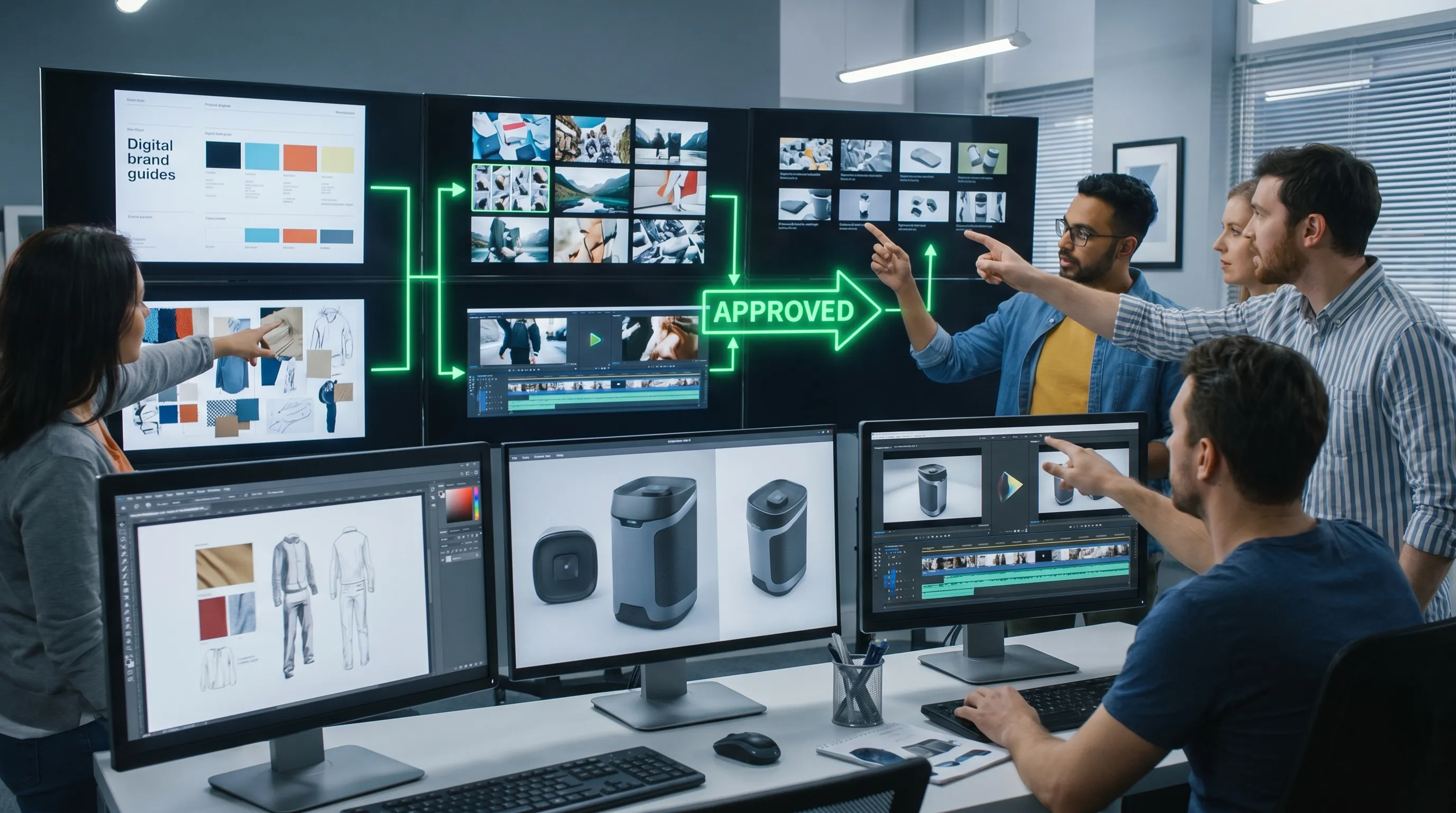
AI creative design has moved from isolated experimentation to production infrastructure. Marketing teams use image models for campaign concepts, studios generate product visuals, game teams explore 3D assets and environments, and content teams test video variations at speed. The opportunity is clear, but so is the risk: the more models you use, the easier it is for your brand to become inconsistent.
A model can generate a beautiful image and still miss the brand. A video can be technically impressive and still feel wrong. A 3D prop can match the brief but fail the worldbuilding rules. This is the central challenge for enterprise creative teams: how do you scale AI output without diluting brand DNA?
The answer is not simply “write better prompts.” Prompting matters, but brand consistency across models requires an operating model: shared context, reusable generation rules, governance controls, review workflows, and integrations with the creative stack your teams already use.
What brand DNA means in AI creative design
Brand DNA is the set of creative, strategic, and production rules that make a brand recognizable across every output. It includes obvious elements, such as logo usage and color palette, but also less visible signals: composition, pacing, material choices, humor, lighting, character attitude, camera language, and the level of polish expected before an asset is production-ready.
In traditional creative operations, brand DNA often lives across brand books, campaign decks, DAM folders, Figma files, game bibles, and the experience of senior creatives. In AI creative design, that knowledge must become operational. If the system cannot access, interpret, and enforce the brand’s creative context, every model becomes a potential source of drift.
| Brand DNA layer | What it includes | Why it matters for AI output |
|---|---|---|
| Strategic identity | Audience, positioning, values, tone | Guides what the asset should communicate, not just how it looks |
| Visual system | Colors, typography, layout, composition, lighting | Keeps images, videos, and 3D assets recognizable |
| Motion and interaction | Camera movement, pacing, transitions, animation behavior | Protects consistency in video, product demos, and game content |
| World and material rules | Environments, textures, props, characters, scale | Critical for 3D, games, virtual production, and product visualization |
| Quality standards | Resolution, fidelity, realism level, allowed artifacts | Defines what can move from exploration to production |
| Compliance rules | Usage rights, sensitive content limits, disclosure needs, regional constraints | Reduces legal, brand safety, and governance risk |
For CMOs, brand DNA protects trust and differentiation. For art directors, it protects creative coherence. For application managers, it creates a clear governance layer. For game developers, it keeps assets aligned with the world, style, and gameplay context.
Why brand consistency breaks across AI models
Different AI models do not “understand” your brand in the same way. Each model has different training data, strengths, limitations, defaults, and interpretation patterns. A prompt that works well in an image model may produce weak results in a video model. A 3D generation model may understand form but not brand-specific materials. A newer model version may improve fidelity while changing the look your team had standardized.
This is why brand drift often appears gradually. One team adjusts prompts for speed. Another uses an unapproved reference image. A regional studio modifies colors to fit a local campaign. A game team experiments with a different model for props. None of these actions is necessarily wrong, but without shared rules and traceability, the creative system becomes fragmented.
Common causes of AI brand drift include:
- Prompt drift: Teams rewrite prompts locally, which changes tone, style, and constraints over time.
- Context fragmentation: Brand references live in separate tools, folders, and teams, so models receive incomplete guidance.
- Model mismatch: A model is used for a task it is not suited for, such as high-fidelity product accuracy or style-locked character design.
- Version changes: A model update alters outputs, even when the same prompt is used.
- Weak approval workflows: AI outputs move into production before creative, legal, or brand stakeholders review them.
- Missing audit trails: Teams cannot easily see which prompt, model, reference, or approval path produced a final asset.
The fix is to stop treating AI generation as a one-off creative act and start treating it as a governed creative pipeline.
The operating model: separate intent, context, and execution
The most reliable AI creative design systems separate three layers: intent, context, and execution.
Intent is the creative goal. It answers: What are we making, for whom, in which channel, and what should it make people feel or do?
Context is the brand and production memory. It includes approved references, mood boards, product data, art direction, previous assets, worldbuilding rules, and compliance constraints.
Execution is how the system generates the asset. It includes model selection, prompt structure, generation settings, review workflow, output format, and integration into downstream tools.
When these layers are mixed together in ad hoc prompts, quality depends on individual operator skill. When they are managed as a system, teams can scale creative AI while preserving control.
Translate brand DNA into generation-ready rules
Most brand guidelines are written for humans. AI systems need rules that are explicit enough to guide generation and evaluation.
For example, “premium but playful” may be useful in a brand deck, but it is too vague as an AI control. A generation-ready version might define lighting, color contrast, camera angle, texture, facial expression, allowed environments, prohibited clichés, and examples of on-brand versus off-brand outputs.
A practical brand DNA rule set should include both positive and negative constraints. Positive constraints tell the system what to aim for. Negative constraints tell it what to avoid. This is especially important when working across multiple models, because each model may have different default aesthetics.
| Guideline type | Human-readable example | Generation-ready version |
|---|---|---|
| Tone | Confident and optimistic | Use direct language, active framing, no exaggerated hype, no fear-based messaging |
| Lighting | Warm and premium | Soft directional light, subtle shadows, controlled highlights, avoid neon glow unless campaign-specific |
| Composition | Product-led | Product remains the visual anchor, no background element should compete with the product silhouette |
| Character style | Aspirational but realistic | Natural poses, believable expressions, no exaggerated fashion editorial posture |
| 3D material | Durable and high-end | Brushed metal, clean bevels, realistic surface wear only when specified |
| Prohibited outputs | Off-brand clichés | Avoid generic futuristic blue gradients, random holograms, distorted logos, unreadable text |
The goal is not to remove creativity. It is to define the boundaries inside which creative exploration can happen safely.
Use generation blueprints instead of one-off prompts
A prompt is a request. A blueprint is a repeatable production pattern.
Generation blueprints are templates that encode creative intent, brand rules, model instructions, output requirements, and review steps for recurring use cases. Instead of asking each team to invent its own prompt, you define controlled patterns for the types of assets your organization creates most often.
For an enterprise marketing team, blueprints might cover campaign key visuals, product lifestyle images, social video variants, ecommerce imagery, or localized creative adaptations. For a game studio, they might cover environment concepts, NPC character exploration, prop ideation, texture studies, or cinematic mood frames.
The value of blueprints is consistency. Teams can still adapt the creative brief, but the underlying structure remains stable. This reduces prompt drift, speeds up onboarding, and makes outputs easier to compare across models.
A strong generation blueprint usually defines:
- The intended asset type and channel
- Required brand context and approved references
- Model or model family used for the task
- Prompt structure and locked language
- Adjustable creative fields, such as audience, product, scene, season, or region
- Output format requirements
- Review and approval stages
- Compliance checks before export
For application managers, blueprints also make AI easier to govern. Instead of monitoring thousands of isolated prompts, the organization can manage approved workflows.
Build a shared context memory
AI brand consistency depends heavily on context. If models do not have access to the right references, they will fall back to generic assumptions. That is when outputs start to look like “AI content” rather than brand content.
A shared context memory gives teams a central source of creative truth. It can include mood boards, approved assets, product references, material samples, character sheets, campaign visuals, art direction notes, rejected examples, and production constraints.
This is particularly valuable when multiple studios, regions, or departments work on the same brand. A CMO may care about global consistency. An art director may care about preserving nuance. A game developer may care about continuity across characters, props, environments, and cinematic sequences. Shared context memory helps all of them work from the same foundation.
Context memory should not be treated as a static archive. It needs curation. The best systems distinguish between approved references, experimental explorations, deprecated assets, and assets that are cleared for production use. Without that distinction, teams may unintentionally train their creative process on outdated or unapproved material.
Orchestrate models by role, not by novelty
The AI model landscape changes quickly. New models often bring better resolution, motion, 3D structure, speed, or style control. But the newest model is not always the right model for a brand-critical task.
Enterprises need a model orchestration strategy. Instead of allowing every team to choose tools independently, define which models are approved for which creative workflows, what risks they introduce, and what review steps are required.
| Model category | Common strength | Brand risk to manage | Governance question |
|---|---|---|---|
| Image generation | Concept art, campaign visuals, style exploration | Visual drift, inaccurate product details, text artifacts | Which references and approval gates are required? |
| Video generation | Motion exploration, storyboards, social variants | Inconsistent characters, unstable logos, unintended motion | What can be used for concepting versus final output? |
| 3D generation | Props, environments, early asset ideation | Scale issues, topology limits, material mismatch | What technical checks are required before pipeline use? |
| Audio generation | Voice, sound cues, music exploration | Tone mismatch, rights concerns, regional sensitivity | What usage rights and disclosure rules apply? |
| Multimodal systems | Cross-format ideation and transformation | Context loss between formats | How is intent preserved from image to video to 3D? |
This is where a Creative AI operating system becomes important. The challenge is not only generating assets, but orchestrating how different models contribute to the same creative intent.
Add governance without slowing down creativity
Governance is often misunderstood as a blocker. In AI creative design, good governance is what lets teams move faster with confidence.
The NIST AI Risk Management Framework emphasizes governance, mapping, measurement, and management as core AI risk functions. For enterprise creative teams, those ideas translate into practical questions: Who can use which models? What data and references can be used? Which outputs require review? What must be logged? What is allowed for internal ideation versus external publication?
Similarly, ISO/IEC 42001 provides a management system standard for organizations developing or using AI. It is not a creative guideline, but it reinforces an important enterprise principle: AI should be operated through defined policies, responsibilities, and controls.
For teams operating in or serving the European market, the EU AI Act also makes AI governance a board-level topic. Creative teams do not need to become legal teams, but they do need workflows that support transparency, accountability, and compliance.
Practical governance for creative AI should cover:
- Role-based access to models, workflows, and assets
- Approved use cases for ideation, production, localization, and publication
- Reference asset permissions and usage rights
- Required review stages for brand, creative, legal, and technical validation
- Logging of prompts, models, versions, inputs, and outputs
- Clear escalation paths for sensitive or high-risk content
The key is to embed governance into the workflow instead of forcing teams to manage it manually after the fact.
Keep humans in the loop where judgment matters
AI can generate variations quickly, but brand DNA depends on judgment. Senior creatives still need to decide whether an output feels right. Legal and compliance teams may need to review sensitive materials. Technical teams need to confirm whether an asset is usable in production.
Human review is most effective when it is structured. A vague “approve or reject” step does not create organizational learning. Review workflows should capture why an asset passed or failed. Was the composition off-brand? Was the product inaccurate? Did the generated video break character continuity? Did the 3D asset fail technical requirements?
Those annotations become valuable feedback for future blueprints and context memory. Over time, the organization builds not just a library of assets, but a library of creative decisions.
For art directors, this means less time repeating the same corrections. For CMOs, it means more consistent brand expression across channels. For application managers, it creates traceability. For game developers, it helps preserve style and lore across production sprints.
Integrate AI creative design into the production stack
AI creative tools cannot remain isolated if the goal is production at scale. Enterprise teams already rely on creative and operational systems: DCC tools, DAM platforms, PIM systems, review tools, project management software, and asset pipelines.
If AI outputs are generated outside those systems, teams waste time downloading, renaming, checking, re-uploading, and manually tracking assets. Worse, they lose context. A final image may be separated from its prompt, source references, model version, approval history, and usage restrictions.
For application managers, integration is one of the most important parts of the AI creative design strategy. The questions are practical:
- Can approved AI outputs flow into the right asset management system?
- Can product data and brand references inform generation workflows?
- Can teams connect AI generation to existing creative tools through plugins or APIs?
- Can permissions, review states, and usage rules travel with the asset?
- Can the organization track pipelines across image, video, audio, and 3D work?
When AI is integrated into the creative stack, it becomes part of the production system rather than a side experiment.
Measure brand consistency with operational signals
Brand consistency can feel subjective, but it can still be managed through clear signals. The goal is not to reduce creativity to a score. The goal is to understand whether your AI workflows are producing reliable, usable, and on-brand results.
| Signal | What it tells you | Who benefits |
|---|---|---|
| First-review approval rate | Whether outputs are close to brand expectations | Art directors and creative leads |
| Revision reasons | Which brand rules or production requirements are failing | Creative operations and governance teams |
| Blueprint reuse | Whether teams are adopting approved workflows | Application managers and studio leads |
| Model performance by use case | Which models work best for each asset type | AI operations and production teams |
| Time from brief to approved asset | Whether AI is improving production speed | CMOs and operations leaders |
| Compliance review outcomes | Whether outputs meet legal and policy requirements | Legal, compliance, and brand safety teams |
| Production readiness | Whether assets can move into DAM, DCC, PIM, or game pipelines | Technical artists and developers |
These metrics help leadership make better decisions. If a model produces beautiful concepts but fails approval 70% of the time, it may be useful for exploration but not production. If a blueprint consistently reduces revisions, it should become part of the standard workflow.
A role-based checklist for keeping brand DNA intact
Different stakeholders need different controls. A successful AI creative design program aligns business, creative, technical, and production needs.
| Role | Primary concern | What to define |
|---|---|---|
| CMO | Brand consistency, speed, governance, market adaptation | Brand-safe use cases, approval rules, regional adaptation boundaries, success metrics |
| Art Director | Creative quality, visual coherence, style control | Generation blueprints, mood boards, negative constraints, review criteria |
| Application Manager | Security, integration, compliance, lifecycle management | Access controls, approved models, logging, APIs, plugins, data residency requirements |
| Game Developer | World consistency, asset usability, pipeline fit | Style bibles, 3D requirements, technical validation, engine-ready handoff rules |
The important point is alignment. AI brand consistency is not owned by one team. It is a shared operating discipline.
How Virtuall helps teams keep brand DNA across models
The Creative AI OS is built for organizations that need to operate creative AI at scale, not just experiment with individual tools. As a Creative AI operating system, Virtuall helps teams control, orchestrate, and scale AI-powered content creation across image, video, audio, and 3D workflows.
For brand DNA, the value comes from connecting the pieces that are often separated: governance controls, workflow orchestration, generation blueprints, studio context memory, collaboration, approvals, asset management, pipeline tracking, and integrations with creative tools through plugins and API.
Nyx, Virtuall’s intelligence layer, orchestrates multiple industry-leading AI models while helping preserve intent and context across studios and teams. That matters because the creative goal is rarely tied to a single model. A campaign may start with image exploration, move into video adaptation, require 3D product assets, and then flow into review and asset management systems. Without orchestration, context gets lost at every handoff.
Virtuall also supports enterprise needs such as compliance, EU-based infrastructure and inference, and production-ready outputs. For teams that need to scale AI creative design responsibly, these controls are not optional. They are what make AI usable inside real studios, workflows, and organizations.
Frequently Asked Questions
What is AI creative design? AI creative design is the use of AI systems to support or generate creative outputs such as images, videos, 3D assets, audio, campaign concepts, and visual variations. In enterprise settings, it also includes the workflows, governance, and integrations needed to make those outputs usable at scale.
Why does brand DNA get lost across AI models? Brand DNA gets lost when models receive incomplete context, teams use inconsistent prompts, model versions change, or outputs move into production without structured review. Different models interpret the same instruction differently, so brand consistency requires shared rules and orchestration.
Are prompts enough to maintain brand consistency? Prompts help, but they are not enough for enterprise-scale work. Teams also need generation blueprints, approved references, context memory, model governance, review workflows, and asset tracking.
How can game studios use AI without breaking art direction? Game studios should define style bibles, worldbuilding rules, approved references, 3D requirements, and technical validation steps. AI can support concepting and asset exploration, but outputs should be reviewed for lore, style, scale, topology, materials, and production fit.
What should enterprises look for in an AI creative design platform? Enterprises should look for governance controls, workflow orchestration, multi-model generation, reusable templates, collaboration features, asset management, compliance support, and integrations with existing creative and production systems.
Scale AI creative design without losing control
Creative AI is most powerful when it amplifies your brand, not when it makes your work look generic. To keep brand DNA intact across models, teams need more than access to generation tools. They need an operating system for creative AI.
Virtuall helps studios and enterprise teams define the rules, preserve context, orchestrate models, manage approvals, and deliver consistent AI-powered content across image, video, audio, and 3D workflows.
If your organization is ready to move from AI experiments to governed creative production, explore how Virtuall can help you operate creative AI at scale.