Unlocking Creative Flow with Business Process Management BPM
Discover how business process management bpm transforms creative workflows. Learn to streamline projects, boost collaboration, and unlock your team's potential.

Picture this: your creative team, freed from the endless chase for approvals and feedback, fully immersed in what they do best—creating. That's the real power of Business Process Management (BPM). It’s a framework that might sound like it belongs in a corporate boardroom, but it's quickly becoming the secret weapon for innovative creative studios looking for a responsible, compliant, and safe way to scale their visual work.
Want to see how a compliant framework can unlock creativity? Try our Creative AI OS, VirtuallPRO. If you haven't generated anything already, you can try it for free to experience firsthand how a unified, secure platform can make even the most complex pipelines feel seamless and predictable.
In simple terms, BPM is all about looking at how visual creative work gets done—from the initial brief to the final delivery—and then finding smart ways to improve that flow.
Putting Process Behind Your Creative Passion

This guide is here to pull back the curtain on business process management for creative minds. Think of it less as a rigid set of rules and more as the art of designing workflows that are as intentional and elegant as your final product. We’ll show you how a little bit of organisation can turn administrative chaos into a clear path for pure creativity.
Why BPM Matters for Creatives Now
The creative world has changed. It's no longer enough to just have brilliant ideas; you need to deliver them efficiently, on time, and at scale. As your studio grows and projects get more complicated, just "winging it" with informal processes leads straight to bottlenecks, blown deadlines, and busted budgets.
Adopting a more structured approach isn't just a nice-to-have anymore—it's essential for survival and growth.
The numbers back this up. The global Business Process Management market was valued at USD 18.1 billion in 2025 and is projected to skyrocket to USD 40.9 billion by 2035, more than doubling in just a decade. This boom shows just how critical process management has become for every industry, creatives included. You can discover more insights about the BPM market growth in recent market analyses.
At its core, BPM for a creative studio is about creating a reliable system that supports, rather than restricts, the artistic process. It ensures the operational side of a project runs so smoothly that creators can focus entirely on their craft.
This move towards structured operations isn't about turning artists into accountants. It’s about giving them a clear, predictable environment where their creative energy is amplified, not drained by logistical headaches.
By thoughtfully implementing BPM, your studio can achieve:
- Greater predictability in project timelines and budgets.
- Improved consistency in the quality of your work.
- Enhanced collaboration between team members, departments, and clients.
- Increased capacity to take on bigger, more ambitious projects.
The Four Pillars of Creative Workflow Design
To really get what business process management is all about, let's ditch the corporate jargon. Think of it less as a rigid set of rules and more like a flexible blueprint for getting great results, every single time. It's built on four core ideas that, when you bring them into a creative space, inject some much-needed order into even the most chaotic visual projects.
These pillars are the bedrock of any well-run studio. They're what transform unpredictable, often stressful workflows into smooth, reliable pipelines. Once you understand them, you'll start spotting the friction points in your own operations and see a clear path to fixing them.
Pillar 1: Process Mapping
First up is Process Mapping. This is a lot like creating a detailed storyboard for your entire project lifecycle. You're visually laying out every single step, from the moment a client brief lands in your inbox to the final render and delivery. This isn't about boxing in creativity; it's about getting everyone on the same page.
You'll identify every task, every decision, and every handover. Who needs to sign off on the initial concept art? Where do 3D assets go after modelling? How does the client actually receive the final video for review? Mapping it all out has a funny way of revealing hidden bottlenecks and silly, redundant steps you never even realised were there.
Pillar 2: Process Modelling
Once you've got your map of how things currently work, you move on to Process Modelling. If mapping was the storyboard, modelling is like designing the perfect, most satisfying quest line in a video game. You take what you learned from your map and start designing an ideal, streamlined workflow where every task flows seamlessly into the next.
This is where you get to ask the big questions. Could we merge the concept review and initial feedback stages into one? What if we had a central asset library so artists stop accidentally using old versions? Modelling is your chance to architect a smarter way of working before you roll it out. You can learn more about optimising your studio’s operations with our detailed guide on creative workflow management software.
Pillar 3: Automation
The third pillar, Automation, is all about bringing in the robots—or at least, the digital equivalent. In a creative studio, this could be your render farm churning through frames overnight or a simple script that batch-resizes hundreds of images. It’s any tool or system that takes the mind-numbing grunt work off your artists' shoulders.
Automation frees up your most valuable resource—your team's creative energy. When artists aren't bogged down by administrative tasks like file conversions or manual uploads, they can dedicate their focus to innovation and quality.
Good automation is a huge part of modern business process management. It keeps things consistent, slashes the risk of human error, and can seriously speed up your project timelines.
Pillar 4: Monitoring
Finally, there’s Monitoring. This is your project dashboard, your mission control. It gives you a real-time, bird's-eye view of everything happening in the studio. It tracks progress against deadlines, keeps an eye on budgets, and measures the key metrics that actually matter.
Are we on schedule to deliver the final animations by Friday? Have we burned through the budget for AI-generated assets? Monitoring gives you data-driven answers, not just gut feelings. Without it, you’re flying blind. With it, you can make smart decisions, tackle problems before they escalate, and constantly tweak your processes for even better results. Understanding the right components is key to designing efficient workflows; explore various Tools For Creators that can serve as essential pillars in your studio's processes.
To bring it all together, here’s a quick look at how these four abstract concepts become concrete actions within a creative team, especially with a system like VirtuallPRO in place.
Core BPM Concepts for Creative Teams
| BPM Concept | Creative Studio Analogy | Key Activity | VirtuallPRO Application |
|---|---|---|---|
| Mapping | "Storyboarding the project" | Visually documenting every task, approval, and handover from brief to delivery. | Use the platform's workflow builder to create a visual template of your production pipeline. |
| Modelling | "Designing the perfect quest" | Analysing the map to find bottlenecks and designing a more efficient, ideal workflow. | Refine and test different workflow variations to optimise task sequencing and resource allocation. |
| Automation | "Hiring digital assistants" | Using tools to handle repetitive tasks like file conversions, notifications, or render jobs. | Set up automated triggers for task assignments, client notifications, and version control updates. |
| Monitoring | "The mission control dashboard" | Tracking real-time progress, budgets, and key metrics to make informed decisions. | Use built-in dashboards to monitor project status, track costs, and measure artist productivity. |
By translating these pillars into practical steps, you can start building a more organised, predictable, and ultimately more creative studio environment.
Real-World Wins from Smarter Process Management
Let's move past the theory. What does applying business process management (BPM) actually do for a creative studio? The truth is, it delivers real, measurable advantages that transform how you work. This isn't about micromanaging creativity; it's about building a solid foundation so your team can focus on what they do best. A well-managed workflow turns daily chaos into a predictable and productive rhythm.
The first thing you’ll notice is how much better everyone works together. Those messy email chains and confusing Slack threads get replaced with a single, clear source of truth. When everyone knows exactly where to find the latest asset, who’s handling the next step, and when feedback is due, teamwork finally feels smooth instead of stressful.
This structured approach naturally elevates the quality and consistency of your work. Whether your team is building a complex 3D character or rolling out a marketing campaign, having a standard way of working ensures every project hits the same high bar.
Speeding Up Delivery and Crushing Bottlenecks
One of the biggest payoffs from BPM is how it helps you get projects out the door faster. When you actually map out a workflow from start to finish, you start to see all the hidden hurdles that slow things down. Maybe it’s a single art director who has to approve everything, creating a massive logjam every Tuesday afternoon.
BPM gives you a clear map to spot these friction points and redesign the process to get rid of them. You might set up parallel approval paths or automate notifications so the next person in line gets a ping the second they can start their task. The result is a much faster turnaround, allowing your studio to take on more work without burning out the team.
Take a game development studio, for example. They might realise their asset pipeline always gets stuck during the texturing phase. With a BPM mindset, they could create a parallel review process. The concept artists could check for artistic style while the technical artists verify the mesh compatibility—at the same time. Just like that, review times could be cut in half.
Becoming More Agile and Keeping Clients Happy
A well-defined process also makes your studio much more agile. When unexpected client feedback lands in your inbox, you can adapt quickly because you already have a system for handling changes. Instead of scrambling to figure out who needs to do what, the workflow guides the revision process, ensuring every change is handled efficiently and nothing gets lost.
This kind of responsiveness is what builds a great client relationship. When clients see their feedback is actioned quickly and systematically, it builds incredible trust and proves you're a professional, reliable partner.
The biggest win from BPM is moving from a reactive, "fire-fighting" culture to a proactive, strategic one. It gives you the clarity to see problems coming, manage your team’s workload, and keep projects on track and on budget.
This newfound visibility allows you to make much smarter decisions. You can see at a glance who’s overloaded and who has bandwidth, which means you can distribute work more fairly and prevent burnout before it happens.
Raising the Bar for Quality and Consistency
At the end of the day, a structured process is your best defence against inconsistent quality. By standardising key creative and operational steps—from project kickoff to final delivery—you create a reliable baseline that every project benefits from. This is how you build a rock-solid brand reputation.
Think about these simple but powerful outcomes:
- Standardised Naming Conventions: A small change that completely eliminates the risk of someone working on an old version of an asset.
- Automated Quality Checks: Building in automatic checks for things like poly count or file resolution before an asset can even move to the next stage.
- Clear Feedback Loops: Creating a formal process for gathering and actioning feedback, so miscommunications vanish and every stakeholder’s notes are addressed.
Ultimately, business process management provides the structure your team needs to do their best work, every single time. It makes your entire creative operation more dependable, more profitable, and ready to grow.
Your Blueprint for Putting BPM into Practice
Alright, let's move from the 'what' and 'why' to the 'how'. Bringing business process management (BPM) into a creative studio isn't about enforcing some rigid corporate manual. Think of it less like a disruptive overhaul and more like a step-by-step journey toward a calmer, more efficient way of working.
The secret is to start small. Don't try to boil the ocean by changing everything at once—that’s a fast track to burnout and pushback. Instead, pick one significant pain point, solve it, and let that success build the momentum you need for bigger changes.
Stage 1: Diagnose Your Current Workflows
Before you can fix anything, you need to understand exactly how things get done right now. This first stage is all about honest observation. We're not looking to place blame; we're hunting for the hidden friction, the bottlenecks, and the mind-numbing repetitive tasks that are secretly draining your team's creative energy.
Your mission is to map out a single, specific workflow from start to finish. A great place to start might be the client feedback loop or the 3D asset pipeline.
- Talk to Your Team: Grab a coffee with the artists, producers, and managers on the front lines. Ask them what drives them crazy. Where do they always get stuck waiting? What tasks feel like a complete waste of their talent?
- Follow the Work: Pick a single project or asset and trace its journey. Document every single handover, every tool switch, and every Slack message, email, or hallway conversation involved.
- Spot the Patterns: Do approvals always seem to land on one person's desk and die? Are artists constantly redoing work because of a casual comment that got lost? These patterns are gold—they're your starting point.
Stage 2: Design a Smarter Process
Once you have a clear picture of the problem, you can start designing a better path forward. The goal isn't to create a bureaucratic maze of rules. It's about architecting a simpler, more logical flow that actually empowers your team to do their best work.
The most effective process designs come from the ground up, not the top down. When you involve your creative team in building the solution, you’re not just getting their buy-in; you’re ensuring the new workflow is practical enough to survive in the real world.
Your new process model should directly attack the friction you found. For example, if feedback is a chaotic mess of emails and screenshots, your new design might centre on a single platform for all comments and markups. If version control is a nightmare of _final_v2_final_FINAL.psd files, the new process will define a rock-solid naming convention and a single source of truth for every asset. The aim is a clean, intuitive flow that everyone can get behind.
Stage 3: Pick the Right Tools for the Job
A brilliant process on paper is useless without the right tools to make it real. For any modern creative studio, a central platform isn't just a nice-to-have; it's the engine that powers your entire BPM strategy. The right tech should make your team’s life easier, not add another layer of complexity.
This is where a Creative OS like VirtuallPRO becomes the backbone of your operation. It's built to be the central nervous system for your studio, providing the infrastructure to support these new, smarter workflows.
Look for a platform that delivers on these key fronts:
- Unified Asset Management: One secure library for all project files, so nobody ever has to ask, "Is this the latest version?"
- Collaborative Workspaces: Tools that let your team give and get feedback in real-time, right on the creative work itself.
- Workflow Automation: The ability to put repetitive tasks—like notifications, approvals, and file conversions—on autopilot.
- Centralised Governance: Features to manage budgets, control who sees what, and keep everything compliant without creating headaches.
Stage 4: Execute, Test, and Tweak
Now for the fun part: rolling it out. Start with a pilot project or a small, dedicated team to test the new workflow in a live environment. This is your chance to gather feedback and smooth out the kinks before deploying it across the entire studio.
Remember, execution isn't a "set it and forget it" activity. Business process management is a continuous loop of improvement.
- Execute: Launch the new workflow with your pilot team. Give them clear training and be on standby to support them.
- Test & Monitor: Keep an eye on your key metrics. Are projects moving faster? Are you seeing less rework? Most importantly, talk to the team and get their honest feedback.
- Tweak: Use the data and the feedback to make smart adjustments. Refine the process based on what you’ve learned.
By embracing this iterative cycle, you ensure your BPM efforts deliver real, measurable results, making your studio more agile, efficient, and, ultimately, more creative.
How VirtuallPRO Centralises Your Creative Operations
Bringing business process management (BPM) principles to life requires more than just a blueprint; you need a powerful engine to drive it. This is where the theory gets real, and VirtuallPRO is engineered from the ground up to be that engine for your creative studio. It’s designed to be the central nervous system of your operations, turning BPM concepts into practical, everyday tools your team can actually use.
Forget juggling scattered assets, chaotic email chains, and a patchwork of disconnected software. Our platform gives you a single, secure environment to manage every single stage of the creative lifecycle. VirtuallPRO isn't just another tool in your stack—it's the Creative OS that connects everything, ensuring your workflows are as organised and compliant as they are creative.
A Single Source of Truth for Every Asset
One of the biggest headaches in any creative project is version control. We’ve all seen files named character_model_final_v3_approved.fbx, and we all know the confusion and costly rework they cause. VirtuallPRO tackles this head-on with unified asset management, creating one authoritative source for every 3D model, texture, and video.
This centralised library means your artists always work with the correct file. No more ambiguity, no more risk. It's a foundational piece of responsible process management, giving you the secure, auditable asset control that big-league projects demand. You can see how this benefits marketing teams in particular in our guide to marketing asset management software.
Dismantling Silos with Collaborative Workspaces
Great creative work lives and dies by collaboration, but it often breaks down in the gaps between departments and tools. Our platform’s collaborative workspaces are designed to tear down those communication silos. Teams can review, annotate, and approve work directly on visual assets, all in real time.
This direct line of communication speeds up feedback loops and gets everyone—from the art director to the client—on the same page. By keeping every conversation tied directly to the work itself, VirtuallPRO fosters a transparent and efficient environment where brilliant ideas can thrive without getting lost in translation.
Automating Workflows and Governing Resources
A huge part of BPM is putting repetitive, time-sucking tasks on autopilot. VirtuallPRO’s workflow automation handles everything from routing assets for approval to deploying AI prompt blueprints for consistently high-quality generation. This frees your artists from administrative grunt work so they can focus purely on being creative.
The infographic below shows the simple, four-step journey of bringing a BPM strategy to life, moving from initial diagnosis to successful execution.
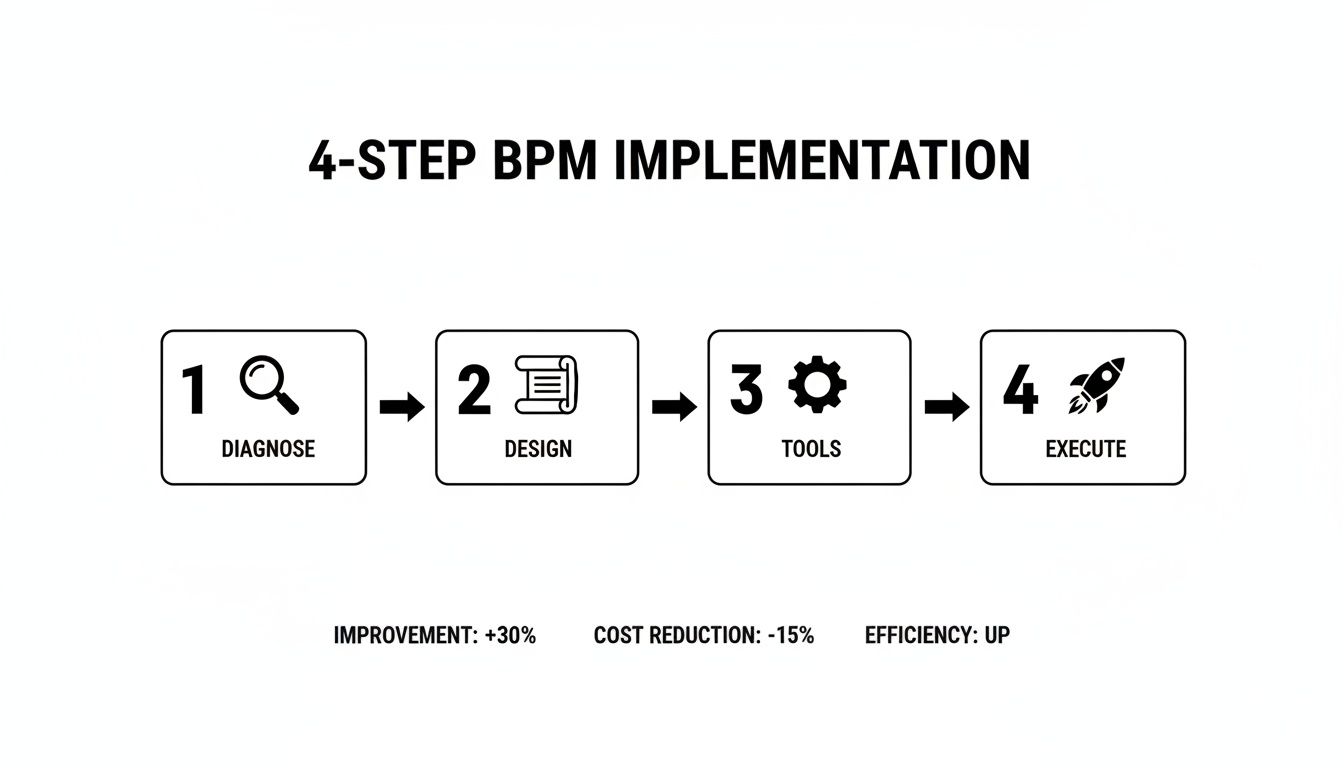
As this visual guide highlights, successful implementation isn’t a one-and-done setup; it's a cycle of continuous improvement. On top of that, our unified AI token system provides robust governance over your most innovative—and potentially expensive—processes.
By centralising AI generation and budget control, VirtuallPRO ensures your studio can experiment and innovate responsibly. You maintain complete oversight of costs and usage, fulfilling the enterprise need for security, compliance, and predictable spending.
This level of control is more important than ever. In Denmark, a mature market for BPM, small and medium-sized enterprises rely on integrated management solutions to boost efficiency. The nation's labour productivity stands at an impressive 140% of the EU average, which shows just how much impact a platform that streamlines workflows and maintains strong governance can have. VirtuallPRO provides exactly this kind of secure, compliant infrastructure, making scalable creative production a reality.
Avoiding Common Pitfalls in Creative Process Adoption
Bringing change to a creative studio is a delicate art. Even the most perfectly planned business process management (BPM) strategy will fall flat if it clashes with the very culture it’s supposed to help. The road to a more organised, efficient studio is often paved with predictable hurdles, but how you navigate them is what separates frustration from genuine progress.
The biggest challenge, almost without fail, is resistance from the artists themselves. Creatives hear the word “process” and immediately picture a corporate straitjacket designed to kill spontaneity. This is why framing BPM as a tool for empowerment, not control, is absolutely essential. The point isn’t to micromanage every brushstroke or keystroke; it’s to get rid of the administrative grind—the endless searching for files or chasing down approvals—that saps creative energy.
Overcoming Resistance and Fear of Rigidity
To get your team on board, you have to show them how the right kind of structure actually creates more freedom, not less. Demonstrate that a clear workflow means less time wasted on boring, non-creative work and more time for what they actually love doing: dreaming up ideas and bringing them to life. A successful BPM adoption builds guardrails, not cages.
The best BPM initiatives in creative environments are the ones that fiercely protect the team's focus. They tame the operational chaos so artists can lose themselves in their craft without constant interruption.
Start by pulling your team into the design process from day one. When artists have a hand in building the new workflows, they see for themselves that the goal is to solve their biggest headaches, not just to impose rules from on high. This collaborative spirit builds a sense of ownership and can turn even the biggest sceptics into your strongest supporters.
Avoiding Over-Engineering and Complicated Tech
Another classic mistake is over-engineering. It’s tempting to map out every conceivable step, but you can easily end up with a process so complex that it’s more of a burden than the mess it was meant to fix. A workflow drowning in approval gates and notifications will simply be ignored. The trick is to keep it lean, focusing only on the critical touchpoints that deliver real value.
The same logic applies to your tech stack. The right tools should feel invisible, making daily tasks easier without adding another layer of complexity. If a platform is clunky, your team will find workarounds, and your whole BPM initiative will fall apart. The technology needs to just work, supporting the flow without being a source of frustration. At Virtuall, we're dedicated to being that partner for creative teams, offering an intuitive OS that respects and enhances their unique way of working.
Getting everyone on the same page requires a smart change management strategy that tackles these concerns head-on.
- Explain the ‘Why’: Don’t just talk about the process; talk about the problems it solves. Frame it in terms your team cares about, like less rework, faster feedback, or more time for deep work.
- Start Small: Pick a single pilot project to test the new process. This lets you prove the value and iron out the kinks in a low-stakes environment before rolling it out studio-wide.
- Train People Properly: Make sure everyone feels confident using any new tools. A little hands-on training goes a long way in preventing frustration and building momentum.
- Listen and Adapt: Create a clear channel for feedback. Listen to what’s working and what isn’t, and be willing to make adjustments. Unscheduled work often throws a spanner in the works, and you can learn more by understanding the challenges of handling ad-hoc tasks.
By anticipating these pitfalls and leading with empathy, you can introduce process management in a way that doesn’t just work—it amplifies the creative power of your entire studio.
Frequently Asked Questions About Business Process Management
When you mention "process management" to a room full of creatives, you can sometimes feel the air get sucked out. I get it. The idea can bring up images of rigid, corporate structures that seem completely at odds with the free-flowing nature of creative work.
But let's clear the air. This isn't about putting creativity in a box. It’s about building a stronger box to hold all the administrative chaos, so your artists have the freedom to think outside of it. Here are some of the most common questions and concerns I hear from studio owners.
Will BPM Make Our Creative Process Too Rigid?
This is, without a doubt, the number one fear. And it’s a valid one. But the short answer is no, not if it's done right.
Think of BPM in a creative studio as the stage crew for a band. A good crew handles the lighting, sound checks, and instrument tuning so the musicians can walk on stage and just play. BPM is your studio’s stage crew. It standardises the boring stuff—like file naming conventions, version control, and client approval rounds—that drains creative energy.
By taking care of that operational background noise, BPM actually gives your team more mental space to focus on what they do best: concepting, designing, and bringing incredible ideas to life. It creates a stable foundation, so your artists can take bigger creative leaps without worrying about the net.
Is BPM Only for Large Studios and Enterprises?
Not at all. In fact, you could argue it’s even more critical for smaller teams. When you’re a small studio or a tight-knit group of freelancers, every hour counts. You don't have the luxury of a big administrative team to chase down files or untangle confusing client feedback.
For smaller outfits, efficiency is survival. Implementing even basic BPM principles can mean the difference between hitting a deadline comfortably and pulling an all-nighter. It helps you manage projects like a pro, handle feedback loops without losing your mind, and scale up without the wheels falling off. Tools like a Creative OS make these powerful ideas accessible to everyone, not just the big players.
The core idea of BPM is scalable. It’s about finding the friction in how you work and smoothing it out, whether you're a team of three or three hundred. It’s a mindset of continuous improvement that benefits everyone.
This mindset helps you build solid foundations. That way, when your studio does start to grow, your workflows can handle the pressure, preventing the chaos that often torpedoes promising teams.
How Do We Start BPM Without a Huge Budget?
You don’t have to boil the ocean. Forget about a massive, expensive overhaul that disrupts everything at once.
The best way to start is small. Pick your single biggest headache. Is it the endless back-and-forth on client approvals? Or maybe it’s the nightmare of tracking asset versions when three different artists are touching the same file. Whatever it is, start there.
Just map out that one process. Get it on a whiteboard and find the obvious bottlenecks. Then, look for a simple tool to help. A platform like Virtuall is designed for this kind of gradual adoption. You can begin by simply using it as a central hub for your assets and then, once your team is comfortable, start layering in automated approval workflows. The key is iterative improvement, not a sudden revolution.
Ready to build a more organised and efficient creative operation? With Virtuall, you can implement powerful business process management principles tailored for creative teams. Centralise assets, automate workflows, and empower your artists to do their best work. Explore the platform and start optimising your studio today at https://virtuall.pro.