The Ultimate Non Disclosure Agreement Guide for Creative Teams
Protect your creative work with a rock-solid non disclosure agreement. This guide covers key clauses, common pitfalls, and best practices for creative teams.
Before you send that killer game concept or the new client mock-ups over, let’s hit pause for a second. We need to talk about protection. A non-disclosure agreement (NDA) is your first, best line of defence. It’s a legal contract that basically says, "What we discuss here, stays here." It's the handshake agreement put down on paper, creating a circle of trust around your sensitive information.
At Virtuall, we understand that protecting your intellectual property is fundamental to responsible and compliant creative operations. This guide is designed to help you build a secure foundation for your visual creative work. To see how a secure environment can transform your workflow, you can explore the Creative AI OS and try it for free to generate your first secure assets.
Why an NDA Is Your Creative Team's Best Friend
In the creative industries, ideas are your most valuable currency. That brilliant flash of inspiration for a new video game, a one-of-a-kind 3D model, or that secret-sauce design process you've perfected—these are your crown jewels. A non-disclosure agreement is the formal promise that keeps them safe from being leaked, stolen, or used without permission. It lays down a secure, compliant foundation for collaboration, whether you're working with clients, bringing on freelancers, or partnering with other studios.
Think about it like this: your NDA sets the legal rules, and your creative platform should be built to enforce them. A system like VirtuallPRO, the Creative AI OS, is designed from the ground up for secure creation and collaboration. Its built-in governance features back up the promises made in your non-disclosure agreement right from the start, ensuring you operate as a safe and responsible enterprise.
The Nightmare Scenario: What a Leak Really Costs
Imagine this. You’ve poured months into a stunning new character design. It’s unique, it’s fresh, it’s yours. Then, you see a suspiciously similar concept pop up in a competitor's project before you've even had a chance to announce it. Your heart sinks. Without a non-disclosure agreement, your options for recourse are complex and expensive. The agreement gives you a clear, enforceable path to protect what you’ve built.
A non-disclosure agreement isn't just another document to sign. It’s a powerful signal to everyone involved that the information being shared is valuable, private, and needs to be handled with serious care. It establishes a professional and secure tone for the entire project.
Building a Fortress Mentality
Integrating NDAs into your standard process does more than just protect individual projects. It helps build a culture of security and respect for intellectual property across your entire team. When every single person—from the junior animator to the senior client—signs a non-disclosure agreement, it drives home the message that confidentiality is non-negotiable. It becomes as routine as using strong passwords or encrypted messaging.
This is where your tools and your legal agreements must work in concert. You need a technical setup that supports the promises you're making on paper. This is precisely why tools that govern creative workflows are so critical. To get a better handle on this, you can learn more about how creative workflow management software provides the technical backbone for the legal promises made in an NDA.
Take a look at how a platform like VirtuallPRO provides the kind of security features you need to actually live up to the terms of your NDA within your workspace.
This visual is a great example of how you can set up detailed access controls and permissions for each project. It ensures collaborators only see the specific assets they’re supposed to see, and nothing more. Features like these are what turn the legal jargon of your non-disclosure agreement into real, practical security measures that protect your creative work every single day.
Understanding the Anatomy of a Strong NDA
A non-disclosure agreement is much more than a box-ticking exercise; it’s a framework for trust built on paper. To properly protect your creative work, you need to get under the hood and understand what gives the document its power. When you can translate the dense legal language into practical concepts, you start to see how each clause works to safeguard your ideas.
Thinking about an NDA this way turns it from a simple signature request into a strategic tool. Each section is there to draw clear lines in the sand for your professional relationships, making sure everyone is playing by the same rules before a single confidential file changes hands. A properly built agreement leaves no grey areas, which is your best defence against messy disputes down the road.
Defining What Is Confidential
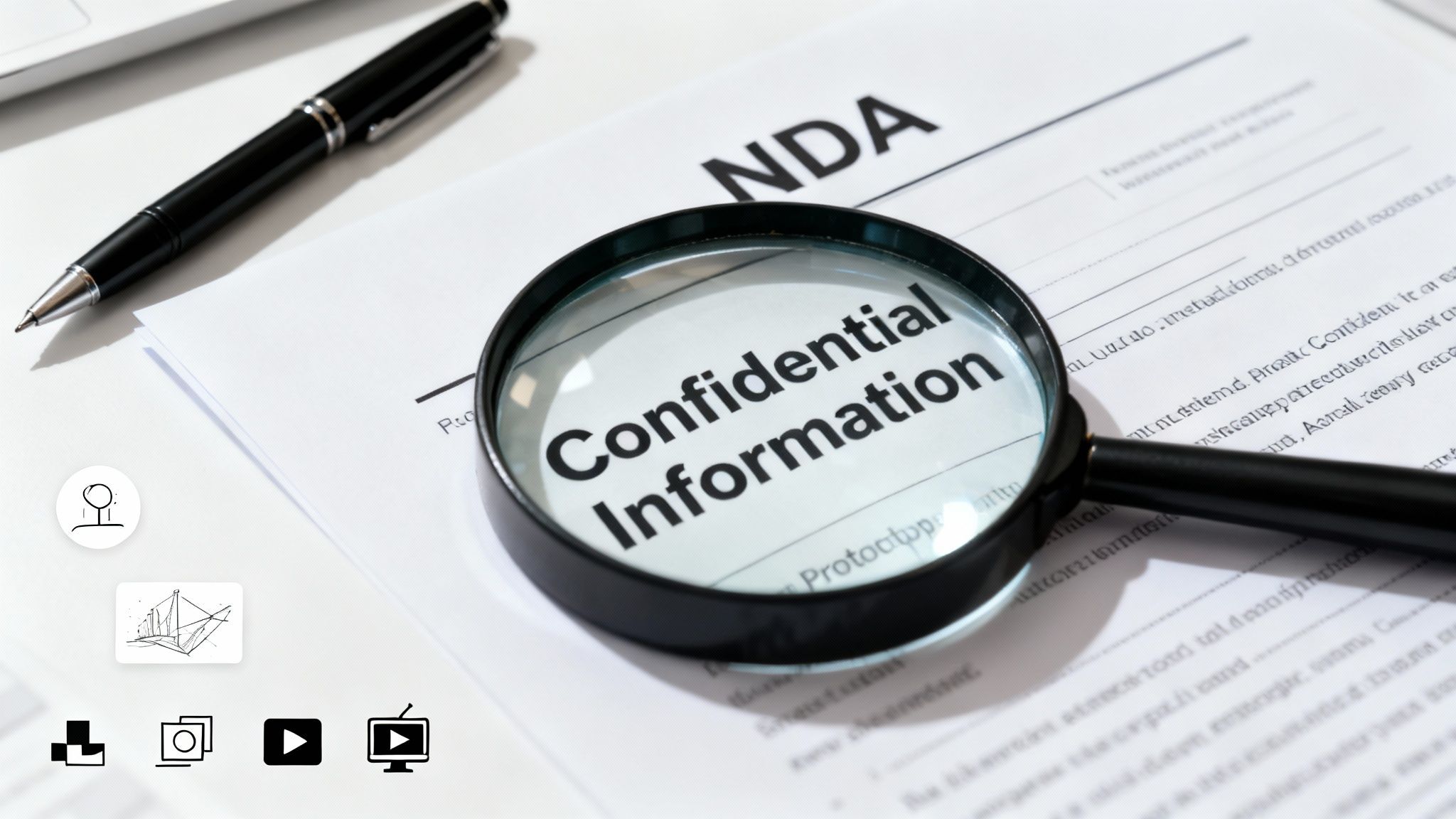
The absolute heart of any NDA is the clause that defines "Confidential Information." Vague, boilerplate definitions are a massive red flag. For creative teams, this section has to be customised to reflect the specific kinds of visual assets you’re actually creating and sharing.
Don’t just settle for generic terms like "trade secrets" or "business plans." Your definition needs to explicitly name the creative work that’s core to your projects.
- Visual Assets: Think concept art, character sketches, 3D models, textures, and storyboards.
- Prototypes and Builds: This includes early game builds, interactive mock-ups, and any alpha or beta software versions.
- Source Files: Uncompiled code, raw video footage, layered design files (like PSDs), and project files from your creative software.
- Project Documentation: Creative briefs, tech specs, marketing strategies, and even sensitive client feedback.
Getting this specific leaves no room for interpretation. If you hand a freelance animator a character model sheet under a non-disclosure agreement, this clause makes it absolutely clear that the sheet itself—and anything created from it—is protected.
One-Way Versus Mutual Agreements
Not all collaborations are built the same, and your NDA needs to reflect that reality. The structure of the agreement hinges on which way the information is flowing. Figuring out the difference between a one-way and a mutual NDA is key to picking the right tool for the job.
A one-way (or unilateral) NDA is your go-to when only one party is sharing secrets. This is the typical setup when you hire a contractor or pitch an idea to a potential investor. You are the one protecting your IP, and they are the ones agreeing not to disclose the information.
On the flip side, a mutual NDA is for true partnerships where both sides are bringing confidential information to the table. Picture two game studios co-developing a new title. They’ll both be sharing proprietary code, art assets, and strategic plans, so the agreement has to protect everyone equally.
The choice between a one-way and mutual non-disclosure agreement really sets the tone for the relationship. It clarifies who’s holding the secrets and who’s bound to protect them, making sure the legal framework matches the reality of your project’s workflow.
Scope, Duration, and the Legal Landscape
Finally, any solid NDA must clearly define its scope and duration. The scope outlines the exact purpose for which the confidential information can be used. For instance, it might state that a 3D model can only be used for a specific client project and absolutely nothing else.
The duration sets the expiration date on the confidentiality obligation. This is usually a fixed term, like 3-5 years, but for genuine trade secrets, it could be indefinite. The trick is to keep the duration reasonable, as courts can be sceptical of terms that seem excessively long.
While you're focused on non-disclosure, it's also smart to keep an eye on related legal shifts. For example, being aware of developments like the nationwide ban on noncompete agreements can provide context on how companies are approaching the broader protection of their IP. These legal trends underscore why it’s so important to craft agreements that are not just strong, but also fully compliant with current regulations, ensuring they’ll actually hold up when it counts.
Navigating Danish Data Protection and NDA Compliance
When your creative projects cross borders, you're not just dealing with different time zones; you're stepping into entirely new legal territories. This is especially true when you're collaborating with Danish partners or clients. In Denmark, protecting intellectual property and sensitive data isn't just a good idea—it's the law, and a standard-issue non disclosure agreement often won't cut it.
The focus shifts dramatically from a simple promise of confidentiality to a much broader framework of data protection. Denmark has a deeply ingrained commitment to privacy, which fundamentally changes how your NDAs need to be built. Get this wrong, and you could be exposing your studio to some serious risks.
The GDPR Is Just the Beginning
Denmark's privacy laws are built on the foundation of the EU's General Data Protection Regulation (GDPR). But they don't just stop there. The country’s own Danish Data Protection Act takes the principles of GDPR and reinforces them, creating a seriously robust framework that demands your full attention.
What does this mean for your visual creative work? Imagine your team is building an augmented reality app for a Copenhagen-based client, and that app collects user data. Under Danish law, that data is heavily protected. Your non disclosure agreement suddenly needs to do more than just shield the app's source code; it must spell out exactly how your team will handle that user data in a fully compliant way.
Trying to navigate this without a solid plan for regulatory compliance risk management is like sailing in a storm without a map. It's easy to miss a critical detail that could leave your agreements full of holes.
Explicit Consent Is Everything
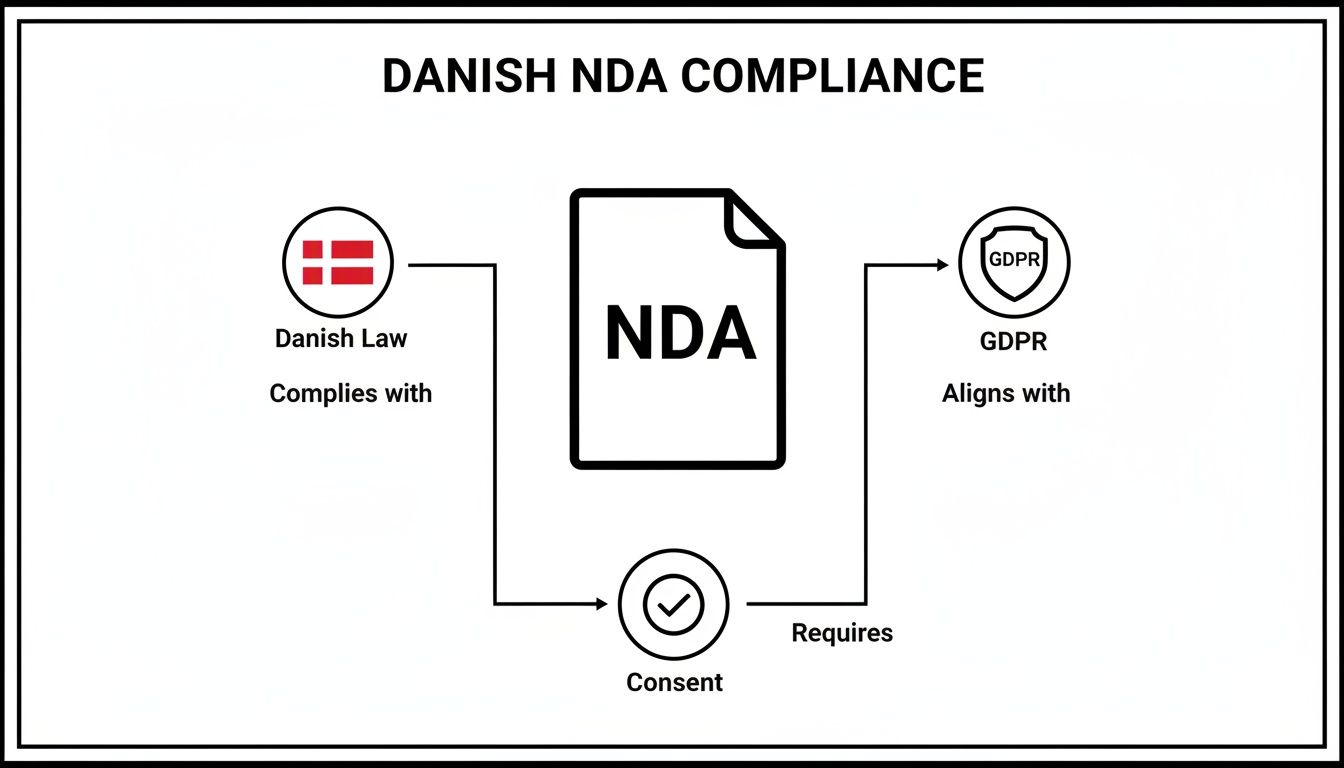
In Danish data law, "implied consent" isn't a thing. You need clear, explicit, and unambiguous permission to handle someone's confidential or personal data. Your NDA should be the very tool that formalises this consent, serving as proof that everyone involved understands and agrees on how information will be used, stored, and protected.
According to Act No. 502, which brings GDPR into Danish law, private companies must get explicit consent before processing any sensitive information. This means your NDA needs to lay out the legitimate reasons for handling the data and include specific mechanisms for getting that consent. This is a crucial detail, especially for teams using collaborative platforms to manage project files.
In Denmark, compliance isn't a suggestion—it's a mandate. The penalties for getting it wrong are steep, with potential fines climbing as high as €20 million or 4% of your company’s annual global turnover, whichever is higher. Suddenly, a well-crafted, compliant NDA feels less like an expense and more like an essential investment.
Practical Steps for Danish Compliance
To make sure your NDAs are up to snuff when working in Denmark, you need to align your legal documents with your everyday operations. This is where a secure, centralised platform really proves its worth. Having a system with strong governance features helps you turn the promises you make in your NDA into concrete actions.
Here’s what that looks like in practice:
- Be Specific About Data Handling: Your NDA should clearly state how and where data will be stored, who gets to see it, and what happens to it when the project is over.
- Integrate Consent into Onboarding: Make signing a compliant NDA a non-negotiable step in your onboarding process for any Danish client, contractor, or partner.
- Use Tech That Backs You Up: Your workflow tools have to support your legal commitments. Look for platforms that offer granular access controls and secure data storage. Managing your assets through a secure cloud as a service model can give you the infrastructure needed to meet these demanding standards.
Think of your non disclosure agreement not as a static legal document, but as a dynamic tool for compliance. With that mindset, you can collaborate with partners in Denmark confidently, knowing your creative work is both groundbreaking and secure.
Putting Your NDA into Practice with Virtuall
A signed non-disclosure agreement is your legal shield, but its true strength is tested in your day-to-day creative operations. A document filed away in a folder has never, on its own, stopped a leak. To genuinely protect your intellectual property, you need to bridge the gap between your legal paperwork and your team's actual workflow. This is about building a culture of confidentiality, not just signing a contract.
This is exactly where your legal agreements and a platform like VirtuallPRO shake hands. The platform gives you the practical tools to turn those promises on paper into real, automated controls. Suddenly, the clauses in your non-disclosure agreement aren't just legal jargon; they're tangible rules that shape how your team handles sensitive creative assets every single day.
Establishing Granular Access Controls
One of the most straightforward ways to enforce an NDA is simply by controlling who sees what. Your agreement probably has a "need-to-know" clause, and VirtuallPRO lets you put that principle into practice with surgical precision. Imagine setting up a shared workspace where your freelance 3D artist can only see the character models they’re working on.
That’s it. No accidental peeks at concept art for an unannounced project or confidential client notes from a different campaign. These controls aren't just a fancy security feature; they're the direct, technical enforcement of your NDA’s most important job.
You can slice and dice permissions however you need to:
- Project-Level Access: Give a team member the keys to an entire project folder.
- File-Level Permissions: Restrict access to individual files. Maybe they can see the final video render, but the source files remain locked down.
- Role-Based Controls: Assign roles like 'Viewer' or 'Editor' to contractors, preventing them from downloading or changing anything.
Leveraging Version History and Audit Trails
If things ever go sideways and a dispute arises, proving who breached your non-disclosure agreement comes down to one thing: evidence. Who touched the file? When? And what did they do with it? VirtuallPRO’s version history and audit trails create a clear, unchangeable record of every single interaction.
Think of it as your project's digital detective. It logs every view, download, edit, and comment, giving you a timestamped chain of custody for your most valuable visual assets. In the worst-case scenario of a leak, this audit trail provides the hard evidence needed to show a specific person accessed the confidential info, giving your legal position some serious teeth.
A strong NDA backed by a detailed audit trail is a powerful combination. It not only helps you prove a breach after the fact but also acts as a significant deterrent against unauthorised disclosure in the first place.
This idea of meticulously logging and monitoring access is a cornerstone of serious data protection, especially in places with tight compliance laws. Take Statistics Denmark, for example. Their model requires that every external user is explicitly approved, all personally identifiable data is anonymised, and compliance is continuously logged. You can see how these Danish non-disclosure requirements are put into practice and why they set such a high bar for data security.
Aligning Technical and Legal Frameworks
The whole point is to create a secure ecosystem where your legal agreements and your creative platform are perfectly in sync. The tools inside VirtuallPRO are built to make that happen, turning NDA compliance into a seamless, almost invisible part of your creative process. You’re no longer just hoping people follow the rules; you’re actively engineering your workflow to make it easy.
This synergy is absolutely crucial for creative solutions that rely on collaboration between distributed teams, where keeping a tight grip on IP is everything. When your platform’s security features directly reflect the duties outlined in your non-disclosure agreement, you build a secure, defensible, and trustworthy space to do your best work—from the first spark of an idea to the final delivery.
Common NDA Pitfalls and Red Flags to Avoid
Not all NDAs are created equal. In fact, signing a poorly written or overly aggressive agreement can be just as dangerous as not having one at all. Think of this section as your field guide for spotting the trouble spots before you ever sign on the dotted line.
A bad clause can do more than just cause a legal headache down the road. It can stop you from growing your business, prevent you from showcasing your best visual work, and even leave your most valuable creative assets surprisingly exposed. Learning to review a non-disclosure agreement with a critical eye is one of the most important things you can do to protect your studio.
Vague Definitions of Confidentiality
The single biggest trap in NDAs is a fuzzy, ill-defined scope of what actually counts as "Confidential Information." When an agreement throws around generic terms like "business information" or "proprietary data" without getting into specifics, it creates a massive grey area just waiting to be exploited. For creative teams, this is a huge risk.
Your NDA has to explicitly name the kinds of visual assets you deal with every day. If it doesn’t list things like 3D models, source files, concept art, character designs, or client feedback, then those assets might not be legally protected. Always, always push for a definition that’s tailored to your studio's specific output.
An NDA with a vague confidentiality clause is like a fortress with an unguarded gate. It gives the illusion of security while leaving your most critical assets exposed. The goal is to eliminate ambiguity so everyone knows exactly what is and isn't protected.
Unreasonable Durations and Scope
Another major red flag is an agreement that tries to lock down information for way too long. While a few genuine trade secrets might need protection forever, most project-specific details don't. A clause demanding confidentiality for 10 years or more on routine project info is usually a sign of overreach.
Courts often find these excessively long terms unreasonable, which can end up voiding that part of the agreement completely. For most creative projects, a much more standard and defensible timeframe is between 3 to 5 years.
On a similar note, watch out for clauses that are too broad in what they restrict. A non disclosure agreement should never be a non-compete agreement in disguise. If the language seems designed to stop you from working in your field or with certain types of clients, that's a massive problem that needs to be negotiated immediately.
One-Sided and Restrictive Clauses
Finally, be on high alert for agreements that are completely one-sided. These are often stuffed with clauses that unfairly tie a freelancer's or studio's hands long after a project is finished. One of the most common issues for creatives is a clause that forbids you from ever showing the work in your portfolio—even after it's been launched to the public.
It’s fair for a client to protect their launch plans, but a reasonable agreement should absolutely allow for portfolio use after an embargo period.
Before you sign anything, it pays to have a mental checklist of these common traps. Here's a quick rundown to help you spot potentially unfair clauses in any non disclosure agreement that comes your way.
NDA Red Flag Checklist for Creative Professionals
This checklist is designed to help you quickly identify potentially problematic clauses in a non disclosure agreement before you commit.
| Red Flag Clause | Why It's a Risk | What to Negotiate For |
|---|---|---|
| Overly Broad Confidentiality | Fails to protect specific creative assets like 3D models or source files, leaving your core IP vulnerable. | A tailored definition that explicitly lists the types of visual and technical assets unique to your work. |
| Excessively Long Duration | Courts may find terms of 7-10+ years unreasonable, potentially rendering the clause unenforceable. | A clear and reasonable time frame, typically 3-5 years, that matches the project's sensitivity. |
| Portfolio Restrictions | Prevents you from showcasing your work to attract new clients, stunting your business growth. | A clause that permits portfolio use after the project is public or after a specific embargo period. |
| Vague "Return of Information" | Lacks clear instructions on how to delete or destroy confidential data, creating future liability risks. | Specific instructions for deleting data from all systems, including backups, and a process for certifying deletion. |
By carefully reviewing every non disclosure agreement for these common pitfalls, you can ask the right questions, push back on unfair terms, and sign agreements that truly protect your creative business. It’s about being a partner, not just a vendor.
How to Respond When Your NDA Is Breached
That sinking feeling in your stomach when you suspect a non disclosure agreement has been breached is unmistakable. But the worst thing you can do is panic. A cool head and a clear plan are your best assets for containing the fallout and protecting your rights.
The moments right after you discover a potential leak are absolutely critical. Your first move should be swift but quiet. The goal is to verify the breach and figure out how bad it is before the other party knows you're onto them—the last thing you want is for them to start covering their tracks.
Gathering Your Evidence
Before you even think about picking up the phone to call a lawyer, you need proof. Hard proof. A hunch or a rumour won't cut it in a legal dispute. You need a clear, documented trail that ties the leaked information directly back to a specific person or company.
This is where a secure platform like VirtuallPRO goes from being a great collaboration tool to your most important investigative asset.
The audit logs and version histories inside VirtuallPRO are your smoking gun. They create an unchangeable record of every single interaction with your visual creative files. You can pinpoint exactly who viewed that top-secret 3D model, who downloaded the new character designs, and the precise time it happened. This digital paper trail is exactly what your legal team needs to build a rock-solid case.
Start compiling a secure dossier with everything you can find:
- Screenshots or links showing the leaked information out in the wild.
- The original, signed non disclosure agreement with the person you suspect.
- Detailed access logs and audit trails pulled directly from your asset management system.
- Any emails, messages, or other communications you have about the confidential project.
Taking Formal Legal Steps
With a solid pile of evidence in hand, it’s time to bring in your legal counsel. They’ll be able to walk you through the proper channels, which almost always start with a formal, but very firm, first contact.
A cease and desist letter is usually the opening salvo. This is a formal legal notice that puts the other party on record: you know they’ve violated the NDA, you demand they stop all further disclosures immediately, and you want all your confidential materials returned or destroyed. More often than not, this is enough to resolve the situation without a lengthy court battle.
But what if they ignore it? If the letter doesn't work or the damage is severe, your legal team might recommend bringing out the bigger guns. This could mean seeking a court-ordered injunction—a legal order that forces the party to stop what they're doing immediately. You may also have grounds to sue for financial damages to compensate for the harm the leak has caused your business.
The legal system takes breaches of confidentiality very seriously. This is especially true when sensitive data is involved, with hefty penalties designed to underscore just how critical robust internal controls really are.
While your NDA is a private contract, it’s worth looking at the penalties under data protection laws to understand the high stakes. The most severe infringements can trigger fines up to EUR 20 million or 4% of a company’s total worldwide turnover. Even lower-tier violations can lead to fines of EUR 10 million or 2% of annual turnover. You can find more details on data protection enforcement in jurisdictions like Denmark, which helps paint a picture of how seriously this stuff is taken.
Got Questions About NDAs? We've Got Answers
Let's be honest, the legal side of creative work can feel like a minefield. To help clear things up, here are some quick answers to the questions we hear most often from creative teams about non-disclosure agreements.
So, When Do We Actually Need to Use an NDA?
Think of it this way: if you're about to share an idea or a visual asset that you wouldn't want plastered on a billboard, it’s time for an NDA.
This could be when you're pitching a new game concept to a potential partner, bringing on a freelance 3D artist to sculpt a top-secret character, or even just onboarding a new team member who'll get a peek behind the curtain at your creative pipeline.
Can't I Just Grab a Generic NDA Template Online?
You can, but it's a bit like using a generic key for a custom-built lock. It might fit, but it probably won’t work properly. Online templates are often too vague to protect the specific, nuanced visual assets you're dealing with every day.
For an NDA to actually hold up, it needs to be specific. A legal professional can help you tailor it to precisely define "Confidential Information," making sure it explicitly covers things like your unique 3D models, source files, and even the details in your creative briefs.
How Does VirtuallPRO Fit Into All This?
VirtuallPRO is the practical muscle that backs up your legal paperwork. An NDA is a promise on paper; VirtuallPRO provides the digital fortress to make that promise a reality.
Features like role-based access mean people only see the files they absolutely need to, nothing more. Every view, download, and comment is logged in a detailed audit trail. This creates a secure, traceable environment that doesn't just support your non-disclosure agreement—it actively enforces it, making it much simpler to prove compliance or pinpoint exactly where a leak happened.
Ready to stop worrying and start creating? With Virtuall’s governance tools, you can finally align your legal protections with how your team actually works. See how the Creative AI OS can lock down your most valuable ideas at https://virtuall.pro.