Unlocking Studio Growth with Key Performance Indicators
Learn how to define, track, and master the right key performance indicator for your creative studio to boost efficiency, prove value, and scale production.

When you’re deep in a creative project, the last thing you want to think about is a spreadsheet full of numbers. But what if those numbers could make your work better and more secure? That’s where Key Performance Indicators (KPIs) come in.
A KPI is a measurable value that shows how effectively your studio is hitting key business objectives. For visual creative work, it’s about moving past gut feelings on a project’s success and using real data to track what matters—like profitability, compliance, or how fast you’re turning work around. A responsible, data-driven approach is essential for any studio-grade operation.
Ready to see how data can sharpen your creative edge? We encourage you to try the Creative AI OS. Our platform, VirtuallPRO, gives you a responsible, compliant, and safe workspace to track and improve these metrics. If you have not generated anything already, you can try it for free and see firsthand how orchestration and control can transform your production pipeline.
Your Guide to Measuring Creative Success
Welcome to your guide on mastering KPIs. We’re going to cut through the business jargon and turn these abstract concepts into practical tools you can use on your visual projects today.
Think of a KPI not as another metric to track, but as a compass. It’s the instrument panel in your studio’s cockpit, giving you the critical data needed to stay on course, make compliant decisions, and prove the value of your work.
Why Tracking KPIs Is Essential
In the world of visual creative work, it’s easy to focus only on the final render or the finished design. But real growth happens when you understand the process behind the creation. Tracking the right data is how you spot bottlenecks, show clients your true value, and scale your studio's output without burnout.
Without clear metrics, you're operating without visibility.
Well-chosen KPIs answer the tough questions that keep creative directors and studio owners up at night:
- Are we actually making money on this project? A simple metric like project margin tells you if your hard work is paying off.
- Is our team working efficiently? Tracking something like asset revision cycles can instantly reveal where your pipeline is getting stuck.
- Are our clients happy, or just quiet? A Net Promoter Score (NPS) gives you a clear, honest look at client loyalty.
- Where should we invest our time and resources next? Data helps you decide whether it’s time to hire, invest in new tech, or refine your current process.
Here’s a common trap: tracking everything. It leads to noise, not clarity. Studies show that strategic plans with fewer than 20 total elements—goals and measures included—succeed 68% of the time. Those with 60 or more? Just an 8% success rate. Focus is everything.
Building a Foundation for Growth
Adopting a KPI-driven mindset is about building a culture of continuous improvement. It’s about empowering your team to celebrate wins based on objective data and tackle challenges before they become full-blown crises.
This shift gives everyone, from 3D artists to project managers, a clear understanding of how their work contributes to the studio's success. To get started, explore strategies to improve business efficiency that can be measured directly by your KPIs.
This proactive approach, supported by a responsible, studio-grade platform like VirtuallPRO, is what sets the stage for sustainable growth and a reputation for excellence.
What Exactly Is a Key Performance Indicator?
The term “Key Performance Indicator” (or KPI) might sound like it belongs in a corporate boardroom, not a creative studio. But beyond the jargon, you’ll find a powerful tool for any team managing a render farm or a complex 3D pipeline.
Think of it this way: when piloting a high-performance vehicle, you don’t need a hundred different dials. You need the critical few—speed, fuel, engine temp—to know if you’re on track. KPIs do the same for your studio. They aren’t just random metrics; they’re the hand-picked gauges that tell you if you’re moving toward your most important goals.
This isn't about micromanagement. Good KPIs do the opposite. They give everyone—from artists to producers—the clarity to make smart decisions that move the entire studio forward, together.
Deconstructing the Term
To truly understand it, let's break down the name itself. Each word is there for a reason.
- Key: This is the most important part. It means the indicator is tied directly to a significant, strategic goal. Tracking social media followers is a metric. But tracking Project Profit Margin when you’re trying to grow the business? That’s a key performance indicator.
- Performance: This is all about measuring how you’re doing against a set target. You’re not just collecting data; you’re asking, "How close are we to our objective?"
- Indicator: This is crucial. A KPI isn’t just a number; it’s a signpost. It informs what to do next. If your client satisfaction scores are dipping, that’s an indicator that you need to examine your feedback process.
A key performance indicator is a navigational tool, not a report card. Its value comes from its ability to guide future actions and steer your visual creative projects towards successful outcomes, ensuring everyone is working in the same direction.
From Vague Goals to Clear Measures
At its core, a KPI’s job is to turn a broad ambition into something you can measure and act upon. It closes the gap between saying "we need to improve our 3D modelling efficiency" and actually doing it.
Without a KPI, that goal is just wishful thinking.
But if you define a KPI like "Average Asset Completion Time," you suddenly have a clear benchmark. You can measure where you are now, set a realistic target (like reducing completion time by 15%), and see if you’re hitting it.
This simple shift moves your team from hoping for the best to executing a real strategy. It creates a shared language for what success looks like and makes it clear how every person’s work connects to the studio’s most critical objectives. That kind of clarity is what high-performing creative teams are built on.
Crafting SMART KPIs for Creative Workflows
A key performance indicator is only as good as the thinking behind it. A vague goal leads to a useless metric—one that creates noise, confuses your team, and doesn’t drive change.
To get from a fuzzy ambition to a clear, actionable target, creative studios can use a simple framework called SMART.
Think of it as a checklist. It ensures every KPI is robust, well-defined, and aligned with your studio's broader goals. It’s what turns a loose idea like "we need better animations" into a concrete mission everyone can support. Let’s break it down for the fast-paced world of visual creative work.
S for Specific
First, be crystal clear. A specific KPI leaves no room for ambiguity. It defines exactly what you want to do, why it matters, and who is accountable.
Vague goals are the enemy of progress. "Make clients happier" sounds good, but it's an ineffective KPI.
A specific version? "Increase the Client Satisfaction Score (CSAT) for 3D modelling projects by 10 points." This pinpoints the metric (CSAT), the exact service (3D modelling), and the target. There is no ambiguity.
M for Measurable
If you can't measure it, you can't improve it. This step forces you to define how you’ll track progress and know when you’ve reached your target. This can feel tricky for visual creative work, but even subjective qualities can be quantified.
Take "improving creative quality." Instead of relying on a gut feeling, you can measure it through proxies.
- Bad Example: "Get better client feedback."
- Good Example: "Reduce the average number of client revision rounds per project from four to two."
This KPI is a hard number. It’s easy to track and tells you directly if your initial delivery is hitting the mark and aligning with the client's vision.
A for Achievable
A good KPI should stretch your team, not break them. Setting an impossible target leads to a demoralized team. The goal must be realistic, considering your team's bandwidth, budget, and current workload.
For instance, aiming to "eliminate all render errors on every project" is unrealistic. A much smarter, achievable KPI would be to "reduce critical render errors that delay final delivery by 25% over the next quarter." This is challenging but grounded in reality.
R for Relevant
This might be the most important letter. A KPI is only key if it actually matters to your studio's larger strategic goals. Does hitting this target move the needle on what your business truly cares about—like profitability, efficiency, or market position?
Every KPI must answer the question, "So what?" If you achieve the target, does it directly contribute to a bigger business win? If not, it's just a metric, not a key performance indicator.
Tracking social media followers is fine, but a KPI like "decrease project turnaround time by 15% to increase studio capacity and revenue" is directly tied to business growth. You can dig deeper into how this all connects to the bigger picture by learning about business process management in our dedicated guide.
T for Time-Bound
Finally, every KPI needs a deadline. A target date creates a sense of urgency and provides a clear finish line for evaluation. Without it, goals tend to drift with no real pressure for completion.
Don't just say, "We want to improve our asset creation workflow." Give it a time-bound KPI. For example: "Implement and fully adopt the new asset management system by the end of Q3 to reduce search time by 50%." Now you have a clear deadline and a defined period for measuring success.
Choosing the Right KPIs for Your Creative Studio
Picking the right KPIs isn’t about finding a magic formula. A metric that’s valuable for one studio might be useless for another. The real goal is to draw a straight line from every metric you track back to a bigger business objective—from a single project task all the way up to your annual revenue goals.
This means you must look beyond individual projects and think about the overall health of your creative operations. Your KPIs should fall into categories that reflect what drives your studio’s long-term success, like financial stability, operational efficiency, and client satisfaction.
A classic trap is chasing vanity metrics. These are numbers that look impressive on a dashboard but offer zero real insight into performance. Think total social media followers or website page views. They might feel good, but they don't tell you if you're profitable, efficient, or delivering work that meets client expectations. The true value is in actionable metrics that show where bottlenecks are, highlight opportunities, and help you make smarter decisions.
Aligning KPIs Across Your Organisation
A solid KPI strategy should cascade down through the business. High-level goals set by leadership must directly inform the KPIs for departments, teams, and even individual projects. This is how you get everyone working in the same direction.
- Studio Level (Strategic): These are your big-picture numbers. They measure the overall health and growth of your business, answering, "Are we succeeding as a company?" Think Net Profit Margin and Customer Lifetime Value (CLV).
- Team/Department Level (Operational): These KPIs focus on the efficiency and effectiveness of specific functions, like your 3D modelling or post-production teams. They answer, "How well are we running our core processes?" Metrics like Asset Production Rate or Average Revision Cycles live here.
- Project Level (Tactical): These are granular metrics tied to a single project's success. They tell you, "Is this specific project on track, on time, and on budget?" Things like Budget Adherence and On-Time Delivery Rate are perfect examples.
Avoiding Vanity Metrics
The most dangerous metrics are those that give you a false sense of security. They're easy to measure but often disconnected from meaningful business outcomes. Knowing the difference between these and genuinely actionable KPIs is critical for any studio wanting to be data-driven.
A vanity metric tells you what happened. An actionable key performance indicator tells you why it happened and guides you on what to do next. It provides context and drives improvement.
It’s easy to get distracted by numbers that look good but mean very little. Here’s a quick comparison to help you focus on what really matters.
Vanity Metrics vs Actionable KPIs for Creative Studios
| Vanity Metric (What to Avoid) | Actionable KPI (What to Track) | Why It's a Better Choice |
|---|---|---|
| Total Website Visits | Conversion Rate on Portfolio Page | This measures how many visitors actually take action (like contacting you), tying your web traffic directly to new business leads. |
| Number of Assets Produced | Asset Utilisation Rate | This shows if the assets you're creating are actually being used and valued, which stops you from wasting time on low-impact work. |
| Hours Worked on a Project | Project Profitability | This focuses on the financial result of your work, not just the time spent, ensuring your creative efforts are commercially viable. |
Focusing on the right metrics helps you see the real story behind your studio’s performance.
So, what makes a KPI genuinely strong and actionable? The classic SMART framework is still the best way to validate your metrics.
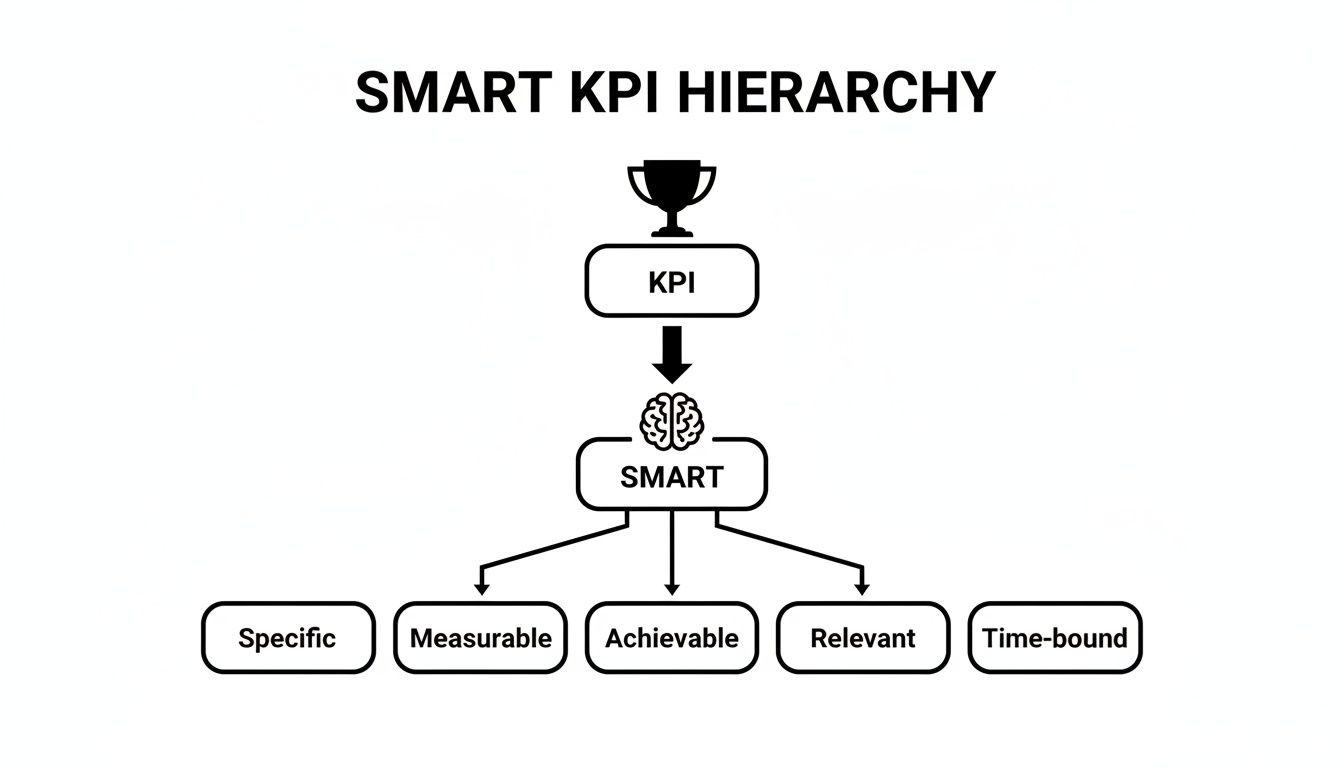
This hierarchy shows exactly how a vague goal gets refined through the SMART criteria to become a precise and powerful KPI that you can act on.
Connecting KPIs to Broader Economic Trends
Your studio doesn’t operate in a vacuum. The wider economic climate has a direct impact on client budgets, project pipelines, and your opportunities for growth.
Take Denmark, for example. Its recent economic performance shows strong GDP growth driven by a few key sectors, with a slowdown expected. For Danish creative studios, this signals a need to double down on operational efficiency to remain competitive. This is where a platform like VirtuallPRO excels, offering unified orchestration and asset management to optimize AI-powered production.
You can learn more about Denmark's economic outlook and what it means for the creative industry. By linking your internal KPIs like Cost Per Asset to these external trends, you can start making more informed strategic decisions.
Getting Practical: KPI Examples for Visual Production
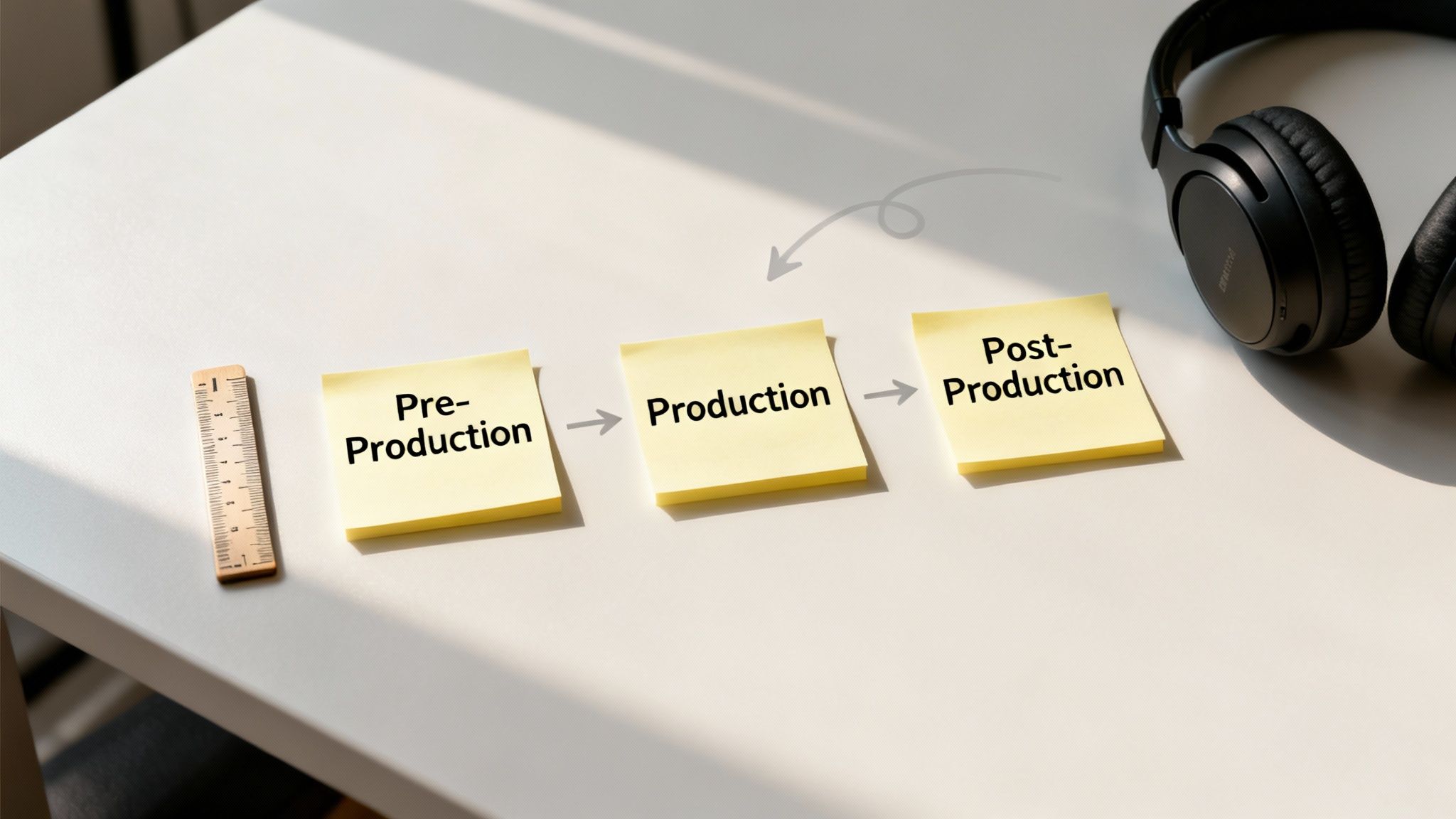
Theory is important, but seeing KPIs in action is where the concepts solidify. Let’s move beyond the abstract and look at concrete examples you can use at each stage of a modern visual production pipeline, from the first sketch to the final render. For any creative studio, these are the metrics that move the needle.
In today's fast-paced environment, just adopting new tech isn't enough; you must measure its impact. Take Denmark, for example. With 81% of citizens saying digitalisation makes their lives easier, there’s a clear embrace of advanced creative tools. This digital-first mindset makes it the perfect ground for studios to use platforms like VirtuallPRO, where tracking these KPIs becomes an automatic part of the workflow, not a manual chore. You can see more on this in Denmark's 2025 digital decade report.
Pre-Production KPIs
This is where projects are set up for success—or failure. Getting things right here prevents a cascade of costly delays and miscommunications later on. The right KPI can highlight friction points before they become major issues.
- Concept Approval Time: How long does it take to get a sign-off after presenting a concept? If this number is high, it could signal a vague brief or a creative disconnect with the client. It’s a direct impact on your timeline.
- Resource Allocation Variance: This is simple: compare your planned budget and team hours against what you actually spent. A significant difference here means your initial project scoping is off, putting you at risk of going over budget.
Production KPIs
Here’s where the visual creation happens: 3D modelling, animation, and AI-powered asset creation. KPIs in this phase are all about tracking efficiency, controlling quality, and ensuring your team is working effectively.
Monitoring production KPIs isn't about rushing creativity. It's about clearing roadblocks so your artists can focus on what they do best—create—instead of getting bogged down in endless rework or searching for the right file.
A good KPI here gives you a real-time pulse on your team's capacity and the health of your workflow.
- Asset Revision Cycles: What’s the average number of times an asset is sent back for changes before approval? A high number is a red flag for poor communication, weak feedback, or a missing style guide. It’s a significant drain on time and morale.
- AI Model Utilisation Rate: For studios using generative AI, this is key. It measures how often your AI models and hardware are actively working versus sitting idle. A low rate might mean your workflow is inefficient or your infrastructure is oversized, hurting your ROI.
- First-Time-Right (FTR) Rate: What percentage of assets or shots are approved on the very first review? A high FTR rate is a fantastic sign that your team is aligned, the brief is clear, and your process is running efficiently.
Tracking these metrics is essential for scaling responsibly. This is where a unified platform from our company, Virtuall, makes a real difference. By managing the entire workflow in one place, the system automatically logs data like revision counts and generation times. KPI tracking becomes a natural part of the process. This automation is a huge lever to pull when you want to improve team productivity and streamline your operations.
Post-Production KPIs
This is the final stretch—rendering, compositing, and delivery. KPIs here are focused on technical performance and final quality, ensuring every project is delivered on time and meets the required standard.
- Final Render Time per Frame: A pure technical metric. How long does it take your machines to render a single, final frame? Tracking this helps you forecast hardware needs, manage your render farm efficiently, and give clients accurate delivery estimates.
- Quality Assurance (QA) Failure Rate: What percentage of final deliverables are rejected by QA for technical errors or for not meeting spec? If this rate is high, it’s a sign you need to tighten your review processes earlier in the pipeline.
- On-Time Delivery Rate: This is a major one for clients. It measures the percentage of projects delivered by the promised deadline. It’s a direct reflection of your studio's reliability and project management skills, and it has a massive impact on client satisfaction and repeat business.
Implementing KPI Tracking and Governance
Having a list of powerful KPIs is just the beginning. The real value is unlocked when you embed them into your studio's daily rhythm, transforming them from static numbers into dynamic tools for continuous improvement. This means building a deliberate system for tracking, reviewing, and governing your performance data.
The goal here isn’t to use metrics to criticize or micromanage; it’s about creating a shared understanding of what success looks like. It’s about building a culture where data informs decisions without stifling creativity.
Establishing a Regular Review Cadence
KPIs come to life when they are discussed. Without regular check-ins, even the best metrics become outdated artifacts. A predictable rhythm ensures that performance data is actually used to steer projects and strategy.
For most creative studios, a tiered approach works well:
- Weekly Project Huddles: Quick, informal meetings focused on project-level KPIs like Asset Revision Cycles or On-Time Task Completion. This keeps teams agile and lets them tackle small issues before they escalate.
- Monthly Team Reviews: A deeper dive into operational KPIs such as Team Utilisation Rate or First-Time-Right Rate. These sessions help team leads spot broader trends and fine-tune internal processes.
- Quarterly Strategic Reviews: High-level meetings where leadership examines studio-wide KPIs like Project Profitability and Customer Lifetime Value. This is where the big decisions about resources, services, and long-term goals are made.
A key performance indicator should spark a conversation, not end one. The number itself is just a starting point; the real work happens when your team discusses what’s behind the data and decides on the next steps together.
The Power of Visual Dashboards
Let's be honest: raw data in a spreadsheet is hard to interpret and easy to ignore. This is where visual dashboards become essential. They translate complex numbers into intuitive charts and graphs, making performance data accessible to everyone, from junior artists to executives.
When you’re looking at KPI data, spotting the trend is everything. Visualising how performance changes over time tells a story. If your team is tracking metrics in spreadsheets, resources like a guide to Mastering the Google Sheets Line of Best Fit can be a huge help for making sense of your data.
A well-designed dashboard gives you an at-a-glance view of your studio’s health, instantly highlighting wins and flagging areas that need attention. That accessibility is key to building a transparent, data-informed culture.
Governance in a Creative AI OS
Data is only useful if it’s accurate, consistent, and secure. This is where KPI governance comes in. Think of it as the rulebook for your data: it defines who is responsible for tracking each metric, who has access to sensitive information, and how you ensure its integrity.
This is a core design principle behind the VirtuallPRO platform. We know that for a studio to operate as a responsible, compliant, and safe partner, data governance can't be an afterthought. Our platform supports robust KPI implementation with features like:
- Shared Workspaces: This ensures everyone is working from a single source of truth, eliminating the chaos of conflicting data from different spreadsheets or systems.
- Versioning and History: Every change to an asset or project is automatically tracked, providing a clear, auditable trail that’s crucial for accurate KPI measurement.
By building these controls directly into your creative workflow management software, our product VirtuallPRO makes it easier to maintain data accuracy and security. This solid foundation lets you trust your KPIs and use them confidently to celebrate successes, learn from challenges, and build a high-performance studio culture.
Your KPI Questions, Answered
Let's tackle some of the common questions that pop up when creative teams start thinking about KPIs.
How Many KPIs Should We Actually Track?
There's no magic number, but the golden rule is "less is more."
Start with 3-5 high-level KPIs that track the studio's overall health. Then, for each project or smaller team, pick just 2-3 that are specific to their goals.
The point is to focus on what truly matters. If you track too many things, you risk "analysis paralysis," where everyone is so busy looking at data that no real work gets done. It's far better to track a few powerful indicators well.
How Can You Measure Something Subjective Like 'Creativity'?
This is a great question. While you can't put a number on a great idea itself, you can absolutely measure its impact and the efficiency of the process that created it.
Think of them as proxy metrics. For example, Client Satisfaction Scores give you a clear signal on how the creative work was received. Another great one is the Number of Revision Rounds per Asset—if that number is consistently high, it might point to a disconnect in the briefing or feedback stages.
Some studios also use an internal scoring rubric, where senior creatives rate work against set criteria. It's a way to bring objective structure to an otherwise subjective field.
What's the Real Difference Between a Metric and a KPI?
It's simpler than it sounds. Think of it like this: all KPIs are metrics, but not all metrics are KPIs.
A 'metric' is just a number you can measure. How many assets did we produce this week? That's a metric.
A Key Performance Indicator (KPI) is a metric you’ve chosen because it's directly tied to a crucial business goal. The word ‘Key’ is what matters—it signals that this specific number is vital for tracking progress toward something important. It tells a story about your performance.
Ready to stop guessing and start measuring? The Virtuall Creative AI OS is built to manage your entire production pipeline, making KPI tracking a natural part of your workflow. See how you can scale your creative output responsibly at https://virtuall.pro.