Professional Generative AI for Creative Teams That Scale
Professional generative AI for creative teams needs governance, repeatable workflows and brand control. Learn how to scale production safely.
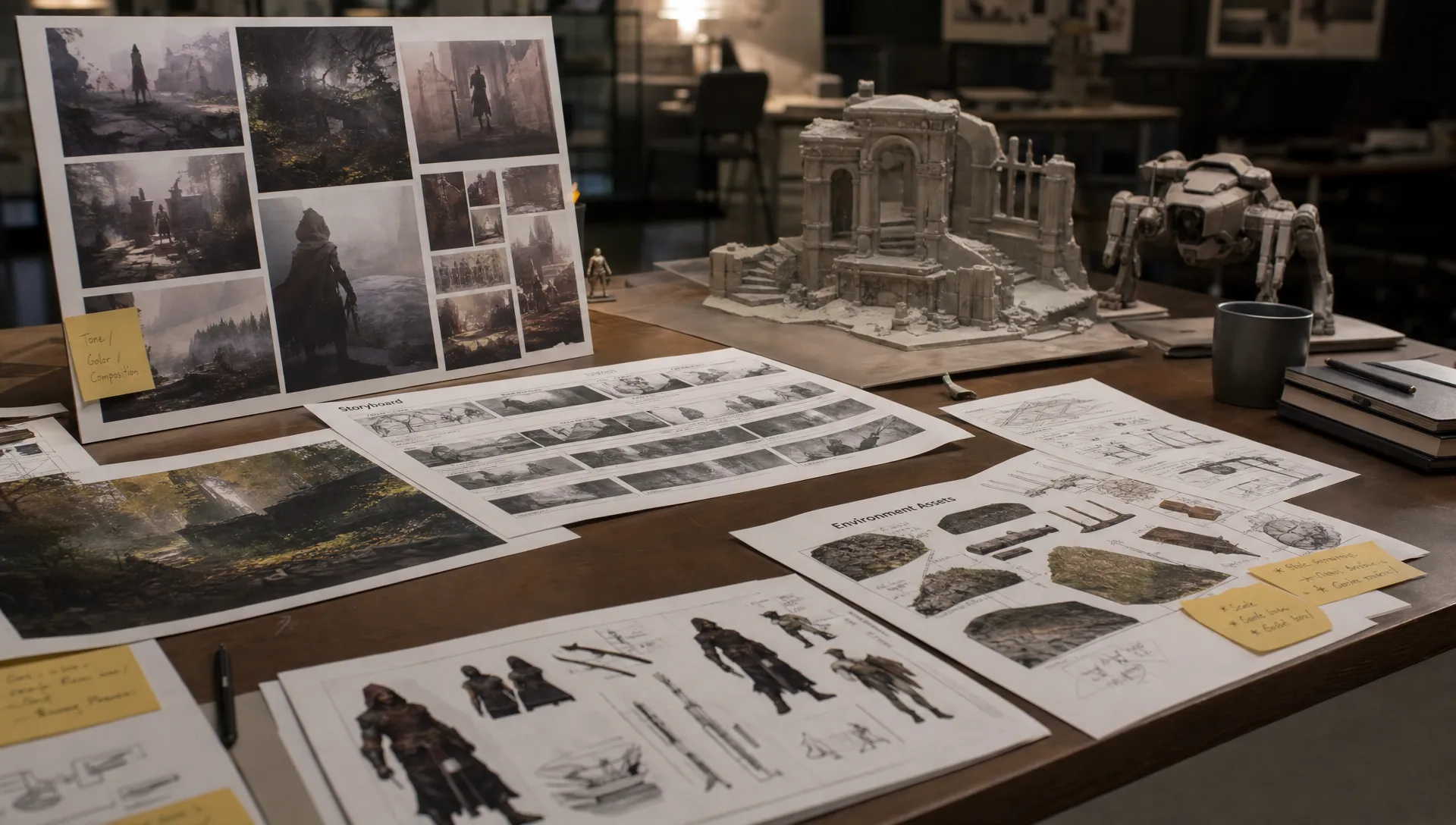
Professional generative AI for creative teams that scale is not a faster prompt box. It is a controlled production capability that helps people turn creative intent into approved assets across brands, markets, channels and formats.
At small scale, a designer can experiment with a model and get a useful concept. At enterprise scale, the same approach can create confusion. Which prompt was used? Which reference image was allowed? Which model generated the result? Who approved it? Can the team reproduce the asset for a different market next month?
Scale changes the question from can we generate this? to can we generate this repeatedly, safely and in the right context? That shift is where professional creative AI starts.
Scaling creative AI is an operating problem
Creative teams do not struggle because they lack imagination. They struggle because generative AI often enters the organization as scattered tools, personal accounts and undocumented experiments. The output may look impressive, but the surrounding process is fragile.
Professional use requires a shared operating model. Creative direction, brand memory, asset rules, review steps, model access, metadata and compliance requirements need to sit in the workflow, not in someone’s notebook or private prompt library. Teams that are still defining day-to-day usage patterns can start with a practical view of how creative teams use generative AI professionally, then build toward a more scalable structure.
For CMOs, this is about brand consistency and speed to market. For art directors, it is about protecting intent while increasing exploration. For application managers, it is about security, governance and integration. For game developers, it is about faster iteration without breaking the asset pipeline.
When these needs are treated separately, AI becomes another source of operational debt. When they are connected, generative AI becomes a production layer.
Where ad hoc AI breaks down
The early stage of AI adoption usually feels productive. Teams create mood explorations, campaign variants, product visuals, video concepts or 3D ideation assets faster than before. The problem appears when the organization tries to repeat the work across teams.
Common failure patterns include prompts being stored in private documents, brand references being uploaded without clear permission rules, assets being reviewed outside the normal approval flow and teams choosing different models for similar tasks. The same brief can produce different results because context is missing or because one team member knows the hidden prompt structure and another does not.
The result is not just inefficiency. It can affect brand governance, legal review, production quality and trust in the technology. Once stakeholders see inconsistent outputs, they often blame AI itself, when the real issue is the lack of an operating layer around AI.
This is why professional adoption should not be framed as giving every team a new tool. It should be framed as designing a controlled production environment. For a deeper look at this failure mode, Virtuall has also covered professional generative AI without workflow chaos.
The five layers of scalable creative AI
A scalable setup needs more than a model picker. It needs a way to capture intent, preserve context, route work through the right models and keep approvals visible. The exact architecture varies by company, but the core layers are consistent.
| Layer | What it controls | Why it matters at scale |
|---|---|---|
| Creative intent | Briefs, goals, formats and constraints | Prevents AI from generating attractive but irrelevant output |
| Studio context | Mood boards, brand systems, references and past decisions | Keeps outputs aligned with the visual language of the team |
| Model orchestration | Which models are used for image, video, 3D, audio or text tasks | Lets teams use the right AI capability without forcing everyone to manage model complexity |
| Workflow controls | Reviews, approvals, annotations and handoffs | Keeps AI-generated work inside the production process |
| Governance and integration | Access rights, compliance rules, asset management and tool connections | Reduces risk and makes AI usable across departments |
This is the role of a Creative AI OS. It is not another isolated generator. It sits between people, models and production tools so the organization can define how AI runs.
Virtuall is built around this principle. Its Creative AI OS helps teams control and orchestrate AI-powered content creation across image, video, audio and 3D. Nyx, the intelligence layer of the OS, orchestrates multiple industry-leading AI models and keeps intent and context across studios and teams. That matters because creative production rarely follows a straight line. Direction evolves, references change and feedback must carry forward.
What different creative leaders need from the same system
A scalable AI environment should not force every role into the same interface or priority list. The system has to serve different operational needs while preserving one shared production reality.
| Role | Primary need | What professional AI must provide |
|---|---|---|
| CMO | Consistent brand output across markets and channels | Governed templates, approval visibility and reusable brand context |
| Art Director | Control over visual direction | Mood boards, creative constraints, iteration history and review workflows |
| Application Manager | Secure adoption across teams and tools | Access controls, integrations, compliance posture and API paths |
| Game Developer | Faster content iteration without pipeline disruption | Multi-format generation, 3D-aware workflows, asset tracking and handoff structure |
The value of professional generative AI is not that it replaces these roles. It gives each role a clearer way to work with AI while reducing the gaps between strategy, creative direction, technical operations and final production.
From prompts to generation blueprints
Prompts are useful for experimentation, but they are weak as production artifacts. They depend too much on individual memory and often miss the surrounding requirements that make an output usable.
A generation blueprint is more durable. It can standardize the brief structure, approved references, output format, model route, negative constraints, review stages and handoff requirements for a recurring creative task. Instead of asking each team to recreate the process, the organization turns a successful workflow into a repeatable pattern.
For example, a retail brand might create blueprints for seasonal product scenes, localized social variants and marketplace image extensions. A game studio might create blueprints for environment ideation, prop variations and early 3D concept exploration. A marketing team might create blueprints for campaign key visuals, storyboard frames and video previsualization.
Blueprints do not remove creative judgment. They remove avoidable process drift so creative judgment can happen at a higher level.
Governance needs to sit inside the workflow
Enterprise AI governance fails when it lives only in policy documents. Creative teams need governance at the point of work: when someone selects an input, chooses a model, generates an asset, requests approval or exports into a production system.
The NIST AI Risk Management Framework is useful because it frames AI risk work around govern, map, measure and manage functions. ISO/IEC 42001 gives organizations a management system approach for AI. In Europe, the European Commission’s AI regulatory framework has also made governance a board-level topic for many companies.
For creative production, governance should answer practical questions. Which inputs can be used? Which models are approved for which tasks? What happens to rights-sensitive references? Who can approve final assets? What records are kept for review? How does the system prevent unapproved tools from becoming shadow production infrastructure?
Virtuall supports AI governance controls and EU-based infrastructure and inference, which is relevant for organizations with strict compliance requirements. This does not replace legal review, but it gives creative and technical teams a governed environment rather than a patchwork of unmanaged accounts.
A practical roadmap for scaling creative AI
Scaling does not require every workflow to be transformed at once. In most organizations, the safest path is to pick high-value use cases, standardize the operating model, then expand.
| Stage | Goal | Practical output |
|---|---|---|
| Align | Define business and creative outcomes | Priority use cases, success criteria and risk boundaries |
| Standardize context | Capture reusable brand and studio knowledge | Mood boards, references, style rules and approved inputs |
| Create blueprints | Turn repeatable tasks into controlled workflows | Templates for briefs, generation steps and output requirements |
| Add review gates | Keep human judgment in the process | Approvals, annotations and version tracking |
| Integrate | Connect AI work to production systems | Links to DCC, PIM, DAM and other tools through plugins or APIs |
| Scale | Expand across teams without losing control | Governance standards, shared libraries and portfolio-level visibility |
This roadmap also helps teams decide when standalone AI tools are no longer enough. If your team is comparing options, it is worth clarifying the difference between generative AI websites and a Creative AI OS before AI decisions become fragmented across the organization.
Measuring value without reducing creativity to volume
The wrong metric for AI adoption is simply more outputs. More assets can still mean more review work, more inconsistency and more rework. Professional creative AI should be measured by its effect on production quality, decision speed and governance.
| Metric | What to track | Why it matters |
|---|---|---|
| Brief-to-review time | Time from approved brief to first reviewable asset | Shows whether AI improves creative throughput |
| Approval quality | Number of review cycles and reasons for rejection | Reveals whether outputs match intent and brand standards |
| Reuse rate | How often blueprints, references and approved assets are reused | Measures whether knowledge is becoming scalable |
| Pipeline fit | Percentage of AI outputs that meet format and handoff requirements | Shows whether AI is production-ready, not just visually impressive |
| Governance coverage | Share of AI work running through approved systems | Helps reduce shadow AI risk |
These metrics respect creative work because they do not treat volume as the only sign of progress. They focus on whether AI helps teams produce better work with clearer control.
Frequently Asked Questions
What makes generative AI professional for creative teams? Professional generative AI connects generation to briefs, brand context, review workflows, governance and production handoff. It is not only about output quality, but also repeatability, control and compliance.
Can creative teams scale AI without losing brand consistency? Yes, but only if brand context is captured and reused. Mood boards, approved references, generation blueprints and human review gates help prevent brand drift as more teams use AI.
Do enterprises need a Creative AI OS instead of separate AI tools? Separate tools can be useful for experimentation. A Creative AI OS becomes valuable when teams need shared governance, orchestration, asset tracking, approvals and integrations across multiple workflows.
How can game studios use professional generative AI? Game teams can use AI for concept exploration, environment ideation, prop variation, early 3D workflows and marketing assets. The key is to keep outputs connected to pipeline requirements and creative direction.
Is EU-based AI infrastructure enough for compliance? EU-based infrastructure and inference can support a stronger compliance posture, especially for European organizations. It should still be combined with internal policy, legal review, access controls and documented workflows.
Bring creative AI under operational control
If your team is ready to move from scattered AI experiments to governed creative production, Virtuall gives studios and enterprises a Creative AI OS for orchestrating image, video, audio and 3D workflows at scale.
You define the rules, keep teams aligned and give AI a controlled role inside the production pipeline, so creative work can scale without losing direction, quality or trust.