Where HPE AI Fits in a Creative AI Infrastructure Stack
Learn where HPE AI fits in a creative AI stack, what it solves for enterprise teams and where a Creative AI OS adds workflow control.
Creative AI teams are starting to ask infrastructure questions that used to belong only to IT. Can we run image, video and 3D generation securely? Can we keep proprietary assets out of unmanaged tools? Can we scale generation without turning every studio into a model operations team?
That is where HPE AI enters the conversation. In this article, HPE AI refers to Hewlett Packard Enterprise's AI infrastructure, hybrid cloud and services portfolio, not a single creative application. For enterprise creative teams, its role is best understood as the foundation that can provide compute, private or hybrid deployment options, storage, networking and operational support for AI workloads.
It is not, by itself, the creative workflow layer. HPE AI can help run AI systems. It does not decide how brand rules are applied, which mood board defines a campaign, who approves a 3D asset or how outputs flow into a DAM, PIM, DCC tool or game engine. Those decisions sit higher in the stack.
The practical question is not whether HPE AI is useful. It is where it fits, what it should own and what another layer must handle so creative teams can produce consistent, compliant and production-ready content.
What HPE AI Means in an Enterprise Creative Stack
HPE has positioned its AI portfolio around enterprise infrastructure, hybrid cloud and private AI deployments. Its public AI messaging focuses on helping organizations design, deploy and run AI with compute, storage, data, security and services. HPE's own artificial intelligence solutions page frames AI as an infrastructure and operations challenge as much as a model challenge.
A major part of this direction is the HPE and NVIDIA partnership. In 2024, HPE and NVIDIA announced NVIDIA AI Computing by HPE, with HPE Private Cloud AI described by HPE as a co-developed private cloud offering for enterprise generative AI. That matters for creative organizations because many production use cases need more than casual access to a public AI tool. They need infrastructure that IT, security and procurement can approve.
For a CMO, the value is not the hardware itself. It is the ability to scale AI-powered content production without creating an uncontrolled shadow stack. For an art director, the value appears only if infrastructure supports consistent creative context and repeatable outputs. For an application manager, HPE AI is relevant because it can become part of the governed enterprise technology landscape rather than another disconnected AI experiment.
The Creative AI Infrastructure Stack, Layer by Layer
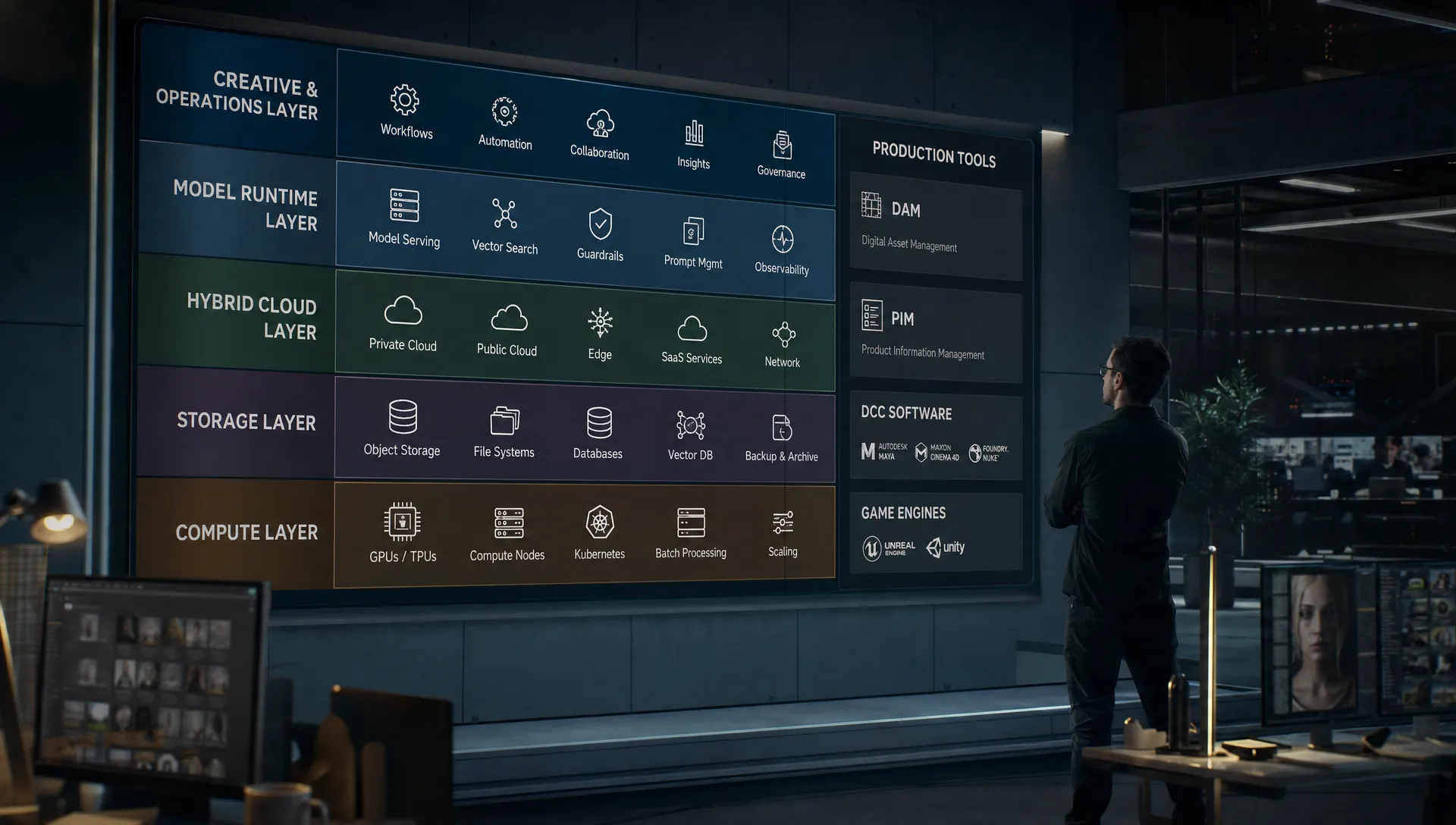
A creative AI stack is not one product. It is a set of layers that move from physical infrastructure to production workflows. HPE AI fits strongly in the lower and middle infrastructure layers, while a Creative AI OS sits above that foundation to control creative intent, governance and workflow execution.
| Stack layer | Main purpose | Typical owners | Where HPE AI fits |
|---|---|---|---|
| Compute, storage and networking | Provide the capacity, performance and connectivity required to run AI workloads | Infrastructure, IT, security | Core HPE territory, especially for private and hybrid AI deployments |
| Hybrid cloud and operations | Provision, monitor, secure and manage AI environments across locations | IT operations, platform teams | Strong fit through HPE hybrid cloud and enterprise operations capabilities |
| AI platform and model runtime | Support model deployment, inference, tuning and runtime management | AI platform teams, application managers | Can be part of the HPE ecosystem, often with partners such as NVIDIA |
| Creative AI operating layer | Translate creative intent into governed workflows, templates, context, approvals and traceability | Creative ops, marketing, art direction, product teams | Requires a specialized creative orchestration layer, not infrastructure alone |
| Creative tools and asset systems | Connect outputs to DCC tools, DAM, PIM, game engines and publishing workflows | Artists, developers, content teams | HPE may support the environment, but workflow integration happens above the infrastructure layer |
This layered view prevents a common mistake: treating AI infrastructure as if it will automatically solve creative operations. It will not. A powerful AI foundation can still produce inconsistent, hard-to-review outputs if the creative workflow layer is missing.
If your team is still defining that upper layer, the distinction is covered in more detail in Virtuall's guide to how an operating system AI fits into your creative tech stack.
Where HPE AI Is Strongest for Creative Organizations
HPE AI is most relevant when creative AI becomes operationally serious. A small team testing prompts in a browser may not need enterprise infrastructure. A global brand, game studio or retail organization producing thousands of campaign, ecommerce, localization or 3D variations has different requirements.
The first strength is private and hybrid deployment. Many creative teams work with unreleased products, licensed IP, talent likenesses, proprietary brand assets, confidential campaigns and regional compliance obligations. Running every experiment through unmanaged tools can create legal, security and reputational risk. HPE AI can support enterprise-controlled environments where IT has clearer oversight of data, access and deployment.
The second strength is performance planning. Image, video and 3D generation can be compute intensive. Inference demand can spike during campaign launches, seasonal content production, game asset iteration or product catalog updates. HPE's infrastructure role is to help organizations plan for the capacity, storage and networking needed to support these workloads predictably.
The third strength is operational maturity. Enterprise AI must be monitored, patched, governed and integrated with security processes. Creative teams often underestimate this until an AI pilot becomes a production dependency. HPE AI belongs in the conversation when creative AI is expected to behave like enterprise software rather than an experimental sandbox.
What HPE AI Does Not Solve by Itself
The gap appears above the infrastructure layer. Creative production is not only about running models. It is about making sure the right model runs in the right workflow, with the right brand context, under the right governance rules and with the right approval path.
HPE AI does not define a campaign's visual system. It does not know whether a generated product image matches a seasonal mood board. It does not automatically preserve art direction across hundreds of assets. It does not replace review workflows, annotations, approvals, content lineage or integration into downstream creative tools.
This is why creative teams need an operating layer above enterprise AI infrastructure. That layer should manage prompts, references, generation blueprints, model selection, team collaboration, asset status and approval logic in a way that maps to real studio operations.
Infrastructure makes AI possible. Creative orchestration makes it usable in production.
HPE AI, NVIDIA AI Enterprise and a Creative AI OS Are Not the Same Thing
The market can be confusing because infrastructure, model runtime, enterprise AI software and creative workflow platforms are often discussed as if they solve the same problem. They do not.
HPE AI and NVIDIA AI Enterprise can be closely related in certain deployments, especially where HPE infrastructure is paired with NVIDIA accelerated computing and software. But a creative organization still needs a layer that translates AI capability into repeatable creative production.
| Component | Primary role | Value for creative teams | What it does not replace |
|---|---|---|---|
| HPE AI | Enterprise AI infrastructure, hybrid cloud and operational foundation | Helps IT run AI workloads in a more controlled, scalable environment | Creative direction, approvals, generation templates, asset workflow logic |
| NVIDIA AI Enterprise | Enterprise AI software and runtime layer for accelerated AI workloads | Supports reliable deployment and operation of AI models on NVIDIA platforms | Studio-specific creative process and brand governance |
| Creative AI OS | Orchestration layer for creative workflows, governance, context and production outputs | Turns AI capability into repeatable image, video and 3D production workflows | The underlying compute and infrastructure foundation |
| DCC, DAM, PIM and game tools | Existing production and asset systems | Receive, edit, store, publish or deploy approved outputs | End-to-end AI governance and multi-model orchestration |
For a deeper view of the NVIDIA layer, Virtuall has covered what NVIDIA AI Enterprise software means for creative pipelines. The key takeaway is similar: infrastructure and runtime software matter, but they are not a complete creative operating model.
What Each Enterprise Stakeholder Should Evaluate
Different teams will evaluate HPE AI through different lenses. The best infrastructure decision is one that satisfies enterprise requirements without slowing down creative production.
For the CMO, the question is whether the stack can scale content while protecting brand trust. Faster asset generation is useful only if outputs remain on-brand, rights-aware and reviewable. HPE AI can support a more controlled foundation, but the CMO still needs visibility into creative governance, approval paths and production throughput.
For the art director, the concern is consistency. AI generation often fails when every user prompts differently, references are scattered and the model has no stable creative context. Infrastructure may improve reliability, but the art team needs generation blueprints, mood boards, context memory and review workflows that preserve intent across formats and campaigns.
For the application manager, the core question is integration. HPE AI may fit into enterprise infrastructure planning, but the full solution must connect with identity, access control, asset management, DAM, PIM, DCC tools, APIs and reporting processes. A creative AI layer should make those operational handoffs explicit instead of leaving them to manual workarounds.
For the game developer, the concern is pipeline fit. AI-generated concept art, textures, props, environments or 3D references need versioning, review and conversion into usable production assets. Compute power helps, but the workflow must still support iteration, asset lineage and handoff into engines or DCC tools.
A Practical Architecture for Creative AI at Scale
A clean architecture separates responsibilities. HPE AI can provide or support the enterprise foundation. Model and runtime layers handle AI execution. A Creative AI OS governs how creative teams use those capabilities in production.
In practice, that means the organization should answer several questions before choosing where each component sits:
- Which workloads require private inference, hybrid deployment or stricter data controls?
- Which creative assets can be used as references, training material or production inputs?
- Who can launch generations, approve outputs and publish final assets?
- How are prompts, model versions, references, review decisions and final files logged?
- Which systems need to receive approved outputs, such as DAM, PIM, DCC tools or game engines?
- How will teams measure throughput, quality, rework, compliance and cost per approved asset?
These questions keep the architecture tied to real creative operations. Without them, teams risk buying infrastructure before defining how content should move through the business.
This is also where a Creative AI OS becomes important. Virtuall is designed to operate creative AI across teams, workflows and tools with governance controls, workflow orchestration, multi-model content generation, generation blueprints, studio context memory, collaboration, asset management and pipeline tracking. Nyx, Virtuall's intelligence layer, orchestrates multiple industry-leading AI models while keeping intent and context across studios and teams.
That does not make Virtuall a replacement for HPE AI. It makes the two categories complementary. HPE AI can support the enterprise environment where AI workloads run. Virtuall can help creative teams decide how AI runs across the studio.
For a broader production view, Virtuall's article on enterprise AI solutions for scalable content production explains why governance and workflow orchestration matter once AI moves beyond experimentation.
When HPE AI Is the Right Foundation
HPE AI is most likely to fit your creative AI stack when the organization already has enterprise infrastructure requirements around security, data control, hybrid cloud or operational support. It is especially relevant when AI workloads involve sensitive assets, heavy compute demand or production systems that must satisfy IT governance.
It is less likely to be the complete answer if the main pain is creative inconsistency, scattered prompts, weak review processes or difficulty moving generated assets into production tools. Those are not infrastructure problems. They are creative operations problems.
A useful decision rule is simple: use HPE AI to strengthen the enterprise foundation, then add a creative operating layer to make that foundation productive for marketers, art directors, content teams and developers.
Frequently Asked Questions
What is HPE AI in a creative AI infrastructure stack? HPE AI is best understood as the enterprise infrastructure and hybrid cloud foundation for AI workloads. It can support compute, storage, deployment and operations, but it is not a creative workflow platform by itself.
Is HPE AI the same as a Creative AI OS? No. HPE AI helps run and manage AI infrastructure. A Creative AI OS controls how AI is used in creative production, including workflows, governance, context, approvals, asset management and integrations with creative tools.
How does HPE AI relate to NVIDIA AI Enterprise? HPE AI can provide enterprise infrastructure and hybrid cloud environments, while NVIDIA AI Enterprise provides AI software and runtime capabilities for NVIDIA accelerated platforms. In some enterprise offerings, HPE and NVIDIA are packaged together, but creative orchestration still sits above that layer.
Why do creative teams need a layer above HPE AI? Creative teams need more than compute. They need repeatable generation blueprints, shared creative context, brand controls, review workflows, approval trails and asset handoff into production systems. Those functions belong in a creative operating layer.
Can Virtuall replace HPE AI? No. Virtuall and HPE AI address different layers of the stack. HPE AI can support the infrastructure foundation, while Virtuall operates the creative AI workflows above it across image, video and 3D production.
Build the Creative Layer on Top of Enterprise AI Infrastructure
If your organization is evaluating HPE AI, treat it as a foundation for controlled AI operations, not as the whole creative production system. The highest return comes when infrastructure, model runtime, governance and creative workflow orchestration are designed together.
Virtuall provides the Creative AI OS layer for teams that need to operate creative AI at scale. It helps studios and enterprise teams control how AI runs across workflows and tools, keep outputs consistent and move image, video and 3D generation closer to production-ready execution.