AI-enabled creative collaboration
Explore AI-enabled creative collaboration, from adaptive workflows to governance, human oversight, and production-ready content at scale.
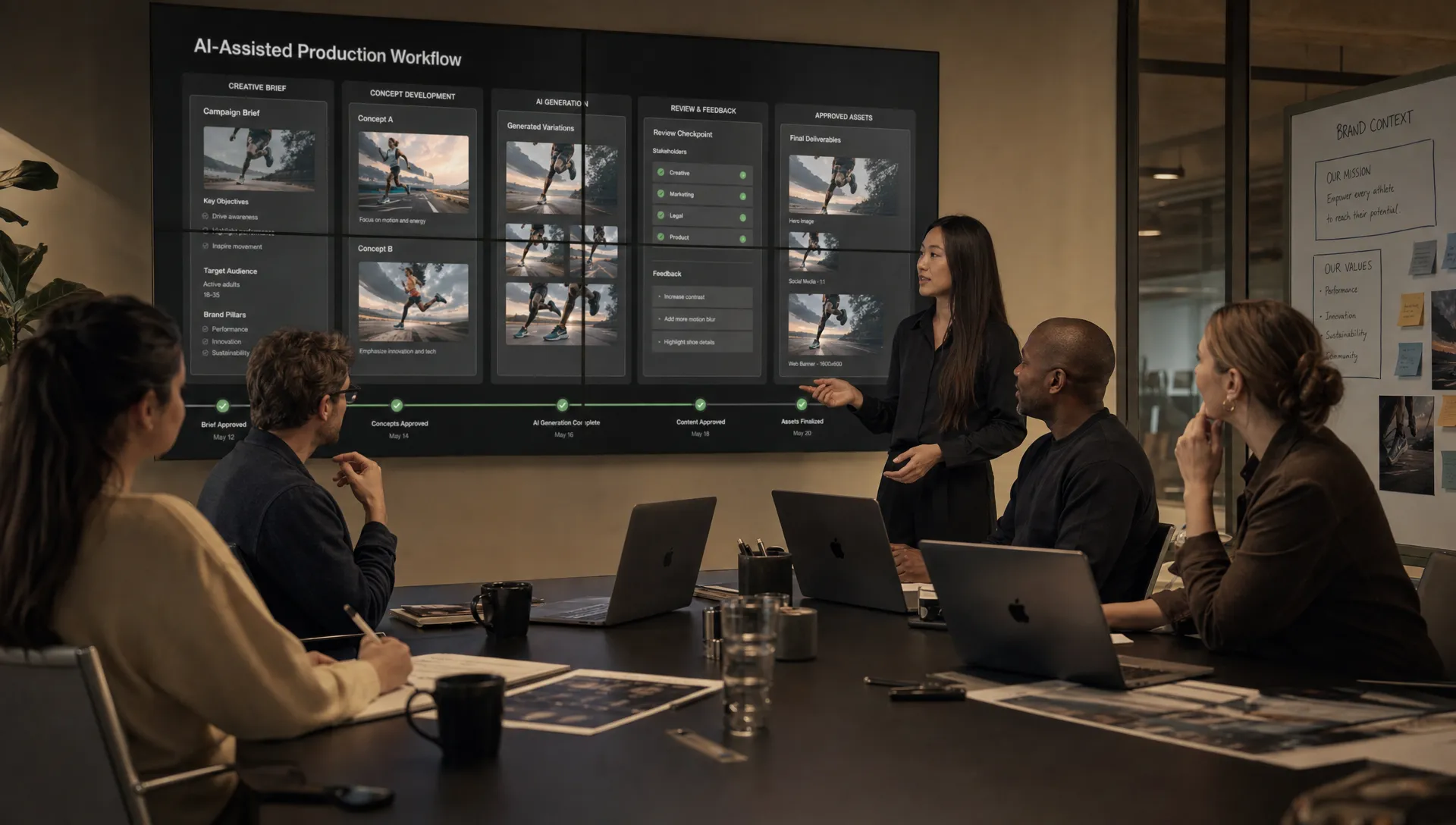
AI-enabled creative collaboration is not simply about putting a generative AI tool in front of every designer, marketer, or developer. In enterprise environments, it changes how creative intent is captured, how teams move work through production, how decisions are reviewed, and how assets remain compliant after they leave the concept stage.
For CMOs, art directors, application managers, and game teams, the opportunity is clear: faster production, broader creative exploration, and more personalized content. The risk is just as clear: inconsistent outputs, unclear rights, shadow AI, fragmented tools, and automated decisions that nobody can explain.
The teams that benefit most from AI are not the ones that automate the most. They are the ones that design a better collaboration model around AI, with shared context, governed workflows, and human oversight built into the production pipeline.
What AI-enabled creative collaboration means
AI-enabled creative collaboration is a way of organizing people, models, tools, assets, and approvals so they can work together across the full creative lifecycle. It connects the strategic layer, such as campaign goals and brand systems, with the operational layer, such as briefs, prompts, model selection, iterations, reviews, and asset delivery.
In a traditional creative workflow, collaboration usually happens through handoffs. Marketing writes the brief, creative interprets it, production generates assets, legal reviews the risky elements, and technical teams integrate the final content into platforms, apps, stores, or game environments.
AI compresses and complicates that process. A single prompt can produce dozens of image directions, video concepts, 3D references, or copy variants. That speed creates value only if everyone understands what was generated, why it was generated, which model or workflow was used, what data influenced the output, and whether the result is approved for production use.
That is why AI-enabled collaboration is less about replacing creative teams and more about coordinating human and machine contributions. It gives teams a shared operating model for using AI without losing brand consistency, legal control, or creative accountability.
Why the collaboration model is changing now
AI adoption has moved from experimentation to operational pressure. McKinsey’s 2024 State of AI research reported that 72% of organizations had adopted AI in at least one business function, while regular use of generative AI had nearly doubled compared with the previous year. In creative and marketing organizations, that adoption often begins informally, with teams using different tools for ideation, retouching, storyboarding, copy, localization, video, or 3D exploration.
At the same time, employees are not waiting for centralized programs. Microsoft’s 2024 Work Trend Index found that 75% of knowledge workers were already using AI at work, and 78% of AI users were bringing their own AI tools. For enterprise creative operations, this is a major signal. AI is already inside the workflow, even when it is not inside the official system.
This creates a new collaboration challenge. The question is no longer “Should we allow AI?” It is “How do we make AI use visible, repeatable, reviewable, and aligned with the way our teams actually create?”
When organizations fail to answer that question, they often see familiar symptoms:
- Multiple teams generate assets from different brand interpretations.
- Prompts, references, and model settings are lost after each iteration.
- Legal and compliance teams are pulled in too late.
- Approved assets are mixed with experimental or unapproved outputs.
- Technical teams cannot trace how content was produced.
- Creative leaders struggle to scale quality across markets, campaigns, or product lines.
AI-enabled creative collaboration solves these issues by making context, workflow, and governance part of the creative system itself.
From linear handoffs to orchestrated creative systems
The most important shift is moving from a linear production chain to an orchestrated creative system. In a linear model, each team waits for the previous team to finish. In an AI-enabled model, teams collaborate around a shared source of intent, with AI supporting exploration, production, adaptation, and review.
| Collaboration area | Traditional creative workflow | AI-enabled creative collaboration |
|---|---|---|
| Briefing | Static documents and meetings | Structured context that can guide AI generation and review |
| Ideation | Limited by time and team capacity | Rapid exploration across approved models and creative directions |
| Production | Manual asset creation and tool-specific workflows | AI-assisted pipelines for image, video, 3D, audio, and variants |
| Review | Late-stage feedback and manual checks | Embedded approvals, annotations, and traceability |
| Governance | Policy documents outside the workflow | Rules applied inside the production process |
| Scaling | More people or more outsourcing | Reusable workflows, templates, and controlled automation |
This does not remove the need for skilled creative judgment. In fact, it makes judgment more important. The difference is that people spend less time recreating context and more time deciding what should move forward.
For example, an art director can define a visual territory once, then use that shared context across multiple concept explorations. A CMO can align campaign personalization with brand and compliance rules before production starts. An application manager can ensure AI tools connect with existing DAM, PIM, DCC, or content systems. A game developer can explore environment assets or character references while preserving pipeline standards.
The result is not just faster content generation. It is a more coherent operating model for creative work.
The four principles of effective AI-enabled collaboration
AI-enabled creative collaboration works best when it is designed around four operational principles: shared context, adaptive workflows, human oversight, and governed experimentation.
1. Shared creative context before generation
Generative AI is highly sensitive to context. If a team gives inconsistent inputs, it will get inconsistent outputs. For creative teams, context includes brand guidelines, mood boards, previous campaigns, approved references, product data, audience insights, format requirements, and market constraints.
A shared context layer helps teams avoid starting from scratch with every prompt. It also makes collaboration more transparent because everyone can see the intent behind the output. This is especially important when multiple teams or agencies work on the same brand system.
Virtuall approaches this through studio context memory, including mood boards, and generation blueprints that help teams preserve intent across workflows. The broader principle is simple: AI should not depend on isolated prompt craft alone. It should work from reusable creative intelligence that teams can trust.
2. Adaptive workflows instead of fixed production paths
Creative production is rarely linear. A campaign may need rapid concepting, legal review, localization, format adaptation, executive feedback, and last-minute market changes. A game studio may need concept art, 3D exploration, technical validation, and asset handoff across different tools.
AI-enabled workflows need to adapt to those realities. Some assets may require strict approval before generation. Others may be safe for early exploration. Some models may be approved for internal ideation but not for production outputs. Some markets may require additional review.
This is where workflow orchestration becomes critical. Rather than asking teams to manage every decision manually, organizations can define workflows that route work based on asset type, risk level, user role, channel, or production stage.
3. Human oversight at decisive moments
AI can accelerate creative production, but it should not become an unreviewed decision-maker. Human oversight matters most at points where creative, legal, commercial, or technical consequences are high.
The NIST AI Risk Management Framework emphasizes governance, mapping, measurement, and management of AI risks. In creative operations, those ideas translate into practical controls: who can generate what, which models are allowed, what data can be used, how outputs are reviewed, and how decisions are documented.
Human oversight should not be a vague instruction to “check the output.” It should be designed into the workflow. For example, a senior art director may approve visual direction before variants are generated. Legal may review likeness, trademark, or rights-sensitive content before campaign release. Technical leads may validate 3D outputs before they enter a game or product visualization pipeline.
4. Governed experimentation
Creative teams need room to experiment. Enterprise teams also need boundaries. The strongest AI collaboration models support both.
Governed experimentation allows teams to explore ideas with approved tools, models, references, and data handling rules. It reduces the temptation to use unapproved tools because the official workflow is fast enough and flexible enough to support real creative work.
This is where ai governance for creative teams becomes practical rather than theoretical. It is not only a legal policy. It is the set of controls that lets creative people move faster without creating avoidable risk.
What changes for each enterprise stakeholder
AI-enabled creative collaboration affects different leaders in different ways. A shared operating model helps each function gain value without creating friction for the others.
| Stakeholder | Main priority | How AI-enabled collaboration helps |
|---|---|---|
| CMO | Brand consistency, speed, personalization, campaign performance | Aligns AI production with brand rules, market needs, and approval processes |
| Art Director | Creative quality, visual coherence, team direction | Preserves creative intent across models, iterations, and asset variants |
| Application Manager | Tool governance, integration, security, scalability | Connects AI workflows with approved systems, APIs, plugins, and access controls |
| Game Developer | Production efficiency, asset consistency, technical pipeline fit | Supports concept exploration and 3D workflows while maintaining pipeline standards |
The value comes from reducing translation loss. In many organizations, strategy, creative direction, production, and technical implementation live in separate systems. AI can either make that fragmentation worse or help connect the dots.
When collaboration is designed well, campaign intent can flow into asset generation. Brand context can travel with the workflow. Review comments can stay attached to the asset. Approved outputs can move into downstream systems with less manual reconstruction.
Building AI-assisted production pipelines
AI-assisted production pipelines are the operational backbone of AI-enabled creative collaboration. They define how content moves from idea to approved asset, and they make AI a controlled part of that journey.
A mature pipeline usually includes several connected layers:
- Creative context, including brand systems, mood boards, references, product information, and campaign goals.
- Model orchestration, including the ability to use different AI models for different media types or workflow steps.
- Generation blueprints, which standardize repeatable creative tasks without forcing every output to look identical.
- Review and approval workflows, including annotations, decision records, and role-based validation.
- Asset management and pipeline tracking, so teams know what is experimental, approved, revised, or ready for distribution.
- Integration with creative and enterprise systems, such as DCC tools, DAM, PIM, and production platforms.
Virtuall is built around this operating-system view of creative AI, with orchestration across image, video, 3D, and audio generation, governance controls, asset management, review workflows, and integrations through plugins and API. Its intelligence layer, Nyx, is designed to orchestrate multiple AI models while keeping intent and context across studios and teams.
The key point is not that every organization needs the same pipeline. It is that AI collaboration needs a pipeline at all. Without one, teams rely on screenshots, copied prompts, disconnected files, and undocumented decisions. That may work for experiments, but it does not scale to enterprise production.
For teams focused on output consistency, the next step is often to standardize how context and generation instructions are reused. Virtuall’s guide on improving AI output across teams and tools explores that challenge in more detail.
Personalization at scale without brand drift
One of the strongest business cases for AI-enabled creative collaboration is personalization. Marketing teams need more formats, more local adaptations, more audience-specific variations, and faster campaign refresh cycles. AI can help create that volume, but volume without control quickly becomes brand drift.
Brand drift happens when assets are technically on brief but visually or tonally inconsistent. It also happens when regional teams adapt creative in ways that slowly weaken the master brand system. With AI, this risk increases because variations can be generated so quickly.
A governed collaboration model keeps personalization connected to approved creative context. Instead of asking every team to interpret brand rules independently, organizations can define reusable blueprints for campaign variants, product visuals, localization, social assets, e-commerce imagery, or concept directions.
The goal is not to make every asset identical. It is to keep variation inside a controlled creative range. That gives CMOs confidence that personalization will not dilute the brand, while giving regional and production teams enough flexibility to meet local needs.
Governance as a collaboration enabler
Governance is often framed as a constraint, but in AI-enabled creative collaboration, it is what makes scale possible. Teams move faster when they know which tools are approved, which models are allowed, what data can be used, and who needs to approve which outputs.
Good governance also improves trust between departments. Creative teams can experiment without worrying that every AI use will be blocked later. Legal and compliance teams get earlier visibility. IT and application managers can reduce shadow AI by offering sanctioned workflows. Executives get more confidence that AI is being used responsibly.
The governance layer should answer practical questions:
- Which AI models are approved for ideation, internal use, or production output?
- What types of prompts, references, customer data, or product data are allowed?
- Who can approve AI-generated assets for external publication?
- How are rights, likeness, brand safety, and sensitive content reviewed?
- How are outputs tracked from generation to final asset delivery?
For organizations formalizing this layer, a structured AI governance framework for enterprise creative teams can help translate policy into access, model, data, brand, and audit controls.
The most effective governance is embedded in daily work. If rules only exist in a PDF, teams will forget them or route around them. If rules are built into workflows, approvals, templates, and permissions, governance becomes part of how creative collaboration happens.
A practical rollout path for enterprise teams
Enterprise teams do not need to transform every creative workflow at once. In fact, the best approach is usually to start with one high-value workflow where speed, consistency, and governance all matter.
A practical rollout can follow five stages:
- Map the current workflow: Identify where briefs, assets, tools, approvals, and handoffs currently live. Pay attention to where context gets lost.
- Choose a focused use case: Start with a repeatable workflow such as campaign variants, concept exploration, product visuals, storyboards, or 3D ideation.
- Define the governance rules: Clarify approved models, data handling, user permissions, review steps, and production criteria before scaling.
- Build reusable creative context: Convert brand guidelines, mood boards, references, and format requirements into structured inputs that can guide AI workflows.
- Measure both speed and quality: Track cycle time, revision volume, approval delays, brand consistency, asset reuse, and stakeholder satisfaction.
This phased approach helps teams prove value without creating uncontrolled AI sprawl. It also gives application managers time to assess integrations, security requirements, and operational fit.
If your organization is moving from pilot projects to production workflows, Virtuall’s article on building AI governance into studio workflows offers a useful companion perspective.
The future of collaboration is orchestrated, not fully automated
The strongest creative organizations will not treat AI as a separate tool category. They will treat it as a collaborative layer across strategy, production, review, and distribution.
That shift requires new habits. Creative direction must become more structured. Approval workflows must happen earlier and more visibly. Technical integrations must support the tools teams already use. Governance must be active inside the workflow, not added after the fact.
AI-enabled creative collaboration gives enterprises a way to increase creative capacity without sacrificing control. It helps teams produce more variations, move faster across formats, and preserve quality across distributed teams. Most importantly, it keeps humans responsible for creative judgment while allowing AI to handle more of the repetitive, generative, and adaptive work.
For CMOs, the outcome is more scalable brand execution. For art directors, it is better control over creative intent. For application managers, it is a safer and more integrated AI stack. For game developers and production teams, it is a faster path from idea to usable asset.
The future is not one person prompting in isolation. It is teams, tools, models, and governance working together as one creative operating system.
Frequently Asked Questions
What is AI-enabled creative collaboration? AI-enabled creative collaboration is the use of AI within a structured creative operating model, where teams share context, orchestrate workflows, review outputs, and govern how AI is used across production.
How does AI improve collaboration in creative teams? AI improves collaboration by accelerating ideation, generating asset variations, preserving reusable context, supporting review workflows, and helping teams scale production across formats such as image, video, audio, and 3D.
Why does AI governance matter for creative collaboration? AI governance matters because creative teams need clear rules for model use, data handling, brand safety, rights, approvals, and auditability. Without governance, AI adoption can create inconsistent outputs and compliance risks.
Can AI-enabled collaboration support personalization at scale? Yes. AI can help teams generate campaign, product, and market-specific variants faster, but personalization works best when it is guided by approved brand context, reusable templates, and human review.
Does AI replace creative teams? No. In enterprise creative operations, AI is most valuable when it supports human judgment. It can accelerate repetitive and generative tasks, while creative leaders remain responsible for direction, quality, and final approval.
Operate creative AI with control
AI-enabled creative collaboration only scales when teams can combine speed, context, governance, and production workflows in one operating model.
Virtuall helps studios and enterprise teams orchestrate creative AI across image, video, 3D, and audio workflows with governance controls, generation blueprints, studio context memory, collaboration tools, asset management, and integrations for production environments. If your team is ready to move beyond isolated AI experiments, The Creative AI OS gives you the foundation to operate creative AI at scale.